Giải tiếng anh 6 Explore English: Unit 3 Where's the shark?
Hướng dẫn giải Tiếng anh 6 Explore English: Giải [..]. Bài được giải chi tiết, rõ ràng, dễ hiểu. Bài giải giúp học sinh nắm vững kiến thức trong sách giáo khoa, rèn kĩ năng giải bài tập và có phương pháp học tập hiệu quả.
Nội dung chi tiết
UNIT 3: WHERE’S THE SHARK?
Preview
A. Listen. Circle the words you hear.
The dolphin is (quiet/beautiful).
The fish is (big/colorful)
The ray is (quiet/colorful)
The shark is (small/scary)
Answer:
1. beautiful
2. colorful
3. quiet
4. scary
B. Complete the sentences. Look at the photos. Use the words from the box
Quiet shy big friendly small
Colorful beautiful fast slow scary
1. Dolphins are friendly and beautiful.
2. Rays are_________________________.
3. Fish are _________________________.
4. Sharks are _________________________.
Answer:
2. big and shy
3. small and quiet
4. big and scary
C. Talk with a partner. Read your sentences in B
Example
Dolphins are shy and quiet
No, they aren’t. They are friendly and noisy.
Answer:
1. Rays are small and quiet
Yes, they are
2. Sharks are big and friendly
No, they aren’t. They are big and scary.
Language focus
A. Listen and read. Then repeat the conversation and replace the words in blue.
B. Practice with a partner. Replace any words to make your own conversation.
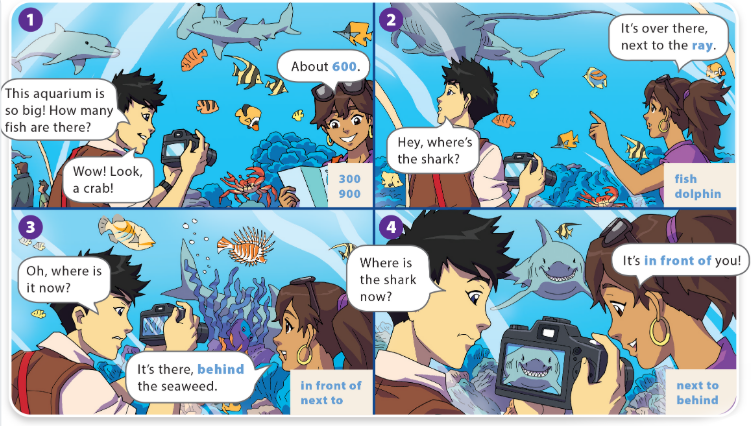
Answer:
Picture 1:
Version 1: Wow! Look, a crab!
This aquarium is so big! How many fish are there?
About 300.
Version 2: Wow! Look, a crab!
This aquarium is so big! How many fish are there?
About 600.
Version 3: Wow! Look, a crab!
This aquarium is so big! How many fish are there?
About 900.
Picture 2:
Version 1: Hey, where's the shark?
It's over there, next to the ray.
Version 2: Hey, where's the shark?
It's over there, next to the fish.
Version 3: Hey, where's the shark?
It's over there, next to the dolphin.
Picture 3:
Version 1: Oh, where is it now?
It's there, behind the seaweed.
Version 2: Oh, where is it now?
It's there, in front of the seaweed.
Version 3: Oh, where is it now?
It's there, next to the seaweed.
Picture 4:
Version 1: Where is the shark now?
It’s in front of you!
Version 2: Where is the shark now?
It’s next to you!
Version 3: Where is the shark now?
It’s behind you!
TALKING ABOUT QUANTITY AND LOCATION (P. 166) | |
The fish is near the crab. The shark is behind the seaweed. | |
How many sea animals are there? | There's one (sea animal). There are 20 (sea animals). |
Where's the crab? | It's on/under/next to the rock. |
Where are the sharks? | They're in front of /behind the rock. |
Is there an octopus in the seaweed? | Yes, there is. / No, there isn't. |
Are there any fish in the seaweed? | Yes, there are some fish in the seaweed. No, there aren't any fish in the seaweed. |
Answer:
The fish is near the crab.
The shark is behind the seaweed.
Are there any fish in the seaweed?
No, there aren't any fish in the seaweed.
DO YOU KNOW?
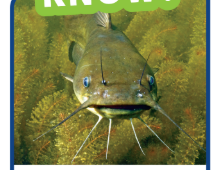
What is this?
What is this?
a. a catfish
b. a horsefish
c. a dogfish
Answer:
a. a catfish
C. Look at picture 1 in the cartoon on page 30. Answer the questions.
1. How many dolphins are there? There's one dolphin.
2. How many colorful fish are there?__________________________
3. Is there an octopus in the aquarium? __________________________
4. How many crabs are there? _________________________________
5. Are there any rocks in the picture? ___________________________
Answer:
2. There are three colorful fish
3. No, there isn't
4. There is one crab
5. Yes, there are
D. Look at the picture at the bottom of this page. Complete the sentences. Use words from the box.
In between | On under | Behind In front of |
1. The seahorse is ____________the rock.
2. The crab is ________________the seaweed.
3. The octopus is. ______________the shark.
4. The starfish is _______________the sand.
5. The fish are _________________the water.
6. The sea turtle is_______________the starfish and the crab.
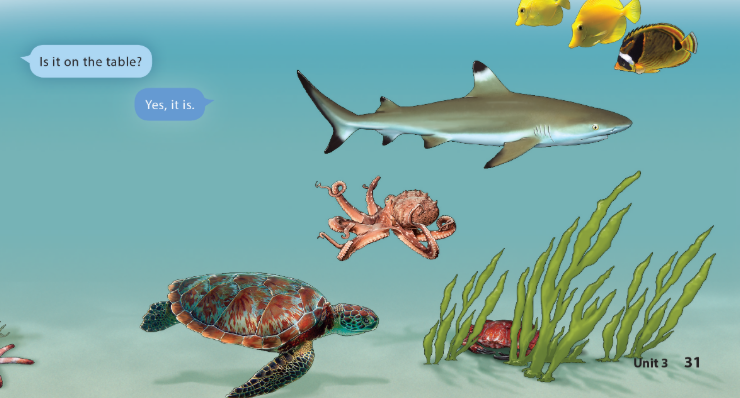
Answer:
in front of
behind
under
on
in
6. Between
E. Play a game. Work in pairs. Student A: Choose something in the classroom.
Student B: Guess what it is.
Is it on the table?
Yes, it is.
Answer:
1. Is it on the table?
Yes, it is
2. Is it under the chair?
No, it isn’t
3. Is it near the window?
Yes, it is
4. Is it next to the door?
5. Is it in the teacher's desk?
No, it isn’t
6. Is it on the shelf?
No, it isn’t
7. Is it in the backpack?
Yes, it is
8. Is it behind the board?
Yes, it is
9. Is it on the floor?
No, it isn’t
10. Is it in the box?
The Real World
Save the ocean
A. Read the information about Mariana Fuenters. Then circle the correct answers
SAVE THE OCEAN Mariana Fuentes is a National Geographic Young Explorer. She studies sea animals, like sea turtles and dugongs. One of her favorite places is the Torres Strait near Australia. She looks after turtles on the beach.
1. Mariana studies (sea turtles / horses).
2. One of her favorite places is (the Torres Strait / France).
3. She looks after turtles (on the beach /in the sea).
Answer:
1. Sea turtles
2. Torres strait
3. On the beach
B. Listen. Circle T for True and F for False
1. There are seven kinds of sea turtles.
2. Leatherback sea turtles are really small.
3. Dugongs live up to 100 years.
4. Dugongs are also called sea cows.
Answer:
1-T
2-F
3-F
4-T
Transcript:
There are 7 kinds of sea turtles leatherback sea turtles are really big and are up to 2.5 meters long. Dugongs are shy animals that live in the oceans near East Africa and Australia. They grow up to 3 meters long. They live up to 70 years. Other names for dugongs are sea cows and sea pigs
Discussion. What sea animal do you want to look after? Why?
A: What sea animal do you want to look after?
B: I want to look after a dolphin. They’re smart, friendly, and fun to watch.
A: That’s cool! I want to take care of a sea turtle because they’re calm and beautiful.
B: Sea turtles are nice. But they need clean water and a safe beach to live.
PRONUNCIATION
Long and short a sounds
IDIOMS
Ì someone is “like a fish out of water” they _______
a. Not comfortable
b. Not well
Answer:
a. Not comfortable
A. Listen and repeat
1. There are
2. They are
Answer:
1. There are
2. They are
B. Listen. Circle There are/ they’re
1. (There are / They're) 800 fish in the tank.
2. (There are / They're) in the seaweed.
3. (There are / They're) between two rocks.
4. (There are / They're) seven kinds of sea turtles.
5. (There are / They're) two crabs on the rock.
Answer:
1. There are
2. They're
3. They're
4. There're
5. There're
C. Work with a partner. Take turns to read the sentences in B.
Answer:
1. There are 800 fish in the tank.
2. They're in the seaweed.
3. They're between two rocks.
4. There're seven kinds of sea turtles.
5. There're two crabs on the rock.
COMMUNICATION
Jaguar sea turtle dolphin shark crab howler monkey
Draw and ask. Choose four animals from the box above and draw them on the beach picture. Ask a partner questions about the animals in his or her picture. Then draw your partner’s picture the pictures on page 133. Compare the pictures.
What animals are in your picture? Is there a shark
Yes, there's a shark.
Where is it?
It's behind the seaweed.
Answer:
You: What animals are in your picture?
Partner: There’s a shark, a crab, a turtle, and an crab
You: Is there a shark?
Partner: Yes, there’s a shark.
You: Where is it?
Partner: It’s behind the seaweed.
You: Is the turtle on the sand?
Partner: No, it’s in the water near the rocks.
READING
Strange sea animals
Do you know that some animals are camouflaged? This means their color is the same as the colors around them. Some camouflaged animals hide in seaweed, rocks, and sand. Look at the photo on the left. This looks like seaweed, but it’s not! It’s the leafy seadragon. It hides in the seaweed. It's the same color as the seaweed. Like the seaweed, its body is also in the shape of a leaf. Look at the photo below. This is a stonefish. it hides on the sand, near rocks. It looks like a rock. Where are its eyes and its mouth?
A. Look at the picture. What things do you see? Check them
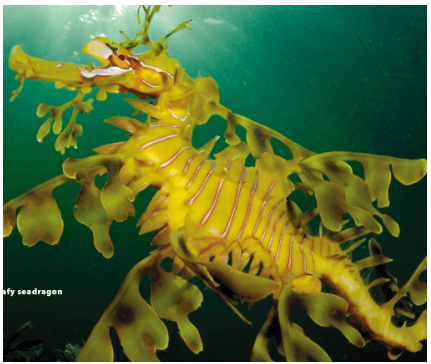
Answer:
- Fish
B. Read the title. Why do you think these animals are strange?
Answer:
Because their color is the same as the color around them.
C. Read the article quickly. Underline the places where the animals hide
Answer:
Seaweed, rocks, sand
Comprehension
A. Choose the correct answers for Strange Sea Animals.
1. Main Idea What's this article about?
a. jungle animals
b. animals that hide
c. endangered animals
2. Vocabulary
When animals hide in the same colors around them, they are.
a. covered
b. camouflaged
c. trapped
3. Detail In line 6, "its" refers to
a. a leaf
b. seaweed
c. the leafy seadragon
4. Detail A stonefish hides
a. on the sand
b. under the sand
c. under the rocks
5. Detail A stonefish looks like
a. seaweed
b. a rock
c. a seadragon
Answer:
1. b. - The article is about animal that hide
2. b. - camouflaged. (Explanation: Do you know that some animals are camouflaged? This means their color is the same as the colors around them.)
3. c - the leafy seadragon (Explanation: This looks like seaweed, but it’s not! It’s the leafy seadragon. It hides in the seaweed.)
4. a - on the sand. (Explanation: This is a stonefish. it hides on the sand)
5. b. - a rock. (Explanation: This is a stonefish. it hides on the sand, near rocks. It looks like a rock.)
B. Complete the chart
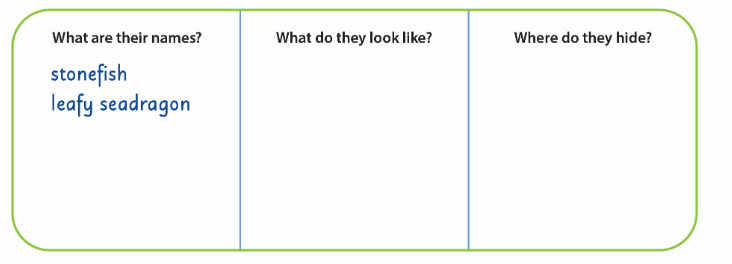
Answer:
What are their names? | What do they look like? | Where do they hide? |
Stonefish
Leafy seadragon | a rock
seaweed | On the sand
In the seaweed |
C. Talk with the partner. What other animals hide in the same color around them?
Answer:
There are some animals that can hide by blending into their surroundings. They include the long-eared owl, the Arctic fox, and the Arctic hare. These animals use their color to stay safe from predators.
Writing
Write a short paragraph. Find a photo of an animal. Then write 40-60 words about the animal.
Asian arowana fish are also called dragon fish. They live in rivers in Southeast Asia. They eat other fish and insects. There are different colors of arowana fish: green, gold, red, and blue.
Answer:
The green sea turtle is a large marine animal. It lives in warm oceans around the world. Green sea turtles eat sea grass and algae. They have smooth, greenish shells and strong flippers. These turtles are slow on land but fast in the water. They are also endangered and need protection.
Video
Ocean Odđities
BEFORE YOU WATCH
What sea animals do you know? Make a list?
Answer:
1. Dolphin
2. Shark
3. Octopus
4. Jellyfish
5. Whale
6. Sea turtle
7. Starfish
8. Crab
9. Lobster
10. Clownfish
11. Seahorse
12. Stingray
13. Squid
WHILE YOU WATCH
A. Check. What animals on your list did you see?
Answer:
Monkey, snake, frog, parrot, bat
B. Watch the video again. Complete the sentences using the words in the box
| noisy | big | small | long |
1. The rain forest on the island of Barro Colorado is very_________.
2. The howler monkey is really____________.
3. The coati's tail is very____________.
4. The red-eyed tree frog is ____________.
Answer:
1. Sargassum fish hide in seaweed.
2. Comb jellyfish are colorful.
3. Beluga whales are very noisy.
4. Clams use their foot to push into the sand.
AFTER YOU WATCH
Talk with a partner. What animals live in rain forests? What interesting animals do you know?
Answer:
Strange animals in Vietnam are:
– leaf-nosed bat (dơi mũi lá)
– snub-nosed monkey (khỉ mũi hếch)
– red-shanked douc (voọc chà vá chân nâu)
– Chapa bug-eye frog (ếch mắt bọ Chapa)
– leopard gecko (tắc kè da báo)
– flying squirrel (sóc bay)
Worksheet
1. Put the animals in the correct columns
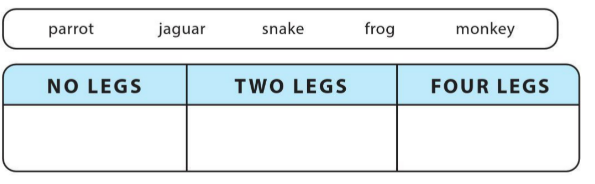
Answer:
NO LEG | TWO LEGS | FOUR LEGS |
Snake | Frog | Jaguar |
Monkey | ||
Parrot |
2. Unscramble the letters to make adjectives.
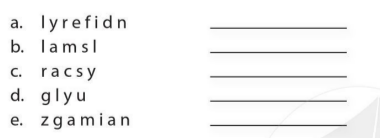
Answer:
1. friendly
2. small
3.scary
4. ugly
5. amazing
3. Write the correct form of the words in parentheses.
Example: Monkeys are bigger (big) than lizards.
a. Parrots are__________ (noisy) than lizards.
b. Frogs are __________ (shy) than lizards. lizards.
c. Parrots are __________ (beautiful) than snakes.
d. Snakes are __________(small) than jaguars.
e. Lizards are __________(colorful) than tigers.
Answer:
a. Parrots are noisier than lizards.
b. Frogs are shier than lizards.
c. Parrots are more beautiful than snakes.
d. Snakes are smaller than jaguars.
e. Lizards are more colorful than tigers.
4. Write sentences describing and comparing the animals.
Example: tigers/ lizards:
Tigers live in the jungle. Tigers are bigger than lizards, but lizards are more colorful.
a. monkeys/jaguars: __________________________________________________
b. aye-ayes/parrots: __________________________________________________
c. iguanas/frogs: _____________________________________________________
d. tigers/howler monkeys:______________________________________________
Answer:
a. Jaguars are bigger than monkeys but monkeys are funnier
b. Aye-ayes are bigger than parrots but parrots are more colorful
c. Iguana is more colorful than frogs but frogs are noisier
d. Tigers are bigger than howler monkeys but howler monkeys are noisier
Tài liệu cùng môn học
Tài liệu khác
- Trắc nghiệm tiếng anh 2 Family and Friends
- Trắc nghiệm tiếng anh 2 Explore our world
- Trắc nghiệm tiếng anh 3 Family and Friends
- Trắc nghiệm tiếng anh 3 Explore our world
- Trắc nghiệm tiếng anh 4 Family and Friends
- Trắc nghiệm tiếng anh 4 Global Success
- Trắc nghiệm tiếng anh 4 Explore our world
- Trắc nghiệm tiếng anh 5 Family and Friends
- => Xem nhiều môn hơn