Giải tiếng anh 6 Explore English: Unit 12 What do you usually do for New Year's?
Hướng dẫn giải Tiếng anh 6 Explore English: Giải [..]. Bài được giải chi tiết, rõ ràng, dễ hiểu. Bài giải giúp học sinh nắm vững kiến thức trong sách giáo khoa, rèn kĩ năng giải bài tập và có phương pháp học tập hiệu quả.
Nội dung chi tiết
UNIT 12: WHAT DO YOU USUALLY DO FOR NEW YEAR’S?
Preview
A. Listen. Match the teenagers to the occasions they celebrate.
1. Maria | a. goes to a festival. He watches a _____ |
2. Yang | b. celebrates Chinese New Year. He watches the _____ |
3. Philippe | c. celebrates her birthday. She has a _____ |
4. Aditi | d. celebrates New Year. She puts up _____ |
5. Chrystie | e. celebrates Diwali. She eats _____ |
Answer:
1 – c | 2 – b | 3 – a | 4 – e | 5 – d |
B. Listen again. Complete the sentences (1-5) in A. Use the words below
 Answer:
1. Maria celebrates her birthday. She has a party.
2. Yang celebrates Chinese New Year. He watches the fireworks.
3. Philippe goes to a festival. He watches a parade.
4. Aditi celebrates Diwali. She eats special food.
5. Chrystie celebrates New Year. She puts up decorations.
C. Talk with a partner. How do you celebrate your favorite festival?
Answer:
A: What is your favorite festival?
B: My favorite festival is Mid-autumn.
A: How do you celebrate it?
B: We eat moon cakes and watch lion dancing with our family
Language focus
A. Listen and read. Then repeat the conversation and replace the words in blue.
B. Practice with a partner. Replace any words to make your own conversation.
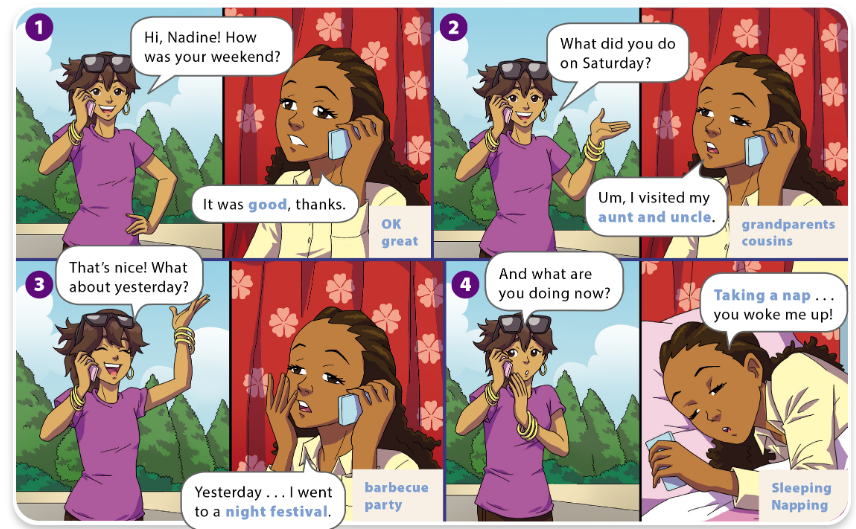
Answer:
A: How was your weekend?
B: It was great, thanks.
A: What did you do on Saturday?
B: Umm, I visited my grandparents.
A: That was great. What about Sunday?
B: Yesterday… I went to a party.
A: What are you doing?
B: Sleeping…. you woke me up.
 Answer:
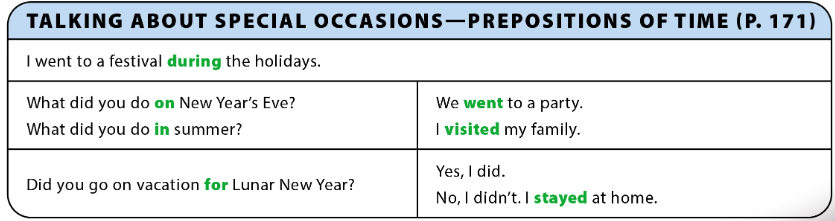
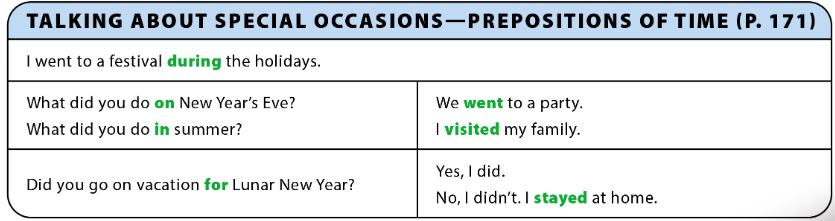
C. Complete the conversation. Use the words in the box. Listen and check.
in on during
David: When’s your birthday, Elisa?
Elisa: It was last month. It was (1) ____ July 10th.
David: Great! What did you do?
Elisa: Well, it was (2) ____ the summer holidays, so I went to Spain. When is your birthday, David?
David: Well, my birthday is (3) ____ winter. It’s (4) ____ the winter holidays!
Elisa: Oh, l remember! It’s (5) ____ December 23rd. I came to your birthday party last year!
Answer:
(1). on | (2). during | (3). in | (4). during | (5). on |
D. Complete the conversation. Use the correct form of the words from the box.
be eat open do visit put have watch
For my birthday, I usually (1) ____ a party at home. l also (2) ____ special food. My aunt and uncle always (3) ____ my home. We all (4) ____ decorations. Last year, we had a barbecue party and fireworks. We all (5) ____ the fireworks and ate some good food. Then we (6) ____ the cards and the presents. It (7) ____ great. I hope we can (8) ____ the same thing this year.
Answer:
(1). have | (2). eat | (3). visit | (4). put |
(5). watched | (6). opened | (7). was | (8). do |
E. Play a game with a partner. Student A: Imagine you had a party.
Answer:
Student B: Ask your partner questions and find out more information. Take turns.
The Real World
Australian Adventure
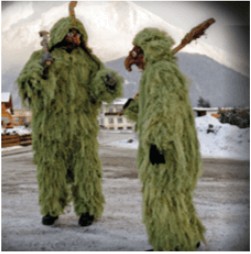
A. Listen. Number the costumes in the photos in the order you hear the descriptions.
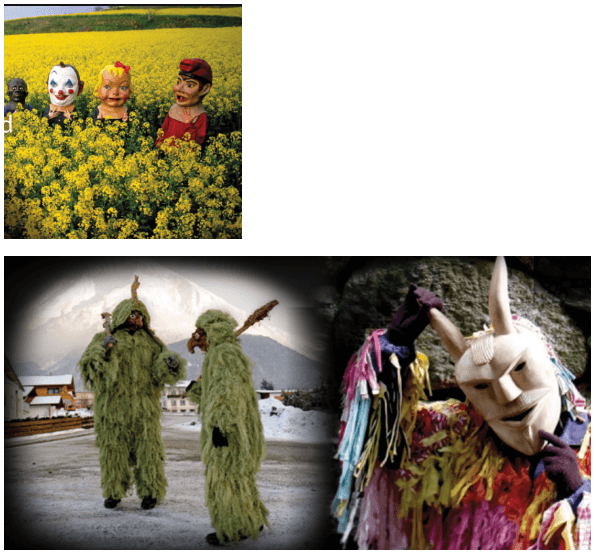
Answer:
(1)→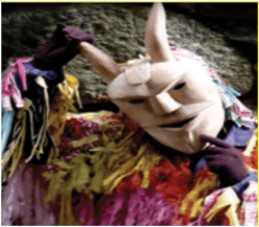 (2)→
(2)→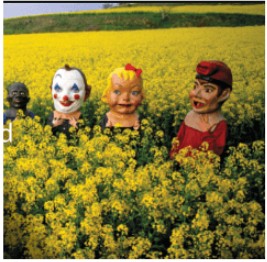 (3)→
(3)→
Transript
Every year in the village of Lazarim in Portugal people celebrate the Lazar ram carnival. They walk in the streets wearing masks carved out of wood. The scary masks are not painted they have sharp horns and a long sharp chicken. In Spain on the days of the summer festival people where really big masks the masks are made out of pieces of paper known as paper mache and are really colorful. Once every 5 years people in Austria dress up for a carnival wild men wear costumes made out of plants it makes them look like trees they also have long noses that look like beaks.
B. Listen. Circle T for True and F for False.
1. Festivals in Europe usually take place from the beginning of November. | T | F |
2. In Portugal, people decorate trế during the Lazarim Carnival. | T | F |
3. During the Lazarim Carnival, there are singing competitions. | T | F |
4. In Spain, people have a festival to enjoy the last nights of summer. | T | F |
5. People wear scary costumes during a carnival in Austria. | T | F |
Answer:
1. Festivals in Europe usually take place from the beginning of November. (Các lễ hội ở Châu Âu thường diễn ra vào đầu tháng 11.) |
| F |
2. In Portugal, people decorate trế during the Lazarim Carnival. (Ở Bồ Đầu Nha, mọi người trang trí câu trong suốt dịp lễ hội Lazarim.) |
| F |
3. During the Lazarim Carnival, there are singing competitions. (Trong suốt lễ hội Lazarim, sẽ có các cuộc thi hát.) |
| F |
4. In Spain, people have a festival to enjoy the last nights of summer. (Ở Tây Ban Nha, mọi người thường tổ chức các lễ hội để tận hưởng những đêm cuối mùa hè.) | T |
|
5. People wear scary costumes during a carnival in Austria. (Mọi người mặc những đồ đáng sợ trong suốt lễ hội ở Áo.) | T |
|
Transcript
Festivals in Europe usually take place from the beginning of December until April people dress up as trees, bears, and even goats and walk the streets in Portugal. During the Lazarim carnival people wear new wooden masks. Every year, they play music, decorate cars and dance. There are also poetry competitions in Spain. People have a festival to enjoy the last nights of summer. People wear very big head masks in Austria. The streets change into a magical world. People wear scary costumes and walk the streets.
Discussion
Which festival on this page is your favorite? Why?
Answer:
My favorite festival on this page is the Twins Days Festival because it's very unique and fun. I think it’s interesting to see so many twins come together, dress alike, and join in special activities. It must be a great place to make friends and take funny photos!”
PRONUNCIATION
Syllable Stress
A. Listen to the stressed syllables. Repeat the words.
1. barbecue
2. decoration
Answer:
1. barbecue
2. decoration
B. Listen and underline the stressed syllable.
1. festival (lễ hội) | 2. vacation (kỳ nghỉ) | 3. party (bữa tiệc) | 4. celebrate (kỉ niệm) |
5. around (xung quanh) | 6. summer (mùa hè) | 7. amazing (tuyệt vời) | 8. winter (mùa đông) |
Answer:
1. festival | 2. vacation | 3. party | 4. celebrate |
5. around | 6. summer | 7. amazing | 8. winter |
C. Work with a partner. Take turns to read the sentences in B.
Answer:
1. festival | 2. vacation | 3. party | 4. celebrate |
5. around | 6. summer | 7. amazing | 8. winter |
COMMUNICATION
Take a class survey. How did your classmates celebrate their birthdays last year. Ask questions and note the name. Then add more information.
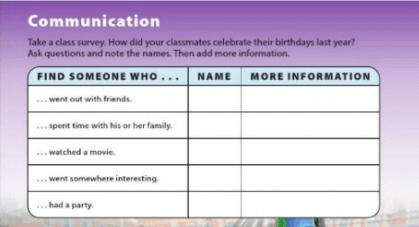
Answer:
Hey, what did you do for your birthday last year?
I went out with friends.
Cool! Who did you go with?
Minh and Maya.
READING
Harbin ice and snow festival
Every year, on January 5th, the city of Harbin in northeast China changes into a winter wonderland. Tourists from all around the world come to visit this amazing ice and snow festival.
The festival started in 1963 and began as a winter party. The festival usually lasts for one month. However, if the weather stays cold and dry, it goes on for a few more days. Temperatures are usually very cold. They can go down to -17°C.
Ice sculptors use different tools to carve the hard ice and snow. These sculptors display their work in two main areas. “Sun Island” has huge snow sculptures of people and animals. “Ice and Snow World” has a sculptures of buildings. At night, these buildings light up with brightly colored lights.
Visitors can do a lot of other activities, such as skiing and ice sliding. They can also go swimming in the icy waters of the Songhua River.
The Harbin Ice and Snow Festival is very popular. Every year, hundreds of thousands of people visit the festival.
A. Look at the photo and read the title. When do you think this festival takes place? What do you think the weather is like?
Answer:
It is on January 5th. The weather is cold and dry.
B. Read quickly. Underline the weather words.
Answer:
Every year, on January 5th, the city of Harbin in northeast China changes into a winter wonderland. Tourists from all around the world come to visit this amazing ice and snow festival.
The festival started in 1963 and began as a winter party. The festival usually lasts for one month. However, if the weather stays cold and dry, it goes on for a few more days. Temperatures are usually very cold. They can go down to -17°C.
Ice sculptors use different tools to carve the hard ice and snow. These sculptors display their work in two main areas. “Sun Island” has huge snow sculptures of people and animals. “Ice and Snow World” has a sculptures of buildings. At night, these buildings light up with brightly colored lights.
Visitors can do a lot of other activities, such as skiing and ice sliding. They can also go swimming in the icy waters of the Songhua River.
The Harbin Ice and Snow Festival is very popular. Every year, hundreds of thousands of people visit the festival.
C. Read again. Where is the city of Harbin?
Answer:
It’s in northeast China.
Comprehension
A. Choose the correct answers for Harbin Ice and Snow Festival.
1. Main idea This article is mainly about ___.
a. a festival in China
b. a winter party
c. festivals around the world
2. Inference The festival continues for more than a month if the weather is ____.
a. cold and wet
b. cold and dry
c. cold and sunny
3. Vocabulary People who make things from ice and snow are called ____.
a. sculptures
b. monuments
c. sculptors
4. Vocabulary What does the word “display” mean? (line 9)
a. carve
b. show
c. make
5. Detail Which activity is NOT mentioned in the article?
a. skating
b. skiing
c. swimming
Answer:
1. a. – a festival in China
(Explanation: The article is mainly about the Harbin Ice and Snow Festival, which takes place in northeast China.)
2. b. – cold and dry
(Explanation: The article says the festival lasts longer if the weather stays “cold and dry.”)
3. c. – sculptors
(Explanation: The people who carve ice and snow are called “sculptors.”)
4. b. – show
(Explanation: The word “display” means to show something for people to see.)
5. a. – skating
(Explanation: The article mentions skiing, ice sliding, and swimming, but it does not mention skating.)
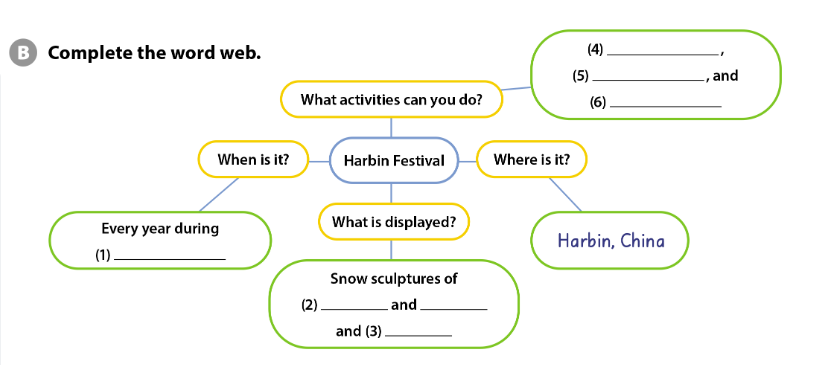
B. Complete the word web.
Answer:
(1). winter | (2). people; animals | (3). buildings |
(4). skiing | (5). ice sliding | (6). swimming |
C. Talk with partner. What festivals is your country famous for? How are they different from festivals in other countries?
Answer:
In Vietnam, we are famous for Tết (Lunar New Year). It is the most important and traditional festival in our country. During Tết, families clean their homes, cook special foods like bánh chưng, give lì xì (lucky money), and visit relatives. There are also fireworks, lion dances, and flower markets.
Tết is different from festivals in other countries because it is based on the lunar calendar, not the solar one. For example, New Year in Western countries is usually on January 1st, but Tết can be in late January or early February. Also, in Vietnam, Tết is more about family and tradition, while in other countries, New Year celebrations are often about parties and fireworks.
Writing
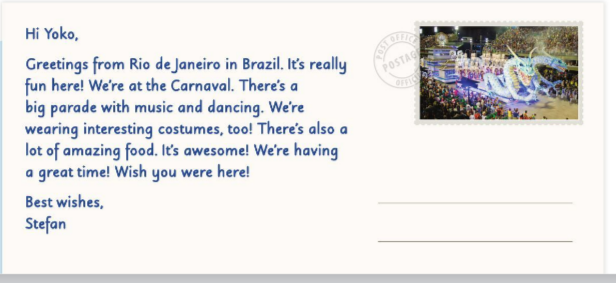
Write a postcard. Tell your friend about a carnival. Write 40-60 words.
Answer:
Hi Ji-Yong
Greeting from Thai Binh in Vietnam. It’s really fun here! We’re at Mid- Autumn festival in my hometown. There are a lot of colorful lanterns here. This is the festival for not only kids but also the whole family. We are eating moon cakes and watching lion dancing. Wish you were here!
Love you,
Thao
Video
Monkey festival
BEFORE YOU WATCH
Look at the photo. Circle two words you think you will hear to describe the monkeys.
angry naughty funny colorful big
Answer:
naughty, funny
WHILE YOU WATCH
A. Check your answers to the Before You Watch question.
Answer:
naughty, funny
B. Watch the video again. Circle T for True or F for False.
1. The festival is in Thailand. | T | F |
2. Hanuman is the name of a place. | T | F |
3. Some people at the festival wear costumes. | T | F |
4. Tourists think that the monkeys are dangerous. | T | F |
5. The tourist was angry when the monkey took his sunglasses. | T | F |
Answer:
1. The festival is in Thailand. | T |
|
2. Hanuman is the name of a place. |
| F |
3. Some people at the festival wear costumes. | T |
|
4. Tourists think that the monkeys are dangerous.
|
| F |
5. The tourist was angry when the monkey took his sunglasses. |
| F |
AFTER YOU WATCH
Talk with a partner. Do you want to go to this festival? Do you know any other animal festivals?
Answer:
Yes, i want to go to this festival because i’m sure that it will be an interesting festival to experience. Moreover, in Vietnam, we have “Racing Elephants Festival in Dak Lak”.
Worksheet
1. Unscramble the letters to make words related to special occasions.
a. w e i o f r s k r ______
b. h y l d i o a ______
c. e l t e e c r b a ______
d. t i h b d r y a ______
e. t r a p y ______
f. e p d a a r ______
Answer:
a. firework | b. holiday | c. celebrate | d. birthday | e. party | f. parade |
2. Use the words from Activity 1 to fill in the blanks. More than one answer may be correct.
a. We’ll watch _____ later tonight.
b. Let’s _____ the New Year at the harbor.
c Let’s have a _____ at home this weekend. I’ll ask my friends to come over.
d. We watched a _____ in the city today. We saw lots of people walking down the streets.
e Is December 25th _____ in your country?
Answer:
a. firework | b. celebrate | c. party | d. parade | e. holiday |
a. We’ll watch firework later tonight.
b. Let’s celebrate the New Year at the harbor.
c Let’s have a party at home this weekend. I’ll ask my friends to come over.
d. We watched a parade in the city today. We saw lots of people walking down the streets.
e Is December 25th holiday in your country?
3. Read the questions and circle the correct option.
a. What do you usually do (in / during) the holidays?
b. What do you usually do (on / in) January 1st.
c. What season is your birthday (on / in)?
d. What do you usually do (during / on) the summer?
e. What do you usually do (in / for) Tet?
Answer:
a. during | b. on | c. in | d. during | e. for |
a. What do you usually do during the holidays?
b. What do you usually do on January 1st.
c. What season is your birthday in?
d. What do you usually do during the summer?
e. What do you usually do for Tet?
4. Answer the questions from Activity 3. Use complete sentences.
Answer:
a. You should go to Australia. It's a beautiful country.
a. I travel with my family.
b. I usually have a day off.
c. It’s in summer.
d. I usually go to the beach.
e. I usually celebrate at home with my family.
Tài liệu cùng môn học
Tài liệu khác
- Trắc nghiệm tiếng anh 2 Family and Friends
- Trắc nghiệm tiếng anh 2 Explore our world
- Trắc nghiệm tiếng anh 3 Family and Friends
- Trắc nghiệm tiếng anh 3 Explore our world
- Trắc nghiệm tiếng anh 4 Family and Friends
- Trắc nghiệm tiếng anh 4 Global Success
- Trắc nghiệm tiếng anh 4 Explore our world
- Trắc nghiệm tiếng anh 5 Family and Friends
- => Xem nhiều môn hơn