Giải tiếng anh 7 Friends plus: Unit 4 In the picture
Hướng dẫn giải Tiếng anh 7 Friends plus: Giải Unit 4 In the picture. Bài được giải chi tiết, rõ ràng, dễ hiểu. Bài giải giúp học sinh nắm vững kiến thức trong sách giáo khoa, rèn kĩ năng giải bài tập và có phương pháp học tập hiệu quả.
Nội dung chi tiết
VOCABULARY
Actions and movement. I can describe a photograph.
THINK! Do you have a favorite photo on your phone? Why is it your favorite?
Answer:
Yes, I do. It was my family picture. We took it when my whole family gathered in Tet.
1. Match pictures 1-10 with the verbs in the box. Then listen and check. climb up hang from hold jump up
kick lie on sit on stand in pick up walk on
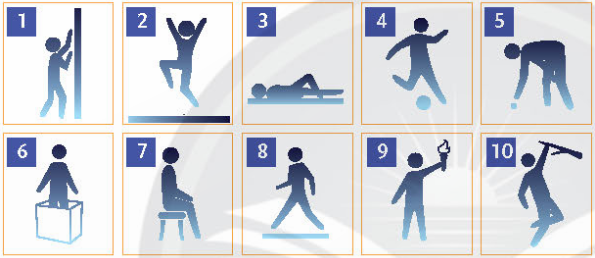
Answer:
1 – clim up
2 – jump up
3 – lie on
4 – kick
5 – pick u
6 – stand in
7 – sit on
8 – walk on
9 – hold
10 – hang from
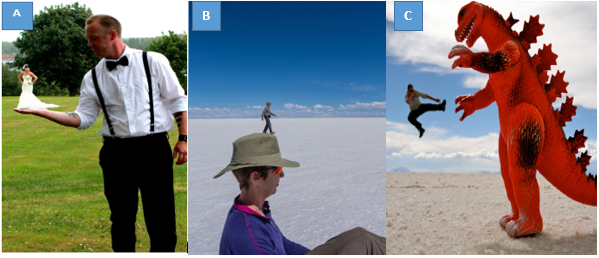
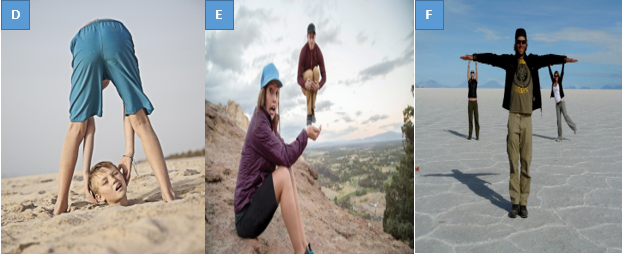
2. Read the description of four photos in the observation test and match descriptions 1-4 with four photos from A-F. Then choose the correct verbs in blue.
OBSERVATION TEST
1. This is brilliant. The boy is on the beach and he’s picking up / sitting on his head, which is hanging from / lying on the sand.
2. They’re in the desert, or somewhere very hot. The woman is wearing a hat and there’s a tiny man on it. He’s standing in / walking on the hat.
3. The man is climbing up / kicking the dinosaur. He’s very brave because he’s really small and the dinosaur is enormous and very angry!
4. The man is in a park and he’s climbing up / holding a really small woman in his hand. She’s wearing a white dress. Are they getting married?
Answer:
1 – D: picking up / lying on
2 – B: walkin on
3 – C: kicking
4 – A: holding
3. Watch or listen. Which photos are the speakers describing?
Answer:
…………………………………………………………………………………….
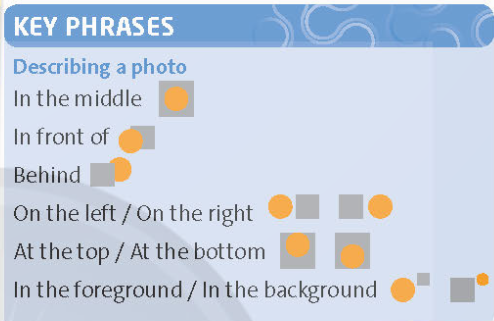
4. Watch or listen again. Which of the key phrases do you hear? Who says them?
Answer:
…………………………………………………………………………………….
5. USE IT! Work in a group. Use the Key Phrases to create your own photograph.
Ex: Maria, stand here in the foreground. Hold this cup. David and Juan, sit on the chair at the back, so it looks like you’re standing in the cup.
Answer:
(Học sinh tự thực hiện)
Finished?
Think of your favorite photo on your phone. Describe it your group.
Answer:
My favorite photo on my phone is when I went to the Robot museum. I’m sitting on the left a huge robot model. It looks like the robot is puching me.
READING
A moment in time. I can predict what an article is about using the title and photos.
THINK! What should you do with rubbish?
Answer:
I will recycle them. For example, I recycled old bottles by planting flowers into these bottles.
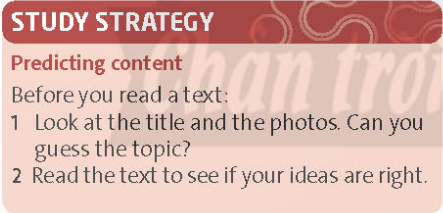
1. Read the Study Strategy. Then use the strategy to do exercise 2.
Answer:
(Học sinh tự thực hiện)
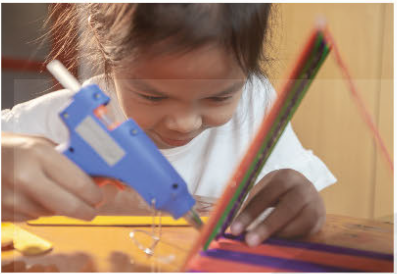
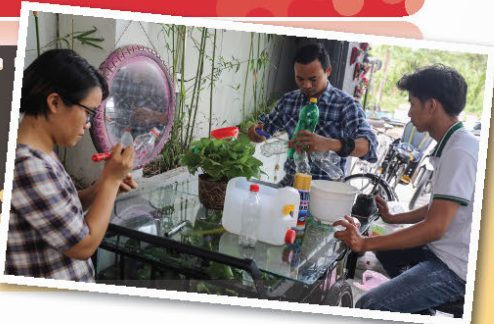
2. Look at the photos. What are the people doing? Why are they doing it? Which countries are they in? Read the texts and check.
Answer:
In the first picture: A girl is making a toy herself from ice-cream sticks. She comes from Thailand.
In the sencond picture: They are making decorations from old tyres and bottles. They are from Vietnam.
3. Read and listen to the text. Write True or False. Explain your answers.
1. The 6-year-old girl in Chiang Mai, Thailand made some toys with ice-cream sticks.
2. According to the photographer, the toy was good.
3. The café was empty.
4. Some people were relaxing with decorations.
5. The writer liked the café with recycled decorations.
Answer:
1. True
2. False
3. False
4. False
5. True
4. VOCABULARY PLUS. Use a dictionary to check the meaning of the words in blue in the text.
Answer:
- ice – cream sticks: que kem
- success: sự thành công
- decorations: vật trang trí
- Although: Mặc dù
- start – up : khởi nghiệp
- success story: câu chuyện thành công
5. Find the word although in the second text. What is it used for?
Answer:
“Although their business was different, it was meaningul to the environment”
→ “Although” is used to show the contrast of two ideas in a sentence.
6. Combine the two sentences using although, but.
1. She is a little girl. She is helpful.
__________________________________________
2. Many collectors want to own her toys. She does not want to sell them.
__________________________________________
Answer:
1. Although she is a little girl, she is helpful.
2. Many collectors want to own hẻ toys, she does not want to sell them.
7. USE IT! Work in pairs. Do you think that recycling can change the world? Can you think of an idea to make toys from rubbish?
Answer:
Yes, I think recycling can help change the world by reducing waste, saving resources, and protecting the environment. It teaches people to care about nature and use things wisely.
One idea to make toys from rubbish is to use old plastic bottles and caps to create toy cars. You can use the bottle as the car body and the caps as wheels. Add some string or paper decorations to make it colorful and fun!
LANGUAGE FOCUS
Past continuous: affirmative and negative. I can describe what was happening when a photograph was taken.
1. Complete the sentences with the words in the box. Then check your answers in the text onpage 46.

1. The little girl _______ smiling nicely.
2. She _______ playing with the toy.
3. She _______ making toys with ice-cream sticks.
4. Some people _______ singing.
5. They ______ making decorations from tyres and bottles.
Answer:
1. was
2. wasn’t
3. was
4. weren’t
5. were
2. Look at the sentences in exercise 1. Then choose the correct words in the Rules.
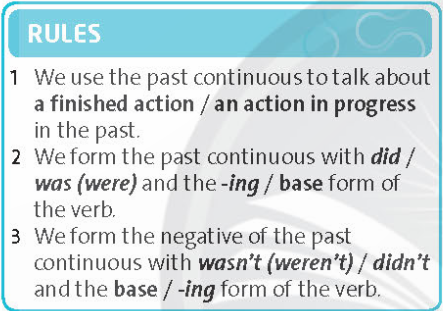
Answer:
1. an action in progress
2. was (were) / -ing
3. wasn’t (weren’t) / - ing
3. Complete the text using the past continuous form of the verbs in brackets.
Photographer David Slater (1) ______ (visit) Sulawesi, an island in Indonesia. He (2) _______ (photograph) the monkeys there and they (3) ______(jump) all over his camera and camera bag. One of the bravest monkeys (4) _______ (play) with the camera, and it took a photo. The monkey took over 100 photos that day, but the one that became a classic was this photo: the monkey (5) _____ (smile) when he took the selfie.
Answer:
1. was visiting
2. was photographing
3. was jumping
4. was playing
5. was smiling
4. Write true sentences about today. Use the affirmative or negative form of the past continuous.
1. my dad / work / 9 a.m.
2. my friends / walk / to school at 8 a.m.
3. it / rain / early this morning
4. I / ride / my bike / at 8.15 a.m.
5. My family / sleep / at 5 a.m.
Ex: I /sleep / at 8.30 a.m.
→ I wasn’t sleeping at 8.30 a.m.
Answer:
1. My dad was working at 9 a.m.
2. My friends were walking to school at 8 a.m.
3. It was raining early this morning.
4. I was riding my bike at 8.15 a.m.
5. My family were sleeping at 5 a.m.
5. USE IT! Work in pairs. Look at thephoto and imagine you saw the event. Describe what was happening. Use the questions to help you.
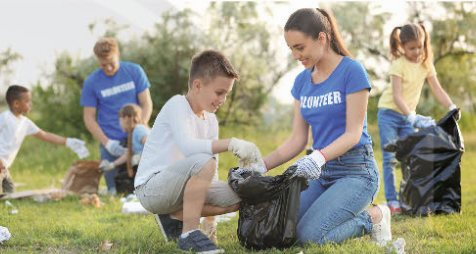
1. Where did the event happen?
2. What were you doing when you saw this?
3. What were the children doing?
4. What was the girl in blue T-shirt doing?
Answer:
1. It happened in the park.
2. I was listening to music when I saw this.
3. They were picking the rubbish.
4. She was holding a bag to collect the rubbish.
Finished?
Finish the monkey’s story: “I was sitting in a tree in Indonesia one day …”
Answer:
I was sitting in a tree in Indonesia one day Suddendly, I saw a man visiting our forest. He was photographing us and we were jumping all over his camera and camera bag. I was really excited about the camera, so played with it and took a lot of photos. I was smiling when I took selfies because I saw many visitors did that before and that was a chance for me to imitate them.
VOCABULARY AND LISTENING
Adjective and adverbs. I can listen to someone describing photos, and understand the main ideas.
THINK! What photographs do you prefer: people, places or sports? Why?
Answer:
I prefer photographs about sports. They show a vibrant atmosphere.
1. Read the text and choose the correct words. Listen and check.
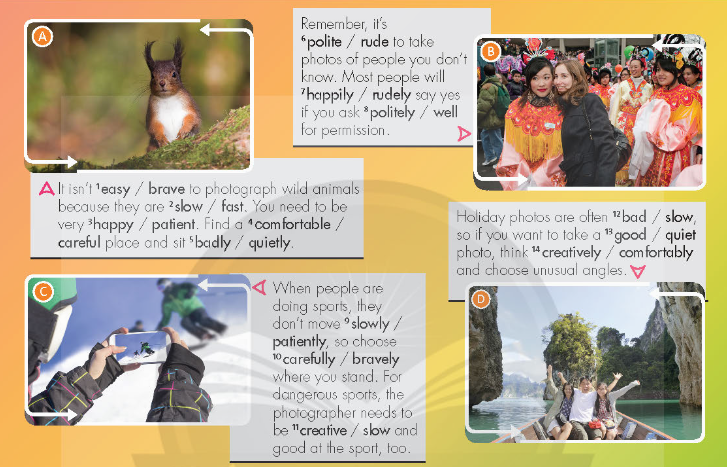
Answer:
1. easy
2. fast
3. patient
4. comfortable
5. quietly
6. rude
7. happily
8. politely
9. slowly
10. carefully
11. creative
12. slow
13. good
14. creatively
2. Complete the table with the adjectives and adverbs in exercise 1.
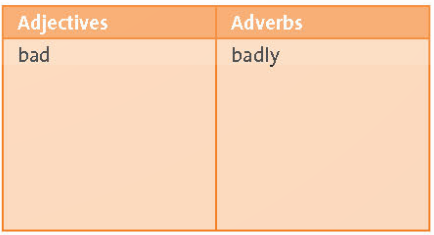
Answer:
Adjectives | Adverbs |
bad polite rude happy good easy brave slow fast patient comfortable careful quiet creative | badly politely rudely happily well easily bravely slowly fast patiently comfortably carefully quietly creatively |
3. Listen to a photographer explaining how he took these photos. Put photos A-D in the order your hear.
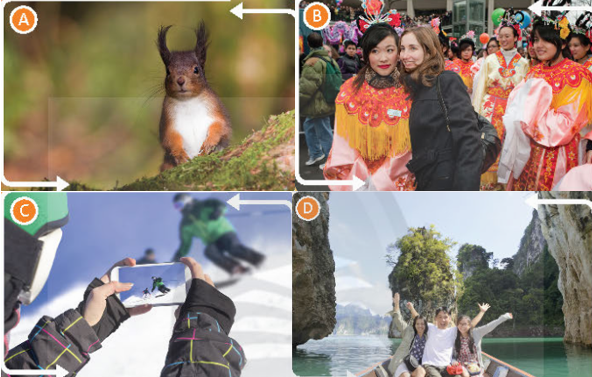
Answer:
…………………………………………………………………………………….
4. Listen again and answer the questions.
1. What was the squirrel doing in photo A?
2. In photo B, why was the photographer in Asia?
3. In photo C, was the photographer skiing?
4. Where was the photographer in photo C?
5. In photo D, was the photographer fast standing in the boat?
Answer:
…………………………………………………………………………………….
5. USE IT! Work in pairs. Say how you can do the activities in the box. Use adverbs from exercise 2.
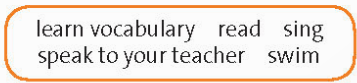
Ex: I can swim fast
Answer:
- I learn vocabulary well.
- I want to read books in a quiet place.
- I sing badly.
- I can comfortably speak to my teacher.
LANGUAGE FOCUS
Past continuous: questions. Past simple and past continuous.
I can talk about travel.
1. Choose the correct option a or b. Then check your answers in the text on page 38.
1. Was the squirrel eating flowers? a. No, it wasn’t.
2. Were the two men posing? b. Steve’s friend
3. What were the men doing? c. Yes, they were
4. Who was skiing? d. They were using a computer.
Answer:
1. a
2. c
3. d
4. b
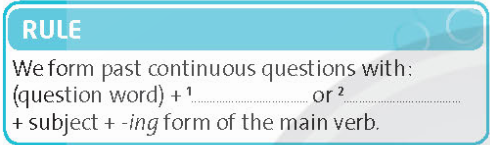
Answer:
1. was
2. were
2. Write questions and answers using the past continuous.
1. the squirrel/ eat / nuts? (X)
2. where / your friends / travel this time last year? (in Canada)
3. what / you / do / last night at 8 p.m ? (watch TV)
4. Maria / swim / in a river? (X)
5. who / you / talk to / after class yesterday ? (Mary)
Ex: the men / ride / horses? (X)
→ Were the men riding horses? No, they weren’t.
Answer:
1. Was the squirrle eat nuts? – No, it wasn’t
2. Where were your friends travelling this time last year? – in Canada
3. What were you doing last night at 8 p.m? – I was watching TV.
4. Was Maria swimming in a river? – No, she wasn’t
5. Who were you talking to after class yesterday? – I was tallking to Mary.
3. Listen. Which words are stressed in each phrase? Listen again and repeat.
1. Were you sleeping at 7 a.m. yesterday?
2. Was your mum listening to music at 8 p.m. last night?
3. What were you doing on Sunday morning?
4. Who were you talking to before class this morning?
Answer:
…………………………………………………………………………………….
4. Work in pairs. Ask and answer the questions from exercise 2. Make true answers.
Ex: Were you sleeping at 7 a.m. yesterday? – Yes, I was
Answer:
- Was your mum listening to music at 8 p.m. last night? – No, she wasn’t.
- What were you doing on Sunday morning? – I was riding my bike.
- Who were you talking to before class this morning? – My parents.
5. Study the sentences. Then complete the Rules with past simple and past continuous.
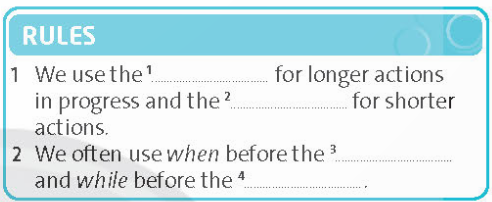
Answer:
1. past continuous
2. past simple
3. past simple
4. past continuous
6. Complete the sentences using the past simple and past continuous form of the verbs in brackets.
Ex: We saw (see) the Pyramids while we were visiting (visit) Egypt.
1. I ______ (take) photos of my friend while we ______ (cycle).
2. She ______(climb) when she ______(have) an accident.
3. We _____(take) photos of elephants while we ______(travel) across Dak Lák.
4. My parents _______(not sleep) when I ______(get) home late last night.
Answer:
1. took / were cycling
2. was climbing / had
3. took / travelling
4. weren’t sleeping / got
7. USE IT! Work in pairs. Imagine you travelled around the world. Talk about things you did using the past simple and past continuous. Use the ideas in the table and your own ideas.
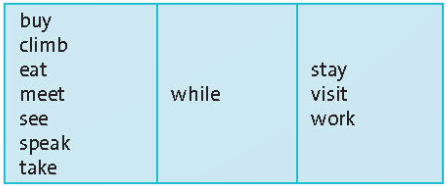
Ex: I saw a tiger while I was visiting India.
Answer:
- I ate beefsteak while I was visting New York.
- I met my old friends while I was working abroad.
- I took some photos while I was staying in Phu Quoc.
Finished?
Imagine you travelled around Việt Nam. Write a diary (60 – 80 words) about what you did.
Answer:
Last week, I travelled around Việt Nam with my family. While we were taking a boat tour in Ha Long Bay, the sun was shining and the water was so clear. Then we visited the ancient citadel in Hue. While we were walking around, we were learning about history. We also tried tasty food in Da Nang. Finally, we were swimming in Nha Trang when it started to rain. It was an unforgettable trip!
SPEAKING
Expressing interest. I can show that I’m interested in a topic.
THINK! Describe the last photo you took on your phone.
Answer:
The last photo I took was my younger sister. She was playing with her toys.
1. Complete the dialogue with the phrases in the box. Then watch or listen and check. What happened in Julie's photo? Where was Julie when she took the photo?

Amelia: Hey, these are good photos, Julie. Did you take them
Julie: Yes. My new phone takes really good photos. What (1) ____ of this one?
Amelia: I like it. That one’s really good.
Julie: Yeah, I’m pleased with it. I was very lucky.
Amelia: But the poor guy wasn’t lucky! Where (2) _____ when you took it?
Julie: I (3) _____ on a wall by the road. He (4) _____ while he (5) ____ past me.
Amelia: Well, it’s an amazing photo. Was it near here?
Julie: No, it was a cycling race near Bristol. I went with my brother.
Amelia: Really? Did he take part in the race?
Julie: You’re kidding! He doesn’t even ride a bike.
Amelia: Well, it’s an amazing photo. I’m impressed!
Julie: That’s really kind of you. Thanks.
Answer:
1. do you think
2. were you
3. was sititng
4. fell off
5. was cycling
2. Look at the Key Phrases. Cover the dialogue and try to remember who says the phrases, Amelia or Julie. Watch or listen again and check.
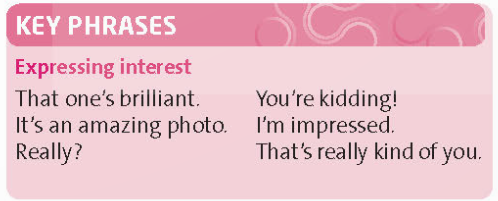
Answer:
…………………………………………………………………………………….
3. Work in pairs. Practise the dialogue.
Answer:
(Học sinh tự thực hành trên lớp)
4. Imagine that you took this photo. Think about your answers to these questions.
1. Where were you?
2. Why were you there?
3. What were the people doing?

Answer:
1. I was at school.
2. Because there was an extracurricular activity.
3. They are dancing.
5. USE IT! Work in pairs. Prepare a new dialogue. Use the key phrases and your ideas from exercise 4. Then practise your dialogue.
Ex: Did you take this photo? – Yes. What do you think of it?
Answer:
A: Did you take this photo?
B: Yes. What do you think of it?
A: I love it. It’s so brilliant.
B: Yeah, I like it too. It’s also my favourite photo.
A: Where were you when you took it?
B: I was in our school yard two months ago.
A: Why were you there?
B: Well, I was there because my school was celebrating its 5th anniversary.
A: Really? What were the people doing?
B: They were singing and dancing.
A: That sounds interesting! Did you join them?
B: No, I didn’t. I was a member of school photography club, so was taking photos for the school’s website at that time.
WRITING
The story of a rescue. I can write a description of of an event using linking words.
THINK! When do animal need humans to help them.
Answer:
Animal need human when they are in danger.
1. Read the story. Where was the rescue? What was the writer doing?
An exciting rescue
I took this photo while we were on a safari holiday in Kenya last February. It was an amazing rescue and I was lucky to see it.
It happened while we were taking photos of wild animals. We were driving slowly when we saw a bulldozer. There was a group of people and they were looking at something. There was on elephant. It was in a mud hole and it couldn't get out. The elephant wasn't moving, but it was alive. A bulldozer was breaking the sides of the hole. As soon as it was possible, the elephant climbed out. After a few minutes, it walked away.
The elephant was very lucky to be alive after twelve hours in the hole. The rescuers were very pleased and one of them posted a video of the rescue online.
Answer:
1. The rescue was in Kenya.
2. He/ She was taking photos of wild animals.
2. Complete the key phrases from the text in your notebook. Then read the text and check your answers.
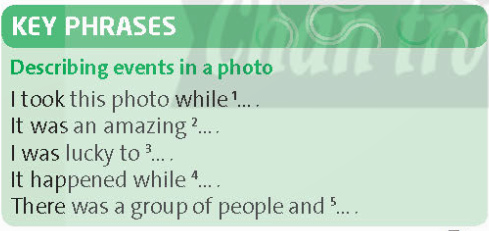
Answer:
1. we were taking photos of wild animals
2. rescue
3. see it
4. we were taking photos of wild animals
5. they were looking at something
3. Read the text again and find the linking words after, as soon as, when, while.
Answer:
- I took this photo while we were on a safari holiday in Kenya last February.
- It happened while we were taking photos of wild animals.
- when we saw a bulldozer.
- As soon as it was possible, …
- After a few minutes, it walked away.
4. Choose the correct linking words.
1. I saw a bear when / while I was walking in the forest.
2. As soon as / while I saw it, I climbed a tree.
3. It ran away while / when my friends arrived.
4. After a few minutes / As soon as, I climbed down.
Answer:
1. I saw a bear while I was walking in the forest.
2. As soon as I saw it, I climbed a tree.
3. It ran away when my friends arrived.
4. After a few minutes, I climbed down.
5. USE IT! Follow the steps in the Writing Guide.
WRITING GUIDE
A. TASK
Imagine that you took the photo of a fire rescue. Write a story (60 - 80 words) with the title An amazing rescue.
B. THINK AND PLAN
1. When and where did the rescue happen?
2. What happened to the people in the photo?
3. Why was the rescue difficult?
4 How did the rescue end?
C. WRITE
Paragraph 1: Introduction
I took this photo …
Paragraph 2: The people and the rescue
There was/ There were …
Paragraph 3: The end and your opinion
The rescuers …
D. CHECK
- when, while, as soon as, after
- There was / There were
- Past simple and past continuous verbs
Answer:
An Amazing Rescue
I took this photo last Saturday evening when a fire broke out in an apartment building downtown.
There were thick clouds of smoke and people screaming for help from the windows. A young girl was trapped on the third floor while firefighters tried to reach her. The fire spread quickly, making the rescue very difficult.
The rescuers acted bravely. After saving the girl, they received loud cheers. I will never forget that moment.
CLIL – Art: The history of animation
I can talk about animation techniques.
1. Check the meaning of the words in the box. Then match them with the pictures.

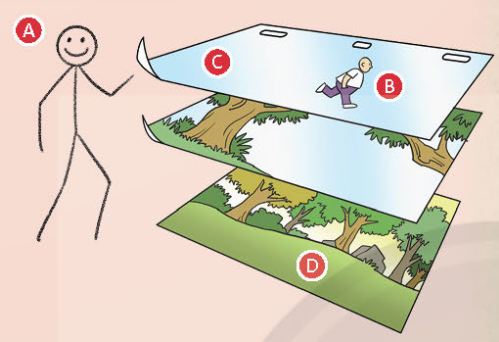
Answer:
cel (n) tấm giấy bóng trong suốt dùng để vẽ hay tô màu
character (n) nhân vật
backgrounds (n) nền
stick figure (hình que)
A – stick figure
B – character
C – cel
D - backgrounds
2. Read and listen to the text. Match headings a-d with paragraphs 1 – 4.
a. Stop motion animation
b. Computer animation
c. Early animation
d. Hand-drawn animation
The history of animation
1. In the 1880s, Endweard Muybridge invented the zoopraxiscope. This machine took photographs of moving things. This was the earliest form of animation.
2. In 1895, the Lumiere brothers invented the cinematograph. Early film-makers used it to make stop-motion animation. With this technique, they made King Kong in 1933.
3. In the 1920s, Will Disney began to use hand- drawn animation. Artists drew the pictures onto transparent pieces of plastic, or eels. The Ill makers put the cels on painted backgrounds and photographed them one at a time. In 1928, Disney studios introduced the character of Mickey Mouse in the first cartoon with sound, Steambont Wille.
4. In the 1960s, people started using computer animation. At first, computers could only make simple stick figures move on films, but by the 1990s, studios used realistie computer generated imagery (CGI) for special effects, soon, they were producing completely computer-animated films Toy Story (1925) was the first fully CGI cartoon.
Answer:
1 – c
2 – a
3 – d
4 – b
3. Read the text again and answer the questions.
1. What did the zoopraxiscope do?
2. When did the Lumiere brothers make the cinematograph?
3. What technique did they use to make King Kong in 1933?
4. Which studio made the first cartoon with sound?
5. When did film-makers start using computers for special effects?
6. What is the name of the first CGI feature film?
Answer:
1. This machine took photographs of moving things.
2. In 1895.
3. Stop-motion animation.
4. Disney studios.
5. By the 1990s.
6. Toy Story (1925).
4. USE IT! Research the making of your favourite animated film. Prepare a short presentation (60 - 80 words) on the film:
Include this information:
- Which film-makers and studios worked on the film?
- What animation techniques did they use?
- Was it a blockbuster?
- What do you like about it?
Give your presentation to the class.
Answer:
Toy Story was created by Pixar Animation Studios and directed by John Lasseter. It was the first fully computer-animated feature film, using 3D animation techniques. Released in 1995, it became a huge blockbuster and changed the world of animation. I love its creative story, fun characters like Woody and Buzz, and the emotional message about friendship. It’s a film that both kids and adults enjoy.
PUZZLES AND GAMES
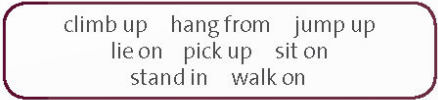
1. ONE – MINUTE RACE. Work in pairs. Follow the instructions:
- Student A: Describe as many verbs in the list as you can in one minute. You must not speak but you can draw or act.
- Student B: Close your book and guess the verbs and prepositions. Say the answers.
- The student who guesses the most in one minute is the winner.
Answer:
(Học sinh tự thực hành trên lớp)
2. WHO DID IT? Someone took a famous painting from the National Gallery in London yesterday. Work in pairs and read the notes. Which person is not in the pictures? This is the person who took the painting.
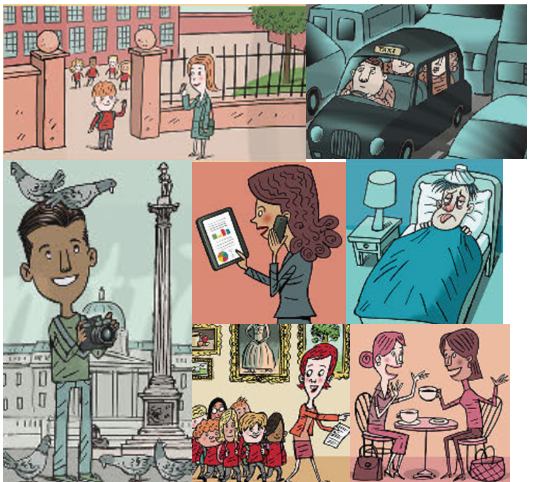
- Sally was meeting her son after school.
- Brian was taking photos outside in Trafalgar Square.
- Lucy and Jill were having lunch in the gallery café.
- Stephen wasn't working yesterday - he was at home. He wasn't well.
- Joe was in his taxi, driving two customers to Victoria train station.
- Mr Jacobs and Mrs Shaw weren't in their office yesterday - they were guiding the children through the museum.
- Jenny was working in her office.
Answer:
Mr. Jacobs is not in the pictures.
3. WORK IN PAIRS. Find the past continuous questions about the people in exercise 2. Think of some answers to the questions.
Answer:
1. What was Sally doing?
2. Who was taking photos outside in Trafalgar Square
3. What were Lucy and Jill doing in the gallery café?
4. Was Stephen working yesterday?
5. Why was Joe in his taxi?
6. What were Mr Jacobo and Mrs Shaw doing?
7. What was Jenny doing in her office?
4. Find nine more adverbs.
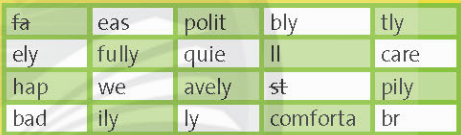
Ex: fast
Answer:
easily
politely
quietly
happily
well
badly
comfortably
carefully
bravely
5. Find five verbs in the grid. Each verb is in a different colour. Change them to past simple and past continuous to complete the sentences.
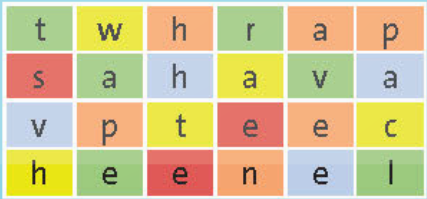
1. As soon as the accident __________, we called the police.
2. We met a lot of interesting people while we ______________.
3. The two men were fishing when they _____________ the shark.
4. Someone stole my MP3 player while I _________ a shower.
5. Tom was playing computer games and his sister __________ TV.
Answer:
1. happened
2. were travelling
3. saw
4. was having
5. was watching
EXTRA LISTENING AND SPEAKING
1. Look at the picture of Malaya and Anya's bedroom. Match objects A-I in the picture with the words in the box. Listen and check.
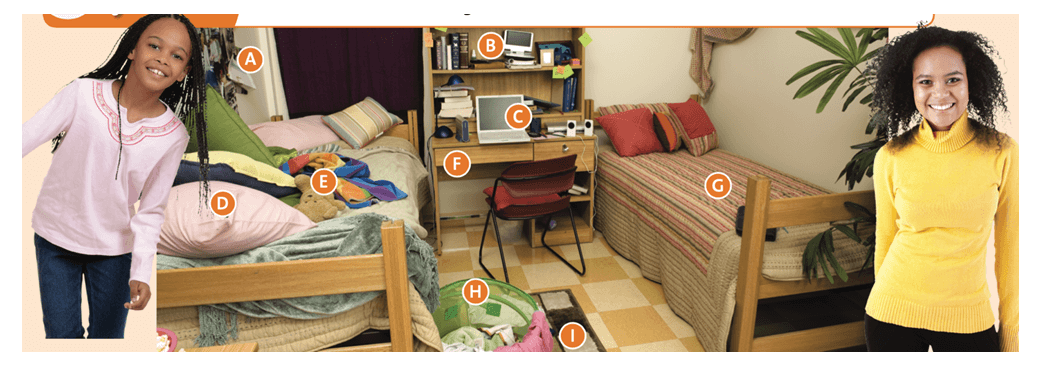
Answer:
…………………………………………………………………………………….
2. Listen to eight false statements about the picture. Correct the sentences.
Answer:
…………………………………………………………………………………….
3. Listen to Malaya and Anya and number key phrases a-d in the order you hear them.
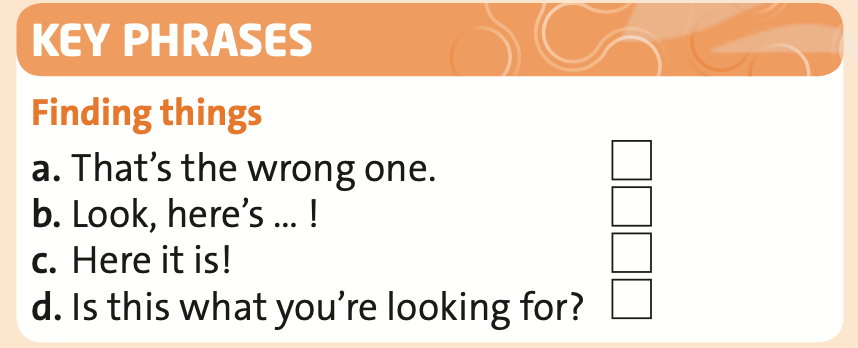
Answer:
…………………………………………………………………………………….
4. Listen to the conversation again and answer the questions.
1. What are the girls looking for?
2. Why does Anya need the book today?
3. Where does Anya usually put her book?
4. Where does she do her homework?
5. Where does Anya find the book?
Answer:
…………………………………………………………………………………….
5. Look at the photo of Adam’s bedroom and listen. Then practise the dialogue with a partner.
Answer:
…………………………………………………………………………………….
6. USE IT! Work in pairs and look at Adam's bedroom again. Imagine you can't find one of the objects in the box. Prepare and practise a new dialogue using the key phrases and the dialogue in exercise 5.

Answer:
Mum: What's wrong?
Adam: I can't find my laptop.
Mum: Is it on your table?
Adam: No, it isn't.
Mum: Look, here's a laptop. Is this what you're looking for?
Adam: No, that's the wrong one. That's my dad’s laptop.
Mum: What about your school bag? Is it in there?
Adam: Oh, here it is! Thanks, mom.
Tài liệu cùng môn học
Tài liệu khác
- Trắc nghiệm tiếng anh 2 Family and Friends
- Trắc nghiệm tiếng anh 2 Explore our world
- Trắc nghiệm tiếng anh 3 Family and Friends
- Trắc nghiệm tiếng anh 3 Explore our world
- Trắc nghiệm tiếng anh 4 Family and Friends
- Trắc nghiệm tiếng anh 4 Global Success
- Trắc nghiệm tiếng anh 4 Explore our world
- Trắc nghiệm tiếng anh 5 Family and Friends
- => Xem nhiều môn hơn