Giải tiếng anh 8 Global Success: Unit 11 Science and technology
Hướng dẫn giải Tiếng anh 8 Global Success: Giải Unit 11 Science and technology. Bài được giải chi tiết, rõ ràng, dễ hiểu. Bài giải giúp học sinh nắm vững kiến thức trong sách giáo khoa, rèn kĩ năng giải bài tập và có phương pháp học tập hiệu quả.
Nội dung chi tiết
GETTING STARTED
Great news for students
1. Listen and read.
Minh: Ann, do you like yesterday's lesson? I really enjoy learning online.
Ann: I prefer having face-to-face classes. I like to interact with my classmates during the lessons.
Minh: I think online classes are convenient during bad weather or epidemics. Also, students can still interact when they are in breakout rooms.
Ann: But the Internet connection doesn't always work well enough for us to learn online. And my eyes get tired when I work in front of the computer screen for a long time.
Minh: I know what you mean. But there’s some great news for us. 3D contact lenses will soon be available. With them, our eyes won't get tired when looking at a computer screen all day long.
Ann: Wow, that’s brilliant!
Minh: Another helpful invention is robot teachers.
They will teach us when our human teachers are not available or get ill. My uncle said the robots would be able to mark our work and give us feedback too.
Ann: Fantastic! I can’t wait.
2. Read the conversation again and tick (v) T (True) or F (False).
| T | F |
1. Ann and Minh had a face-to-face class yesterday. |
|
|
2. Ann likes face-to-face classes because she can interact with her classmates. |
|
|
3. Minh finds online classes inconvenient. |
|
|
4. When students use 3D contact lenses, their eyes will not get tired. |
|
|
5. Robot teachers will be able to mark papers and comment on students' work |
|
|
Answer:
1. F - Explain: Minh: Ann, do you like yesterday's lesson? I really enjoy learning online.
2. T - Explain: Ann: I prefer having face-to-face classes. I like to interact with my classmates during the lessons.
3. F - Explain: Minh: I think online classes are convenient during bad weather or epidemics. Also, students can still interact when they are in breakout rooms.
4. T - Explain: Minh: I know what you mean. But there’s some great news for us. 3D contact lenses will soon be available. With them, our eyes won't get tired when looking at a computer screen all day long.
5. T - Explain: Minh: Another helpful invention is robot teachers. They will teach us when our human teachers are not available or get ill. My uncle said the robots would be able to mark our work and give us feedback too.
3. label each picture with a phrase from the box.
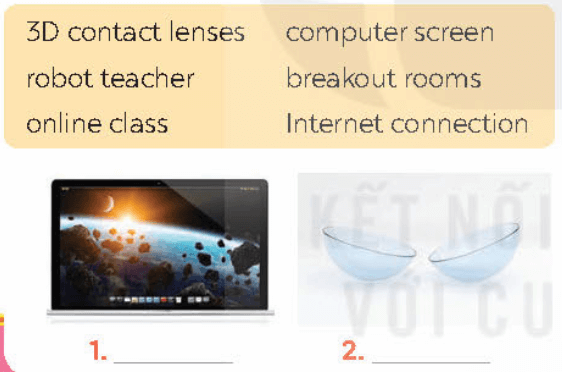
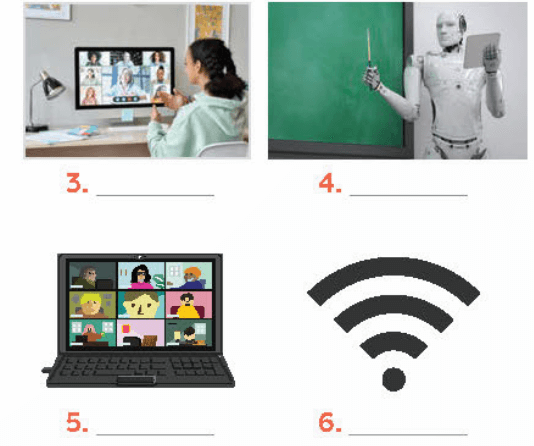
Answer:
1. computer screen | 2. 3D contact lenses | 3. online class |
4. robot teacher | 5. breakout rooms | 6. Internet connection |
Explain:
1. computer screen: màn hình máy tính
2. 3D contact lenses: kính áp tròng 3D
3. online class: lớp học trực tuyến
4. robot teacher: giáo viên người máy
5. breakout rooms: phòng đột phá
6. Internet connection: kết nối Internet
4. Complete the sentences, using the phrases in 3.
1. I can't see the documents on this computer very clearly. I need a larger ___________.
2. During our lessons, our teacher puts us into ____________ for group discussions.
3. A ____________ in Korea teaches English to primary students.
4. We had a(n) ___________ yesterday with a teacher in the US.
5. Can l wear ___________ and watch a movie too?
Answer:
1. computer screen - I can't see the documents on this computer very clearly. I need a larger computer screen.
2. breakout rooms - During our lessons, our teacher puts us into breakout rooms for group discussions.
3. robot teacher - A robot teacher in Korea teaches English to primary students.
4. online class - We had a(n) online class yesterday with a teacher in the US.
5. online class - Can I wear 3D contact lenses and watch a movie too?
5. QUIZ. Do you know what things were invented in these years? Work in pairs and find out
1. 1822: Charles Babbage invented it. Students use it to type essays and to learn online.
2. 1876: Alexander Graham Bell invented it. We use it to communicate with our friends and families.
3. 1928: Sir Alexander Fleming discovered it. It was the world’s first antibiotic.
4. 1989: Tim Berners-Lee invented it. It links information sources so everyone can access them.
5. 2000: Honda developed it. It can run, jump, and work as a bartender.
Answer:
1. the computer | 2. the telephone | 3. penicillin |
4. WWW | 5. a walking robot |
A CLOSER LOOK 1
VOCABULARY
1. Write a word or phrase from the box under each picture.
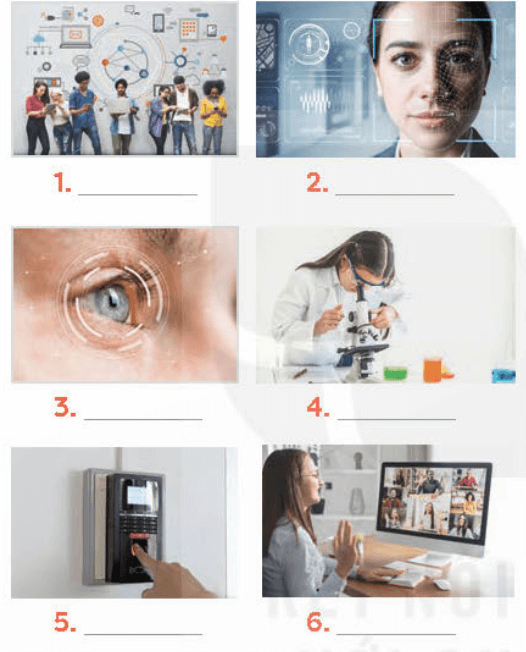
Answer:
1. digital communication | 2. face recognition | 3. eye-tracking |
4. experiment | 5. fingerprint scanner | 6. video conferencing |
Explain:
1. digital communication (n) giao tiếp kỹ thuật số
2. face recognition (n) công nghệ nhận biết gương mặt
3. eye-tracking (n) công nghệ theo dõi cử động mắt
4. experiment (n) thí nghiệm
5. fingerprint scanner (n) thiết bị quét vân tay
6. video conferencing (n) hội nghị qua video
2. Choose the option that best completes each phrase.
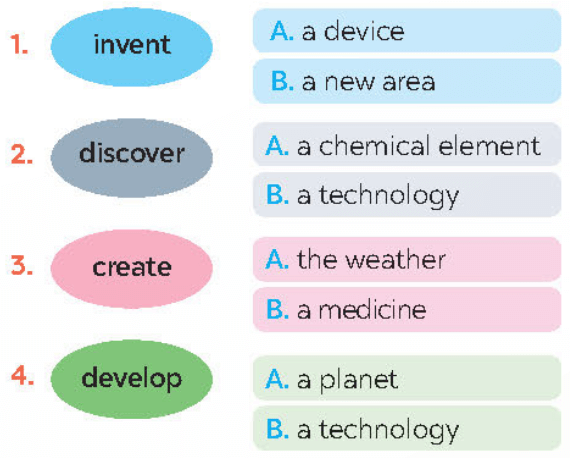
Answer:
1 - A: invent a device
2 - A: discover a chemical element
3 - B: create a medicine
4 - B: develop a technology
3. Complete the sentences with the words and phrase from the box.
Invented Experiments Fingerprint scanner | Created discovered |
1. Marie Curie and Pierre Curie ______________ radium and polonium.
2. Thomas Edison ___________ the light bulb in 1880.
3. Sarah Gilbert is the creator of a vaccine. She ___________ it in 2020.
4. Scientists have carried out many ___________ to find a cure for cancer.
5. Scan your finger on this _____________ to check attendance, please.
Answer:
1. discovered - Marie Curie and Pierre Curie discovered radium and polonium.
2. invented - Thomas Edison invented the light bulb in 1880.
3. invented - Sarah Gilbert is the creator of a vaccine. She created it in 2020.
4. invented - Scientists have carried out many experiments to find a cure for cancer.
5. fingerprint scanner - Scan your finger on this fingerprint scanner to check attendance, please.
PRONUNCIATION
Stress in words ending in -ese and -ee
4. Listen and repeat the sentences. Pay attention to the bold syllables.
1. I don't have a computer.
2. Do you call her every day? - No, I don't.
3. They are not familiar with that new computer.
4. A: Did you lend her your laptop? - B: Yes, I did.
5. Who do you work with on Sundays?
Answer:
1. I don't have a computer.
2. Do you call her every day? - No, I don't.
3. They are not familiar with that new computer.
4. A: Did you lend her your laptop? - B: Yes, I did.
5. Who do you work with on Sundays?
5. Listen and repeat the sentences. How many stressed words are there in each sentence?
1. He is an inventor.
2. We won't have a robot teacher next year.
3. She likes learning online.
4. Was she checking attendance when you came? - No, she wasn't.
5. What did he invent?
Answer:
1. 1 | 2. 5 | 3. 3 | 4. 6 | 5. 2 |
A CLOSER LOOK 2
GRAMMAR
Reported speech (statements)
1. Look at part of the conversation in Getting Started again. Then match Minh’s uncle’s direct speech with his reported speech.
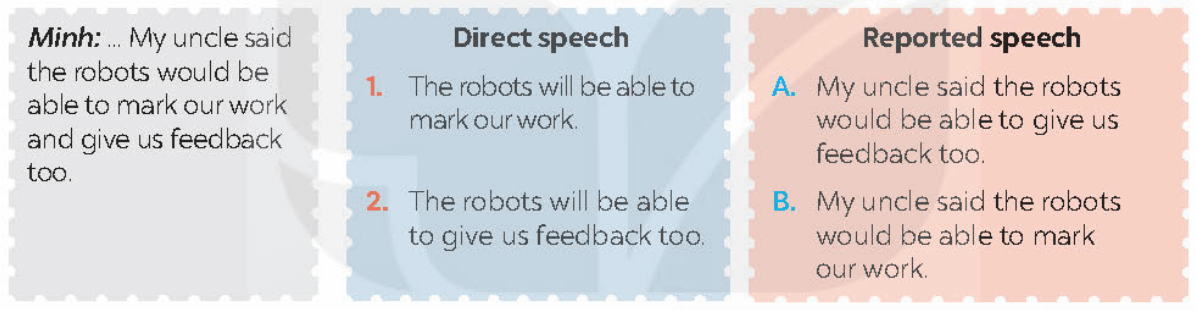
Answer:
1. B | 2. A |
2. Complete the second sentences using the correct verb forms.
1. “I am a member of the IT club.”
Minh said that he _______ a member of the IT club.
2. “Mai will take an online course to improve her speaking.”
Nam said Mai _______ an online course to improve her speaking.
3. “I am talking to Phong on the phone.”
Tom said he __________ to Phong on the phone.
4. “They are going to send me an email.”
He said they _________ to send him an email.
5. “I don't have an iPod to listen to music.”
She said that she _________ an iPod to listen to music.
Answer:
1. was | 2. would take | 3. was talking |
4. were going | 5. didn’t have |
|
3. Complete the second sentences with the words and phrases from the box.

1. “I'm having a science test tomorrow.” Mary said.
Mary said she was having a science test ____________.
2. “The group is working on their project now,’ Tom said.
Tom said the group was working on their project __________.
3. “Mai is reading about Thomas Edison today,” the teacher said.
The teacher said that Mai was reading about Thomas Edison __________.
4. “They will invent a smart cooker this year,” my mum said.
My mum said that they would invent a smart cooker __________.
5. “My teacher will park her car here,” said Mi.
Mi said her teacher would park her car __________.
Answer:
1. the next day | 2. then | 3. that day |
4. that year | 5. there |
4. Complete the second sentence in each pair so that it means the same as the first one.
1. “We will live much longer in the future” said the scientist.
The scientist said that ______________________________________.
2. “Our school is going to have a new laboratory here,” said our teacher.
Our teacher said that ________________________________________.
3. “They are developing technology to monitor students better,” my dad said.
My dad said that ____________________________________________.
4. “There are no classes tomorrow because our teacher is ill,” Tom said.
Tom said that _______________________________________________.
5. “We want some students to join the science club next semester,” the teacher said.
The teacher said that _________________________________________.
Answer:
1. The scientist said that we would live much longer in the future.
2. Our teacher said that our school was going to have a new laboratory there.
3. My dad said that they were developing technology to monitor students better.
4. Tom said that there were no classes the next day because their teacher was ill.
5. The teacher said that they wanted some students to join the science club the next semester.
5. GAME. He / She said that...
Work in pairs. One student says a sentence and the other changes that sentence into reported speech. Then swap roles.
Answer:
1. My mum buy a car.
She said that she bought a car.
2. My mum is living in London.
She said that she was living in London.
3. 'I love the Toy Story films,' she said.
She said she loved the Toy Story films.
4. 'I worked as a waiter before becoming a chef,' he said.
He said he'd worked as a waiter before becoming a chef.
5. 'I'll phone you tomorrow,' he said.
He said he'd phone me the next day.
COMMUNICATION
Everyday English
Giving and responding to good news
1. Listen and read the conversation. Pay attention to the highlighted sentences.
Nick: Great news for us. We'll have school clouds so we won't have to carry lots of books to school.
Mi: Great!
Nick: And I won first prize in the essay contest and got an iPad so I can read books from the school clouds.
Mi: Congratulations!
2. Work in pairs. Give news and respond to the news in the following situations.
1. You tell your classmate about the new vending machine at your school.
2. You tell your classmate about a new laptop that your dad gave you on your birthday.
Answer:
1.
A: Great news for us. Our school has the news vending machine.
B: Great!
2.
A: Hi, B. What's up? My dad just gave me a new laptop on my birthday.
B: Great. Happy birthday to you, A.
Online learning
3. Work in pairs. Read the posts from some students about online learning and complete the table.
Mi: Our teacher uses Zoom to teach. But some students don't have computers or smartphones. Others complain about the poor connection. I also feel more stressed when learning online.
Tom: Our teacher uses Google Meet for video conferencing. It’s quite convenient, and we don't have to get up early. Still, I prefer to study face to face. I want to see my classmates.
Phong: We use Microsoft Teams. I don't like online learning. My eyes get tired. I can’t concentrate well. But online learning helps us become more independent.
Nick: We use Zoom to discuss and share ideas. We interact in breakout rooms. It also helps us avoid traffic jams. But I’m not happy about the Internet connection at times.
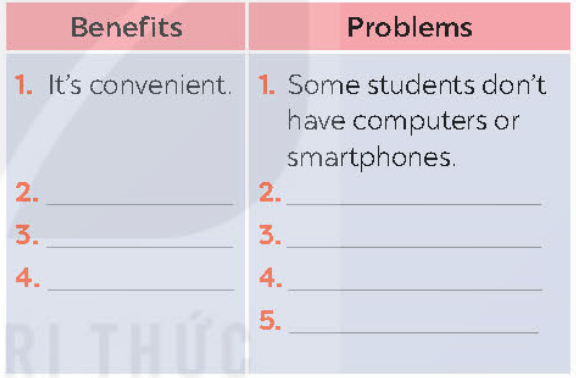
Answer:
Benefits | Problems |
1. It’s convenient. | 1. Some students don’t have computers or smart phones. |
2. Students don’t have to get up early. | 2. The Internet connection is poor. |
3. It helps students become more independent. | 3. It makes some students feel more stressed when learning online. |
4. It helps students avoid traffic jams. | 4. Students can’t meet their classmates. 5. Some students get tired eyes and can’t concentrate well. |
4. Work in groups. Talk about a platform you use for your online classes or one you know about. What are the benefits and problems of using it?
Answer:
Platforms use for online classes: Microsoft Teams, Zoom, Google Meet, ...
Benefits | Problems |
1. Easy to use and deploy 2. Zoom App Pricing goes easy on the budget | 1. Zoom Security Concerns 2. Cyber Attacks may shrink the number of users |
5. Report the answers of one of your group members to the class.
Answer:
Lan said that her extra class used Microsoft Teams. She said that she and her classmates found it difficult to use. However, it is convenient to have online classes on Microsoft Teams when the weather is bad.
SKILL 1
READING
Work in pairs. Name the technological applications in the pictures. Can they be used in schools?
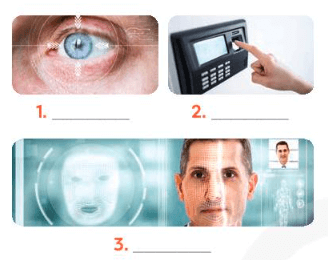
Answer:
1. eye tracking
2. fingerprint scanner
3. face recognition
2. Read the texts and tick (v) B (Biometrics) or N (Nanolearning).
Biometrics
No more worries about truancy and cheating! Just introduce biometric applications at your school. With fingerprint scanners, or facial or voice recognition technologies, schools will be able to check students’ attendance. Teachers will no longer need to call students’ names to find out who is absent. This will make more time for activities!
Schools can also use these biometric applications for students who borrow books and equipment. Even more amazing, teachers can even use the eye-tracking applications to check students’ understanding of a lesson and to motivate students to learn.
For more information, visit www.biometricappsolution.com
Nanolearning
Tired of sitting in front of a computer all day long? Unable to concentrate for very long in your classes? Or frequently forgetting large amounts of information? The solution to these is Nanolearning created by Junglemap in 2006.
Nanolearning provides you with small amounts of information over a short period of time. Your learning will become effortless.
Believe us! Receive bits of information within two to five minutes via our platform, and you will increase your learning attention and ability. Our app also reports your study activities and results to your teacher.
Contact us at www.nanoleamingsolution.edu.com
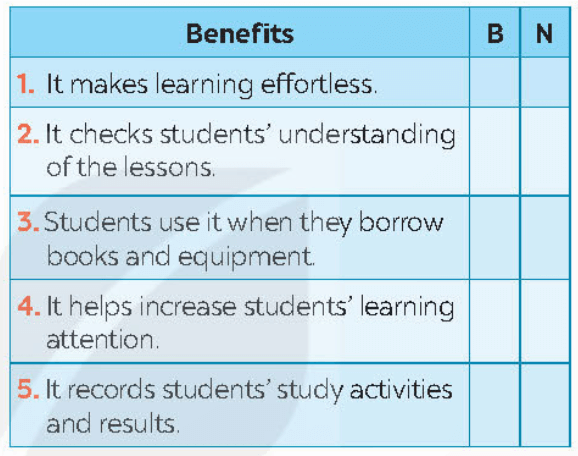
Answer:
1. N | 2. B | 3. B | 4. N | 5. N |
Explain:
1. Your learning will become effortless.
2. Even more amazing, teachers can even use the eye-tracking applications to check students’ understanding of a lesson and to motivate students to learn.
3. Schools can also use these biometric applications for students who borrow books and equipment.
4. Receive bits of information within two to five minutes via our platform, and you will increase your learning attention and ability.
5. Our app also reports your study activities and results to your teacher.
3. Read the interview again. Choose the correct answer A, B, or C.
1. What does checking students’ attendance mean?
A. Checking their presence.
B. Scanning their faces.
C. Checking their fingerprints.
2. With Nanolearning students can ____________.
A. access large amounts of information
B. improve their learning quality
C. concentrate longer
3. What DOESN'T Nanolearning do?
A. Provide a platform.
B. Report students’ results.
C. Entertain students.
4. The texts are from ___________.
A. science books
B. advertisements
C. manuals
Answer:
1. A - With fingerprint scanners, or facial or voice recognition technologies, schools will be able to check students’ attendance. Teachers will no longer need to call students’ names to find out who is absent.
2. B - Believe us! Receive bits of information within two to five minutes via our platform, and you will increase your learning attention and ability.
4. C
For more information, visit www.biometricappsolution.com
Contact us at www.nanoleamingsolution.edu.com
SPEAKING
4. Work in pairs. Discuss and match the questions in A with the answers in B, and then make a conversation about an invention.
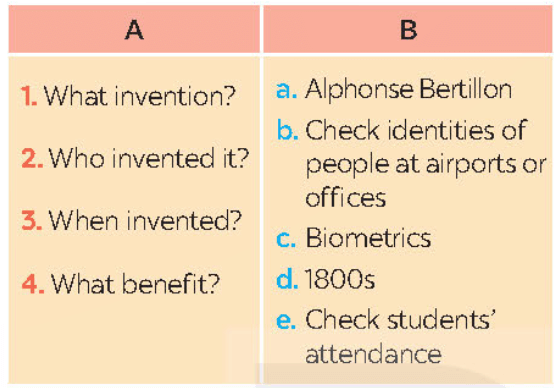
Answer:
1. c | 2. a | 3. d | 4. b, e |
A: What technology do you like?
B: I like biometrics.
A: Who invented it?
B: Alphonse Bertillon.
A: When did he invent it?
B: In 1880s.
A: How can we use it?
B: It can help us check students’ attendance. We can also use it to check identities of people at airports or offices.
5. Work in groups. Ask and answer questions about a technology or an invention. Use the example in 4 as a cue. Then report your answers to the class
Answer:
Mi likes biometrics. Alphonse Bertillon invented it in the 1800s. It is a very important technology. We use it to check the identities of people at airports or offices and check students' attendance.
SKILL 2
LISTENING
1. Tick (V) the things that you think a robot teacher can do.
1. It can teach different subjects.
2. It can mark students’ work.
3. It can teach students how to behave.
Answer:
Sentence: 1, 2
2. Listen to the conversation and fill in each blank with ONE word
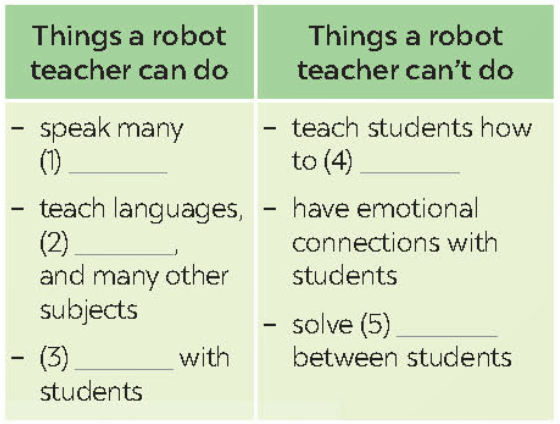
Answer:
1. languages | 2. maths | 3. interact | 4. behave | 5. problems |
Transcript:
- I heard that in Finland a robot called Elias can speak 23 languages. This robot teaches many subjects like languages and maths to school students.
- Well, can it interact with students?
- Yes, students can practice English with Elias in real time. Elias can even do a Gangnam Style dance for the students.
- Sounds exciting. I think children would enjoy studying in a class with Elias.
- Exactly. This robot is patient and doesn't feel tired repeating words. It can also ask questions that are suitable for the students' level.
- So students can answer questions which are not too difficult, and they won't feel embarrassed when they make mistakes, right?
- Definitely. I think one day robot teachers will replace human teachers.
- I don't think so. They can't teach students how to behave.
- That's true. Also, robots don't have emotional connections with students like humans do.
- One more thing is that robots can't solve problems between students.
3. Listen again and tick (v) T (True) or F (False).
1. Elias can do a Gangnam style dance.
2. Students can practise English with the robot in real time.
3. The robot feels tired when it repeats words.
4. The robot asks questions that are too difficult for students to answer.
5. Robots can teach students how to behave correctly.
Answer:
1. T (Explain: Ellas can even do a Gangnam style dance for the students.)
2. T (Explain: Students can practise English with Ellas in real time.
3. F (Explain: This robot is patient and doesn't feel tired repeating words.)
4. F (Explain: T It can also ask questions that are suitable for the students’ level.
5. F (Explain: T They can't teach students how to behave.)
WRITING
4. Work in pairs. Discuss if you agree or disagree that robots will soon replace teachers at schools. Write the reasons in the table.
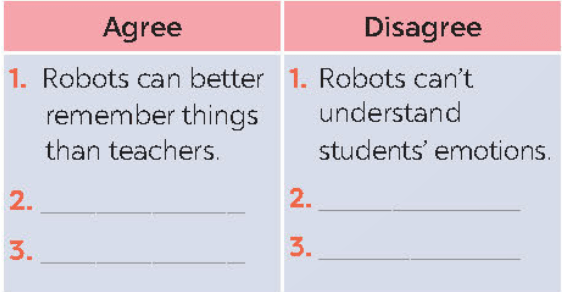
Answer:
Agree | Disagree |
1. Robots can better remember things than teachers. 2. Robots provides variety of educational methods including interactive ones. 3. If a robotic machine is the subject mentor of a classroom, pupil will be unafraid, and therefore give less seriousness in the study. | 1. Robots can’t understand students’ emotions. 2. Robots will be expensive compare to teachers giving lectures to students. 3. Robots can memorize the vast of information that enables it to produce the best match of the study programme depending on the result or the progress of the study of each student. |
5. Now write a paragraph (80 - 100 words) to express your opinion. Use the notes in 4.
Answer:
Many people think that the intelligent machine could substitute teacher's responsibilities in the classroom. This way of thinking is totally disagreed with. In this essay, Limitation of AI technology in the educational system, as well as different methods to communicate rather than the original one (face to face) will be provided. There are several constraints of substituting instructors by AI. The machine can not develop a profound relationship with students as it is a non-physical system; for example, when the students need to talk with instructors in leisure time, AI is incapable of generating conversation. Hence, the connection between students and the machine is likely to fail. Moreover, there is an issue with the student's concentration. The smart machine is not capable of controlling the learner because it was given the logical coding for teaching only. Therefore, in this point of view, it is obvious why smart machines are not suitable for the entire educational system.
LOOKING BACK
VOCABULARY
1. Circle the option that goes with each verb.
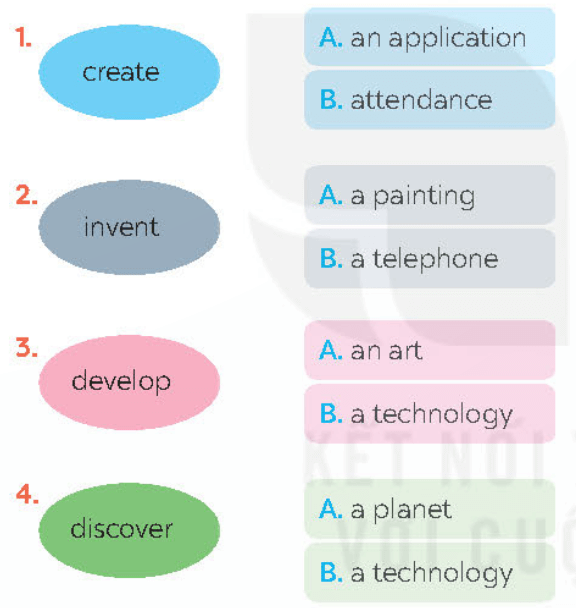
Answer:
1 - A: create an application
2 - B: invent a telephone
3 - B: develop a technology
4 - A: discover a planet
2. Fill in each gap with a word or phrase from the box. You may have to change the form of the word or phrase
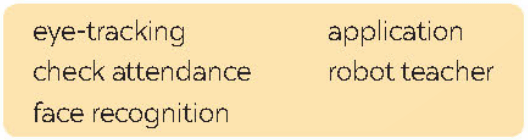
1. They will develop more _____________ to support human teachers at schools.
2. Siri, the voice recognition technology, is a(n) ____________ of biometric technology.
3. Please look at this _____________ screen. It will check if you are a club member.
4. Teachers can ask students to wear _________ glasses and check if they understand a lesson.
5. Schools can _______________ quickly and effectively using fingerprint scanners.
Answer:
1. robot teacher | 2. application | 3. face recognition |
4. eye-tracking | 5. check attendance |
|
GRAMMAR
3. Which of the underlined parts in each question is incorrect? Find and correct it.
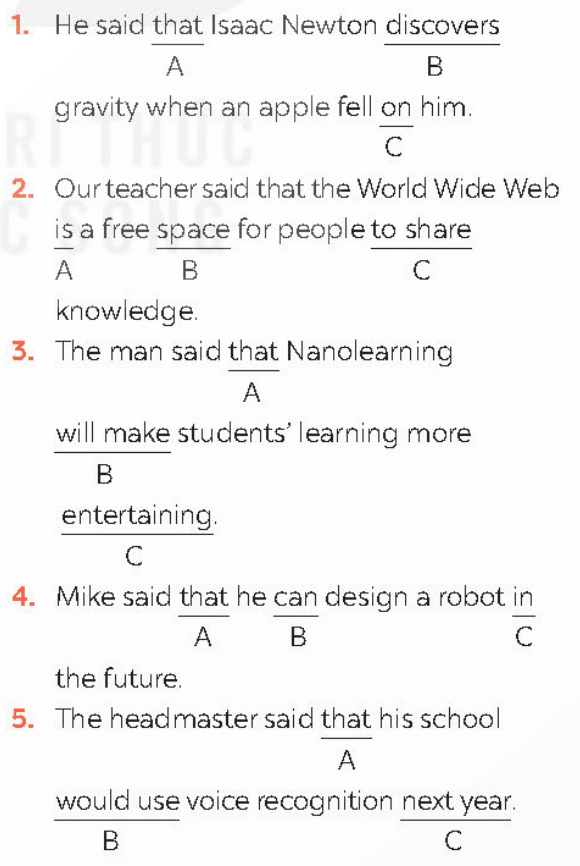
Answer:
1. B (discovers -> discovered)
2. B (is -> was)
3. B (will make -> would make
4. C (a day ago -> a day before)
5. C (next year -> the next/following year)
4. Rewrite the following sentences, using the words in BOLD.
1. "We can't connect to the Internet to work online here," said Tom. THERE
2. "Science is becoming a more important subject in schools now", Mr Thompson said. THEN
3. "The school will use a machine to check students' attendance next year", said the headmaster. WOULD
4. "We are having a science competition this week", said the monitor to the class. THAT
5. "We don't like robot teachers at all", said the students. DIDN'T
Answer:
1. Tom said they couldn’t connect to the Internet to work online there.
2. Mr. Thompson said (that) science was becoming a more important subject in schools then.
3. The headmaster said (that) the school would use a machine to check students’ attendance the following year.
4. The monitor said to the class (that) they were having a science competition that week.
5. The students said (that) they didn’t like robot teachers at all.
PROJECT
Your invention
Work in groups.
1. Think about a problem you have at home or at school. Imagine an invention (a tool, a machine, an application ...) that helps you deal with your problem.
Answer:
Problem: can't sleep well (Vấn đề: không thể ngủ ngon)
Product: Aroma Lamp (Sản phẩm: đèn Aroma)
2. Discuss and answer the following questions
- What is the name of the invention?
- What does it look like?
- How can it help you solve the problem?
Answer:
- Product's name (Tên sản phẩm): Aroma Lamp
- Its appearance (Diện mạo của nó):

- Main function: diffuse calming scents and colors into your room, creating a cozy and comfortable environment for you to sleep
3. Prepare a poster presentation with pictures or a paper model of the invention and present it to your class.
Answer:
A busy working and studying day makes me really tired and quickly wants to sleep to recharge my energy. But then I realize that I can’t go to sleep like normal, but sleep if there’s a scent in my room. So I created the Aroma Lamp to help me deal with the problem. The Aroma Lamp is a lamp that diffuses calming scents and colors into your room, creating a cozy and comfortable environment for you to sleep. The lamp has a built-in aromatherapy device that lets you choose from different essential oils, such as lavender, chamomile, or vanilla, and adjust the intensity and duration of the diffusion. The lamp also has a color-changing LED light that matches the mood of the scent. The Aroma Lamp can help you with your sleep by creating a soothing and relaxing environment in your bedroom. The lamp diffuses calming scents and colors that can reduce stress, anxiety, and insomnia. The scents can also trigger positive memories and emotions that can make you feel more comfortable and peaceful. The colors can also affect your mood and energy levels, as well as your circadian rhythm. By using the Aroma Lamp before bed, you can prepare your mind and body for a good night’s sleep. You should use the lamp for about 30 minutes to an hour before your desired bedtime, as this can give enough time for the scents and colors to take effect and help you relax. You can also adjust the intensity and duration of the diffusion according to your needs and liking. You can experiment with different settings and see what works best for you
Tài liệu cùng môn học
Tài liệu khác
- Trắc nghiệm tiếng anh 2 Family and Friends
- Trắc nghiệm tiếng anh 2 Explore our world
- Trắc nghiệm tiếng anh 3 Family and Friends
- Trắc nghiệm tiếng anh 3 Explore our world
- Trắc nghiệm tiếng anh 4 Family and Friends
- Trắc nghiệm tiếng anh 4 Global Success
- Trắc nghiệm tiếng anh 4 Explore our world
- Trắc nghiệm tiếng anh 5 Family and Friends
- => Xem nhiều môn hơn