Giải tiếng anh 8 Global Success: Unit 9 Natural disasters
Hướng dẫn giải Tiếng anh 8 Global Success: Giải Unit 9 Natural disasters. Bài được giải chi tiết, rõ ràng, dễ hiểu. Bài giải giúp học sinh nắm vững kiến thức trong sách giáo khoa, rèn kĩ năng giải bài tập và có phương pháp học tập hiệu quả.
Nội dung chi tiết
GETTING STARTED
We are all safe!
1. Listen and read.
Mi: My uncle called us this morning. Our home town has been affected by a flood. It’s the second time this year.
Tom: I'm sorry to hear that. How are things there now?
Mi: My uncle, his wife, and his children are all safe. They moved everything to the second floor of their house last night. Are there natural disasters in your home town in the US?
Tom: Yes, we sometimes have tornadoes.
Mi: Tornadoes? Sounds strange. What's a tornado?
Tom: It’s a violent storm that moves in a circle with very strong winds. I still remember the tornado we had last year.
Mi: What happened?
Tom: One evening my parents and I were having dinner. Suddenly, we heard a very loud noise. When we looked out of the window, we saw a big funnel of wind moving towards us.
Mi: Did it cause any damage?
Tom: Yes, a lot. It damaged the roof of our house and pulled up some trees in our yard. Fortunately, no one was hurt.
2. Read the conversation again. Complete each sentence with no more than TWO words from it.
1. There is a _______________ in Mi's home town.
2. Her uncle’s family had to move everything to the _______________ last night.
3. A tornado is an example of a _______________.
4. Tom’s family _______________ dinner when the tornado came.
5. The tornado damaged their roof and _______________ up some trees in their yard.
Answer:
| 1. flood | 2. second floor | 3. natural disaster |
| 4. were having | 5. pulled |
Explain
1. flood: lũ lụt
2. second floor: tầng hai
3. natural disaster: thiên tai
4. were having: đang có
5. pulled: kéo
3. Write the natural disasters from the box under the pictures. Then listen, check, and repeat.
volcanic eruption earthquake landslide | storm tornado flood |
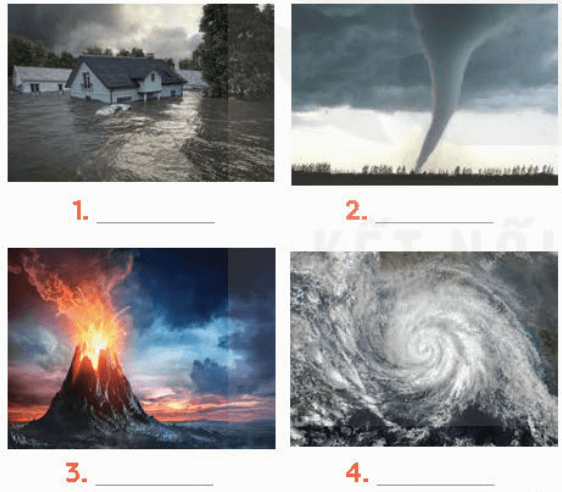
Answer:
| 1. flood | 2. tornado | 3. volcanic eruption |
| 4. storm | 5. landslide | 6. earthquake |
Explain:
1. flood: lũ lụt
2. tornado: lốc xoáy
3. volcanic eruption: núi lửa phun trào
4. storm: cơn bão
5. landslide: lở đất
6. earthquake: trận động đất
4. Choose the correct option to complete each sentence .
1. When there is a(n) earthquake / volcanic eruption, hot gases and liquid rock pour out from a mountain.
2. Oh, the house is shaking! I think we're having a(n) earthquake / flood.
3. We wanted to travel to Ha Giang, but there was a tornado / landslide. Some big rocks and mud came down the mountains.
4. Every year more than ten floods / storms with strong winds and rain cause damage in our country.
5. A tornado / storm looks like a huge funnel and causes a lot of damage. Its strong winds can reach 480 km per hour.
Answer:
1. volcanic eruption - When there is a(n) volcanic eruption, hot gases and liquid rock pour out from a mountain.
2. earthquake - Oh, the house is shaking! I think we're having a(n) earthquake.
3. landslide - We wanted to travel to Ha Giang, but there was a landslide.
Some big rocks and mud came down the mountains.
4. storms - Every year more than ten storms with strong winds and rain cause damage in our country.
5. tornado - A tornado looks like a huge funnel and causes a lot of damage.
5. Word web. Work in groups. Complete the web with all of the words and phrases related to natural disasters you know.
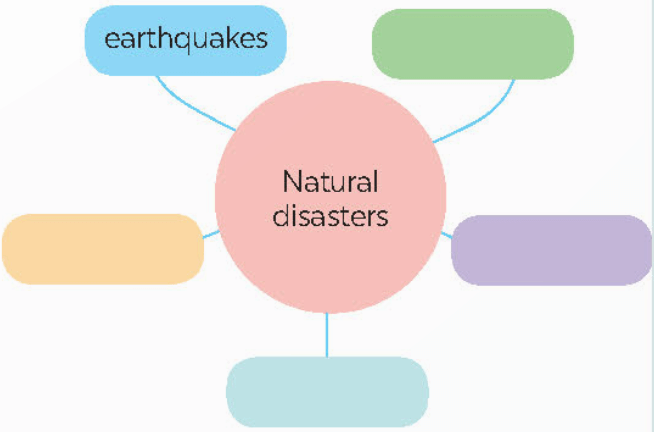
Answer:
Natural disasters:
- earthquakes
- flood
- tornado
- volcanic eruption
- storm
- landslide
A CLOSER LOOK 1
VOCABULARY
1. In column B, write the noun forms of the verbs in column A.
| A | B |
1. destroy 2. erupt 3. warn 4. predict 5. damage |
Answer:
| 1. destruction | 2. eruption | 3. warning | 4. prediction | 5. damage |
2. Write a word or phrase from the box under the correct picture.
emergency kit rescue worker whistle | victim property |
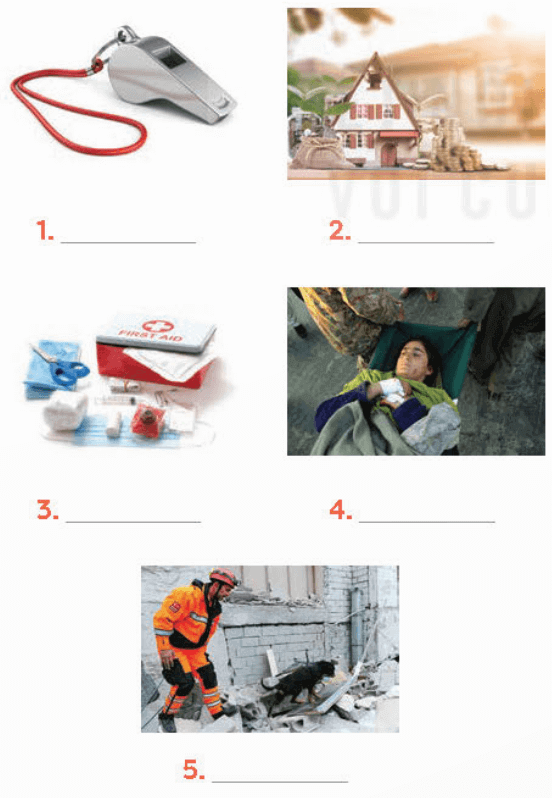
Answer:
| 1. whistle | 2. property | 3. emergency kit |
| 4. victim | 5. rescue worker |
Explain:
1. whistle: còi
2. property: tài sản
3. emergency kit: bộ cấp cứu
4. victim: nạn nhân
5. rescue worker: nhân viên cứu hộ
3. Fill in each blank with a word or phrase from the box
Warning damage | Predict Emergency kit | property |
1. Natural disasters can cause serious _________ to human life.
2. Local authorities gave a flood _______ yesterday, so today people are moving to safer places.
3. To prepare for a natural disaster, we should make a(n) _________.
4. It’s hard to believe that we cannot _________ when earthquakes will happen.
5. They lost all of their _________ because of the volcanic eruption.
Answer:
1.damage - Natural disasters can cause serious damage to human life.
2. warning - Local authorities gave a flood warning yesterday, so today people are moving to safer places.
3. emergency kit - To prepare for a natural disaster, we should make a(n) emergency kit.
4.predict- It’s hard to believe that we cannot predict when earthquakes will happen.
5. property - They lost all of their property because of the volcanic eruption.
PRONUNCIATION
Stress in words ending in -al and -ous
3. Listen and repeat the words. Pay attention to the word stress.
musical national personal | dangerous practical marvellous | humorous poisonous
|
Answer:
musical national personal | dangerous practical marvellous | humorous poisonous
|
5. Listen and repeat the sentences. Mark the stress in the underlined words.
1. The flood victims are collecting their personal property.
2. Avoid dangerous places, such as windows or bookcases, during an earthquake.
3. There are numerous tropical storms in this area every year.
4. Some natural disasters, such as landslides, usually happen in mountainous areas.
5. She gave us practical tios about treating poisonous wastes.
Answer:
1. The flood victims are collecting their ‘personal property.
2. Avoid ‘dangerous places, such as windows or bookcases, during an earthquake.
3. There are ‘numerous ‘tropical storms in this area every year.
4. Some ‘natural disasters, such as landslides, usually happen in ‘mountainous areas.
5. She gave us ‘practical tios about treating poisonous wastes.
A CLOSER LOOK 2
GRAMMAR
The past continuous
1. Complete the sentences by putting the verbs in brackets into the past continuous.
1. They (help) _________ the flood victims at 10 o'clock last night.
2. It (not snow) _________ when left home this afternoon.
3. While she (work) _________ the field, the tornado came.
4. - What _________ you (do) _________ at 9 o'clock yesterday morning?
- I (watch) _________ the news about a volcanic eruption.
5. - _________ you (cry) _________ when I saw you two days ago?
- No, I wasn't.
Answer:
1. were helping - They was helping the flood victims at 10 o'clock last night.
2.was snowing - It wasn't snowing when I left home this afternoon.
3. was working - While she was working the field, the tornado came.
4. were …. doing/ was watching- What were you doing at 9 o'clock yesterday morning?
- I was watching the news about a volcanic eruption.
5. were …. crying - Were you crying when I saw you two days ago?
- No, I wasn't. (Không phải.)
2. Circle the correct answer to complete each sentence.
1. We donated / were donating money to help the earthquake victims last month.
2. - What did you do / were you doing when the volcano erupted?
- I slept / was sleeping in my bed.
3. While they camped / were camping near the river, the flood was coming / came suddenly.
4. After Tom ran / was running out of his house, he moved / was moving quickly to a safer place.
5. I didn't read / wasn't reading a newspaper at 9 a.m. yesterday, but I watched / was watching the news about the tornado.
Answer:
1. donated - We donated money to help the earthquake victims last month.
2. were you doing, was sleeping - What were you doing when the volcano erupted?
- I was sleeping in my bed.
3. were camping, came - While they were camping near the river, the flood came suddenly.
4. ran, moved - After Tom ran out of his house, he moved quickly to a safer place.
5. wasn’t reading, was watching - I wasn’t reading a newspaper at 9 a.m. yesterday, but I watched the news about the tornado.
3. Look at the picture and write what each person in Lan’s family was doing when the earthquake happened. Use the given word and phrases from the box.
Watch TV Read a book Talk on the phone | Draw Drink tea |
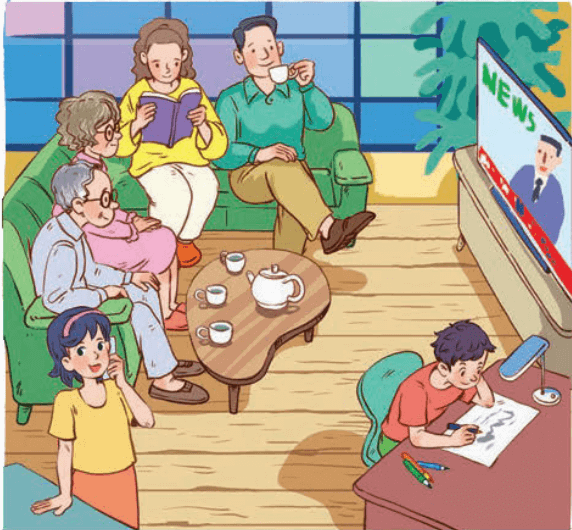
Answer:
1. Lan’s grandparents were watching TV.
2. Lan’s/ Her mother was reading a book.
3. Lan’s/ Her father was drinking tea.
4. Lan was talking on the phone.
5. Lan’s/ Her brother was drawing.
4. Form questions using the past continuous. Then in pairs, ask and answer the questions.
1. you / have dinner / 7 o'clock yesterday evening?
2. you / do / homework / 8 o'clock yesterday evening?
3. you / watch / film / 9 o'clock yesterday evening?
Answer:
1. Were you having dinner at 7 o’clock yesterday evening?
2. Were you doing your homework at 8 o’clock yesterday evening?
3. Were you watching a film at 9 o’clock yesterday evening?
5. Memory challenge. Work in groups. Take turns to say a sentence that describes what each person in the picture was doing.
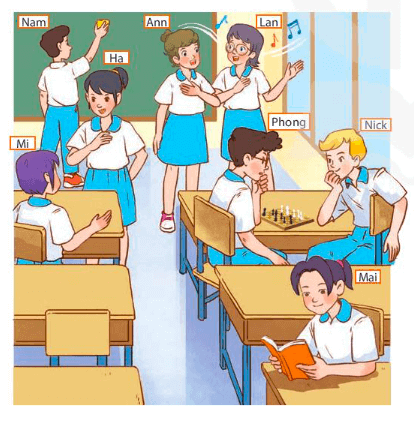
Answer:
1. Ann and Lan were singing while Nam was cleaning the board.
2. Phong and Nick were playing chess while Mai was reading a book.
3. Ha and Mi were talking to each other.
COMMUNICATION
Everyday English
Giving and responding to bad news
1. Listen and read the dialogue below. Pay attention to the highlighted sentences.
Mark: Phong, why are you so sad?
Phong: My grandparents called this morning. A flood destroyed their house.
Mark: I'm sorry to hear that.
Phong: It also damaged all of their crops.
Mark: That’s awful. I hope your grandparents are safe.
2. Work in pairs. Practise giving and responding to bad news in the following situations.
- You have a friend in a mountainous area. A landslide destroyed his family’s garden yesterday. You share this news with your classmate.
- You hear that a big earthquake hit a city. You share this news with your classmate.
Answer:
1.
A: Why you look so sad, B?
B: I have a friend lives in a mountainous area. A landslide destroyed his family's garden yesterday.
A: I'm sorry to hear that. I hope his family are safe.
2.
A: Why you look so sad, B?
B: A big earthquake hit a city.
A: Oh my god. That's awful. I hope everyone is fine.
Knowledge of natural disasters
3. Read the short passages below. Decide which natural disaster each person below is talking about.
Nam: We were travelling on the road near a mountain. Suddenly, a lot of rocks and mud came down the mountain.
Ann: While I was working in the garden, I saw a big funnel of wind moving towards us very quickly.
Tom: Suddenly, everything in our living room began to shake. My sister and I quickly hid under the table.
Answer:
| Nam: landslide | Ann: tornado | Tom: earthquake |
4. Choose the correct answer to each question to see how much you know about natural disasters.
QUESTIONNAIRE
Question 1: Which of these may cause landslides?
A. Heavy rain.
B. Wind.
C. Lightning.
Question 2: Which of these activities may cause landslides?
A. Littering.
B. Cutting down trees.
C. Polluting the air.
Question 3: What scale is used for measuring earthquakes?
A. Fahrenheit scale.
B. Celsius scale.
C. Richter scale.
Question 4: What natural disaster can an earthquake cause?
A. A flood.
B. A landslide.
C. A tornado.
Question 5: What do tornadoes form from?
A. An earthquake.
B. A flood.
C. A thunderstorm.
Question 6: Where do tornadoes mostly happen?
A. In the USA.
B. In the UK.
C. In Viet Nam.
Answer:
| 1. A | 2. B | 3. C | 4. B | 5. C | 6. A |
SKILL 1
READING
1. Match the headlines (1 - 2) with the natural disasters (A - B).
| 1. 30 seconds of a slight shaking in Ha Noi | A. volcanic eruption |
| 2. A thick layer of ash covers Tonga | B. earthquake |
Answer:
| 1. B | 2. A |
2. Read the two news articles. Match the highlighted words with their meanings.
A volcano in the South Pacific erupted violently last Saturday. It hit Tonga, an island country in the area. The eruption sent a cloud of ash and gas into the air. People could see this cloud from 20 kilometres away. The eruption also caused a tsunami which flooded properties in Tonga’s capital. Besides, it destroyed hundreds of homes on some small islands. More than twenty people on these islands are still missing. New Zealand sent two big ships to Tonga to help the victims yesterday.
Residents in tall buildings in Ha Noi were frightened when they felt a slight shaking for about 30 seconds last night. “I was watching TV when my building started trembling. Books, lights, and other things also moved”. Ms Nguyen Ha, a resident in the Sunshine Building, shared. Many people living in the building ran out of their homes in fear. According to scientists, a strong earthquake in China caused this shaking. Luckily, there was no damage
| 1. violently | a. not yet found |
| 2. tsunami | b. slightly shaking |
| 3. missing | c. the bad feeling you have when you are frightened |
| 4. trembling | d. very strongly |
| 5. fear | e. very large waves in the sea |
Answer:
1 - d: violently - very strong
2 - e: tsunami - very large waves in the sea
3 - a: missing - not yet found
4 - b: trembling - slightly shaking
5 - c: fear - the bad feeling you have when you are frightened
3. Read the articles again and answer the questions.
1. Where and when did the eruption happen?
2. What did the eruption cause?
3. What were the other effects of the eruption?
4. How long did the buildings shake?
5. What caused the shaking?
Answer:
1. In the South Pacific last Saturday.
2. A tsunami.
3. It destroyed hundreds of homes on some small islands, and more than twenty people on these islands are missing.
4. For about 30 seconds.
5. A strong earthquake in China.
SPEAKING
4. Work in pairs. Match the questions with the answers.
| 1. What kind of natural disaster was it? | a. Five days of heavy rain caused it. |
| 2. When and where did it happen? | b. Many houses were flooded, two villagers died, and five others were missing. |
| 3. What caused it? | c. It was a serious flood. |
| 4. What were its effects? | d. Rescue workers looked for the missing people, and volunteers gave food and drinks to the victims. |
| 5. How did people help the victims? | e. It happened in a village in Phu Yen last week. |
Answer:
1 - c: What kind of natural disaster was it? - It was a serious flood.
2 - e: When and where did it happen? - It happened in a village in Phu Yen last week.
3 - a: What caused it? - Five days of heavy rain caused it.
4 - b: What were its effects? - Many houses were flooded, two villagers died, and five others were missing.
5 - d: How did people help the victims? - Rescue workers looked for the missing people, and volunteers gave food and drinks to the victims.
5. Work in groups. Prepare a short piece of news about the natural disaster in 4 or one you know of. Report the news to the class.
Answer:
Five days of heavy rain caused a serious flood in a village in Phu Yen. The flood happened last week. Many houses were flooded, two villagers died, and five others were missing. Rescue workers looked for the missing people, and volunteers gave food and drinks to the victims.
SKILL 2
LISTENING
1. Work in pairs. Look at the picture and answer the questions.
1. What can you see in the picture?
2. When do we need these things?
Answer:
1. A torch, a mask, a lamp, a whistle, a bottle of water, some medicine, matches, a radio, some plasters, a candle, a multi-purpose knife, some batteries, a blanket.
2. We need these things when it has a natural disaster.
2. Listen to a broadcast. Put the activities (1- 6) in the correct column.
1. Listen to instructions from local authorities.
2. Prepare an emergency kit.
3. Stay inside the house.
4. Keep away from dangerous areas.
5. Avoid windows and glass doors.
6. Strengthen houses.
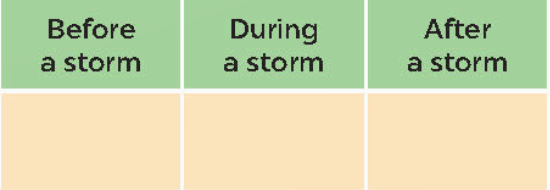
Answer:
+) Before a storm: 2, 6
+) During a storm: 3, 5
+) After a storm: 1, 4
Transcript:
This is Ambien Commune radio station. The storm season is coming. So today's special program will tell you about what you should do before, during and after a storm. Before a storm, each family should prepare an emergency kit with necessary things like plasters, basic medicine, a whistle, bottles of water, food, etc. Bring in outdoor things like flower pots or rubbish bins because they can get blown away by strong winds strengthen your house. If necessary during a storm, stay inside even when the rain and winds stop. Wait, because the storm may start up again. Stay away from Windows and glass doors. They could break and hurt you. Gather in the safest room in the house. After the storm, don't leave your house right away. Listen to important instructions from local authorities. They may warn you about which parts of your area are dangerous and should be avoided. Stay away from broken power lines.
3. Listen again and tick (v) T (True) or F (False) for each sentence.
1. The broadcast is on TV.
2. You should bring flowerpots and rubbish bins into the house.
3. Right after the storm, you can leave your home.
4. The local authority man warn you about dangerous places.
Answer:
1. F (Explain: This is An Binh Commune Radio Station.
2. T (Explain: Bring in outdoor things like flowerpots or rubbish bin because they can get blown away by strong winds.
3. F (Explain: After the storm, don't leave your house right away.
4. T (Explain: Listen to important instructions from local authorities. They may warn you about which parts of your area are dangerous and should be avoided.
WRITING
4. Work in pairs. Discuss what you should do before, during and after a flood. Write your ideas in the columns.
Answer:
| Before a flood | During a flood | After a flood |
- Prepare an emergency kit. - Check your insurance. - Listen to local radio. | - Stay inside a safe and high place. - Follow the routes specified by officials. - Time permitting, leave a note informing others when you left and where you went. | - Avoid moving water. - Emergency workers will be assisting people in flooded areas. - Return home only when authorities indicate it is safe. |
5. Write instructions (80 - 100 words) about things to do before, during, and after a flood
Answer:
Here a things you should do before, during and after a flood.
Before:
- Build an emergency kit and make a family communications plan.
- Avoid building in a floodplain unless you elevate and reinforce your home.
- Elevate the furnace, water heater and electric panel in your home if you live in an area that has a high flood risk.
- Consider installing "check valves" to prevent flood water from backing up into the drains of your home.
- If feasible, construct barriers to stop flood water from entering the building and seal walls in basements with waterproofing compounds.
During:
- Listen to the radio or television for information.
- Be aware that flash flooding can occur. If there is any possibility of a flash flood, move immediately to higher ground. Do not wait for instructions to move.
- Be aware of streams, drainage channels, canyons and other areas known to flood suddenly. Flash floods can occur in these areas with or without typical warnings such as rain clouds or heavy rain.
After:
- Avoid moving water.
- Stay away from damaged areas unless your assistance has been specifically requested by police, fire, or relief organizations.
- Emergency workers will be assisting people in flooded areas. You can help them by staying off the roads and out of the way.
- Play it safe. Additional flooding or flash floods can occur. Listen for local warnings and information. If your car stalls in rapidly rising waters, get out immediately and climb to higher ground.
- Return home only when authorities indicate it is safe.
LOOKING BACK
VOCABULARY
1. Write the name of a natural disaster in each blank.
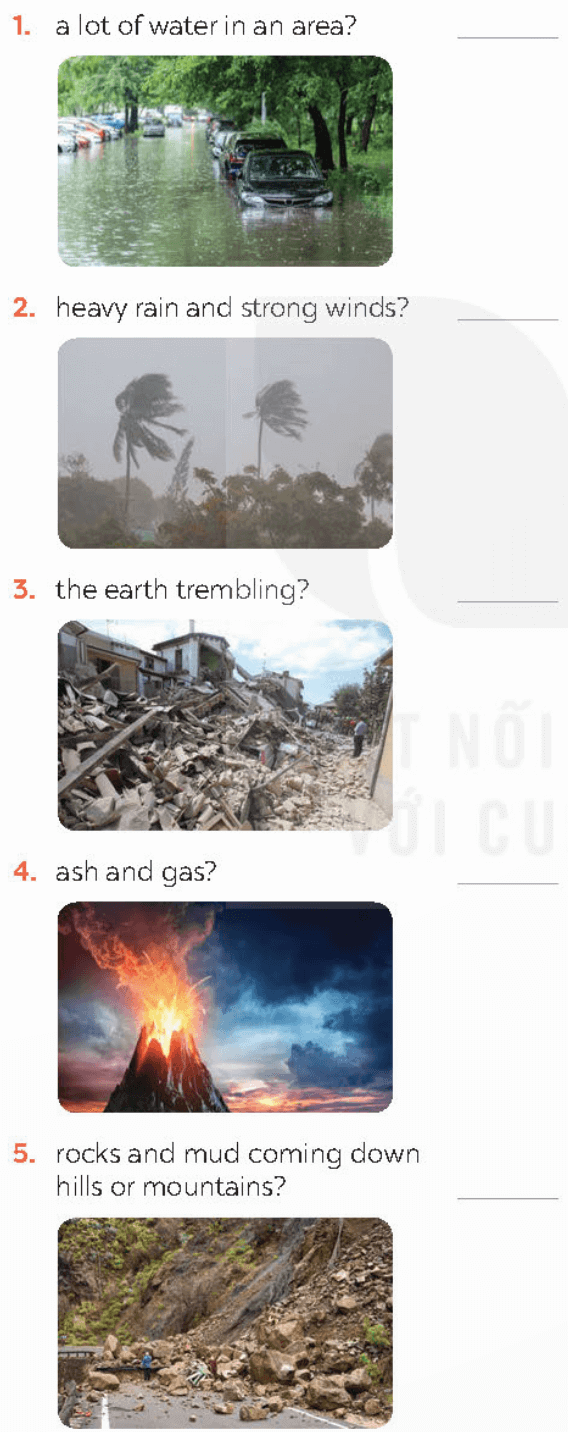
Answer:
| 1. flood | 2. storm | 3. earthquake |
| 4. volcanic eruption | 5. landslide |
2. Fill in each blank with the correct form of the word in brackets.
1. The tsunami brought _________ to cities and towns near the sea. (destroy)
2. The government has developed some systems to help make _________ about natural disasters. (predict)
3. We are donating money and food to help the _____ of the landslide. (victim)
4. The local authorities _________ the villagers about a landslide yesterday. (warning)
5. Rescue _________ are trying hard to save people in the flooded area. (work)
Answer:
1. destruction - The tsunami brought destruction to cities and towns near the sea.
2. predictions - The government has developed some systems to help make predictions about natural disasters.
3. victims - We are donating money and food to help the victims of the landslide.
4. warned - The local authorities warned the villagers about a landslide yesterday.
5. workers - Rescue workers are trying hard to save people in the flooded area.
GRAMMAR
3. Put the verbs into the correct tense: the past simple or past continuous.
1. What ______ you (do) ______ at 8 o'clock yesterday morning?
2. Last year, earthquakes (destroy) ______ a lot of houses in Japan.
3. He (water) ______ the flowers in his garden when the tornado (come) ______.
4. While they (call) ______ for help, the rescue workers (appear) ______.
5. ______ you (listen) ______ to music at 9 o'clock yesterday evening?
Answer:
1. were … doing
2. destroyed
3. was watering; came
4. were calling; appeared
5. Were … listening
4. Complete the sentences about you and your family members.
At 7 p.m. yesterday,...
1. I was__________________________________________
2. my grandmother/grandfather_______________________
3. my mother_____________________________________
4. my father______________________________________
5. my sister/brother ________________________________
Answer:
At 7 p.m. yesterday, ...
1. I was doing my homework.
2. my grandmother / grandfather was watching TV.
3. my mother was reading a book.
4. my father was drinking a tea.
5. my sister / brother was washing dishes.
PROJECT
What do we know about it?
Work in groups.
1. Choose a natural disaster you want to learn more about.
Answer:
volcanic eruption
flood
earthquake
landslide
tornado
cyclone
hurricane / storm
tsunami
2. Research it. You can use these questions to guide you
- What causes it?
- Where and when does it usually happen?
- What effects can it have?
- What should people do before, during, and after it happens?
Answer:
Floods happen when there is too much water in an area, and it cannot drain away. This can be caused by heavy rain, rivers overflowing, broken dams, or typhoons. Floods usually happen in low-lying areas, near rivers or the sea, and during the rainy season or after storms.
Floods can have many bad effects. They can damage houses, roads, and crops. People can lose their homes, and sometimes even their lives. There may be no clean water, and diseases can spread.
Before a flood, people should prepare an emergency kit, store food and water, and move to higher ground. During a flood, they should stay safe, avoid floodwater, and listen to the news. After a flood, people should clean carefully, check for damage, and get help if needed.
3. Create a poster about this natural disaster. Draw pictures or find suitable photos for it.
Answer:
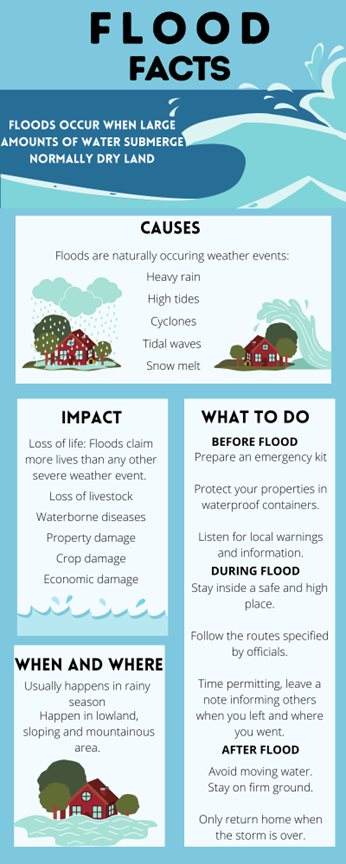
4. Present the poster to the class
Answer:
A flood happens when water overflows or soaks land that is normally dry. There are few places on Earth where people don’t need to be concerned about flooding. Generally, floods take hours or even days to develop, giving residents time to prepare or evacuate. Sometimes, floods develop quickly and with little warning.
A flood usually happens in rainy seasons and it frequently occurs in lowlands, urban areas, areas near rivers or sloping and mountainous area.
Floods are naturally occuring weather events: heavy rain, high tides, cyclones, tidal waves, snow melt.
Flood has many bad impacts. Floods claim more lives than any other severe weather event and cause great damage. According to a report at the end of 2022 in Vietnam, flood claimed 175 lives and nearly 20000 hectares of newly-grown rice, crops and annually were damaged. Also, it was estimated that our country lost nearly 20000 billion dong. Flood also brings waterborne disease. As flood water spreads, it carries disease. Flood victims can be left for weeks without clean water for drinking or hygiene. This can lead to outbreaks of deadly diseases like typhoid, malaria, hepatitis A, and cholera.
So what should people do before, during, and after it happens? Before flood happens, we should prepare an emergency kit in case there is a electric cut. Remember to protect your properties in waterproof containers and put it above in a high place. Also, listen to the local warning and information about the flood on the TV or radio. During a flood, stay inside a safe and high place, follow the routes specified by officials. And remember to leave a note informing others when you left and where you went. After a flood, avoid moving water and stay on firm place. Return home only when authorities indicate it is safe.
Tài liệu cùng môn học
Tài liệu khác
- Trắc nghiệm tiếng anh 2 Family and Friends
- Trắc nghiệm tiếng anh 2 Explore our world
- Trắc nghiệm tiếng anh 3 Family and Friends
- Trắc nghiệm tiếng anh 3 Explore our world
- Trắc nghiệm tiếng anh 4 Family and Friends
- Trắc nghiệm tiếng anh 4 Global Success
- Trắc nghiệm tiếng anh 4 Explore our world
- Trắc nghiệm tiếng anh 5 Family and Friends
- => Xem nhiều môn hơn