Giải tiếng anh 8 Global Success: Unit 2 Life in the countryside
Hướng dẫn giải Tiếng anh 8 Global Success: Giải Unit 2 Life in the countryside. Bài được giải chi tiết, rõ ràng, dễ hiểu. Bài giải giúp học sinh nắm vững kiến thức trong sách giáo khoa, rèn kĩ năng giải bài tập và có phương pháp học tập hiệu quả.
Nội dung chi tiết
GETTING STARTED
Last summer holiday
1. Listen and read
Nick: You look great with a tan, Mai!
Mai: Thank you. I've just come back from a very enjoyable summer holiday.
Nick: Really? Where did you stay?
Mai: I stayed at my uncle's house in a small village in Bac Giang Province.
Nick: What did you do there?
Mai: A lot of things. It was harvest time. The villagers were harvesting rice with a combine harvester. I helped them load the rice onto a truck. Then we unloaded the rice and dried it.
Nick: Sounds great!
Mai: And sometimes I went with the village children to herd the buffaloes and cows. I made friends with them on my first day.
Nick: Were they friendly?
Mai: Yes, they were. They took me to the paddy fields to fly kites. And in the evening, we played traditional games like bamboo dancing and dragon-snake.
Nick: Oh, I envy you!
Mai: Things move more slowly there than in our city, but people seem to have a healthier life.
2. Read the conversation again and choose the correct answer to each question.
1. How does Mai feel about her summer holiday?
A. She likes it.
B. She doesn't like it.
C. She thinks it was fine.
2. Where did she stay during her summer holiday?
A. At her friend's house.
B. At her uncle's house.
C. At her grandparents' house.
3. During harvest time, people harvest rice by.
A. themselves
B. using a truck
C. using a combine harvester
4. Mai thinks people in the countryside lead
A. a healthy life
B. an exciting life
C. an interesting life
Answer:
- A (The text mentions “Nick: You look great with a tan, Mai!”)
- B (The text mentions “Mai: I stayed at my uncle's house in a small village in Bac Giang Province.”)
- C (The text mentions “Mai: … The villagers were harvesting rice with a combine harvester.”)
- A (The text mentions “Mai: Things move more slowly there than in our city, but people seem to have a healthier life.”)
- Complete the sentences with the words and phrases from the box.
Paddy field Harvest time | Herd Combine harvest | load |
1. It took them an hour to … all the goods onto the truck.
2. Nowadays, people in my village use a … to harvest their rice and separate the grains from the rest of the plant.
3. Today it is my turn to … the cows.
4. A place in which people grow rice is called a …
5. A busy time when people cut and gather their crops is called …
Answer:
- Load - It took them an hour to load all the goods onto the truck.
- Combine harvester - Nowadays, people in my village use a combine harvester to harvest their rice and separate the grains from the rest of the plant
- Herd - Today it is my turn to herd the cows.
- Paddy field - A place in which people grow rice is called a paddy field.
- Harvest time - A busy time when people cut and gather their crops is called harvest time.
- Match the activities (1 - 6) that people living in the countryside often do with the pictures (a - f).
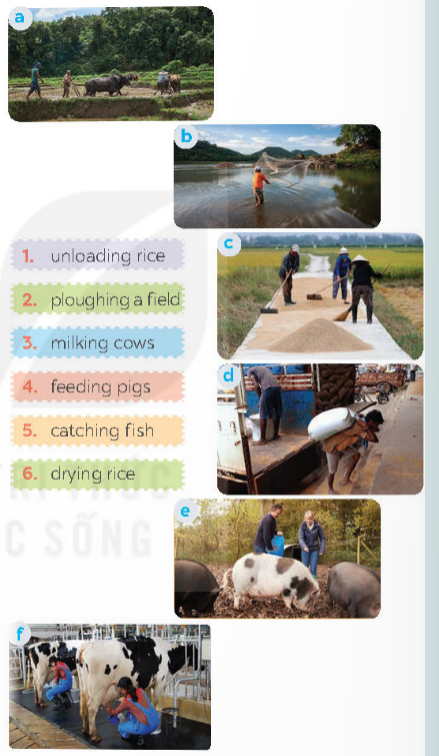
Can you adđ some more activities?
Answer:
| 1. d | 2. a | 3. f | 4. e | 5. b | 6. c |
- Work in pairs. Ask and answer about the pictures in 4.
Example:
A: What are they doing in picture a?
B: They’re ploughing a fields
Answer
More activities (Thêm các hoạt động)
- planting/watering the vegetables
- swimming in the river
- collecting eggs
- harvesting the rice
- riding on the buffalo
- flying a kite
What are they doing in picture b? They're catching fish.
- What are they doing in picture c? They're drying rice.
- What are they doing in picture d? They're unloading rice.
- What are they doing in picture e? They're feeding pigs.
- What are they doing in picture f? They're milking cows.
A CLOSER LOOK 1
VOCABULARY
1. Circle the correct words to complete the sentences.
2. We helped the farmers herd cattle / poultry.
3. Theyare helping their parents pick plants / fruit in the orchard.
4. At harvest time farmers are busy cutting and collecting food / crops.
5. The driver loaded / unloaded the rice from the back of the truck.
6. People here live by catching / holding fish from nearby lakes and ponds.
Answer:
- Cattle - We helped the farmers herd cattle.
- Fruit - They are helping their parents pick fruit in the orchard.
- Crops - At harvest time farmers are busy cutting and collecting crops.
- Unloaded - The driver unloaded the rice from the back of the truck.
- Catching - People here live by catching fish from nearby lakes and ponds.
- Match the following adjectives with their definitions.
|
|
|
|
|
|
|
|
|
|
Answer:
1 – c: vast - extremely large in area, size, amount, etc
2 – d: hospitable - pleased to welcome guests; generous and friendly to visitors
3 - e. well-trained - having received good or thorough training
4 – b: surrounded - having something near or around
5 – a: picturesque - pretty, especially in a way that looks old-fashioned
- Complete the sentences with the words from 2.
1. The local people are kind and … to visitors.
2. Our factory needs a lot of … workers.
3. While travelling up the mountain, people always stop and take photos of the … scenery.
4. The Sahara is a … desert that covers parts of eleven countries in northern Africa.
5. The lake is … by a lot of trees.
Answer:
1. hospitable - The local people are kind and hospitable to visitors.
2. well-trained - Our factory needs a lot of well-trained workers.
3. picturesque - While travelling up the mountain, people always stop and take photos of the picturesque scenery.
4. vast - The Sahara is a vast desert that covers parts of eleven countries in northern Africa.
5. surrounded - The lake is surrounded by a lot of trees.
PRONUNCIATION
/ə/ and /ɪ/
- Listen and repeat the words. Pay attention to the sounds /ə/ and /ɪ/
| /ə/ | /ɪ/ |
Activity Hositable Garden Picturesque collect | Pick Village Harvest Busy cottage |
- Listen and practise the sentences. Underline the bold words with /ə/, and circle the bold words with /ɪ/
1. There is a lot of water in the bottle.
2. The farmers here are hard-working.
3. They are picking fruits in the orchard.
4. People in my village usually gather at weekends.
5. Please buy some milk and pasta at the supermarket.
Answer:
1. in - There is a lot of water in the bottle.
2. hard -working - The farmers here are hard-working.
3. picking - They are picking fruits in the orchard.
4. village - People in my village usually gather at weekends.
5. milk - Please buy some milk and pasta at the supermarket.
A CLOSER LOOK 2
GRAMMAR
Comparative adverbs
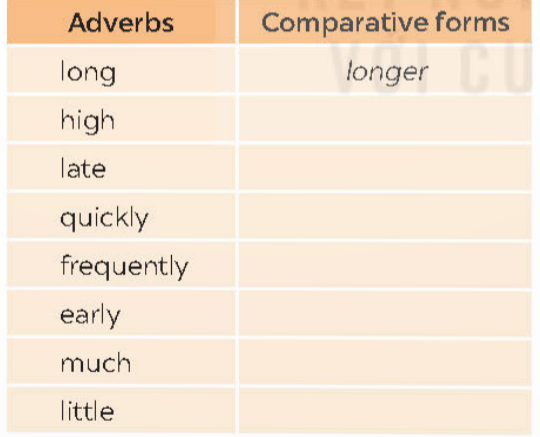
1. Write the comparative forms of the adverbs in the table below
Answer:
| Adverbs | Comparative forms |
long
high
late
quickly
frequently
early
much
little | longer
higher
later
more quickly
more frequently
earlier
more
less |
2. Complete the sentences with the comparative forms of the adverbs in brackets.
1. Mai dances (beautifully) than Hoa does.
2. Please write (clearly). I can't read it.
3. Life in the city seems to move (fast) than that in the countryside.
4. If you want to get better marks, you must work much (hard).
5. Today it's raining (heavily) than it was yesterday.
Answer:
1. more beautifully - Mai dances more beautifully than Hoa does.
2. more clearly - Please write more clearly. I can't read it.
3. faster - Life in the city seems to move faster than that in the countryside.
4. harder - If you want to get better marks, you must work much harder.
5. more heavily - Today it’s raining more heavily than it was yesterday.
3. Complete the sentences with suitable comparative forms of the adverbs from the box.
Early carefully | Soundly quietly | fast |
1. After his accident last month, he is driving … now.
2. A horse can run … than a buffalo.
3. You're too loud. Can you speak a bit …?
4. After working hard all day on the farm, we slept … than ever before.
5. The farmers started harvesting their crops … than expected.
Answer:
1. more carefully - After his accident last month, he is driving more carefully now.
2. faster - A horse can run faster than a buffalo.
3. more quitely - You're too loud. Can you speak a bit more quietly.
4. more soundly - After working hard all day on the farm, we slept more soundly than ever before.
5. earier - The farmers started harvesting their crops earlier than expected.
4. Read the situations and complete the sentences using the comparative forms of the adverbs in brackets.
1. The red car can run 200 km/h while the black car can run 160 km/h.
The red car can run (fast).
2. Nick can jump 1.5 m high while Tom can jump only 1.3 m.
Nick can jump (high).
3. Mai and Hoa both did well on the exam. Hoa got 80% of the answers correct and Mai got 90%.
Mai did (well).
4. My dad expected the workers to arrive at 7 a.m., but they arrived at 6:30 a.m.
The workers arrived (early).
5. The buses run every 15 minutes. The trains run every 30 minutes.
The buses run (frequently).
Answer:
1. The red car can run faster than the black car.
2. Nick can jump higher than Tom.
3. Mai did better on the exam than Hoa.
4. The workers arrived earlier than my dad expected.
5. The buses run more frequently than the trains.
5. Work in pairs. Ask and answer to find out who:
- can run faster
- can jump higher
- stays up later at night
- gets up earlier in the morning
Example:
A: How fast can you run?
B: I can run 15 kilometres an hour.
A: OK, you can run faster than me.
Report your results to the class.
Answer:
A: How fast can you run?
B: I can run 15 kilometres an hour.
A: I can run 12 kilometres an hour. OK, you can run faster than me.
A: How high can you jump?
B: I can jump 1.5 metres.
A: I can jump 1.2 metres. You can jump higher than me.
A: What time do you usually go to bed?
B: I usually stay up until 11:30 p.m.
A: I usually stay up until 10:30 p.m. So, you stay up later than me.
A: What time do you get up in the morning?
B: I usually get up at 6:30 a.m.
A: I get up at 5:30 a.m. That means I get up earlier than you.
COMMUNICATION
Everyday English
Giving and responding to compliments
1. Listen and read the conversations. Pay attention to the highlighted sentences.
1. Tom: What a beautiful kite you have, Mai!
Mai: Thank you, Tom. My dad made it for me last weekend.
2. Nick: You really have a nice dress, Hoa.
Hoa: I'm glad you like it, Nick. I think its colour really suits me.
2 Work in pairs. Make similar conversations to practise giving and responding to compliments, using the cues below.
- a shirt
- a bicycle
- a school bag
Answer:
- A Shirt
A: What a nice shirt you’re wearing!
B: Thank you! My sister gave it to me for my birthday. - A Bicycle
A: That’s a really cool bicycle you have!
B: Thanks! I just got it last month. I ride it to school every day. - A School Bag
A: Your school bag looks great!
B: Thanks a lot! I chose it because it’s big and very comfortable to carry.
Adverts for beautiful villages
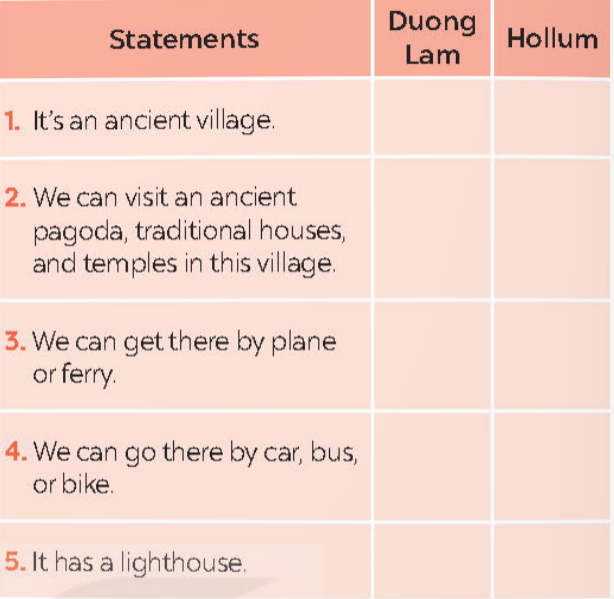
- Read the adverts for the two beautiful villages. Tick (V) the boxes to show which village the statements describe. Sometimes both boxes need to be ticked.
Duong Lam Village
Duong Lam, one of the most ancient villages in Ha Noi, is situated in Son Tay. Visitors can get there from the centre of Ha Noi by car, bus or even by bicycle. It is famous for its ancient pagoda, traditional houses, and temples. Besides these, visitors can observe the locals making specialities, such as keo doi, che lam, etc. and then try them.
Hollum Village
Hollum is one of the ancient villages on the island of Ameland, the Netherlands. Many visitors come to the village because of its historical and cultural values. It is full of fascinating sights, such as traditional houses, a museum, a church, a lighthouse, etc. Besides sightseeing, visitors can also take part in sports like kite-flying, surfing, etc. Visitors can reach the village by air or ferry.
Answer:
| 1. Both | 2. Duong Lam | 3. Hollumn |
| 4. Duong Lam | 5. Hollumn |
Explaination:
1. Information
- Duong Lam, one of the most ancient villages in Ha Noi
- Hollum is one of the ancient villages on the island of Ameland
2. Information: It is famous for its ancient pagoda, traditional houses, and temples.
3. Information: Visitors can reach the village by air or ferry.
4. Information: Visitors can get there from the centre of Ha Noi by car, bus or even by bicycle.
5. Information: It is full of fascinating sights, such as traditional houses, a museum, a church, a lighthouse, etc.
4. Work in groups. Take turns to talk about the similarities and differences between Duong Lam and Hollum.
Answer:
Duong Lam and Hollum are both ancient villages.
Duong Lam is in Viet Nam, but Hollum is in the Netherlands.
| Đường Lâm | Hollum |
situated in Son Tay, Ha Noi
| located on the island of Ameland, New Zealand. |
get there by car, bus or even by bicycle
| get there by plane or ferry |
places to visit: traditional houses, and temples
| places to visit: traditional houses, a museum, a church, a lighthouse |
| observe the locals making specialities, such as keo doi, che lam, etc. and then try them. | take part in sports like kite-flying, surfing, etc.
|
5. Work in pairs. Which village in 3 would you like to visit for a holiday? Explain your choice to your partner.
Answer:
1.
- Which village would you like to visit for a holiday?
- Duong Lam, of course!
- Why?
- Because I love watching the locals making specialities
2.
A: Which village would you like to visit for a holiday?
B: Hollum, of course!
A: Why?
B: Because Duong Lam is quite near my house, I've visited it many times. In additon, I also love watching fascinating sights, such as traditional houses, a museum, a church, a lighthouse,... and taking part in sports like kite-flying, surfing, etc.
SKILL 1
READING
- Work in pairs. Look at the picture and discuss the following questions
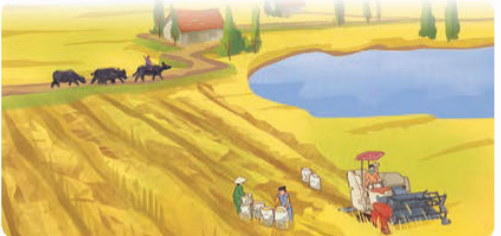
1. What can you see in it?
- Which of the following adjectives describe the picture?
Peaceful pictureque | Vast noisy | crowded |
Answer:
1. paddy fields, cattle (buffaloes), farmers, a combine harvester, a lake / pond, trees, houses, a dirt road, horizon, etc.
2. peaceful, vast, picturesque
2. Read the text about life in a village in Viet Nam. Match the highlighted words in the text with their meanings.
I feel fortunate that I am living in a peaceful village in southern Viet Nam. The scenery here is beautiful and picturesque with vast fields stretching long distances. The houses are surrounded by green trees. There are lakes, ponds, and canals here and there. The air is fresh and cool. Life here seems to move more slowly than in cities. The people work very hard. They grow vegetables, cultivate rice, and raise cattle. At harvest time, they use combine harvesters to harvest their crops. Many families live by growing fruit trees in the orchards. Others live by fishing in lakes, ponds, and canals. Life in the village is very comfortable for children. They play traditional games. Sometimes they help their parents pick fruit and herd cattle. People in my village know each other well. They are friendly and hospitable. They often meet each other in the evening, eating fruit, playing chess, singing folk songs, and chatting about everyday activities.
Answer:
1 - c: stretching - covering a large area of land
2 - a: canals - small passages used for carrying water to fields, crops, etc.
3 - d: cultivate - to grow plants or crops.
4 - b: orchards - place where people grow fruit trees
3. Read the text again and tick (V) T (True) or F (False) for each sentence.
1. Life in the author's village is very peaceful.
2. The people in the village work very hard.
3. Villagers live only by catching fish in lakes, ponds, and canals.
4. The children are always busy helping their parents.
5. The villagers get along well.
Answer:
1.T ( The text mentions: I feel fortunate that I am living in a peaceful village in southern Viet Nam.
2. T (The text mentions: The people work very hard.)
3. F (The text mentions: Many families live by growing fruit trees in the orchards. Others live by fishing in lakes, ponds, and canals.
4. F (The text mentions: Life in the village is very comfortable for children. They play traditional games. Sometimes they help their parents pick fruit and herd cattle.
5. T. (The text mentions: People in my village know each other well. They are friendly and hospitable.)
SPEAKING
4. Make notes about the village or town where you live or which you know
Answer:
| Name | Hoan Kiem Lake - Hoan Kiem District |
| Location | Ha Noi |
| Scenery | Hoan Kiem Lake - Ngoc Son Temple |
| How people live | People go to work every day |
| Activities adult or children often do | Children go to school Adult go to work in their company or they work from home selling stuff |
| The relationships among the people | People get along well |
| Special features | Crowded and noisy city |
| Name | Uoc Le Village |
| Location | Tan Uoc commune, Thanh Oai district, Ha Noi City |
| Scenery | ancient bridge with village gate, traditional house and market, ancient temples and well
|
| How people live | make traditional gio lua |
| Activities adult or children often do | children go to school and help parents after class |
| The relationships among the people | get on well together |
| Special features | peaceful |
5. Work in groups. Take turns to talk about the village or town where you live or which you know. Use the information in 4
Answer:
1. I live in Duong Lam. It's an old village outside Ha Noi. It has ancient pagoda, traditional houses and temples.
2. I want to talk about an ancient village named Uoc Le. It is a famous village for making traditional gio cha. The scenery here is picturesque with the old bridge and the village gate. There are many places to visit like traditional house, temples and wells. People in this village live by making traditional gio cha, but some other people go to work at factory. This is village is suitable for children. They go to school in the morning and help their parents after classes. People here get on well together. This village is very peaceful and suitable for anyone who wants to escape from the life of the city.
SKILL 2
LISTENING
- Work in pairs. Discuss the following question. (Làm việc theo cặp. Thảo luận câu hỏi sau).
What do you like dislike about life in the countryside?
Answer:
- I like living in the countryside because it is a peaceful place and we can enjoy healthy natural conditions.
- I don’t like the life in the countryside because it’s boring to me. I don't have many options of entertainment and there is also a lack of other facilities there.
- Listen to three people talking about life in the countryside. Choose the opinion (A - C) that each speaker (1 - 3) expresses.
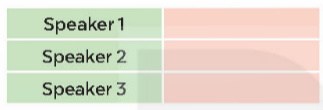
| Options |
| A. I don't like rural life because there are not many good schools and colleges. And entertainment and means of transport are very poor. |
| B. I like rural life because the people here are close to each other. |
| C. I want to live in the countryside because there are many things I can't easily do in the city. |
Answer:
- B
- A
- C
Transcript:
Speaker 1: I chose to live in a village because the relationships between people here are very good. There is a great sense of community here. The people welcome neighbours to their homes. They are always willing to help each other. They share almost everything with one another.
Speaker 2: There are many things I don't like about life in the countryside. There aren't many good schools or colleges. It's boring here because there aren't many places for entertainment like theatres, cinemas, etc. Transportation is another big problem. There are few means of public transport. And in general, there are many things that we should do to improve the life of villagers.
Speaker 3: I love to live in the countryside. It is spacious. We can do many, many things that are hard to do in the city. We can go swimming, play football, fly kites and do other interesting things. Life is also peaceful and simple here.
3. Listen again and choose the correct answer A, B, or C.
1. According to speaker 1, there is a great sense of _______ in his village.
A. security
B. duty
C. community
2. Speaker 1 says that people in his village are very ______.
A. supportive
B. unsociable
C. well-trained
3. In speaker 2’s opinion, ______ is a big problem in the countryside.
A. the cost of living
B. safety
C. transportation
4. Speaker 2 says that they should __________ in the countryside.
A. improve the lives of people
B. prevent crime
C. protect nature
5. According to speaker 3, life in the countryside is peaceful and _______.
A. slow
B. simple
C. safe
Answer:
| 1. C | 2. A | 3. C | 4. A | 5. B |
WRITING
4. Work in groups. Discuss and write what you like or dislike about like in the countryside.
Answer:
| Like | Dislike |
- Low cost of living. - Many cheap things. - peaceful - fresh air - many beautiful sceneries - friendly and hospitable villagers - delicious and fresh food - less traffic | - Not many entertainment places, such as theatres, cinemas, etc. - Poor means of transport. - lack of facilities - less job opportunities - small income
|
5. Write a paragragh (80 - 100 words) about what you like or dislike about life in the countryside
Answer:
I really like life in the countryside because it is peaceful and fresh. The air is clean, and the scenery is beautiful with green fields and tall trees. People are friendly and always willing to help each other. I enjoy the simple lifestyle and the slower pace of life. However, sometimes I feel bored because there are not many entertainment activities like in the city. Also, traveling can be difficult because buses and shops are far away. Still, I love the countryside very much.
LOOKING BACK
VOCABULARY
1. Write a phrase from the box under the correct picture.
unloading rice
milking cows
catching fish
| ploughing fields
feeding pigs
drying rice |
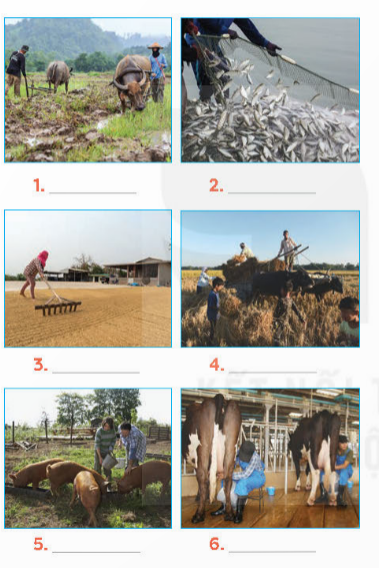
Answer:
| 1. ploughing fields | 2. catching fish | 3. drying rice |
| 4. unloading rice | 5. feeding pigs | 6. milking cows |
2. Choose the correct answer A, B, or C.
1. There is a huge cloud ______ as far as the eye can see.
A. surrounded
B. stretching
C. vast
2. People in my village are really _______; they are always generous and friendly to visitors.
A. well-trained
B. funny
C. hospitable
3. The development of cities destroys ____________ areas of countryside.
A. vast
B. much
C. stretching
4. The workers in our factory are very _______ because they took a lot of good training courses.
A. hospitable
B. kind
C. well-trained
5. The area around the village is famous for its ________ landscape.
A. picturesque
B. boring
C. Dull
Answer:
| 1. C | 2. C | 3. C | 4. C | 5. A |
1. There is a huge cloud stretching as far as the eye can see.
2. People in my village are really hospitable; they are always generous and friendly to visitors.
3. The development of cities destroys vast areas of countryside.
4. The workers in our factory are very well-trained because they took a lot of good training courses.
5. The area around the village is famous for its picturesque landscape.
GRAMMAR
3. Complete the sentences with the comparative forms of the adverbs in brackets.
1. Every morning Nick gets up ten minutes (early) ___________ than his sister.
2. I speak French (fluently) ____________ now than I did last year.
3. You'll find your way around the village (easily) ____________ if you have a good map.
4. It rained (heavily) ______________ today than it did yesterday.
5. If you work (hard) ______________ , you will do (well) ______________ in your exam.
Answer:
| 1. earlier | 2. more fluently | 3. easier | 4. heavier | 5. harder, better |
1. Every morning Nick gets up ten minutes earlier than his sister.
2. I speak French more fluently now than I did last year.
3. You'll find your way around the village more easily if you have a good map.
4. It rained more heavily today than it did yesterday.
5. If you work harder, you will do better in your exam.
4. Underline the mistakes in the sentences and correct them.
1. I run faster as my brother does.
2. People in the city seem to react quicklier to changes than those in the country.
3. We need to work more hardly, especially at exam time.
4. You must finish harvesting the rice the earlier this year than you did last year.
5. As they climbed more highly up the mountain, the air became cooler.
Answer:
1. as => than
Correction: I run faster than my brother does.
2. quicklier => more quickly / quicker
Correction: People in the city seem to react more quickly to changes than those in the country.
3. more hardly => harder
Correction: We need to work harder, especially at exam time.
4. the earlier => earlier
Correction: You must finish harvesting the rice earlier this year than you did last year.
5. more highly => higher
Correction: As they climbed higher up the mountain, the air became cooler.
PROJECT
My favourite village
Work in groups.
1. Search for a village in Viet Nam or a foreign country that you would like to visit.
Answer:
We went to Doi Tam, a village famous for its drum making techniques, in Ha Nam Province last month. The craft was first introduced to the village sometime in the 8th or 9th century. Today there are more than six hundred drum makers living in Doi Tam village.
I was amazed to see big drums in front of every house in the village. People say that it takes four workers three days to make a drum with a diameter of 1.5 metres. To make a drum, the craftsmen have to follow an eight-stage process. Stretching the drumhead is the most challenging stage since they have to carefully assess the sound it makes. The other steps do not require such high skills.
Nowadays, Doi Tam drums are not only famous in Viet Nam but are also sold to other countries such as Laos, Cambodia, Japan, and the USA.
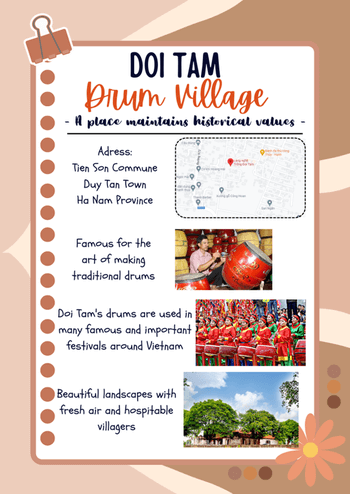
2. Design a poster about that village, including:
- name
- location
- scenery
- people and their activities
Answer:
3. Present your poster to the class.
Answer:
Today, I will introduce about Doi Tam Village, a village lying on the foot of Doi Mountain. This village has a traditional drum-making craft for over 1000 years, which has been recognized as “representative craft village”. Doi Tam Village helps maintain historical values, which have been in Vietnamese’s mind for a long time. The village is located at Tien Son Commune, Duy Tan Town, Ha Nam Province. Doi Tam village is famous for its traditional drum making techniques. Doi Tam’s drums has such great reputation that they are used in many important festival of the country. Additionally, the landscapes in the village are beautiful and the air is fresh. The villagers are kind and helpful too. I hope one day you can get the chance to visit this amazing village.
Tài liệu cùng môn học
Tài liệu khác
- Trắc nghiệm tiếng anh 2 Family and Friends
- Trắc nghiệm tiếng anh 2 Explore our world
- Trắc nghiệm tiếng anh 3 Family and Friends
- Trắc nghiệm tiếng anh 3 Explore our world
- Trắc nghiệm tiếng anh 4 Family and Friends
- Trắc nghiệm tiếng anh 4 Global Success
- Trắc nghiệm tiếng anh 4 Explore our world
- Trắc nghiệm tiếng anh 5 Family and Friends
- => Xem nhiều môn hơn