Giải tiếng anh 8 Global Success: Unit 4 Ethnic groups of Viet Nam
Hướng dẫn giải Tiếng anh 8 Global Success: Giải Unit 4 Ethnic groups of Viet Nam. Bài được giải chi tiết, rõ ràng, dễ hiểu. Bài giải giúp học sinh nắm vững kiến thức trong sách giáo khoa, rèn kĩ năng giải bài tập và có phương pháp học tập hiệu quả.
Nội dung chi tiết
GETTING STARTED
I’m from the Tay ethnic group
1. Listen and read
Tom: Hi, I’m Tom. You look new here.
Lai: I am. I'm Lai from Ha Giang.
Tom: Oh, I’ve heard about beautiful Ha Giang. Do you live in the mountains?
Lai: Yes, I do. I’m from the Tay ethnic group. We are the second largest ethnic group in Viet Nam, only after the Kinh.
Tom: Oh ... I once saw a bamboo house on high posts in a travel brochure. Do you live in a home like that?
Lai: Yes, we call it a “stilt house”. Our house overlooks terraced fields.
Tom: Awesome. What is life in your village like?
Lai: It’s peaceful. There are 16 houses in my village. We live very close to nature.
Tom: I love it. Can you tell me something about your culture?
Lai: Certainly. We have our own culture. You can see it in our folk dances, musical instruments like the dan tinh, and our special five-colour sticky rice.
Tom: It sounds interesting. I hope to visit Ha Giang one day.
2. Read the conversation again and circle the correct answers.
1. What are Tom and Lai talking about?
A. Minority groups in Viet Nam.
B. Ha Giang.
C. Life of the Tay people.
2. A “stilthouse” _______________.
A. is a multi-storey home
B. is on high posts
C. always faces a field
3. Lai mentions ___________ of the Tay people.
A. folk dances
B. popular festivals
C. costumes
Answer:
1. C (Tom and Lai are talking about life of the Tay people)
2. C (The text mentions “Lai: Yes, we call it a “stilt house”. Our house overlooks terraced fields.”)
3. A (The text mentions “You can see it in our folk dances, musical instruments like the dan tinh, and our special five-colour sticky rice.”)
3. Match the pictures with the word and phrases from the conversation
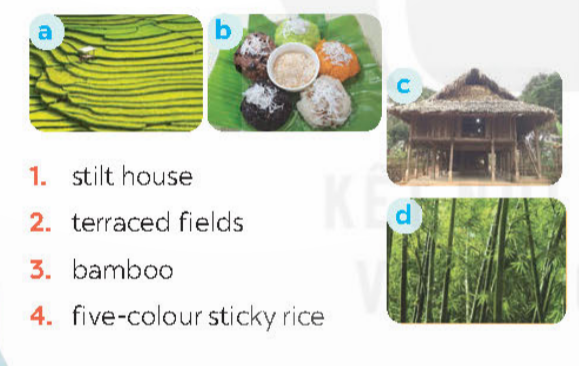 Answer:
| . c | 2. a | 3. d | 4. b |
Explanation
1. stilt house = nhà sàn
2. terraced fields = ruộng bậc thang
3. bamboo = tre
4. five-coloured sticky rice = xôi ngũ sắc
4. Complete the sentences with the words and phrases from the box
Overlooks Folk dance Musical instrument | Traditional Ethnic groups |
1. I love mua sap, a popular _________ of the Thai people.
2. Their beautiful stilt house _________ a large rice field.
3. A: What is the name of a popular Tay’s _________? - B: It’s dan tinh.
4. Every ethnic group has their own _________ culture.
5. Of the 54 _________ in Viet Nam, the Kinh is the largest.
Answer:
1.folk dance - I love mua sap, a popular folk dance of the Thai people.
2. overlooks - Their beautiful stilt house overlooks a large rice field.
3. musical instrument - A: What is the name of a popular Tay’s musical instrument? - B: It’s dan tinh.
4. traditional - Every ethnic group has their own traditional culture.
5. ethnic groups - Of the 54 ethnic groups in Viet Nam, the Kinh is the largest.
5. GAME. Where are they?
Work in groups. Discuss and label the map with the names of the ethnic groups from the box. The first team to get all the correct answers wins.
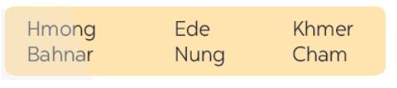
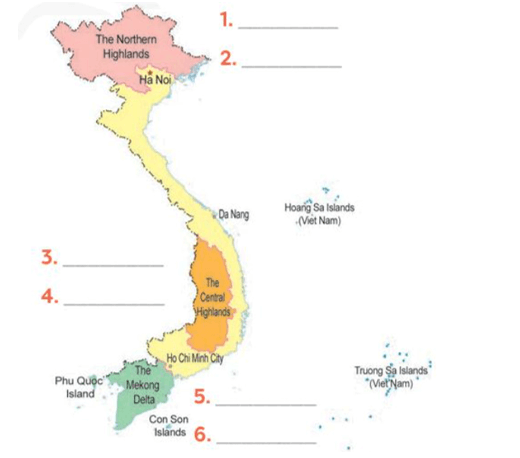
Answer:
1. Nung
2. Hmong
3. Cham
4. Ede
5. Bahnar
6. Khmer
A CLOSER LOOK 1
VOCABULARY
1. Write a word or phrase from the box under each picture
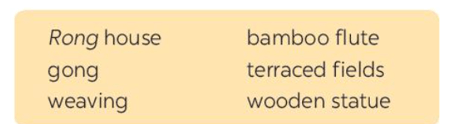
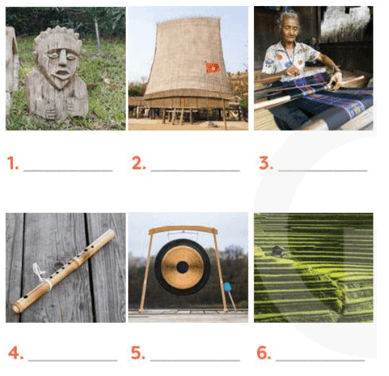
Answer:
| 1. wooden statue | 2. Rong house | 3. weaving |
| 4. bamboo flute | 5. gong | 6. terraced fields |
Explanation
1. wooden statue = tượng gỗ
2. Rong house = nhà Rông
3. weaving = dệt
4. bamboo flute = sáo trúc
5. gong = chiêng
6. terraced fields = ruộng bậc thang
2. Match the words and phrases with their meanings
|
|
|
|
|
|
|
|
|
|
Answer:
1 – c: A group smaller in size than other groups in the same country
2 – a: The animals we keep on a farm like cows and sheep
3 - e. Work like growing, watering, weeding and harvesting
4 – d: A traditional musical instrument
5 – b: A large room for community activities
3. Complete the sentences with the words and phrases from the box
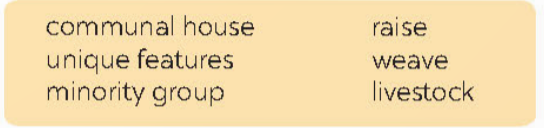
1. It’s interesting to learn about the ____________ of an ethnic group's traditional culture.
2. Most mountain girls know how to ____________ clothing.
3. The Cham in Ninh Thuan ____________ sheep and cows.
4. A ____________ is for community meetings and events.
5. There are fewer Nung than Kinh, so they are an ethnic _______________.
6. Children in both the lowlands and highlands help raise their family’s ________________.
Answer:
1. unique features - It’s interesting to learn about the unique features of an ethnic group's traditional culture.
2. weaving - Most mountain girls know how to weave clothing.
3. raise - The Cham in Ninh Thuan raise sheep and cows.
4. communal house - A communal house is for community meetings and events.
5. minority group - There are fewer Nung than Kinh, so they are an ethnic minority group.
6. livestock - Children in both the lowlands and highlands help raise their family’s livestock.
PRONUNCIATION
/k/ and /g/
1. Listen and repeat the words. Pay attention to the sounds /k/ and /g/
| /k/ | /g/ |
cultural communal musical folk overlook | gong garden gathering tiger pig |
2. Listen and repeat the sentences. Pay attention to the underlined words
1. The kitchen is for family gatherings.
2. Tigers and monkeys live in the forest.
3. I love five-colour sticky rice.
4. Yesterday, we harvested cucumbers from our garden.
5. Most girls know how to cook.
Answer:
1. The kitchen is for family gatherings.
2. Tigers and monkeys live in the forest.
3. I love five-colour sticky rice.
4. Yesterday, we harvested cucumbers from our garden.
5. Most girls know how to cook.
A CLOSER LOOK 2
GRAMMAR
Yes/No and Wh-questions
1. Change the sentences into Yes / No questions.
Example:
The farmers are harvesting their crops in the fields.
→ Are the farmers harvesting their crops in the fields?
1. Women play an important role in a Jrai family.
→_____________________________________________?
2. Mua sap is a popular folk dance of the Thai people.
→_____________________________________________?
3. We didn't have boarding schools for minority students in 1950.
→_____________________________________________?
4. I attended the Ban Flower Festival in Dien Bien last year.
→_____________________________________________?
5. We will watch a documentary about the Khmer.
→_____________________________________________?
Answer:
1. Are women play an important role in a Jrai family?
2. Is mua sap a popular folk dance of the Thai people?
3. Did you have boarding schools for minority students in 1950?
4. Did you attend the Ban Flower Festival in Dien Bien last year?
5. Will you watch a documentary about the Khmer?
2. Choose the correct question word for each question below
1. A: _______________ do you like best about Sa Pa? - B: I like its local markets best.
A. Why
B. What
2. A: _______________ can we find the most beautiful terraced fields? - B: In Mu Cang Chai.
A. When
B. Where
3. A: _______________ is the Ban Flower Festival? - B: It's in spring.
A. When
B. Why
4. A: _______________ tall is an average stilt house? - B: About 5 - 6 metres tall.
A. How
B. What
5. A: _______________ festival is more important for the King: the Mid - Autumn or the Lunar New Year? - B: The Lunar New Year.
A. What
B. Which
Answer:
| 1. B | 2. B | 3. A | 4. A | 5. B |
Explanation:
| Các từ để hỏi | Chức năng |
| What | Dùng để hỏi về thông tin |
| When | Dùng để hỏi về thời gian |
| Where | Dùng để hỏi về địa điểm |
| Who | Dùng để hỏi về người |
| Whom | Dùng để hỏi về người (làm tân ngữ trong câu) |
| Whose | Dùng để hỏi về sự sở hữu |
| Why | Dùng để hỏi lý do |
| How | Dùng để hỏi cách thức |
3. Write C (countable) or U (uncountable) for the underlined words.
Some minority (1) groups are farmers. They do not have much (2) land and they use simple farming techniques. After finding an (3) area for a garden, the men cut the (4) trees down and burn them. The (5) ash they collect helps enrich the soil. They then grow a few (6) crops like rice and corn.
Answer:
| 1. C | 2. U | 3. U | 4. C | 5. U | 6. U |
4. Fill in each blank with a, much, many, a little, or a few.
1. My uncle has _________ coffee plantation in Kon Tum.
2. How _________ ethnic groups live on the Hoang Lien Son mountain range?
3. There are only _________ waterwheels left in my village.
4. You should add _________ more water to your noodles. It's a bit dry.
5. How _________ information about the Van kieu have you collected?
Answer:
1. a- My uncle has a coffee plantation in Kon Tum.
2. many - How many ethnic groups live on the Hoang Lien Son mountain range?
3. a few - There are only a few water wheels left in my village.
4. a little - You should add a little more water to your noodles. It's a bit dry.
5. much - How much information about the Van Kieu have you collected?
5. GAME. Word games
Work in groups. Think of six nouns related to each of the topics below, in which three nouns are countable and three nouns are uncountable. The group that comes up with the correct six words first wins.
- Leisure time
- Living in the mountains
Answer:
- Leisure time
+ Countable: Book, Movie, Game
+ Uncountable: music, time, entertainment
- Living in the mountains
+ Countable: cabin, tree, animal
+ Uncountable: snow, air, nature
COMMUNICATION
Everyday English
Giving opinions
1. Listen and read the conversation. Pay attention to the highlighted parts.
Tom: What do you think about life in the mountains?
Trang: I think it’s very interesting. People in the mountains live close to nature.
Tom: What about you, Mai? What do you think?
Mai: To my way of thinking, there are better services in the city.
2. Work in pairs. Make a similar conversation to ask and give opinions about these topics
- Playing traditional games
2. Living close to nature
Answer:
1. Playing traditional games
Lan: What do you think about playing traditional games?
Linh: I think it's very interesting. Children always love playing traditional games.
Lan: What about you, Mai? What do you think?
Mai: I think playing traditional games will bring people together.
2. Living close to nature
Cuong: What do you think about living close to nature?
Chau: That sounds great. We can learn how to protect our planet.
Cuong: What about you, Dat? What do you think?
Dat: I think Cuong is right. Additionally, living close to nature will improve our mental health.
Lifestyle of the ethnic minority groups
3. QUIZ. How much do you know about ethnic groups in Viet Nam?
1. There are ____________ ethnic groups in Viet Nam.
A. 63
B. 45
C. 54
2. Ethnic minority groups form about ____________ of the total population of Viet Nam.
A. 7%
B. 13%
C. 25%
3. They mainly live ____________.
A. in the lowlands
B. in the mountains
C. in the Mekong Delta
4. The Jrai decorate houses for the dead with a lot of ____________.
A. wood statues
B. flowers
C. colourful pictures
5. The Khmer mostly earn their living from weaving and _____________.
A. farming
B. hunting
C. fishing
6. Picture ____________ shows a Thai woman's costume.
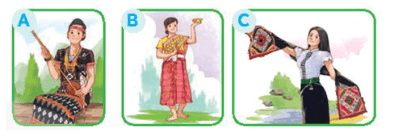
Answer:
| 1. C | 2. B | 3. B | 4. A | 5. A | 6. C |
4. Work in pairs. Read the information below about the Jrai. Take turns to ask and answer about the information.
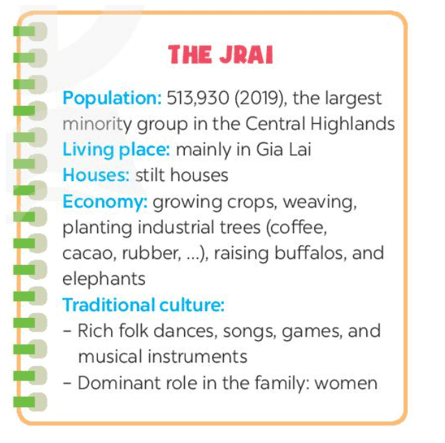
Answer:
Người JRAI
Dân số: 513.930 (2019), dân tộc thiểu số đông nhất Tây Nguyên
Nơi sống: chủ yếu ở Gia Lai
Nhà ở: nhà sàn
Kinh tế: trồng trọt, dệt vải, trồng cây công nghiệp (cà phê, ca cao, cao su,...), chăn nuôi trâu, voi
Văn hóa truyền thống:
Các điệu múa, bài hát, trò chơi và nhạc cụ dân gian phong phú
Vai trò chủ đạo trong gia đình: phụ nữ
5. Work in groups. Share with your group the information about the Jrai people you find interesting.
You may start sharing your opinion with:
I like _________ because _________
I think that _____________________
Answer:
I like the way they use bamboo trees to make the stilt house because it’s very environmentally friendly.
I think that women play the dominant role in the Jarai family is a radical thought.
SKILL 1
READING
1. Write the words and phrase from the box under the correct pictures
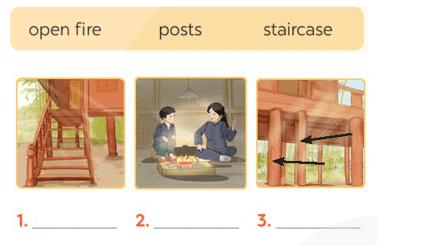
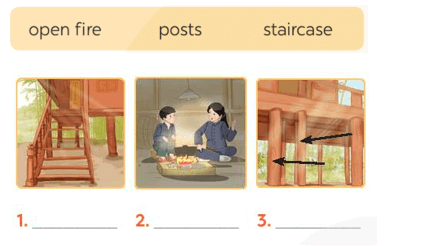
Answer:
1. staircase
2. open fire
3. posts
2. Read the passage and tick (V) T (True) or F (False)
Stilt houses
Stilt houses are popular among different ethnic minority groups, from the Thai in the Northern Highlands to the Khmer in the Mekong Delta. The houses come in different sizes and styles, and show the traditional culture of their owners.
Stilt houses are made from natural materials like wood, bamboo, and leaves. They stand on strong posts, about two or three metres above the ground. This allows them to keep people safe from wild animals. People climb a seven- or nine-step staircase to enter the house. The most important place in the house is the kitchen. It has an open fire in the middle of the house. It is the place for family gatherings and receiving guests.
The stilt houses of the Tay and Nung usually overlook a field. The stilt houses of the Thai, however, face mountains or a forest. The Bahnar and Ede have a communal house (called a Rong house) as the heart of their village. These communal houses are the largest and tallest ones in the village.
1. Only a few minority groups live in stilt houses.
2. All stilt houses look alike.
3. Family gatherings take place by the open fire in the middle of the house.
4. The Rong house serves as the center of an Ede village.
Answer:
| 1. F | 2. F | 3. T | 4. T |
Explanation
1. Information: Stilt houses are popular among different ethnic minority groups, from the Thai in the Northern Highlands to the Khmer in the Mekong Delta.
2. Information: The houses come in different sizes and styles, and show the traditional culture of their owners.
3. Information: It has an open fire in the middle of the house. It is the place for family gatherings and receiving guests.
4. Information: The Bahnar and Ede have a communal house (called a Rong house) as the heart of their village.
3. Read the passage again and fill in each blank with ONE word.
1. A stilt house shows the ____________ culture of the owner.
2. The Tay’s and Nung’s stilt houses overlook a ____________.
3. The Thai's stilt houses overlook a ____________ or ____________.
4. The largest and tallest house in an Ede village isthe ____________ house.
Answer:
- Traditional
- Field
- Mountain - forest
- communal
SPEAKING
4. Work in pairs. Discuss and tick (V) the features of a stilt house from the list below. Share your opinions with the class.
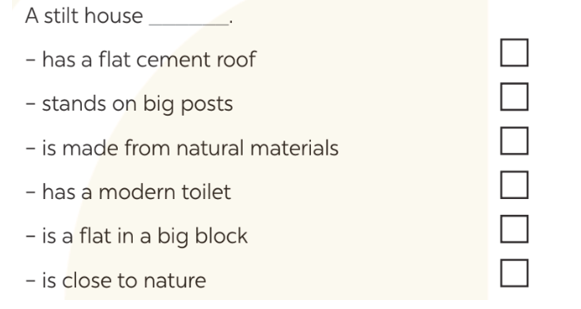
Answer:
A stilt house
- stands on big posts
- is made from natural materials
- is close to nature
5. Work in pairs. Ask and answer about the type of home each of you lives in. Take notes of your partner’s answers and report what you find to the class.
Answer:
Suggested questions:
- What type of home do you live in? (a flat, a house, a detached house, a stilt house, a farmhouse, a cottage, a tree house, ...)
- What materials is it made from?
- What is the most important part of your home? What do you do there?
| Name | Type of
| Material
| Important part of the house – Activity
|
| An | a flat
| brick and cement
| living room – watching TV with the family
|
| Bảo | a detached house
| brick and cement
| garden – where the family members relax and hold party
|
| Chi | stilt house
| woods, bamboo tree, leaves
| kitchen – place for family gathering and receiving guest
|
| Dung | a flat
| brick and cement
| living room – receiving guest
|
SKILL 2
LISTENING
1. Match the phrases with the correct pictures.
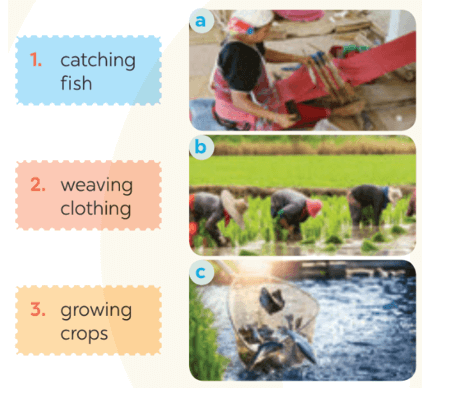
Answer:
| 1. c | 2. a | 3. b |
2. Listen and tick (V) the activities that minority children do to help their families.
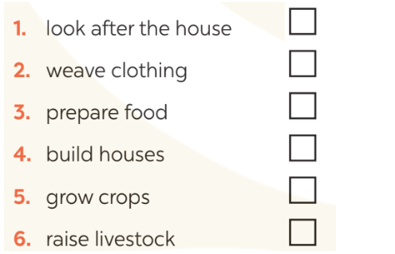
Answer:
1 - 2 - 3 - 5 - 6
Transcript:
Ethnic minority Children might live a life different from that of most Ken's Children. They spend some of their time helping their parents inside and outside the house. They learn to work from an early age, usually at six. Girls help look after the house, care for smaller children, weave clothing and prepare food. Boys learn to do what their fathers do. They grow crops, raise the family's livestock and catch fish. In the evening, the family often gathers around the open fire. Children listen to stories or legends of heroes from their grandparents. They also listen to adults talk about their work. This is how the elders pass on traditions and knowledge to their Children. Nowadays, more and more minority Children are going to school. There, they meet Children from other ethnic groups. They play new games and learn new things.
3. Listen again and circle the correct answer A, B, or C.
1. Minority children usually learn to work at _______________.
A. twelve
B. ten
C. six
2. Girls _______________.
A. weave clothing
B. do the gardening
C. catch fish
3. Boys _______________.
A. prepare food
B. raise livestock
C. do housework
4. Children learn traditions through _______________
A. work
B. music
C. stories
5. The number of minority children going to school is _______________.
A. going up
B. going down
C. staying the same
Answer:
| 1. C | 2. A | 3. B | 4. C | 5. A |
WRITING
4. Note five things you do to help your family.
Answer:
- Throw away your garbage.
- Dust the room.
- Make your bed.
- Pick up books and toys.
- Ask other family members if they need help.
5. Write a paragraph (80 - 100 words) about the things you do to help your family. Use the ideas in 4.
Answer:
To help my family, I do several chores at home every day. I often wash the dishes after meals and sweep the floor to keep the house clean. On weekends, I help my mother cook and go to the market with her to buy food. Sometimes, I take care of my younger brother by helping him with his homework or playing with him. Doing these things not only supports my parents but also makes me feel responsible and helpful. I enjoy helping because it brings my family closer together.
LOOKING BACK
VOCABULARY
1. Match the words and phrases with the pictures.
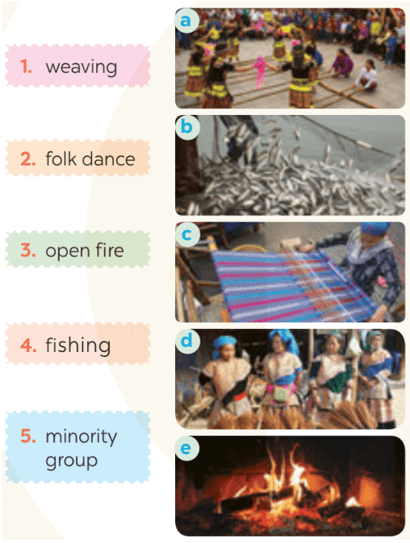
Answer:
| 1. c | 2. a | 3. e | 4. b | 5. d |
2. Complete the sentences with the word and phrases from the box
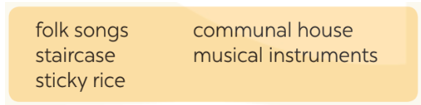
1. Minority groups have their own ____________ like the dan tinh, gong, t’rung.
2. The Kinh use ____________ to make banh chung and banh tet.
3. For most minority groups like the Bahnar and Ede, the _______________, usually known as Rong house, is the heart of the village.
4. My grandmother taught me to sing many _______________.
5. The _____________ of a Muong’s stilt house has an odd number of steps: 5, 7, or 9
Answer:
1. musical instruments - Minority groups have their own musical instruments like the dan tinh, gong, t’rung.
2.sticky rice - The Kinh use sticky rice to make banh chung and banh tet.
3. communal house - For most minority groups like the Bahnar and Ede, the communal house, usually known as Rong house, is the heart of the village.
4. folk songs - My grandmother taught me to sing many folk songs.
5. staircase - The staircase of a Muong’s stilt house has an odd number of steps: 5, 7, or 9.
GRAMMAR
3. Write questions from the clues
1. you / attend / the Khmer’s Moon Worship Festival / last year / ?
2. How many / ethnic minority groups / Viet Nam / ?
3. Where / the Hmong / live / ?
4. What / you / do / the Ede’s Harvest Festival / last October / ?
5. How old / minority children / when / they / start helping / the family / ?
Answer:
1. Did you attend the Khmer's Moon Worship Festival last year?
2. How many ethnic minority groups in Viet Nam?
3. Where is the Hmong live?
4. What did you do in the Ede's Harvest Festival last October?
5. How old the minority children when they start helping the family?
4. There is one incorrect underlined word in each sentence. Circle and correct it
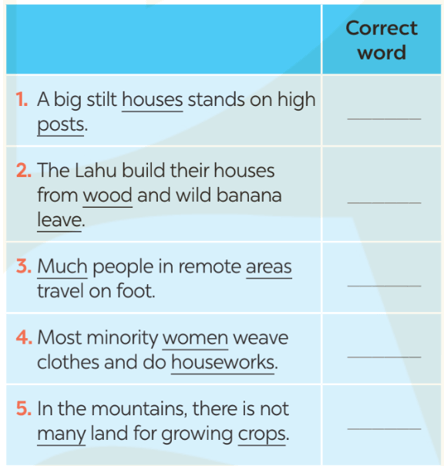
Answer:
| 1. houses => house | 2. leave => leaves | 3. much => many |
| 4. houseworks => housework | 5. many => much |
PROJECT
Our ethnic groups
Work in groups.
1. Choose an ethnic group in Viet Nam you are most interested in.
Answer:
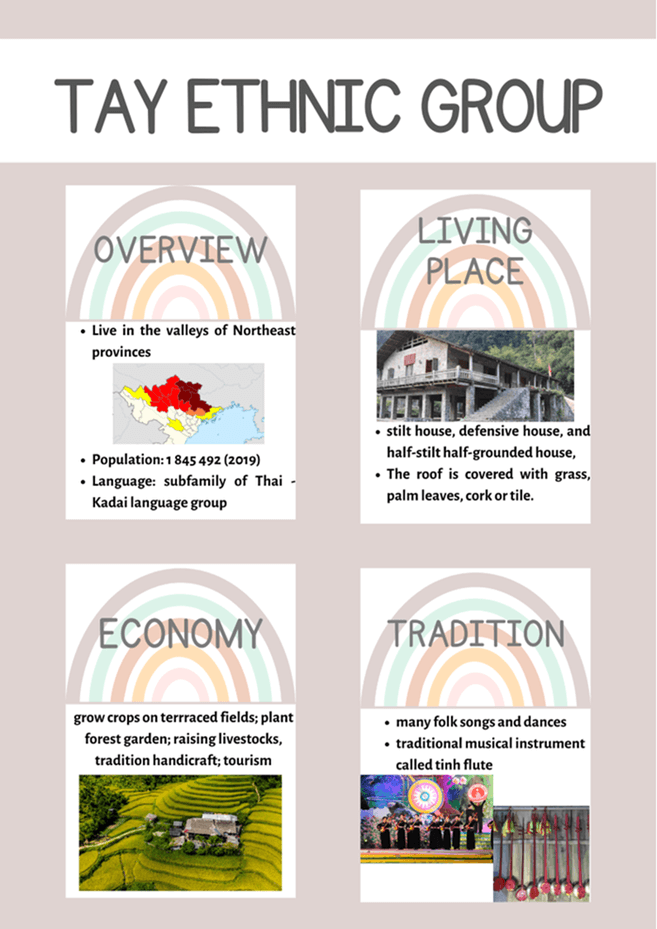
The Tay people
2. Do a little research about it, focusing on its:
- living place (homes or villages)
- economy
- traditional culture
Answer:
History: The Tay people were present in Vietnam very early, from the end of the first millennium BC and were one of the first owners of ancient Vietnam.
Population: According to the census on the 53 ethnic minorities as announced on April 1, 2019, the total population of the Tay ethnic group is 1,845,492.
Language: The Tay language is a subfamily of the Tai-Kadai language group.
Housing: Traditional houses of the Tay people include three basic types: houses on stilts, half-stilt houses and half-ground houses and defensive houses. In particular, the house on stilts is the most popular traditional type of house. The roof is covered with grass, palm leaves, cork or tile.
Economic conditions:
+ exploited the valleys and hills of their habitation into fields and fertile terraces, into forest gardens with palm, anise, and green fruit trees.
+ know how to diversify their crop structure, combining traditional farming techniques such as intercropping, crop rotation, the use of microbiological and chemical fertilizers, developing livestock with many types of cattle and poultry. The Tay people have many handicrafts such as knitting, weaving, dyeing indigo, making tiles, and woodworking.
Art: The Tay people have many folk songs such as luon, then, quan lang, vi singing, lullaby, and folk songs.
3. Make a poster
Answer:
4. Present your poster to the class
Answer:
Today, my group will introduce the Tay people, an ethnic group which has been present for over three millennia in Vietnam. The Tay people mostly live in valleys of Northern provinces like Quang Ninh, Bac Giang, Lang Son, Cao Bang, Bac Kan, Thai Nguyen, Ha Giang, Tuyen Quang to Lao Cai and Yen Bai. According to the census on the 53 ethnic minorities as announced on April 1, 2019, the total population of the Tay ethnic group is 1,845,492. The Tay people speak the subfamily of Thai-Kadai people.
Tay people live in three kinds of houses: houses on stilts, half-stilt houses and half-ground houses and defensive houses. But houses on stilt is the most common one. And the roof is covered with grass, palm leaves, cork or tile so it’s environmentally friendly.
To earn a living, they exploited the valleys and hills to make fields for crops and forest gardens to grow palm anise, and fruit trees. They also raise cattle and poultry and have many handicrafts such as knitting, weaving, dyeing indigo, making tiles, and woodworking.
Tay people have many folk songs such as luon, then, quan lang, vi singing, lullaby, and folk songs. They also have folk dance like then and traditional musical instruments like dan tinh.
Tài liệu cùng môn học
Tài liệu khác
- Trắc nghiệm tiếng anh 2 Family and Friends
- Trắc nghiệm tiếng anh 2 Explore our world
- Trắc nghiệm tiếng anh 3 Family and Friends
- Trắc nghiệm tiếng anh 3 Explore our world
- Trắc nghiệm tiếng anh 4 Family and Friends
- Trắc nghiệm tiếng anh 4 Global Success
- Trắc nghiệm tiếng anh 4 Explore our world
- Trắc nghiệm tiếng anh 5 Family and Friends
- => Xem nhiều môn hơn