Giải tiếng anh 8 Global Success: Unit 5 Our customs and traditions
Hướng dẫn giải Tiếng anh 8 Global Success: Giải Unit 5 Our customs and traditions. Bài được giải chi tiết, rõ ràng, dễ hiểu. Bài giải giúp học sinh nắm vững kiến thức trong sách giáo khoa, rèn kĩ năng giải bài tập và có phương pháp học tập hiệu quả.
Nội dung chi tiết
GETTING STARTED
Tet is coming
1. Listen and read
Elena: Wow, this girl looks so cute.
Trang: Yeah ... She’s my cousin. She's at Sa Dec Flower Village. Tet is coming soon, so many people visit flower villages to take pictures with the blooming flowers.
Elena: Oh, I'm fond of admiring the flowers. Does your family visit places like this too?
Trang: Yes, we do. We usually visit Nhat Tan Village to buy kumquat trees and peach blossoms.
Elena: I see flowers and ornamental trees everywhere these days. What are they for?
Trang: We, Vietnamese, use plants and flowers for decorations and for offerings. They are an important part of our Tet tradition.
Elena: And what's that tall tree in the photo?
Trang: Well, it's actually a bamboo pole. People place it in the yard of the communal house. They hang decorative items like small bells and lanterns on it. They want to chase away bad luck and pray for a lucky new year.
Elena: Interesting! I didn’t know that.
2. Read the conversation again and tick (v) T (True) or F (False)
| T | F | |
| 1. Elena and Trang are at Sa Dec Flower Village. | ||
| 2. Many people visit flower villages to take photos. | ||
| 3. Trang’s family usually buys kumquat trees and peach blossoms at Nhat Tan Village. | ||
| 4. Flowers are not part of any Vietnamese traditions. | ||
| 5. People decorate bamboo poles with small bells and lanterns for New Years. |
Answer:
1. F (The text mentions Trang: Yeah ... She’s my cousin. She's at Sa Dec Flower Village.)
2. T
3. T (The text mentions Trang: … We usually visit Nhat Tan Village to buy kumquat trees and peach blossoms.)
4. F (The text mentions We, Vietnamese, use plants and flowers for decorations and for offerings. They are an important part of our Tet tradition.)
5. T (The text mentions Trang: Well, it's actually a bamboo pole. People place it in the yard of the communal house. They hang decorative items like small bells and lanterns on it.)
3. Match the phrases with the correct pictures
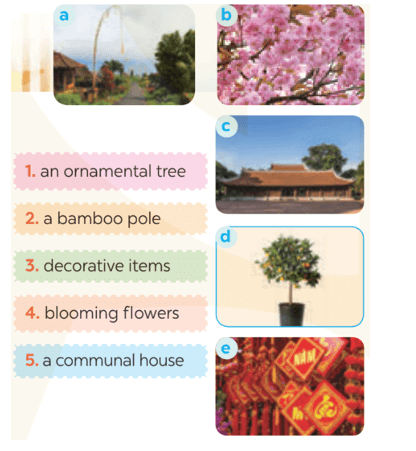
Answer:
| 1. d | 2. a | 3. e | 4. b | 5. c |
Explanation:
1. an ornamental tree (n) cây cảnh
2. a bamboo pole (n)
3. decorative items (n) đồ trang trí
4. blooming flowers (n) hoa nở
5. a communal house (n) đình làng, nhà Rông
4. Complete the sentences with the verbs from the box
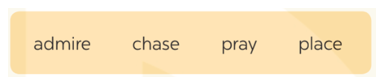
1. The British decorate their Christmas trees and _________ presents under them.
2. Tomi likes to _________ the view from the hill.
3. In many cultures, knocking on wood is a way to _________ away bad spirits.
4. Many Asians go to Buddhist temples to _________ for good luck.
Answer:
1. place - The British decorate their Christmas trees and place presents under them.
2. admire - Tomi likes to admire the view from the hill.
3. chase- In many cultures, knocking on wood is a way to chase away bad spirits.
4. pray - Many Asians go to Buddhist temples to pray for good luck.
5. QUIZ. New Years around the world
People around the world celebrate New Years differently. Choose the country with each tradition below.
1. Visiting pagodas
A. The US
B. Viet Nam
2. Throwing water at each other
A. Thailand
B. Japan
3. Ringing a bell 108 times
A. Japan
B. Viet Nam
4. Giving and receiving lucky money
A. The US
B. Viet Nam
5. Watching a ball drop at midnight in Times Square
A. Thailand
B. The US
Answer:
| B | 2. A | 3. A | 4. B | 5. B |
A CLOSER LOOK 1
VOCABULARY
1. Write a phrase from the box under each picture
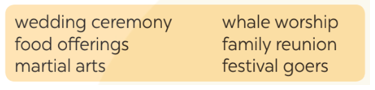
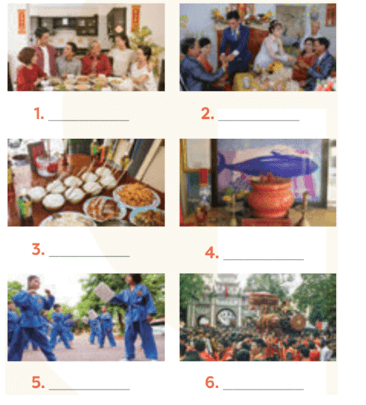
Answer:
| 1. family reunion | 2. wedding ceremony | 3. food offerings |
| 4. whale worship | 5. martial arts | 6. festival goers |
Explanation
1. Family reunion (n) sum họp gia đình
2. Wedding ceremony (n) lễ cưới
3. Food offerings (n) đồ thờ
4. Whale worship (n) tục thờ cá Ông
5. Marital art (n) võ thuật
6. Festival goers (n) người đi hội
2. Complete each sentence with the correct option A, B, or C.
. We have a tradition of holding a family _________ on the first day of Tet.
A. reunion
B. work
C. meal
2. It’s a tradition for shops to have a lion dance performance at their opening _________.
A. worship
B. celebration
C. ceremony
3. The tradition of _________ whales is popular in Vietnamese coastal villages.
A. admiring
B. worshipping
C. praying
4. She broke with family tradition by not practising _________.
A. acrobat
B. martial arts
C. offering
5. Traditionally, the Vietnamese prepare _________ to worship their ancestors during Tet.
A. offerings
B. decoration
C. worshipping
Answer:
| 1. A | 2. C | 3. B | 4. B | 5. A |
3. Complete the sentences with the words from the box
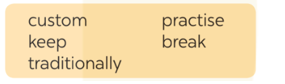
1. This year, we will _________ with tradition and go on holiday instead of staying at home during Tet.
2. _________ children in the US go from house to house to ask for sweets on Halloween.
3. Holding a party to wish our grandparents longevity is one of the customs we ________ at Tet.
4. Organising a folk song club is one way for us to _________ our traditions alive.
5. It's becoming a _________ for young people to celebrate New Years in addition to Tet.
Answer:
1. break - This year, we will break with tradition and go on holiday instead of staying at home during Tet.
2. Traditionally - Traditionally, children in the US go from house to house to ask for sweets on Halloween.
3. keep - Holding a party to wish our grandparents longevity is one of the customs we keep at Tet.
4. practise - Organising a folk song club is one way for us to practise our traditions alive.
5.custom - It's becoming a custom for young people to celebrate New Years in addition to Tet.
PRONUNCIATION
/n/ and /η/
4. Listen and repeat the words. Pay attention to the sounds /n/ and /η/
| /n/ | /η/ |
Thin Land Ceremony Longevity tradition | Thing Thank Single Language offering |
5. Listen and practise the sentences. Underline the words with the sound /n/ and circle the words with the sound /η/
1. Mary wore a pink dress last night.
2. I think we should buy this ornamental tree.
3. He thanked the host for the enjoyable party.
4. My mum made the spring rolls for the longevity party.
5. I will bring some food to the party on Saturday..
Answer:
/n/: night; ornamental; enjoyable; longevity; on
/η/: pink; think; thank; spring; bring
A CLOSER LOOK 2
GRAMMAR
1. Choose the correct option in each sentence below
1. It takes more than a / an hour to drive to Can Tho.
2. It’s a / 0 tradition for children to wake up early on Christmas Day.
3. The Ok Om Bok Festival takes place in the / 0 October.
4. We went to Can Tho by an / 0 air.
5. A: Where’s a / the book? - B: I thought you left it next to the TV.
Answer:
| 1. an | 2. a | 3. 0 | 4. 0 | 5. the |
Explanation:
- “a” thường đứng trước danh từ đếm được số ít, bắt đầu bằng một phụ âm.
- “an” thường đứng trước danh từ đếm được số ít bắt đầu bằng nguyên âm (e, u, i, o, a) hoặc âm “h” câm.
- “the” thường đứng trước danh từ khi:
+ vật thể hay nhóm vật thể là duy nhất hoặc được xem là duy nhất
+ danh từ này vừa được đề cập trước đó
+ danh từ này được xác bằng 1 cụm từ hoặc 1 mệnh đề
+ đặt trước một danh từ chỉ một đồ vật riêng biệt mà người nói và người nghe đều hiểu
+ trước so sánh nhất (đứng trước first, second, only..) khi các từ này được dùng như tính từ hoặc đại từ
- Không dùng mạo từ khi:
+ danh từ không đếm được hoặc trừu tượng
+ đưa ra tuyên bố chung chung
+ mô tả các hình thức vận tải chung
2. Which of the underlined parts in each question is incorrect? Find and correct it
1. The worshipping Kitchen Gods is a long-time tradition of the
A B C
Vietnamese.
2. People organise the worshipping ceremony at noon so that a Kitchen
A B C
Gods can leave for Heaven at 12 o'clock. Gods car
3. Most families in the Viet Nam prepare offerings for the Kitchen Gods
A B C
4. The offerings include a set of flowers and fruits, a paper clothes, and
A B C
three carps.
5. The Vietnamese people believe that the Kitchen Gods go to Heaven
A B
on carps.
C
Answer:
| 1. C => 0 | 2. C => 0 | 3. B => 0 | 4. C => 0 | 5. A => 0 |
Explanation
- “a” thường đứng trước danh từ đếm được số ít, bắt đầu bằng một phụ âm.
- “an” thường đứng trước danh từ đếm được số ít bắt đầu bằng nguyên âm (e, u, i, o, a) hoặc âm “h” câm.
- “the” thường đứng trước danh từ khi:
+ vật thể hay nhóm vật thể là duy nhất hoặc được xem là duy nhất
+ danh từ này vừa được đề cập trước đó
+ danh từ này được xác bằng 1 cụm từ hoặc 1 mệnh đề
+ đặt trước một danh từ chỉ một đồ vật riêng biệt mà người nói và người nghe đều hiểu
+ trước so sánh nhất (đứng trước first, second, only..) khi các từ này được dùng như tính từ hoặc đại từ
- Không dùng mạo từ khi:
+ danh từ không đếm được hoặc trừu tượng
+ đưa ra tuyên bố chung chung
+ mô tả các hình thức vận tải chung
3. Complete the sentences with a, an, the, or 0 (zero article)
1. It is a custom in my family to have ___ breakfast at home on Sundays.
2. When visiting a family home in some countries, you should bring ___ small gift with you.
3. Our village festival is held on the 10th of ___ January.
4. Ancient Egyptians worshipped ___ Sun.
5. Many people think that hard work is ___ important Vietnamese value.
Answer:
| 1. 0 | 2. a | 3. 0 | 4. the | 5. an |
Explanation
1. have breakfast = ăn sáng
2. “a” thường đứng trước danh từ đếm được số ít, bắt đầu bằng một phụ âm (s)
3. trước tháng trong năm không dùng mạo từ
4. “the” đứng trước danh từ là duy nhất hoặc được xem là duy nhất
5. “an” thường đứng trước danh từ đếm được số ít bắt đầu bằng nguyên âm (i)
4. Complete the text with the or 0 (zero article)
A recent study in (1) ___ UK shows that family time traditions are good for (2) ___ teens. These traditions include family members playing card games, watching their favourite TV programmes, or performing (3) ___ karaoke shows at weekends with one another. These activities often lead to lots of laughter and (4) ___ fun conversations. By taking part in such activities, teens strengthen (5) ___ bonds with their family.
Answer:
| 1. the | 2. 0 | 3. 0 | 4. 0 | 5. the |
5. GAME Bingo! Work in groups.
1. Read the sentences that the teacher gives you.
2. Identify the mistake with article(s) in each sentence.
3. Correct the mistakes.
4. Say Bingo! as soon as your group finishes.
5. The first group to come up with all the correct answers wins.
Answer:
- Could you come here for a minute when you are available?
- Emma said she wants to eat vegetables in dinner, not a meal with meat in it.
- Dad promised me to tell an interesting story before bedtime.
- It would be better if you give me an ice cube for this drink.
- Could you please pass me the remote? The series I watch will start soon.
- I loved the book you gave me. Even though it is a very long story, I finished it in a night.
- My mom has just cleaned the carpet. Please be careful with that juice.
- Joseph adores the view he sees from the window of his apartment. There is no way that he will move somewhere else.
COMMUNICATION
Everyday English
Giving advice
1. Listen and read the conversation below. Pay attention to the highlighted parts
Tom: My parents are taking me to their friend’s house for dinner. Could you tell me a bit about Vietnamese table manners?
Mai: Well, perhaps you should wait for the host to start eating.
Tom: I will.
Mai: It’s a good idea to hand bowls with both hands.
Tom: Sure. I'll remember that one.
Mai: And don't hit the bowl with your chopsticks. This may bring bad luck to the host family.
2. Work in pairs. Make similar conversations with the following situations
1. Student A is travelling to Sa Pa in winter. He / She doesn't know what to wear. Student B gives advice.
2. Student A is going to a birthday party. He / She doesn't know what kind of gift to bring. Student B gives advice.
Answer:
1.
A: My family are going to travel to Sapa in this winter. But I don't know what to wear. Can you give me some advice?
B: Sure. The temperature in Sapa is very cold. You should bring winter clothing.
A: Can you suggest me a list of winter clothing? I don't want to get freeze in there.
B: You can bring beanies, sweaters, gloves, scarf, socks, jeans, jacket, boots,...
A: Oh. Anything else?
B: I think you should prepare a raincoat or an umbrella. It will be snowing.
A: I got it. Thank you so much.
2.
Linh: Tomorrow is Mi's birthday. I don't know what kind of gift I should bring. Any ideas B?
Giang: I see that Mi is keen on playing sports. Why don't you give her trainers?
Linh: Such a good idea. Do you know what colours does she like?
Giang: Black and white I think.
Linh: Amazing. Thank you, Giang. I own you this time.
The Japanese lion dance and Vietnamese unicorn dance
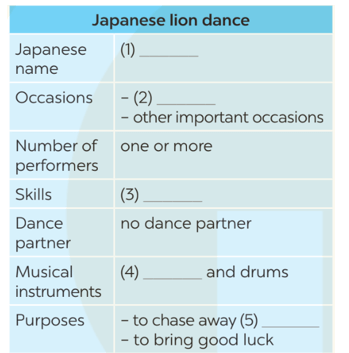
3. Read the text about the lion dance in Japan and complete the table with the information from the text
The lion dance is called shishi-mai in Japanese. People perform it during New Year celebrations. Shishi-mai groups also perform at other important occasions such as business openings and weddings. Most forms of shishi-mai have one or more people performing the dance. The performers are excellent at acrobatics. One person controls the lion’s head and the other moves the lion’s body. The lion dances to the sounds of flutes and drums. The drummers and flute players often follow the lion around, but they do not dance with it.
The Japanese perform shishi-maito chase away bad spirits and to bring good luck.
Answer:
1. Shishi - mai
2. New Year celebrations
3. controls the lion's head and moves the lion's body
4. flutes and drums
5. bad spirits
4. Work in groups. Read Mai’s notes on the Vietnamese unicorn dance. Compare the Vietnamese unicorn dance with the Japanese lion dance
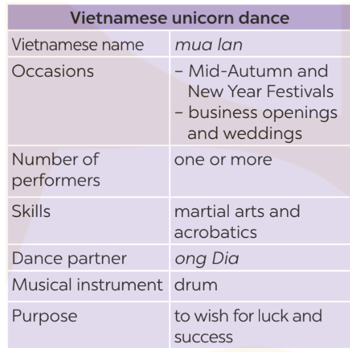
Example:
The Vietnamese unicorn dance and the Japanese lion dance are both popular on New Year Festivals.
Answer:
The Vietnamese unicorn dance and the Japanese lion dance are both popular on New Year Festivals.
The Vietnamese unicorn dance is also performed during the Mid-Autumn Festival, while the Japanese lion dance is mainly seen at the beginning of the year.
Both dances are believed to bring good luck and drive away bad spirits.
The Vietnamese unicorn dance often features a dance partner called Ông Địa, but the Japanese lion dance has no partner.
In Vietnam, the unicorn dancers need martial arts skills, while in Japan, lion dancers focus on acrobatics.
The Vietnamese dance uses drums, while the Japanese version uses both drums and flutes.
One or more people can perform the unicorn dance in Vietnam, just like the Japanese lion dance.
SKILL 1
READING
1. Work in pairs. Look at the pictures and answer the following questions
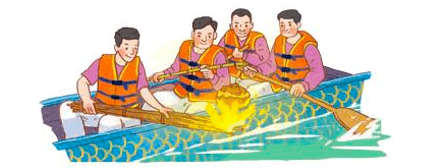
1. What are the men doing?
2. When do you think this event occur?
Answer:
1. Farmers exam cooking rice on boat at Bach Hao Pagoda Festival in Hai Duong Province, Vietnam.
2. Bach Hao Pagoda Festival is held on the 5th and 6th of the first lunar month every year.
2. Read the text. Choose the correct answer A, B or C
A village festival day
I live in a small village in northern Viet Nam. Every year, people in my village look forward to the third day of Tet. It is one of our most important festival days.
In the morning, we gather along the riverside to watch some competitions. First, there is a special boat race. Some team members cook rice on the boat while others row the boat as fast as they can. The fastest team with well-cooked rice wins the race. Then, the referee releases a duck into the middle of the river. Contestants jump into the river to catch it. The atmosphere becomes loud with the sound of drums and cheers of festival goers.
At noon, there is a village party at the communal house for the elders. Each family also holds a home party. We cook traditional dishes like sticky rice and steamed chicken. Sometimes, we include food that children love, such as bun cha or even pizzas!
The village festival helps us maintain our traditions, connect with other people, and strengthen our family bonds.
1. What is the text mainly about?
A. A local tradition.
B. A family tradition.
C. A cooking contest.
2. To win the boat race, a team must
A. row the boat more quickly than the other teams
B. be the fastest boat and properly cook the rice
C. cook rice properly and catch the duck
3. The phrase “releases a duck” in the text means
A. gives it freedom
B. catches it
C. takes it home
4. Why is the festival important?
A. Because it is exciting.
B. Because people win valuable prizes.
C. Because it keeps some village traditions alive.
Answer:
| 1. A | 2. B | 3. A | 4. C |
Explanation:
1. The text talks about a local tradition
2. The text mentions “The fastest team with well-cooked rice wins the race.”
releases a duck = thả một con vịt
4. The text mentions “The village festival helps us maintain our traditions, connect with other people, and strengthen our family bonds.”
3. Read the text again. Complete the mind map about a family party.
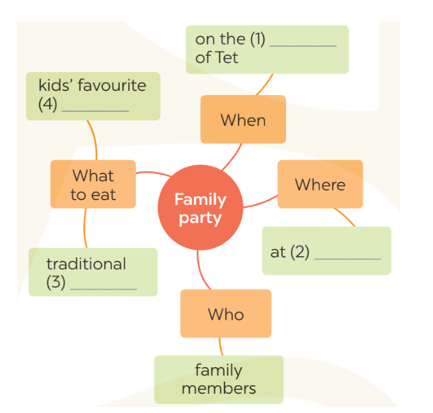
Answer:
Family party:
- Who: Family members
- When: on the (1) third day of Tet
- Where: at (2) communal house
- What to eat: traditional (3) dishes (sticky rice and steamed chicken) / kid's favourite (4) food (bun cha or pizzas)
SPEAKING
4. Work in pairs. Put the questions (A - E) in the correct blanks (1- 5) to make a complete dialogue. Then role-play it
Nick: (1) ____________________________
Lan: Well, I join birthday parties of all my family members.
Nick: (2) ____________________________
Lan: In a Vietnamese restaurant. But sometimes we break with tradition by going to a Western one.
Nick: (3) ____________________________
Lan: Everyone in my family.
Nick: (4) ____________________________
Lan: Well, the birthday person opens the gifts. And everyone has some good food.
Nick: (5) ____________________________
Lan: Yes, I always look forward to them. They are a great time for family bonding.
Answer:
| 1. B | 2. D | 3. E | 4. A | 5. C |
5. Make notes about a normal family event that you take part in. Use the questions below as cues
- What is the event?
- Where and when does it happen?
- Who joins with you?
- What do you often do at that event?
- Do you like it or not? Why or why not?
Answer:
1. What is the event?
The event is a birthday party.
2. Where and when does it happen?
It happened on one of my family member's birthdays. It helds in my house.
3. Who joins you?
My family members joined me.
4. What do you often do at that event?
I always buy a birthday cake.
5. Do you like it or not? Why or why not?
Yes, I like it a lot. Because it's an opportunity to bring everyone together.
Now work in pairs. Make a dialogue asking and answering about the event. You can use your notes.
Answer
An: Bao, what family event do you often take part in?
Bao: It’s the family reunion party at the end of the year.
An: Where do you hold these parties?
Bao: It holds in my grandparents’ house.
An: Who joins you at these parties?
Bao: Every family member gathers at my grandparent’s house.
An: And what do you do at parties?
Bao: We have lots of good food and each other tells what happened to them in a year.
An: Do you like these parties?
Bao: Yes, I always look forward to them. They are a great time for family bonding.
SKILL 2
LISTENING
1. Work in pairs. Look at the photos and answer the following questions.
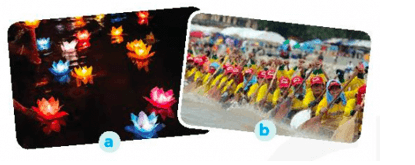
1. What can you see in the photos?
2. In which part of Vietnam might the festival occur?
Answer:
1. In picture a, I see it's a Flower garlands and coloured lanterns festival. In picture b, I see it's a boat racing festival.
2. In the Central region of Vietnam the festival might occur.
2. Listen to part of the programme “Charming Viet Nam”. Fill in each blank with no more than TWO words.
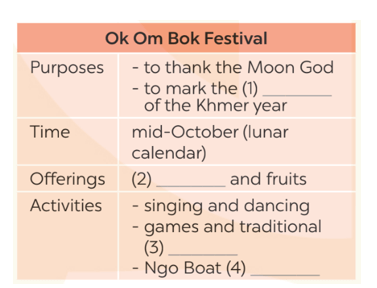
Answer:
| 1. end | 2. young rice | 3. fashion shows | 4. Race |
Transcript
Let’s go to the Mekong Delta enjoying the Ooc-om-bok Festival of the Khmer people. It is also called the moon worshiping festival. Traditionally, the Khmer use the festival to thank the Moon God for giving them a good harvest. It also marks the end of the year of the Khmer calendar. Ooc-om-bok occurs in mid October, according to the lunar calendar. When the Moon is at its highest position, the monks and the elders offer young rice and fruits to the moon God. Then they take some young rice to feed children and ask them about their wishes. People sing and dance in the moonlight. Visitors can participate in games, watch traditional fashion shows, and see flying lantern contests. The next day, villagers organize the race. This is a boat race that attracts many tourists. Here is some advice to tourists at the Ooc-om-bok Festival. They should not wear shorts or sleeveless shirts when attending the religious ceremony. And don't litter the temple grounds. And now, let's …
3. Listen again and tick (v) T (True) or F (False)
1. Ok Om Bok is the Moon Worshipping Festival.
2. On the night of the festival, the elders talk about their wishes.
3. There are lantern contests at the festival.
4. Tourists should wear informal clothes when attending the worshipping ceremony.
Answer:
| 1. T | 2. F | 3. T | 4. F |
WRITING
4. Work in groups. Read the following pieces of advice for tourists at the Ok Om Bok Festival. Put them in the correct column
a. dress up for the Moon God offering ceremony
b. keep quiet when the monks and the elders are talking
c. climb on the animal statues in the temple ground
d. show respect to the monks and the elders
e. refuse young rice when the elders offer it to you
f. litter the temple ground
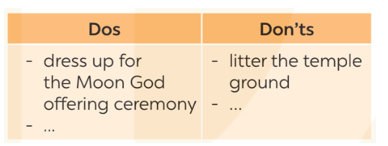
Answer:
| Dos | Don’ts |
- Dress up for the Moon God offering ceremony. - Keep quiet when the monks and the elders are talking. - Show respect to the monks and the elders. | - Climb on the animal statues in the temple ground. - Refuse young rice when the elders offer it to you. - Litter the temple ground. |
5. Tom sent you an email. Read part of his email below.
“... Guess what! My dad is taking me with him to Soc Trang Province. We will be there during the Ok Om Bok Festival. What are some dos and don'ts at this festival? ...”
Write an email (80 - 100 words) to advise Tom about participating in the Ok Om Bok Festival
Answer:
Dear Tom,
I'm happy to hear that you are going to join the Ok Om Bok Festival in Soc Trang Province. Here, I have some advice for you to dos and don'ts at that festival. First, I think you should wear trainers or shoes and comfortable clothes because maybe you must be walk a lot. And then, remember to bring some bottle of water, it will be hot in Soc Trang so you will get thirsty. Also, I should remind you that you must not to litter on the ground or run away from your father.
I hope you will have a great time with your dad and enjoy the festival.
Best wishes,
Linh
LOOKING BACK
VOCABULARY
1. Choose the correct option to complete each sentence below
1. It is becoming a _____ for many families in Viet Nam to celebrate Women's Day and Family Day.
A. habit
B. custom
2. _____, we hold the Spring Festival on the 15th of January in lunar calendar.
A. Traditionally
B. In the past
3. Janet is from a family of doctors, but she broke with _____ when she went to an art college.
A. tradition
B. habit
4. Having dinner at my grandparents' house on Saturdays is one of the customs our family _____.
A. does
B. practises
5. Story telling is a great way to _____ the local tradition alive.
A. maintain
B. keep
Answer:
| 1. B | 2. A | 3. A | 4. B | 5. B |
2. Fill in each blank with the suitable form of the word given
1. Kien was so tall that no one recognised him at the family ____ last summer. (union)
2. My mum puts in a lot of effort to prepare ____ to worship our ancestors. (offer)
3. The festival ____ gathered on the riverside to cheer the boat racers. (go)
4. Dragon-snake (Rong ran len may) is a ____ Vietnamese game for children. It is very enjoyable. (tradition)
5. We happened to see some locals ____ animals in their village temples. (worship)
Answer:
| 1. reunion | 2. offerings | 3. goers | 4. traditional | 5. worshipped |
GRAMMAR
3. Complete the sentences with a, an, the or 0 (zero article)
1. These days, many teenagers write ____ emails instead of letters.
2. My dad bought ____ ornamental kumquat tree for Tet.
3. I don't like that restaurant. ____ food there isn't very good.
4. Don't wear ____ hat when you go into a temple or a pagoda.
5. It's becoming a custom for us to stay out very late on ____ New Year's Eve.
Answer:
| 1. 0 | 2. an | 3. The | 4. a | 5. 0 |
4. Complete the text with a, an, the or 0 (zero article)
Here are two easy ways to raise children's awareness of (1) customs and traditions. First, it is (2) good idea for parents to teach children to cook. By doing this, children can learn and preserve their family recipes. Second, parents can take children to (3) local festivals. This helps them discover (4) culture of their community and develop (5) understanding of local traditions.
Answer:
| 1. 0 | 2. a | 3. 0 | 4. the | 5. the |
PROJECT
Our school club
Work in groups.
1. Choose a custom or tradition practised in your home town
Answer
Hung Kings' Festival
- Search for information about that custom or tradition. You can ask your parents or grandparents about it.
Use the following guiding questions:
- What is the custom / tradition?
- Who practises it?
- Where and when do people practise it?
- What do people do?
- Why do people practise that custom / tradition?
Answer:
Annually, thousands of visitors from all over the country participate in a national festival – Hung King Temple Festival. It is a ceremony in honor of Hung Kings, who were instrumental in the founding of the nation. The Hung King Temple Festival is held from the 8th to the 11th day of the third lunar month, but the main festival day is on the 10th. On that day, Vietnamese working people can have a day off. The main ceremony takes place at the Hung Temple on Nghia Linh Mountain in Phu Tho Province. Many ancient and modern flags are hung along the road to the temple. During the Hung Temple Festival, there are many folk games such as bamboo swings, rice cooking competitions, human chess,… Banh Chung (square cake) and Banh Giay (circle cake) are also prepared to remind people of the Lang Lieu Legend. It’s true that the Hung King Temple Festival is one of the most important and sacred festivals of the Vietnamese people.
3. Report your findings to your class. You can use visual aids to illustrate your report
Answer:
The Hung King Temple Festival
Introduction
King Hung Temple Festival is a traditional festival which honors the first King of Vietnam - King Hung. It's occasion for every Vietnamese to remember their origin and express their respect as well as gratitude to ancestor of Vietnamese people. Therefore, it's considered as national festival of Vietnam.
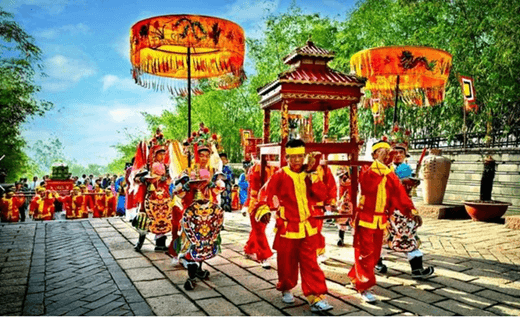
Picture 1: Hung King Temple Festival
Place and time
King Hung Temple Festival takes place yearly at King Hung Temple from the 8th to 11th day of the third lunar month in the year. According to the legend, the 10th day of that month is the death anniversary of King Hung. During the festival, Vietnamese people from all over the country as well as Vietnamese people living abroad head for King Hung Temple on Nghia Linh Mountain, Phu Tho Province to take part in this historical and meaningful festival.
The ceremony
To begin with, the spotlight is on bronze drum performance and competition of procession with participation of about 40 villages. After that, a solemn national ceremony is held with incense-offering liturgy. Governmental leaders will lead the procession up to Upper Temple (“Den Thuong”) – the highest temple of King Hung Temple Complex on Nghia Linh Mountain. Offering involves five-fruit trays, specialties from all regions in the country and indispensably a couple of “chung” cakes and “day” cakes, which are two traditional foods of Vietnam.
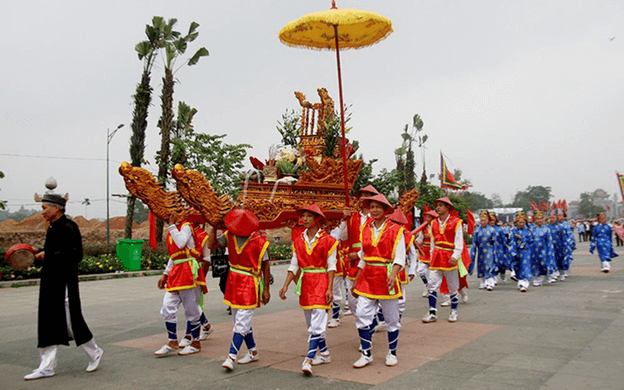
Picture 2: Procression in Hung King Temple Fesitival
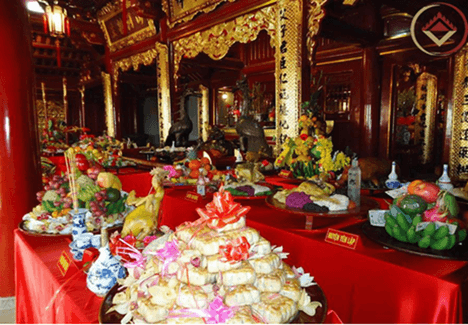
Picture 3: Offerings in the ceremony
The festival
The festival is featured with many folk games such as “danh du” (bamboo swings), “nem con” (game of throwing a sacred ball through the ring), rice cooking competitions, lion dance, human chess, water puppet performance, wrestling, etc. All folk games contribute a bustling ambiance to the festival and attract participation of various people. Besides, “xoan” singing and “gheo” singing are also performed at the festival by local residents.
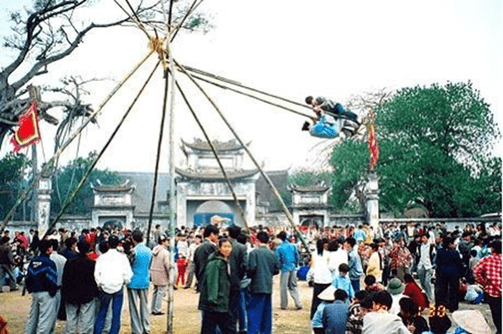
Picture 4: Danh du
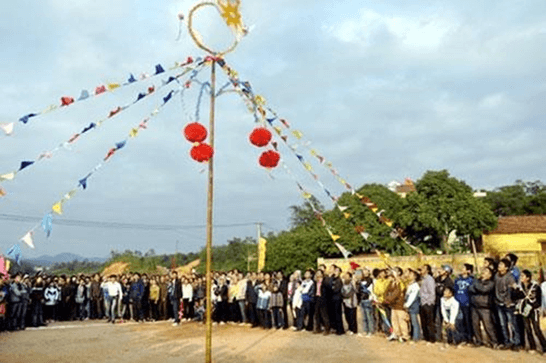
Picture 5: Nem con
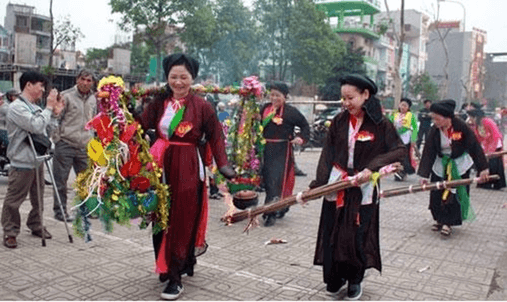
Picture 6: Rice cooking competition
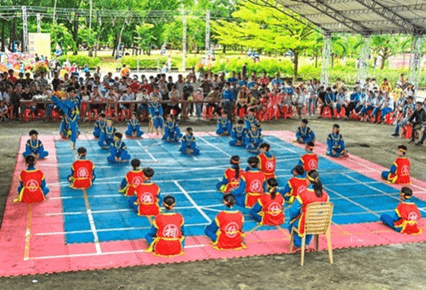
Picture 7: Human Chess
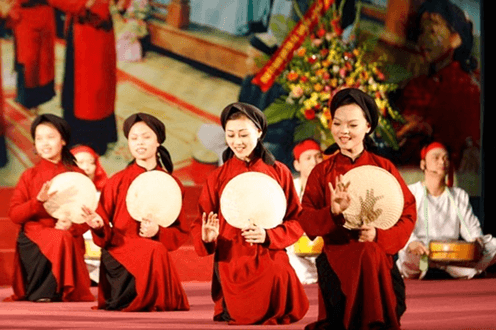
Picture 8: Xoan singing
Conclusion
Hung King Temple Festival is not only a festival but also a special occasion where tradition embodies spiritual solidarity and provides a good time to acknowledge national origins and sources of Vietnamese cultural and moral identity.
Tài liệu cùng môn học
Tài liệu khác
- Trắc nghiệm tiếng anh 2 Family and Friends
- Trắc nghiệm tiếng anh 2 Explore our world
- Trắc nghiệm tiếng anh 3 Family and Friends
- Trắc nghiệm tiếng anh 3 Explore our world
- Trắc nghiệm tiếng anh 4 Family and Friends
- Trắc nghiệm tiếng anh 4 Global Success
- Trắc nghiệm tiếng anh 4 Explore our world
- Trắc nghiệm tiếng anh 5 Family and Friends
- => Xem nhiều môn hơn