Giải tiếng anh 8 Global Success: Unit 6 Lifestyles
Hướng dẫn giải Tiếng anh 8 Global Success: Giải Unit 6 Lifestyles. Bài được giải chi tiết, rõ ràng, dễ hiểu. Bài giải giúp học sinh nắm vững kiến thức trong sách giáo khoa, rèn kĩ năng giải bài tập và có phương pháp học tập hiệu quả.
Nội dung chi tiết
UNIT 6: LIFESTYLES
GETTING STARTED
Lifestyle differences
1. Listen and read
Nam: Hello, Tom. How're things?
Tom: Oh good. I like it here. The lifestyle is interesting and different from that in my country.
Nam: Really?
Tom: Sure. Students here call their teachers by their title "teacher", not by their names.
Nam: Right. How do you greet your teachers?
Tom; We usually say "Hello" or "Good morning" then Mr, Mrs, or Miss and their surnames, for example "Good morning, Mr Smith."
Nam: Are there other differences?
Tom: People buy and sell a lot of street food here. In my country, people usually buy food in a store or a restaurant.
Nam: Yeah. Buying street food is a common practice in my city.
Tom: And l've noticed that many people have breakfast on the street too! In my country, we typically have a light breakfast at home.
Nam: I see. But here many adults are in the habit of having breakfast outside of their homes. If they're not in a hurry, they'll even have a leisurely coffee there.
Tom: That's fascinating!
2. Read the conversation again and complete the table
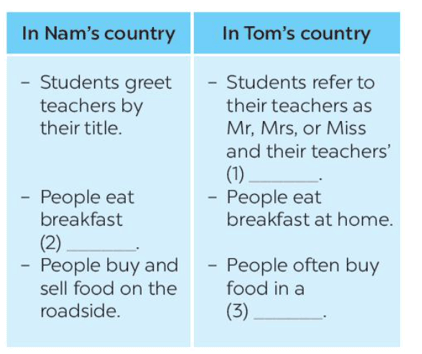
Answer:
| 1. surnames | 2. on the street | 3. store / restaurant |
3. Complete the sentences with the words and phrases from the box
1. A balanced diet and exercise are important for a healthy _____.
2. Handshaking, bowing, and hugging are some of the ways in which people _____ one another.
3. Waiters and waitresses _____ food in restaurants.
4. Going out for breakfast has become a common _____ in this city.
5. My mum is _____ keeping everything in the kitchen bright and clean.
Answer:
1. lifestyle - A balanced diet and exercise are important for a healthy lifestyle.
2. greet - Handshaking, bowing, and hugging are some of the ways in which people greet one another.
3. serve - Waiters and waitresses serve food in restaurants.
4. practice - Going out for breakfast has become a common practice in this city.
5. in the habit of - My mum is in the habit of keeping everything in the kitchen bright and clean.
4. Label each picture with a word or phrase from the box
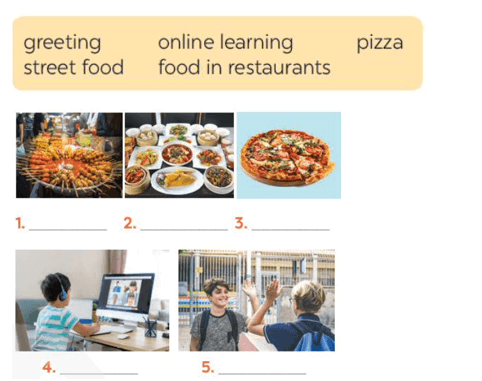
Answer:
| 1. street food | 2. food in restaurants | 3. pizza |
| 4. online learning | 5. greeting |
5. QUIZ Greetings around the world. Take the quiz.
1. Which is probably the most common way of greeting around the world?
A. Shaking hands.
B. Sticking out one's tongue.
2. In the USA, people greet each other by _____
A. shaking heads
B. saying "Hello"
3. Thais greet their elders by saying "sawadee" and ____
A. saying their surname
B. slightly bowing to them
4. The Maori of New Zealand greet each other by _____
A. kissing each other's cheek
B. pressing their noses together
5. How do people in Japan normally greet each other?
A. They bow to each other.
B. They hug each other.
Answer:
| 1. A | 2. B | 3. B | 4. B | 5. A |
A CLOSER LOOK 1
VOCABULARY
1. Match the words and phrases with the pictures
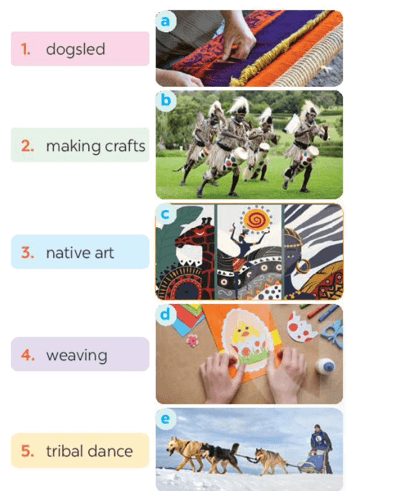
Answer:
| 1. e | 2. d | 3. c | 4. a | 5. b |
2. Complete the sentences with the words and phrases from the box

1. The traditional craft of the villagers is ______ bamboo baskets.
2. We all joined in the ______ when we attended the local festival.
3. The gallery in the city centre has an excellent collection of ______.
4. Hoa is very keen on ______. She loves to knit gloves after school.
5. The ______ is still used as a means of transport in Alaska today.
Answer:
1. weaving - The traditional craft of the villagers is weaving bamboo baskets.
2. tribal dances - We all joined in the tribal dances when we attended the local festival.
3. native art - The gallery in the city centre has an excellent collection of native art.
4. making crafts - Hoa is very keen on making crafts. She loves to knit gloves after school.
5. dogsled - The dogsled is still used as a means of transport in Alaska today.
3. Choose the correct answer A, B, or C to complete each sentence
1. The tribal women know how to _____ these threads into beautiful clothes.
A. weave
B. make
C. cut
2. She comes from Korea, so her _____ language is Korean.
A. modern
B. native
C. practical
3. Sticking out one's tongue was a way of greeting in _____ Tibetan culture.
A. traditional
B. leisurely
C. simple
4. How do people _____ New Years in your country, Jack?
A. practise
B. keep
C. celebrate
5. We like that restaurant: it _____ very delicious food.
A. practises
B. serves
C. buys
Answer:
| 1. A | 2. B | 3. A | 4. C | 5. B |
PRONUNCIATION
/br/ and /pr/
4. Listen and repeat the words. Pay attention to the sounds /n/ and /η/
| /br/ | /pr/ |
Bridge Broccoli Breakfast Algebra celebrate | Present Practice Precious Programme express |
5. Listen and practise the sentences. Underline the bold words with /br/, and circle the bold words with /pr/
1. My brother says online learning improves our IT skills.
2. Santa claus brings a lot of presents to children.
3. She briefly introduced the new programme.
4. He spent a lot of time preparing for his algebra test.
5. My mum prays at the temple before breakfast on Sundays.
Answer:
1. My brother says online learning improves our IT skills.
2. Santa claus brings a lot of presents to children.
3. She briefly introduced the new programme.
4. He spent a lot of time preparing for his algebra test.
5. My mum prays at the temple before breakfast on Sundays.
A CLOSER LOOK 2
GRAMMAR
1. Use the verbs from the box with will or won't to complete these dialogues
1. Alice: Are you taking exams next week, Phong?
Phong: I'm not sure. The teacher ______ us tomorrow.
2. Linh: Where are you going on the holiday, Chris?
Chris: We're planning to visit Ta Ho Village. We ______ the local festival, but we ______ the tribal dance as it is late in the evening.
3. Dad: Are you having online lessons tomorrow?
Daughter: No. We ______ lessons, but we ______ experiments in the lab.
Answer:
| 1. will tell | 2. will attend – won’t join | 3. won’t have – will do |
2. Arrange these words and phrases in the correct order to form meaningful sentences.
1. We / first-term exams / our / will take / very soon /.
2. Alaska / they / in an igloo / stay / when / visit / Will they /?
3. She / the tribal groups / to help them / will work with / revive their culture /.
4. online learning / in / I won't choose / the second semester /
5. I'll come / to / I go / to London / if / this summer / see you /.
Answer:
1. We will take our first-term exams very soon.
2. Will they stay in an igloo when they visit Alaska?
3. She will work with the tribal groups to help them revive their culture.
4. I won't choose online learning in the second semester.
5. I’ll come to see you if I go to London this summer.
First conditional
3. Give the correct tense of the verbs in brackets, using the first conditional
1. If you (eat) an apple every day, you will stay healthy.
2. Will Dan wear a kilt if he (go) to Scotland?
3. He (have) sore eyes if he spends too much time on the computer.
4. If you (not do) anything bad, you won't get into trouble.
5. _____ she (be) able to eat the soup if I put some chillies in it?
Answer:
| 1. eat | 2. goes | 3. will have | 4. don’t do | 5. Will she be |
1. If you eat an apple every day, you will stay healthy.
2. Will Dan wear a kilt if he goes to Scotland?
3. He will have sore eyes if he spends too much time on the computer.
4. If you don’t do anything bad, you won't get into trouble.
5. Will she be able to eat the soup if I put some chillies in it?
4. Fill in each blank with IF or UNLESS
1. _____ we eat lunch now, we won't arrive at the cinema on time.
2. The teacher will be furious _____ you don't do the homework.
3. I won't eat kimchi when I go to Korea _____ I have to.
4. _____ you turn on the light, you will be able to see better.
5. You won't be able to find the house _____ you use your GPS. There's no one around.
Answer:
| 1. Unless | 2. if | 3. unless | 4. If | 5. unless |
5. Complete the following sentences to make them true for you. Then share your answers with a partner.
1. If it rains tomorrow, ______.
2. Unless I get good marks, ______.
3. If I have free time this weekend, ______.
4. If I study harder, ______.
5. Unless I go to bed early, ______.
Answer:
1. If it rains tomorrow, I will go to school by bus.
2. Unless I get good marks, my parents will be so sad.
3. If I have free time this weekend, I will visit my grandparents.
4. If I study harder, I will get good marks.
5. Unless I go to bed early, I won’t pay attention to the lesson tomorrow.
COMMUNICATION
Everyday English
Expressing certainty
1. Listen and read the conversations. Pay attention to the highlighted sentences
1. Nam: Can I come over to your house on Sunday?
Tom: Sure. You’re welcome.
2. Alice: Vietnamese cooking uses a lot of vegetables and herbs.
Mai: Yes, certainly.
2. Work in pairs. Make similar conversations to express certainty in the following situations.
1. You ask your friend to help you with your maths homework.
2. You say that Vietnamese love seafood.
Answer:
1. A: Can you help me with my maths homework?
B: Yes, certainly. / Yes, sure.
2. A: Vietnamese love seafood.
B: Yes, certainly. / Yes, sure.
Cuisines around the world
3. QUIZ How much do you know about the cuisines of different countries? Do the quiz to find out.
1. Which country is famous for pasta and pizza?
A. Thailand.
B. Italy.
C. Brazil.
2. Which country is famous for kimchi?
A. Korea.
B. Portugal.
C. Australia.
3. England is well-known for ______.
A. dim sum
B. spaghetti
C. fish and chips
4. Sushi comes from ______.
A. Japan
B. Korea
C. Taiwan
5. In which country do you think kangaroo steak is common?
A. China.
B. Australia.
C. The USA.
Answer:
| 1. B | 2. A | 3. C | 4. A | 5. B |
4. Work in groups. Read the two passages and discuss the questions below
Italy: Italy is famous for pizza. Pizza is a dish with a flat round bread base with cheese, meat, and vegetables on top. The country is also known for its spaghetti and pasta. Italy is also famous for its many types of cheese (over 400 types). There is one that allows flies to lay eggs on it, and it has a unique taste.
India: Curry is a common dish in India. It is a dish of meat and vegetables cooked in a sauce and served with rice or bread. In fact, India has a vast range of cuisines.
People in some areas of India favour vegetarian food. But chicken, lamb, or goat are common in other areas. Generally, Indians avoid beef.
Answer:
I like Indian cuisine because I enjoy curry. It’s savory and delicious. I hope one day I will have the chance to try Italian cuisine
5. Work in groups. Talk about the typical food in your area. Discuss the following
- staple food
- favourite food
- foods eaten on special occasions
Answer:
1.
A: What is the staple food in your area?
B: It's rice.
C: Yes. We have rice with most of our meals.
2.
A: What is the staple food in your country?
B: It’s rice. People eat rice all day. And we cannot live without rice.
A: What’s your favourite food?
B: It’s fried chicken and spring roll. I never getting tired of eating these food.
A: What do you usually eat on special occasion?
B: On special day, my family gathers at our favourite café and enjoy a dish called ‘bun bo’.
SKILL 1
READING
1. Work in groups. Look at the picture, and discuss what you know about Alaska
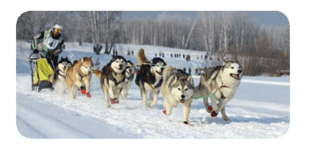
Answer:
+ Alaska: a state of the US (49th)
+ location: northwest of North America
+ population: over 700,000
+ climate: oceanic climate, very cold
+ native people: Alaskan Natives
+ languages: English 86.3%, Alaska Native languages.
Read the text and check your answers.
If you go to the American state of Alaska, you might find the traditional lifestyle there interesting. Although Alaska is quite large, with nearly 1.7 million square kilometres, it has a small population of about 730,000.
The native peoples in Alaska still maintain many of their traditions. They keep their old ways of making arts and crafts alive. Various native groups have their own special styles of carving or weaving as well as their unique tribal dances and drumming. Therefore, visitors to Alaska may experience some of their culture in their villages. They may see performances of traditional music and native art in galleries and museums.
Alaska is also known for its unusual method of transport - the dogsled. Today, dog sledding (= mushing) is more of a sport than a true means of transport. The best-known race is the Iditarod Trail Sled Dog Race, a 1,510 km race from Anchorage to Nome. Mushers from all over the world come to Anchorage each March to compete for cash and prizes.
2. Match the highlighted words in the text with their meanings
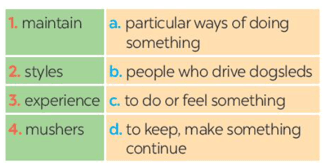
Answer:
| 1. d | 2. a | 3. c | 4. b |
Explanation
1. maintain = duy trì
2. styles = phong cách
3. experience = trải nghiệm, kinh nghiệm
4. mushers = người tập thể dục
3. Read the text again and answer the questions.
1. What is the population of Alaska?
2. Who have special styles of carving or weaving?
3. Where can we find the culture of the native peoples in Alaska?
4. How long is the Iditarod Trail Sled Dog Race?
5. Is the Iditarod Trail Sled Dog Race an international competition?
Answer:
1. Alaska has small population of about 730,000.
2. Various native groups have their own special styles of carving or weaving as well as their unique tribal dances and drumming
3. They may see performances of traditional music and native art in galleries and museums.
4. The best-known race is the Iditarod Trail Sled Dog Race, a 1,510km race from Anchorage to Nome.
5. Yes, it is. Mushers from all over the world come to Anchorage each March to compete for cash and prizes.
SPEAKING
4. Work in pairs. Look at the pictures and use the cues to talk about what people in some places do to maintain their traditional lifestyle.
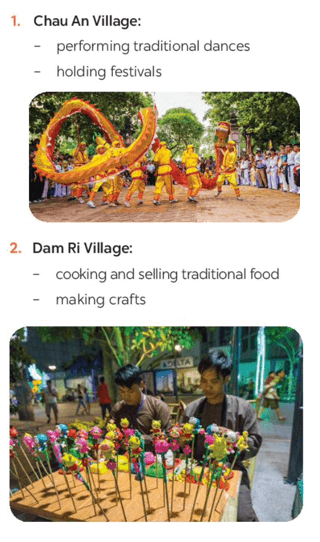
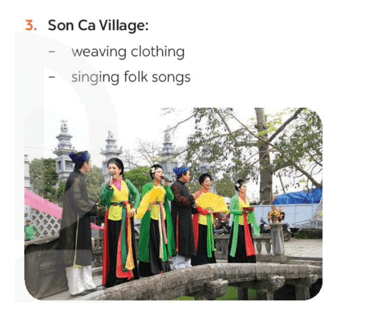
Answer:
1. Chau An Village
A: What do people in Chau An Village do to maintain their traditional lifestyle?
B: They perform traditional dances. They also hold festivals.
2. Dam Ri Village
A: What do people in Dam Ri Village do to maintain their traditional lifestyle?
B: They cook and sell traditional food. They also make crafts.
3. Son Ca Village
A: What do people in Son Ca Village do to maintain their traditional lifestyle?
B: They weave clothing. They also sing folk songs.
5. Work in pairs. Ask and answer about how people in your area maintain their traditional lifestyle. You can use the ideas in 4 and the reading text in 1
Answer:
I live in Bat Trang, which is a pottery village not far from Ha Noi centre. To maintain the traditional lifestyle, local people will make pottery and paint on the ceramic statues. Then they will sell those pottery products to tourists.
SKILL 2
LISTENING
1. Work in groups. Which of the following do you think is more influenced by modern technology? Tick (✓) your choice(s).
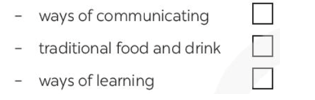
Answer:
- ways of communicating ✓
- traditional food and drink
- ways of learning ✓
2. Listen to the conversation and tick (✓) T (True) or F (False).
| T | F | |
| 1. When Mai was studying online, the power went off. | ||
| 2. Chris likes studying online as it's convenient. | ||
| 3. Mai says it's easy to concentrate when learning online. | ||
| 4. Chris disagrees that technology improves friendship. | ||
| 5. Mai thinks technology is changing our way of learning and working. |
Answer:
| 1. T | 2. T | 3. F | 4. F |
Transcript
- Hi Mai, how's everything?
- Not bad. We still have lessons online every day, but this morning when we were studying, the power went off suddenly.
- Really? Modern technology sometimes causes us problems.
- Yeah, by the way, do you like studying online?
- Well, yes, it's convenient and comfortable. You don't have to get up early and get dressed for class.
- But it's difficult to concentrate and I still want to go to class. I want real interaction with my teachers and friends.
- Yeah, and learning online all day long causes us headaches and sore eyes.
- Sure. And do you think that modern technology is greatly changing our lifestyle?
- Yeah, technology changes the way we communicate with others.
- And it improves our friendship because it's easy to keep in touch with people living far away.
- Certainly.
- Technology is also changing how we live and work.
3. Listen again and choose the correct answer to each question
1. The talk is generally about _______.
A. the impact of modern technology
B. the good points of online learning
C. the weak points of online learning
2. Both Mai and Chris think that modern technology is _______.
A. changing greatly
B. changing our lifestyle
C. entertaining us
3. Mai wants to go to class because _______.
A. online learning doesn't work for her
B. she likes to get up early
C. she wants to interact with her teachers and friends
4. Which of the following is true?
A. Mai and Chris are classmates.
B. Mai and Chris have similar ideas about online learning.
C. Mai thinks online learning has some weak points.
Answer:
| 1. A | 2. B | 3. C | 4. C |
WRITING
4. Look at the list below. Put the ideas about online learning in the correct columns.
- convenient
- comfortable
- difficult to concentrate
- more freedom
- no real interaction
- independent
- harmful to our eyes
- expensive equipment
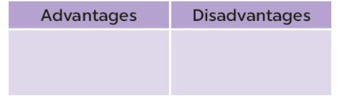
Answer:
- Advantages: convenient, comfortable, more freedom, independent
- Disadvantages: difficult to concentrate, no real interaction, harmful to our eyes, expensive equipment
5. Write a paragraph (80 – 100 words) about the advantages OR disadvantages of online learning. You can refer to the listening and the ideas in 4
1.
Today online learning plays an important role in students’ academic life. First, it is undeniable that studying in E-classes is a safe and convenient way for students to keep track of their study at home if an outbreak of disease occurs like the Coronavirus pandemic. Students do not need to go to school, so they can avoid being infected with fatal diseases. Second, it enables students to take advantage of new technology in studying. They are able to review the videos of E-lessons after class, actively communicate with their teachers via free, easy-to-use apps with various supporting tools, do assignments, and get feedback quickly. Finally, it helps students become more proactive in learning. Unlike face-to-face learning, students become more independent and have to improve their self-awareness, time-management skills as well as concentrate on teachers’ E-lessons. In short, students had better take advantage of online learning effectively with a view to getting good study results.
2.
I think that online learning has so many disadvantages. To begin with, online learning is more difficult to concentrate on the lesson than classroom learning as there are so many distraction from other things like phones or family member. Additionally, there will be no real interaction between the teacher and the students. And the teachers can easily get depressed because they are the only one who is speaking and hardly receive any responses from the students. Moreover, spending too much time looking at the screen during online classes can be harmful to your eyes. This can lead to short-sightedness, and you have to wear glasses. Finally, the cost of money for preparing equipment for online classes are great.
LOOKING BACK
VOCABULARY
1. Match each word or phrase with its meaning
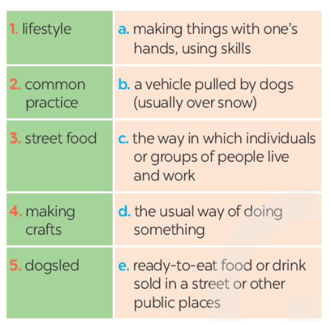
Answer:
| 1. c | 2. d | 3. e | 4. a | 5. b |
1 - c: lối sống - cách thức mà cá nhân hoặc nhóm người sống và làm việc.
2 - d: common practice - cách làm thông thường của một việc gì đó.
3 - e: thức ăn đường phố - thức ăn hoặc đồ uống làm sẵn được bán trên đường phố hoặc những nơi công cộng khác.
4 - a: làm đồ thủ công - làm đồ bằng tay, sử dụng các kỹ năng.
5 - b: dogsled - xe do chó kéo (thường là trên tuyết)
2. Complete each sentence with a word or phrase from the box

1. My younger sister is __________ listening to music while studying.
2. The native people there ___________ us warmly when we arrived.
3. Many people are trying to adopt a healthy __________ these days.
4. I believe that _________ are not as interesting as offline lessons.
5. It is difficult for some villages to _________ their traditional lifestyle.
Answer:
| 1. in the habit of | 2. greeted | 3. lifestyle |
| 4. online lessons | 5. maintain |
GRAMMAR
3. Complete the sentences, using the correct tense of the verbs in brackets.
1. No worries. The organisers (send) _______ us an invitation soon.
2. Unless they behave, those children (not be) __________ welcome here.
3. Do you think online learning (become) ________ the new mode of education?
4. If I (win) ________ the competition, I will donate half of the prize money to charity.
5. ______ we (have to) _______ keep to the left when we drive in Singapore next week?
Answer:
| 1. will send | 2. won’t be | 3. will become |
| 4. win | 5. Will we have to |
Explanation
Cấu trúc thì tương lai đơn:
(+) S + will + V-inf + …
(⎯) S + won’t + V-inf + …
(?) Will + S + V-inf + …?
- Rewrite the following sentences, so that their meaning stays the same.
1. Don't play computer games for too long. You will harm your eyes.
If you play _______________________________.
2. Be careful with your diet, or you will get overweight.
You will _________________________________.
3. We'll go to the beach unless it rains.
If ________________________________________.
4. If you don’t hurry up, you will be late.
Unless ____________________________________.
5. Unless the teacher explains the lesson again, we won't understand it very well.
If ________________________________________.
Answer:
1. If you play computer games for long, you will harm your eyes.
2. My dad will visit Coober Pedy next summer.
3. If it doesn't rain, we'll go to the beach.
4. Unless you hurry up, you will be late.
5. If the teacher doesn’t explain the lesson again, we won’t understand it very well.
Explanation
- Cấu trúc điều kiện loại I: If + Present Simple, Future Simple.
- Unless = If … not … (trừ khi …)
PROJECT
Our school club
Work in groups.
1. Find information about an interesting way of life around the world, including
- everyday life
- ways of cooking
- making crafts
- folk songs and dances
- festivals
Answer:
Everyday life:
The life of Mongolian is punctuated by caring animals. A Mongolian nomadic family has five types of animals: horses and sheep for hot season and cows, camels and goats for cold season.
Several times during the year, according to the needs of livestock and pasture conditions, nomadic families move their yurts.
In summer, the nomadic family will favor a location near a river, to ensure water supply for the family and herds, and good pastures.
In winter, the priority is given to protection against the intense cold of Mongolian winter, and the family settles its "winter" camp sheltered from the wind in a small valley or at the edge of a forest.
The woman is very busy with the household, kitchen, 2 or 3 children, and milking the mares, cows... at least five times a day.
The husband watches the herds of yaks, horses, cows and sheep scattered on often significant surfaces and must gather them every night to protect them against the wolf attacks, frequent in Mongolia. He also deals with equipment maintenance and repairs.
Ways of cooking: In traditional Mongolian cooking, seasoning was not used; although salt was there a long time and it is used it even in tea! Typically, they cook with a wok and most of the foods are either boiled or stir-fried.
Since a lot of livestock is raised in Mongolia, it is no mystery that Mongolian cuisine revolves around them. Sheep and goat are most popularly grilled or boiled. Traditionally soup and dumplings used to be in all the courses of the meals, without which, it was regarded to be incomplete.
There are many types of crafts can be found in Mongolian culture: wooden sculptures, ger - nomadic dwelling, metalwork, embroidery art, leather crafting, art of jewelry.
The traditional masterpiece of Mongolian is accompanied with the morin-khuur. Most famous Mongolian dance are: Jinai dance (milking dance), the Caihong dance (rainbow dance), the Zhongwan dance (bowl dance), the Kuaizi dance (chopsticks dance), and the Andai dance
There are lots of festivals in Mongolia but these are the most well-known one: Tsagaan Sar (Lunar New Year); Khovsgol Ice Festival; Naadam Festival; Khongoriin Bombani Hural; Ölgii Eagle Festival.
You can refer to one of these, or you can choose your own. You may need to use the Internet to find information.
- Life of residents in Coober Pedy, Australia
- Nomadic life in Mongolia
- Life of the Ede ethnic group of Viet Nam
2. Work in groups. Make a poster to introduce the people
Use the following guiding questions:
Answer:
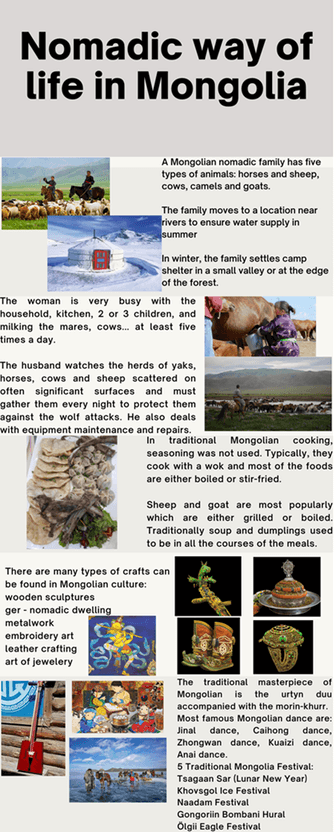
3. Give a presentation to the class.
Answer:
Hello everyone, today our group will introduce the nomadic way of life in Mongolia. The life of Mongolian family depends on the health of herds and is punctuated by caring for animals.
Traditionally, a Mongolian nomadic family has five types of animals: horses and sheep, cows / yaks, camels and goats.
Several times during the year, according to the needs of livestock and pasture conditions, nomadic families move their yurts.
In summer, the nomadic family will favor a location near a river, to ensure water supply for the family and herds, and good pastures.
In winter, the priority is given to protection against the intense cold of Mongolian winter, and the family settles its "winter" camp sheltered from the wind in a small valley or at the edge of a forest.
The woman is very busy with the household, kitchen, 2 or 3 children, and milking the mares, cows... at least five times a day.
The processing of dairy products (cream, yogurt, liquor, milk, cheese ...) takes a long time as well.
The husband watches the herds of yaks, horses, cows and sheep scattered on often significant surfaces and must gather them every night to protect them against the wolf attacks, frequent in Mongolia. He also deals with equipment maintenance and repairs.
In traditional Mongolian cooking, seasoning was not used; although salt was there a long time and it is used even in tea! Typically, they cook with a wok and most of the foods are either boiled or stir-fried. Sheep and goat are most popularly grilled or boiled. Traditionally soup and dumplings used to be in all the courses of the meals.
There are many types of crafts that can be found in Mongolian culture: wooden sculptures, ger - nomadic dwelling, metalwork, embroidery art, leather crafting, art of jewelry.
The traditional masterpiece of Mongolian is the urtyn duu accompanied with the morin-khuur. Most famous Mongolian dance are: Jinai dance (milking dance), the Caihong dance (rainbow dance), the Zhongwan dance (bowl dance), the Kuaizi dance (chopsticks dance), and the Andai dance
There are lots of festivals in Mongolia but these are the most well-known ones: Tsagaan Sar (Lunar New Year); Khovsgol Ice Festival; Naadam Festival; Khongoriin Bombani Hural; Ölgii Eagle Festival. Thanks for listening.
Tài liệu cùng môn học
Tài liệu khác
- Trắc nghiệm tiếng anh 2 Family and Friends
- Trắc nghiệm tiếng anh 2 Explore our world
- Trắc nghiệm tiếng anh 3 Family and Friends
- Trắc nghiệm tiếng anh 3 Explore our world
- Trắc nghiệm tiếng anh 4 Family and Friends
- Trắc nghiệm tiếng anh 4 Global Success
- Trắc nghiệm tiếng anh 4 Explore our world
- Trắc nghiệm tiếng anh 5 Family and Friends
- => Xem nhiều môn hơn