Giải tiếng anh 8 Global Success: Unit 7 Environmental protection
Hướng dẫn giải Tiếng anh 8 Global Success: Giải Unit 7 Environmental protection. Bài được giải chi tiết, rõ ràng, dễ hiểu. Bài giải giúp học sinh nắm vững kiến thức trong sách giáo khoa, rèn kĩ năng giải bài tập và có phương pháp học tập hiệu quả.
Nội dung chi tiết
UNIT 7: ENVIRONMENTAL PROTECTION
GETTING STARTED
At the Go Green Club
1. Listen and read.
Club leader: Hello. Welcome back. Today we’re discussing environmental problems and environmental protection. What are our serious environmental problems now?
Nam: Pollution and habitat loss, I think.
Ann: I agree. The air and water quality are getting worse and worse.
Club leader: Any others?
Ann: Yes, I can think of some like global warming, endangered species loss, …
Nam: So what should we do to help protect our environment?
Club leader: We can reduce our carbon footprint even in our homes.
Ann: What do you mean by “carbon footprint”?
Club leader: It’s the amount of carbon dioxide we release into the environment.
Ann: I see. So we can do things like turning off devices when we’re not using them.
Club leader: Right … And there is much more we can do, like practising the 3Rs.
Nam: We can plant more trees in our neighbourhood too.
Ann: And try to avoid using single-use products, like plastic bags, and stop littering.
Club leader: Yeah. And we can volunteer at some local environment programmes to save endangered species.
2. Read the conversation again and match the two halves in the two columns.
| To protect the environment, we should | |
| a, using single-use products |
| b, littering |
| c, our carbon footprint |
| d, devices when we’re not using them |
| e, more trees in out neighbourhood |
Answer:
1. C | 2. D | 3. E | 4. A | 5. B |
Explain:
1. reduce our carbon footprint: giảm lượng khí thải carbon của chúng ta
2. turn off devices when we're not using them: tắt thiết bị khi không sử dụng
3. plant more trees in our neighbourhood: trồng thêm cây xanh trong khu phố của chúng ta
4. avoid using single - use products: tránh sử dụng sản phẩm dùng một lần
5. stop littering: ngừng xả rác
3. Complete each sentence with one word or phrase from the box
Reduce Pollution Environment programmae | Single -use Carbon footprint |
1. _______________ is a serious problem everywhere.
2. We should avoid dumping waste into lakes and rivers to _______________ water pollution.
3. We shouldn’t thow away _______________ products but recycle them.
4. _______________ is the amount of carbon dioxide we release into the environment.
5. We hope a lot more people join our _______________.
Answer:
1. pollution | 2. reduce | 3. single-use |
4. carbon footprint | 5. environment programme |
|
Explain:
1. pollution (n) ô nhiễm
2. reduce (v) giảm
3. single-use (a) sử dụng một lần
4. carbon footprint (n) dấu chân carbon
5. environment programme (n) chương trình môi trường
4. Write a phrase from the box under each picture.
Plastic rubbish Single -use products Endangered species | Water pollution 3Rs |
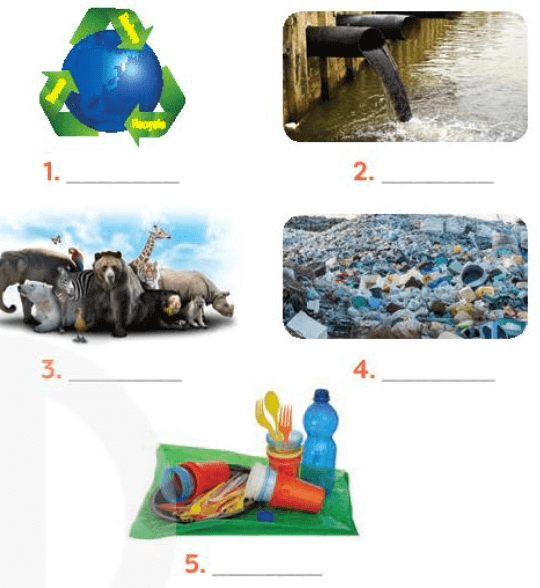
Answer:
1. 3Rs
2. water pollution (ô nhiễm nước)
3. endangered species (loài có nguy cơ tuyệt chủng)
4. plastic rubbish (rác thải nhựa)
5. single-use products (sản phẩm dùng một lần)
5. QUIZ. Environment Quiz. Do the following quiz.
1. Which of the following is the greenest form of transport?
A. Motorbike.
B. Bus.
C. Bicycle.
2. Which of the following is a renewable Source?
A. Coal.
B. Oil.
C. Wind.
5. What causes the most pollution?
A. Factories.
B. Animals.
C. Hospitals.
4. The surroundings in which we live are our _________.
A. habitat
B. place
C. environment
5. Which of these will reduce your carbon footprint?
A. Cutting down a lot of trees.
B. Recycling paper products.
C. Leaving the TV on all night.
Answer:
1. C | 2. C | 3. A | 4. C | 5. B |
A CLOSER LOOK 1
VOCABULARY
1. Label each picture with a phrase from the list
a. building a campfire | b. cutting down trees | c. picking up rubbish |
d. protecting endangered species | e. saving water |
|
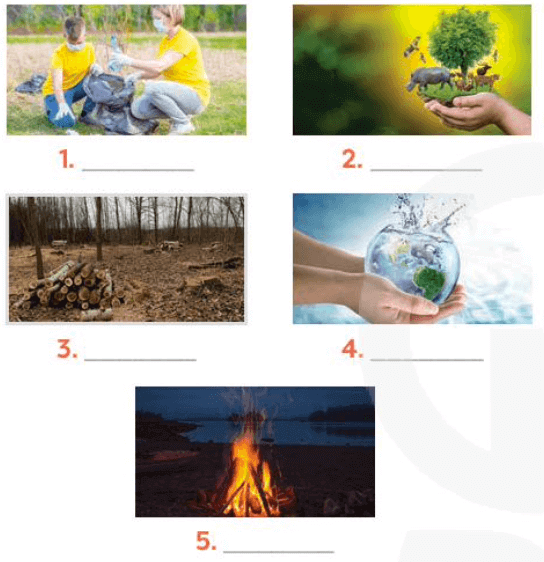
Answer:
1. picking up rubbish | 2. protecting endangered species | 3. cutting down trees |
4. saving water | 5. building a campfire |
|
Explain:
1. picking up rubbish: nhặt rác
2. protecting endangered species: bảo vệ các loài có nguy cơ tuyệt chủng
3. cutting down trees: chặt cây
4. saving water: tiết kiệm nước
5. building a campfire: đốt lửa trại
2. Match each word or phrase in column A with its meaning in column B
A | B |
| a. the process of making water, air, soil, etc. dirty by adding harmful substances |
| b. the practice of protecting the natural environment |
| c. the way living and non-living things in a particular area are related to each other |
| d. animals facing a high risk of extinction in the wild |
| e. the place where a type of plant or animal lives |
Answer:
1 - e: ecosystem - the place where a type of plant or animal lives.
2 - a: pollution - the process of making water, air, soil, etc. dirty by adding harmful substances.
3 - c: habitat - the way living and non-living things in a particular area are related to each other.
4 - b: environmental protection - the practice of protecting the natural environment.
5 - d: endangered species - animals facing a high risk of extinction in the wild.
3. Complete each sentence with a word or phrase from the box
habitat ecosystem carbon dioxide | cutting down trees endangered species
|
1. People in my neighbourhood are doing a lot to save __________.
2. Con Dao National Park provides a rich __________ for marine life.
3. Forests help release oxygen and absorb _________; they also provide homes for many species.
4. ________ is a serious environmental concern as it harms natural habitats.
5. An ________ maybe a whole forest, or a small pong, and it can be of any size.
Answer:
1. endangered species - People in my neighbourhood are doing a lot to save endangered species.
2. habitat - Con Dao National Park provides a rich habitat for marine life.
3. carbon dioxide - Forests help release oxygen and absorb carbon dioxide; they also provide homes for many species.
4. cutting down trees - Cutting down trees is a serious environmental concern as it harms natural habitats.
5. ecosystem - An ecosystem maybe a whole forest, or a small pond, and it can be of any size.
PRONUNCIATION
/bl/ and /kl/
4. Listen and repeat the words. Pay attention to the sounds /bl/ and /kl/.
/bl/ | /kl/ |
Block Blast Blanket Black problem | Clean Clown Club Class clear |
Answer:
/bl/ | /kl/ |
Block Blast Blanket Black problem | Clean Clown Club Class clear |
5. Listen and practise the sentences. Underline the words with /bl/, and circle the words with /kl/.
1. Look! There are black clouds all over!
2. A truck blocked the way to the club.
3. The students painted the classroom blue.
4. The wind blew the clock down.
5. We cleaned up the environment after the blast.
Answer:
1. Look! There are black clouds all over!
2. A truck blocked the way to the club
3. The students painted the classroom blue.
4. The wind blew the clock down.
5. We cleaned up the environment after the blast.
A CLOSER LOOK 2
GRAMMAR
Complex sentences with adverb clauses of time
1. Read the sentences and write I.C if the underlined clause is an independent clause or D.C if it is a dependent clause
Example:
You must be careful when you cross the street. __D.C____
1. I'll wait for you here until you get back. ________
2. Make sure you lock the door when you go out. ________
3. You must get a permit before you build a campfire at a national park. ________
4. Don't use too much water while you are having a shower. ________
5. As soon as my friends come, we will pick up rubbish on the beach. ________
Answer:
1. I.C | 2. D.C | 3. I.C | 4. D.C | 5. D.C |
2. Choose A, B, or C to complete each sentence
1. I was not at home _________ he came to see me yesterday.
A. when
B. until
C. as soon as
2. We called the forest guard unit _________ we saw the bush fire.
A. as soon as
B. while
C. until
3. I went straight to the gym ________ I left home.
A. while
B. before
C. after
4. You can stay with us _________ you find a suitable place to stay.
A. as soon as
B. before
C. until
5. We cleaned up everything at the campsite _________ we left.
A. until
B. before
C. while
Answer:
1. A | 2. A | 3. C | 4. C | 5. B |
Explain:
1. when = khi
2. as soon as = ngay khi
3. after = sau khi
4. until = cho tới khi
5. before = trước khi.
3. Match the clauses in the two columns to form complex sentences
| 1. We will clean up the beach | a. until he made a successful light bulb. |
| 2. Don't forget to turn off the lights | b. as soon as it stops raining. |
| 3. You have to show your ticket | c. while I'm cooking the soup? |
| 4. Can you help me lay the table | d. before you go out. |
| 5. Thomas Edison kept trying | e. when you get on the train. |
Answer:
1 - b: We will clean up the beach as soon as it stops raining.
2 - d: Don't forget to turn off the light before you go out.
3 - e: You have to show your ticket when you get on the train.
4 - c: Can you help me lay the table while I'm cooking the soup?
5 - a: Thomas Edison kept trying until he made a successful light bulb.
4. Combine each pair of sentences, using the conjunction in brackets
1. I arrive at the station. I will call you right after. (as soon as)
2. Many Vietnamese women wear conical hats. They work in the field. (when)
3. My father taught me how to use the computer. Then he bought one for me. (before)
4. Nick is reading a novel. Jack is reading a cartoon. (while)
5. The tornado hit. There were only a few houses left standing. (After)
Answer:
1. I will call you as soon as I arrive at the station.
2. We have to follow the steps when we make a conical hat.
3. My father taught me how to use the computer before he bought one for me.
4. Nick is reading a novel while Jack is reading a cartoon. / While Nick is reading a novel, Jack is reading a cartoon.
5. After the tornado hit, there were only a few houses left standing.
5. GAME Matching game. Work in two groups, A and B. Group A write main clauses. Group B write adverb clauses of time.
Do they match? Are there any funny sentences?
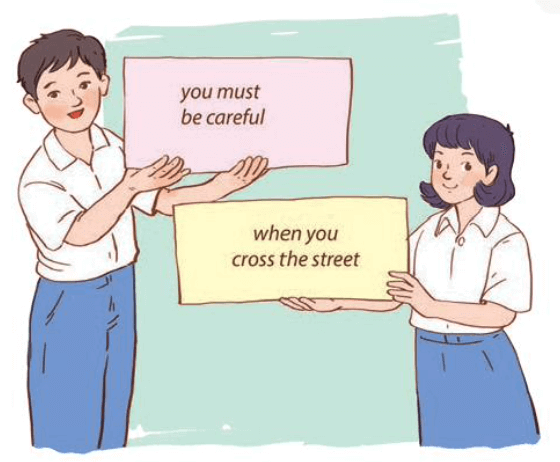
Answer:
- Don’t use the cell phone while you are driving.
- As I was walking down the street, I saw James driving a Porsche.
- He went to work after he fed the cats.
- He went abroad after he finished his studies.
- Bring me some water before you go.
- They were told to wait till the signal was given.
- I will wait here until you arrive.
- As soon as he heard the news, he called me.
- Just as he entered the room the clock struck.
COMMUNICATION
Everyday English
Asking for clarification
1. isten and read the dialogue. Pay attention to the highlighted sentences.
Mi: Hey, Linda. What does ‘endangered species’ mean?
Linda: Endangered species are animals in the wild that face a high risk of extinction.
Mi: And what do you mean by ‘in the wild’?
Linda: That means animals that live in their natural habitats, not in zoos.
Mi: Oh, I get it now. Thanks, Linda.
2. Work in pairs. Make similar conversations to ask for and give clarification for the following.
- single-use products
- global warming
Answer:
Situation 1:
A: What does it mean / what do you mean by ‘single-use products’?
B: ‘Single-use products’ are products made to be used once only.
A: And what does it mean / what do you mean by ‘global warming’?
B: It is the increase in the atmosphere’s temperatures caused by the rise of gases, especially carbon dioxide.
A: Oh, thank you.
Situation 2:
A: Hey, B. What does ‘single-use products’ mean?
B: Single-use plastics are goods that are made primarily from fossil fuel–based chemicals and are meant to be disposed of right after use - often, in mere minutes.
A: And what do you mean by ‘global warming’?
B: Global warming is the long-term heating of Earth’s surface observed since the pre-industrial period due to human activities, primarily fossil fuel burning, which increases heat-trapping greenhouse gas levels in Earth’s atmosphere.
A: Oh, I get it now. Thanks, B.
3. Read the passage and tick (V) the correct answers.
Every year on April 22nd, more than 190 countries celebrate Earth Day to protect the planet. The first Earth Day started in 1970 in America. Today more than 1 billion people participate in Earth Day activities each year, making it one of the largest movements. By taking part in activities like picking up litter and planting trees, you can help protect nature and the environment. You can also do things like buying green products and practising reduce, reuse and recycle. We can celebrate Earth Day and protect the earth at the same time. Moreover, we should continue doing things to save the earth every day of the year.
What activities do people do on Earth Day?
1. picking up litter
2. protecting endangered species
3. planting trees
4. buying green products
5. helping neighbours
Answer:
Sentence 1, 3, 4
4. Match the activities people do on Earth Day with their results
| 1. planting trees | a. making our environment clean, reducing pollution |
| 2. buying green products | b. reducing global warming, protecting animal habitats |
| 3. picking up litter | c. saving electricity to save natural resources |
| 4. turning off the lights | d. improving our health, reducing pollution |
Answer:
1 - d: planting trees - improving our health, reducing pollution
2 - b: buying green products - reducing global warming, protecting animals habitats
3 - a: picking up litter - making our environment clean, reducing pollution
4 - c: turning off the lights - saving electricity to save natural resources
5. Work in pairs. Ask and answer about the things you and your friends do on Earth Day
Answer:
1.
A: What do you do on Earth Day?
B: We pick up litter and clean the streets. And you?
2.
A: What do you do on Earth Day?
B: We plant trees and flowers along the neighbour’s streets. And you?
A: We join a team to clean up the trash on the street and we hang up some bee houses.
SKILL 1
READING
1. Work in groups. Look at the picture and say what you see. Then list the names of some endangered species you know
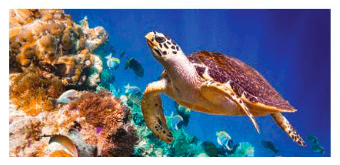
Answer:
I see a marine turtle in the ocean. The names of some endangered species: giant panda, tiger, whooping crane, blue whale …
2. Read the text and choose the words or phrases to make the following statements correct.
Today, there are national parks all over the world. and the number is rising all the time. A national park is a special area for the protection of the environment and wildlife.
In Viet Nam, there are now 34 national parks. Con Dao National Park is one of them. It became a national park in 1993. The park is in Con Dao District, Ba Ria-Vung Tau Province. It contains 16 small islands covering 20,000 hectares. The ecosystem here is very diverse with thousands of species, including marine animals. Many species of corals as well as sea turtles, dolphins, and endangered dugongs live here as well. The park is also home toa lot of valuable kinds of woods and medicinal plants. Three ancient trees in the park were named “Vietnamese Heritage Trees”.
Con Dao National Park, like other national parks, plays a key role in saving endangered species as well as protecting the environment and natural resources. It also helps raise the awareness of local residents about the importance of nature.
1. There are 34 national parks / nations’ parks in Viet Nam now.
2. The conservation / ecosystem in Con Dao is very diverse.
3. The dugong is a(n) dangerous / endangered animal.
4. National parks play a key role in saving the environment / small islands.
Answer:
1. national parks - There are 34 national parks in Viet Nam now.
2. ecosystem - The ecosystem in Con Dao is very diverse.
3. endangered - The dugong is a(n) endangered animal.
4. environment - National parks play a key role in saving the environment.
3. Read the text again and choose the correct opinion A, B or C
1. What is the best title for the passage?
A. National Parks in Viet Nam
B. Con Dao National Park
C. The Protection of Wildlife
2. National parks are areas for _______________.
A. the protection of the environment
B. the management of marine life
C. the sale of animal products
3. What is the area of Con Dao National Park?
A. 34 hectares.
B. 16 hectares.
C. 20,000 hectares.
4. Con Dao National Park has many kinds of _______________ .
A. valuable plants
B. ancient trees
C. natural values
5. Which of the following is NOT true, according to the passage?
A. There are more and more national parks in the world.
B. Con Dao National Park is rich in animal species.
C. Con Dao National Park's mission is to help other national parks.
Answer:
1. B (Explain: In Viet Nam, there are now 34 national parks. Con Dao National Park is one of them. It became a national park in 1993..
2. A (Explain: A national park is a special area for the protection of the environment and wildlife.
3. C (Explain: It contains 16 small islands covering 20,000 hectares.
4. A (Explain: The ecosystem here is very diverse with thousands of species, including marine animals. Many species of corals as well as sea turtles, dolphins, and endangered dugongs live here as well. The park is also home to a lot of valuable kinds of woods and medicinal plants.
5. C (Explain: Con Dao National Park, like other national parks, plays a key role in saving endangered species as well as protecting the environment and natural resources. It also helps raise the awareness of local residents about the importance of nature.
SPEAKING
4. Work in pairs. Ask and answer about Vu Quang National Park. Look at the facts.
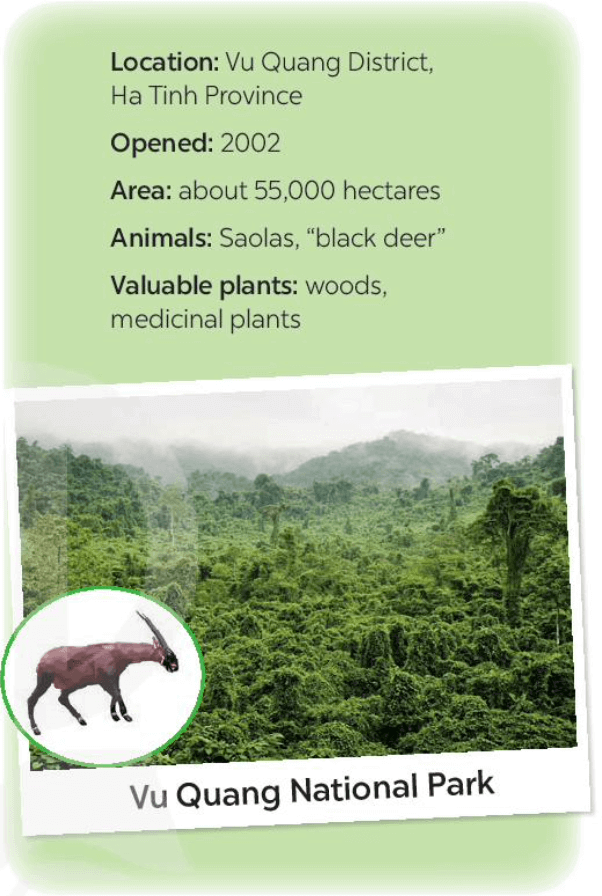
Answer:
A: Where is Vu Quang National Park?
B: It's in Vu Quang District, Ha Tinh Province.
A: When did Vu Quang National Park open?
B: It's opened in 2002.
A: What is the area of Vu Quang National Park?
B: About 55,000 hectares.
A: What kind of species does Vu Quang National Park has?
B: It has Saolas, "black deer" and also valuable plants, woods, medicinal plants.
5. Work in groups. Talk about Vu Quang National Park, using the answers in 4.
Answer:
Vu Quang National Park is in Vu Quang District, Ha Tinh Province. It opened in 2002. The area of National Park is about 55,000 hectares. It has so many kind of species. Saolas, "black deer" as the animals. And the park also has valuable plants, wood, medicinal plants.
SKILL 2
LISTENING
1. Work in groups. Make a list of some activities that cause water pollution
Answer:
- throwing rubbish into rivers and lakes
- pouring domestic wastes
- pouring industrial wastes
- using chemicals and pesticides in soil
- spilling fuel
2. Listen to the conversation and choose the correct word to complete each sentence
1. Polluted water is unsafe for drinking / cooking and for other uses.
2. Sometimes toxic substances flow into rivers from factories / hospitals.
3. Water pollution has a dangerous / harmful effect on our life.
4. We couldn't / shouldn't throw litter into rivers and lakes.
Answer:
1. drinking | 2. factories | 3. harmful | 4. shouldn’t |
Transcript:
All living things need water, but water pollution has become a serious problem. Polluted water is unsafe for drinking and for other uses. Water pollution happens when wastes and toxic substances make the water unsafe. There are two sources of water pollution, man made and natural. Man made substances pollute water when they flow into the water from factories and homes. Natural pollution occurs when rainwater with toxic chemicals flows into rivers or lakes. These rivers and lakes are a source of drinking water for humans. Water pollution has a harmful effect on our lives. But there are ways we can reduce water pollution. The first thing we can do is to treat water from factories and households. We should also stop littering, especially dumping waste into rivers and lakes. Finally, we can reduce water pollution by using green products and avoiding single use products like plastic bags.
3. Listen again and give short answers to the following questions. Use no more than THREE words
1. What is the listening text about?
2. How many sources of water pollution are there?
3. What are two common sources of drinking water?
4. What type of effect does water pollution have on our life?
5. What products can we use to reduce water pollution?
Answer:
1. Water pollution.
2. Two.
3. Rivers and lakes.
4. A harmful effect.
5. Green.
WRITING
4. Work in pairs. Read the notice and match the headings (a - e) below with the numbers (1-5)
a. Name of institution or organisation (school, etc.)
b. Body (date / time / duration / place, etc.)
c. Date of writing the notice
d. Author's name and signature
e. Contact details
(1) ABS Lower Secondary School NOTICE (2) 10 March, 20... School Writing Contest (3) Our school is organising a writing contest about the environment. Students from all the classes will participate. Interested students should contact the school by 20 March, 20... Contest details: Time: 2 p.m.-4 p.m., 5 April Place: School Grand Hall Topic: Environmental protection (4) If you have any questions, please contact us at 031-823-1231 or email abs@fmail.com. (5) Head Teacher Dr. Adam Sanders (signed) |
Answer:
1. a | 2. c | 3. b | 4. e | 5. d |
5. Write a notice for the Go Green Club leader to invite students to attend a lecture on water pollution. Use the following details.
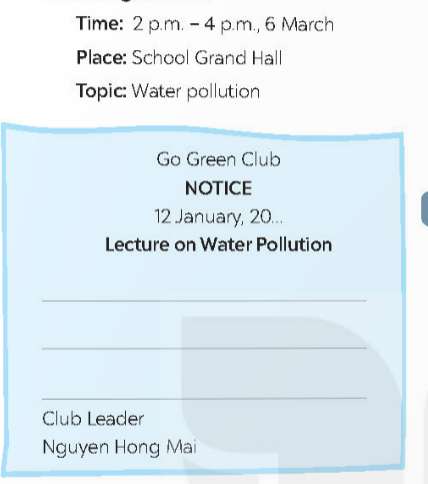
Answer:
Go Green Club
NOTICE
12 January, 2023
Lecture on Water Pollution
Go Green Club is organising a lecture about the Water Pollution. Students from all the classes will participate. Interested students should contact the school by 20 February, 2023.
Lecture details:
Time: 2 p.m - 4 p.m., 6 March
Place: School Grand Hall
Topic: Water Pollution
If you have any questions, please contact us at 031 - 823 - 1231 or email abs@fmail.com
Club Leader,
Nguyen Hong Mai
LOOKING BACK
VOCABULARY
1. Choose the correct answer A, B, or C to complete each sentence.
1. The panda’s natural ____________ is the bamboo forest.
A. habitat
B. ecosystem
C. area
2. This forest provides a habitat for hundreds of ____________ of plants and animals.
A. styles
B. classes
C. species
3. ____________ the environment must be the job of everyone in the community.
A. Caring
B. Protecting
C. Keeping
4. We should ____________ the consumption of single-use products like plastic bottles and bags.
A. reduce
B. encourage
C. raise
5. ____________ trees and burning forests destroy a lot of wildlife habitats.
A. Watering
B. Cleaning up
C. Cutting down
Answer:
1. A - The panda’s natural habitat is the bamboo forest.
2. C- This forest provides a habitat for hundreds of species of plants and animals.
3. B - Protecting the environment must be the job of everyone in the community.
4. A- We should reduce the consumption of single-use products like plastic bottles and bags.
5. C- Cutting down trees and burning forests destroy a lot of wildlife habitats.
2. Complete each of the sentences with a word or phrase from the box
carbon footprint picking up rubbish endangered species | Littering habitats |
1. Do you know that _______________ can cause pollution?
2. One effective way to reduce your _______________ is to walk or cycle whenever you can.
3. By planting trees and _______________, we can improve our environment.
4. Humans are harming the _______________ of bees throughout the world.
5. Animals such as saolas and dugongs are _______________.
Answer:
1. littering - Do you know that littering can cause pollution?
2. carbon footprint - One effective way to reduce your carbon footprint is to walk or cycle whenever you can.
3. picking up rubbish - By planting trees and picking up rubbish, we can improve our environment.
4. habitats - Humans are harming the habitat of bees throughout the world.
5. endangered species - Animals such as saolas and dugongs are endangered species.
GRAMMAR
3. Complete the following sentences using a clause. Use your own ideas
1. We should wait here until ______________________.
2. As soon as l arrived, ___________________.
3. Remember to lock the door before __________________.
4. There were not many animals on the mountain after ____________________.
5. When we finished our picnic, ____________________.
Answer:
1. We should wait here until he gets back.
2. As soon as l arrived, I will call you right after.
3. Remember to lock the door before you go out.
4. There were not many animals on the mountain after we build a campfire.
5. When we finished our picnic, we will pick up rubbish.
4. Circle A, B, or C to identify the underlined part that needs correction
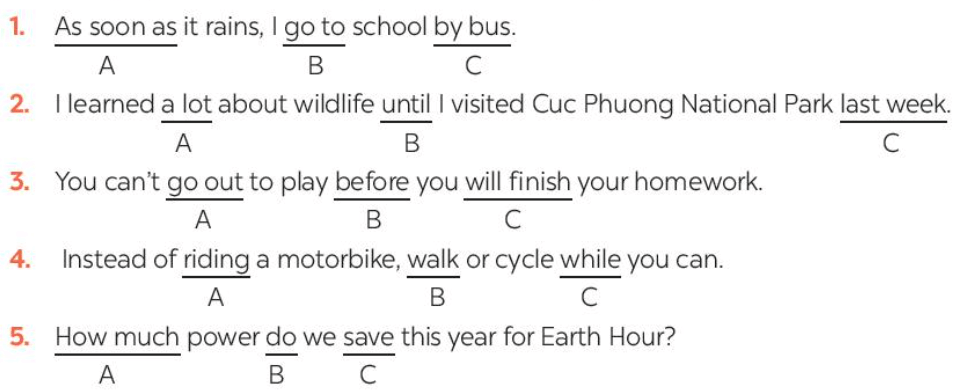
Answer:
1. A | 2. B | 3. C | 4. C | 5. B |
Explain:
1. A => Because (bởi vì)
2. B => when (khi)
3. C => finish (dùng hiện tại đơn)
4. C => when (khi)
5. B => did (dùng quá khứ đơn)
PROJECT
A serious pollution problem in my area
Work in groups.
1. Choose a serious pollution problem in your area (noise pollution, air pollution, water pollution, ...). Suggest solutions to the problem.
Answer:
Air pollution is measured by a number called the Air Quality Index (AQI), which ranges from 0-500, with anything over 150 considered “unhealthy.” The World Health Organization considers any reading above 100 to be hazardous and recommends that people avoid prolonged exposure. While Vietnamese cities such as Hanoi and Ho Chi Minh City have AHI readings around 100 or higher, many provinces have far worse levels of pollution. In some areas of the south, where there are large rubber plantations and coal mines, AQI numbers can surpass 500..
Some simple way to reduce air pollution
1. Using public transports
2. Turn off the lights when not in use
3. Recycle and reuse
4. Say no to plastic bags
5. Reduction of forest fires and smoking
6. Use of fans instead of air conditioner
7. Use filters for chimneys
8. Avoid usage of crackers
9. Avoid using of products with chemicals
10. Implement afforestation
2. Make a poster. Write your solutions on your poster. Use picture or illustrate / decorate your poster.
Answer:
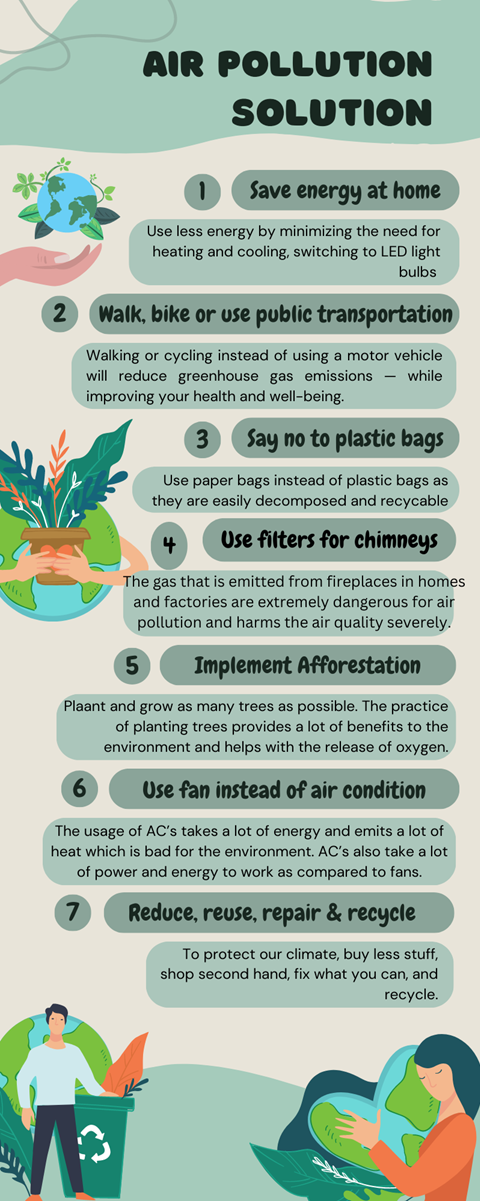
3. Present your poster to the class.
Answer:
As we can know, air pollution is measured by a number called the Air Quality Index (AQI), which ranges from 0-500, with anything over 150 considered “unhealthy.” The World Health Organization considers any reading above 100 to be hazardous and recommends that people avoid prolonged exposure. While Vietnamese cities such as Hanoi and Ho Chi Minh City have AHI readings around 100 or higher, many provinces have far worse levels of pollution. In some areas of the south, where there are large rubber plantations and coal mines, AQI numbers can surpass 500. So, what can we do to improve our air quality? Here are some simple way to reduce air pollution.
The first one is saving energy at home. You can save energy by reducing the need for heating and cooling in your house and replace normal light bulb to energy saving fluorescent lights to help the environment.
The second one is using public transport or walking or riding bike whenever you can. Doing that will not only reduce the carbon emission but also help saving money. Also, walking or riding bike is good for your health.
Next is saying no to plastic bags. The use of plastic products could be very harmful to the environment as they take a very long time to decompose, due to their material made up of oil. The use of paper bags instead is a better alternative as they decompose easily and are recyclable.
Implementing afforestation is also a way to lessen air pollution. There are a lot of volunteer group plating forests every year but we can practice it at our home by plant a tree or make a garden in the yard. Trees helps release oxygen and make the atmosphere cooler.
The next one is use fan instead of air conditioner. The usage of AC’s takes a lot of energy and emits a lot of heat which is bad for the environment. AC’s also take a lot of power and energy to work as compared to fans.
Finally, we reduce, reuse, repair and recycle. We should buy less stuff and buy second hand, fix what you can and recycle. This helps save a lot of money and protect the environment.
Tài liệu cùng môn học
Tài liệu khác
- Trắc nghiệm tiếng anh 2 Family and Friends
- Trắc nghiệm tiếng anh 2 Explore our world
- Trắc nghiệm tiếng anh 3 Family and Friends
- Trắc nghiệm tiếng anh 3 Explore our world
- Trắc nghiệm tiếng anh 4 Family and Friends
- Trắc nghiệm tiếng anh 4 Global Success
- Trắc nghiệm tiếng anh 4 Explore our world
- Trắc nghiệm tiếng anh 5 Family and Friends
- => Xem nhiều môn hơn