Giải tiếng anh 8 Global Success: Unit 10 Communication in the future
Hướng dẫn giải Tiếng anh 8 Global Success: Giải Unit 10 Communication in the future. Bài được giải chi tiết, rõ ràng, dễ hiểu. Bài giải giúp học sinh nắm vững kiến thức trong sách giáo khoa, rèn kĩ năng giải bài tập và có phương pháp học tập hiệu quả.
Nội dung chi tiết
GETTING STARTED
At the technology club
1. Listen and read.
Trang: Mark, we're having a video conference with Tech Savvy next Thursday, but ...
Mark: Hold on. Is that the technology club at the Japanese school?
Trang: Exactly. But I'm a bit worried. I've never had a video conference call.
Mark: You're kidding! Who doesn’t know how to make a video call? Alright, let’s do a practice call now.
Trang: Hmm, what do I need to do first?
Mark: It’s a piece of cake, Trang. Now, you sit in front of the computer. I'll connect with you via one of my tablets and ...
Trang: Sorry, but how can I adjust this webcam? It’s focusing on my forehead.
Mark: Use this button to move it up or down, and this to zoom in or out.
Trang: Thanks. And can you see me clearly on your tablet?
Mark: Yes, of course. We have a high-speed Internet connection here.
Trang: I hope the conference goes smoothly.
Mark: I'm sure it will. We should hold more video conferences like this in the future.
Trang: That's exactly how I feel.
2. Read the conversation again and circle the correct answer A, B, or C.
1. What are Trang and Mark doing?
A. Practising a video call.
B. Making a call with Tech Sawy.
C. Learning how to use a tablet.
2. What device does Trang need help with?
A. The tablet.
B. The computer.
C. The webcam.
3. Mark says that they should ___________ in the future.
A. have more video conferences
B. do more practice calls
C. have a high-speed Internet connection
Answer:
1. A - Explain: Mark: You're kidding! Who doesn’t know how to make a video call? Alright, let’s do a practice call now.
2. C _ Explain: Trang: Sorry, but how can I adjust this webcam? It’s focusing on my forehead.
Mark: Use this button to move it up or down, and this to zoom in or out.
3. A - Explain - Mark: I'm sure it will. We should hold more video conferences like this in the future.
3. Match the words and phrases in the conversation with their pictures.
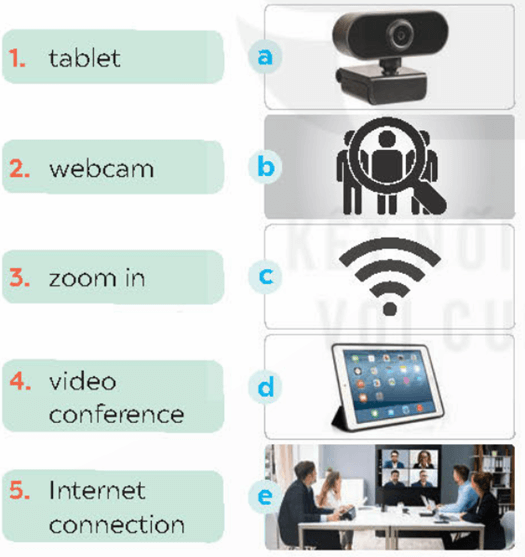
Answer:
| 1. d | 2. a | 3. b | 4. e | 5. c |
4. Circle the words / phrases which are CLOSEST in meaning to the underlined words / phrases.
1. Our English exam was a piece of cake. I got full marks on it.
A. easy
B. difficult
2. You're kidding! I can't believe Ms Mai and you are sisters.
A. serious
B. joking
3. I can't read the text on the computer screen. Can you zoom in on it?
A. make it bigger
B. make it smaller
4. We need a high-speed Internet connection to make video calls.
A. fast
B. slow
5. That's exactly how I feel. It's true that video conferences are very convenient.
A. I don't think so.
B. You are absolutely right.
Answer:
| 1. A | 2. B | 3. A | 4. A | 5. B |
Explain:
1. piece of cake = easy (dễ)
2. kidding = joking (đùa)
3. zoom in on it = make it bigger (phóng to)
4. high-speed = fast (nhanh)
5. That’s exactly how I feel. (Đó chính xác là cảm giác của tôi.) = You are absolutely right. (Bạn hoàn toàn đúng.)
5. QUIZ. Work in groups. Complete the diagram of the history of communication technology with the words and phrases from the box.
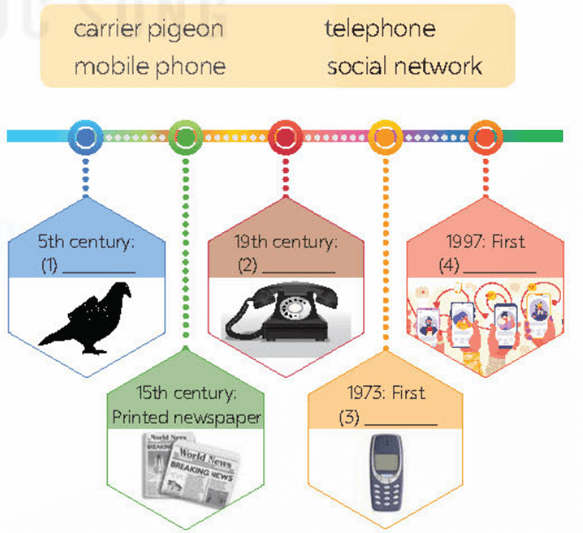
Answer:
1. carrier pigeon
2. telephone
3. mobile phone
4. social network
A CLOSER LOOK 1
VOCABULARY
1. Write the correct word or phrase from the box under each picture
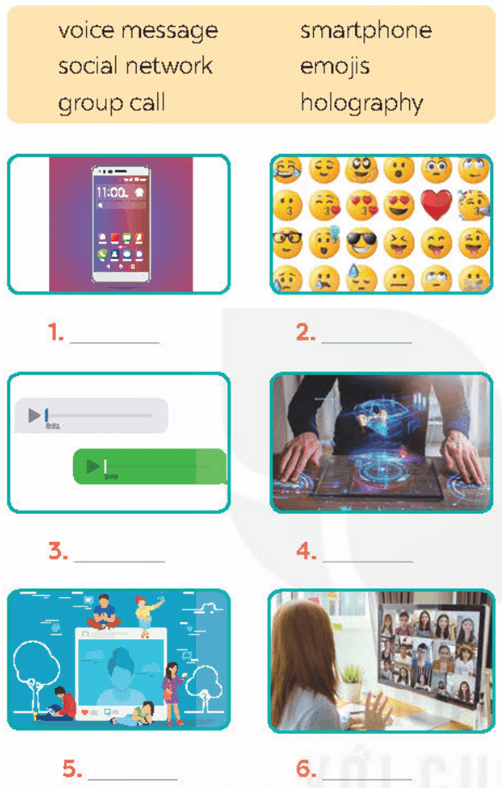
Answer:
1. smartphone
2. emojis
3. voice message
4. holography
5. social networks
6. group call
2. Choose the correct answer A, B, or C.
1. Many people add _______ to their text messages to express their feelings.
A. emojis
B. words
C. letters
2. I send _______ messages when I don't feel like talking.
A. group
B. text
C. voice
3. Many teenagers like to meet on social _________ rather than face to face.
A. television
B. networks
C. projects
4. In a __________ people in different places can join the conversation.
A. voice message
B. group call
C. system of emojis
5. By using _________, you can attend a meeting with your 3D image instead of being there in person.
A. holography
B. voice messages
C. social networks
Answer:
1. A - Many people add emojis to their text messages to express their feelings.
2. C - I send voice messages when I don't feel like typing.
3. B- Many teenagers like to meet on social networks rather than face to face.
4.B- In a group call people in different places can join the conversation.
5. A- By using holography, you can attend a meeting with your 3D image instead of being there in person.
3. Complete the sentences with the words from the box.
Translation instantly | Real private | language |
1. Do you often send ________ messages to your friends?
2. Can learning English help you overcome the ________ barrier when living abroad?
5. Telephone helps you communicate in _________ time.
4. Do you think translators will lose their jobs when _________ machines become popular?
5. Many people reply to messages ________, but others take a long time to respond.
Answer:
1. private - Do you often send private messages to your friends?
2. langauge - Can learning English help you overcome the language barrier when living abroad?
3. real - Telephone helps you communicate in real time.
4. translation - Do you think translators will lose their jobs when translation machines become popular?
5. instantly - Many people reply to messages instantly, but others take a long time to respond.
PRONUNCIATION
Stress in words ending in -ese and -ee
3. Listen and repeat the words. Pay attention to the word stress.
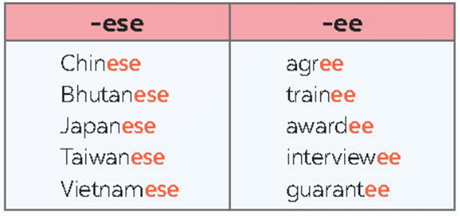
Answer:
| -ese | -ee |
Chinese Bhutanese Japanese Taiwanese Vietnamese | agree trainee awardee interviewee guarantee |
5. Mark the stress in the underlined words. Then listen and repeat the sentences.
1. The interviewees said that they were Taiwanese.
2. Joe agrees with me that learning Chinese is difficult.
3. She obtained a bachelor's degree in Japanese.
4. The Taiwanese company gave each awardee a smartphone.
5.The Japanese teacher sent a video to the absentees on Monday.
Answer:
1. interview'ees / Taiwa'nese
2. a'grees / Chi'nese
3. de'gree / Japa'nese
4. Taiwa'nese / awar'dee
5. Japa'nese / absen'tees
A CLOSER LOOK 2
GRAMMAR
Prepositions of place and time
1. Complete the sentences with at, in, in front of, on, opposite, or under
1. Lily’s house is ________ the end of this street.
2. Players always sit ________ each other in a chess game.
3. She looked _________ the table and finally found her smartwatch.
4. Don't walk _______ the street. Walk _________ the pavement.
5. Ann stood _______ me in a line to get on the bus.
Answer:
| 1. at | 2. opposite | 3. under | 4. on | 5. in front of |
2. Circle the correct preposition in each sentence
1. Let's get ready by / on / for 10 a.m. We are meeting Dr Saito at 10:15.
2. The first camera phone appeared on / at / in May 1999 in Japan.
3. We will be away on / for / by two weeks.
4. In the UK, supermarkets always close early in / by / on Sundays.
5. I think language barriers will disappear in / for / by 30 years.
Answer:
| 1. by | 2. in | 3. for | 4. on | 5. in |
3. Complete the text with the prepositions from the box. Use each preposition only ONCE.

I think smartphones will change a lot (1) _____ the near future. They will be much thinner. (2) _______ 2035, we might be able to roll a phone like a sheet of paper. They will become much smarter, too. They will be able to charge their battery automatically when we are (3) _______ home. They might check the latest news (4) _______ the Internet. We won't have to wait (5) _______ a long time for these super smartphones.
Answer:
| 1. in | 2. By | 3. at | 4. on | 5. for |
4. Work in pairs. Tell each other whether you agree or disagree with the following ideas
1. We should not use our smartphones for more than a few hours every day.
2. By 2050, the way people communicate with each other will be different from now.
Answer:
1. I agree with this idea. Smartphones are bad for your eyes. If you spend too much time looking at the phone screen for a long time, you will be short-sighted. Also, smart phones has an negative effect on your health. You can’t fall asleep if you use a smartphone before you go to bed.
2. I agree with this idea. In the future, we no longer need to visit a relative or friend to get updates. Alternatively, we can let them know our updates instantly. For many years ago, we have to travel for a long time to meet them, but in the future, we can meet our friends and relatives using video calls. Moreover, we can make so many friends via chatting or social networking.
Possessive pronouns
5. Complete the second sentence so that it has the same meaning as the first sentence.
1. Jack is one of her cousins.
Jack is a ____________________.
2. Is this one of his tablets?
Is this a _____________________?
3. Can I borrow a pencil of yours?
Can l borrow ___________________?
4. You look like Nick and Peter. Are you one of their relatives?
You look like Nick and Peter. Are you a ___________________?
5. Last year, two of our classmates won scholarships to the US.
Last year, __________________________ won scholarships to the US.
Answer:
1. Jack is a cousin of hers. Is this a tablet of his?
2. Can I borrow one of your pencils?
3. You look like Nick and Peter.
4. Are you a relative of theirs?
5. Last year, two classmates of ours won scholarships to the US.
COMMUNICATION
Everyday English
Interrupting politely
1. Listen and read the conversations below. Pay attention to the highlighted parts
Mark: Now, about the video conference ... Everyone must be here at 9:30 a.m., and ...
Trang: Sorry for interrupting, but I think we should meet at 9:00 a.m. We need to test the devices.
Nick: This webcam is easy to handle. You click these buttons to move it up or down and these to ...
Lan: Hold on. Can you repeat that, please?
2. Work in pairs. Make similar conversations with the following situations.
1. Student A is telling student B how to make a video call. Student B interrupts student A to ask for clarification.
2. Student A is telling student B the place for their next meeting. Student B interrupts student A to suggest another place.
Answer:
1.
A: First, you open Facetime application on your laptop. And then you select from your contacter or you type their phone number ...
B: I'm sorry, I didn't catch that. Can you repeat, please?
2.
A: Well, the meeting is 9 a.m tomorrow morning. We will hold a meeting in Communication room which is in floor ...
B: Sorry for interupting, but that room this occupied by the other class. We can hold a meeting in Room 401.
The future of language
3. Work in pairs. Make similar conversations with the following situations.
Mark: In 20 years, people of all ages will be using emojis even more than now. Emojis help people communicate their emotions effectively regardless of the language they speak. For example, a smiley face expresses the same meaning everywhere. An emoji can replace words to a certain extent. One day, we might receive an email that contains only emojis!
1. What means of communication is Mark talking about?
2. When will emojis become more commonly used?
3. Who will be using them?
4. How will they help in communication?
5. Why will they become more popular?
Answer:
1. Emojis.
2. In 20 years.
3. People of all ages.
4. Emojis help people communicate their attitudes effectively regardless of the language they speak.
5. Because an emoji can replace words to a certain extent / because they are convenient and effective, etc.
4. Work in pairs. Choose one means of communication below. Ask and answer questions about it
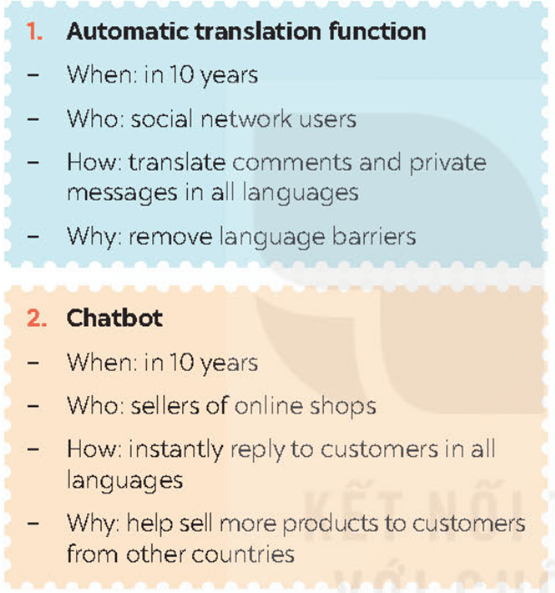
Answer:
1. Automatic translation function
1. When will automatic translation function become more commonly used?
Automatic translation function will become more commonly used in 10 years.
2. Who will be using them?
Social network users will be using them.
3. How will they help in communication?
They will translate comments and private messages in all languages.
4. Why will they become more popular?
Because they will remove language barriers.
2. Chatbot
1. When will chatbot become more commonly used?
Chatbot will become more commonly used in 10 years.
2. Who will be using them?
Sellers of online shops will be using them.
3. How will they help in communication?
They will instantly reply to customers in all language.
4. Why will they become more popular?
Because they will help sell more products to customers from other countries.
5. Report your pair’s conversation to the class by making a similar talk to Mark’s prediction in 3
Answer:
1. In 10 years, social network users will be using automatic translation functions. It helps people translate comments and private messages in all languages. And also, automatic translation functions will remove language barriers.
2. In 10 years, chatbots will become more commonly used by sellers of online shops. Chatbot helps sell more products to customers from other countries and it instantly replies to customers in all languages.
SKILL 1
READING
1. Work in pairs. List as many ways of communication as you can
Answer:
meeting face-to-face, sending letters, sending emails, texting, chatting online, sending voice messages, making phone calls, making group calls, having video calls, etc.
2. Read an interview with two students, Minh and Tom. Then tick (V) the speaker of each sentence
TELEPATHY
MC: Hi everyone. Today, I'll ask some members of the Technology Club to predict how people will communicate in the future. Let’s meet Minh and Tom.
Minh Tom: Hi everyone.
MC: Minh and Tom, how do you and your friends keep in contact?
Minh: Well, we mostly text each other. We also send voice messages.
Tom: I often see my friends in person, but sometimes we call via the Internet.
MC: Do you think these ways of communication will still be popular in 50 years?
Tom: Not really. We'll use more advanced ways, like telepathy. We'll pass our thoughts to another person without talking and...
MC: Hold on. I think only a very few people may have this ability.
Minh: Yes, but in the future, everyone will be able to use telepathy. We'll wear a tiny device to catch our thoughts and send them to other people.
MC: Cool! But will there be any problems with telepathy?
Tom: Hmm, telepathy devices can “read” one’s mind, so bad people might take advantage of it to control someone else.
MC: Besides that, some people will be too lazy to even talk anymore.
| Who says that….? | Minh | Tom |
| 1. he sends voice messages to friends | ||
| 2. he calls his friends by using the Internet | ||
| 3. everyone will be able to use telepathy in the future | ||
| 4. people need a small device to send their thoughts to others | ||
| 5. bad people can make use of telepathy to harm others |
Answer:
1. Minh (Explain: Minh: Well, we mostly text each other. We also send voice messages.)
2. Tom (Explain: Tom: I often see my friends in person, but sometimes we call via the Internet.)
3. Minh (Explain: Minh: Yes, but in the future, everyone will be able to use telepathy.)
5. Minh (Explain: Minh: We'll wear a tiny device to catch our thoughts and send them to other people.)
5. Tom (Explain: Tom: Hmm, telepathy devices can “read” one’s mind, so bad people might take advantage of it to control someone else)
3. Read the interview again. Choose the correct answer A, B, or C.
1. What is the interview mainly about?
A. One way of future communication.
B. Voice chats and online calls.
C. Problems of telepathy.
2. Which way of communication below is NOT mentioned in the interview?
A. Meeting face to face.
B. Writing an email.
C. Telepathy.
3. According to Tom, telepathy means _______________.
A. making phone calls via the Internet
B. talking on tiny devices
C. communicating by thoughts
4. The MC says that ________________.
A. telepathy is perfect
B. not all people can do telepathy
C. she disagrees with Minh's opinion
5. What does the MC think may be a problem with telepathy?
A. People won't want to meet each other.
B. Telepathy devices can be expensive.
C. Some people won't want to talk anyrnore.
Answer:
1. A ( Explain: MC: Hi everyone. Today, I'll ask some members of the Technology Club to predict how people will communicate in the future. Let’s meet Minh and Tom. )
2. B (Explain: Minh: Well, we mostly text each other. We also send voice messages.
Tom: I often see my friends in person, but sometimes we call via the Internet.
3. C (Explain: Minh: Yes, but in the future, everyone will be able to use telepathy. We'll wear a tiny device to catch our thoughts and send them to other people.
4. B (Explain: MC: Hold on. I think only a very few people may have this ability.)
5. C (Explain: MC: Besides that, some people will be too lazy to even talk anymore.
SPEAKING
4. Work in pairs. Read the following ideas about online calls. Put the ideas in the correct column.
a. They’re cheap or even free.
b. There must be an Internet connection.
c. You can talk to people from distant places.
d. You may receive unwanted calles.
e. You can make group calls.
f. You need a smart device.
Answer:
| Advantages: a, c, e | Disadvantages: b, d, f |
5. Work in groups. Choose a way of communication and discuss its advantages and disadvantages. Then report your answers to the class
Answer:
I think there are both advantages and disadvantages of online calls. Online communication makes life more accessible because it can help people learn and develop. It is also worth admitting that online communication is helpful because it contributes to the fact that ordinary people have access to information that they did not previously know. In addition to that, online communication has also participated in enriching the research field. Irrespective of the information above, it is impossible to ignore the fact that online communication can imply some drawbacks. The possible disadvantages include the “lack of security, Internet addiction, information overload, and loss of social contacts”.
SKILL 2
LISTENING
1. Look at the pictures. Complete the word / phrase for each picture.
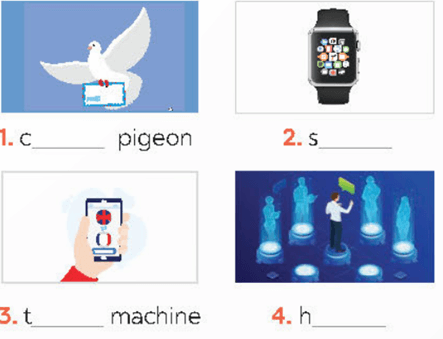
Answer:
| 1. carrier pigeon | 2. smart watch | 3. time machine | 4. holography |
Explain:
1. carrier pigeon: chim bồ câu đưa thư
2. smart watch: đồng hồ thông minh
3. time machine: cỗ máy thời gian
4. holography: hình ba chiều
2. Listen to an announcement about an exhibition. Complete each gap in the agenda with One word or a number.
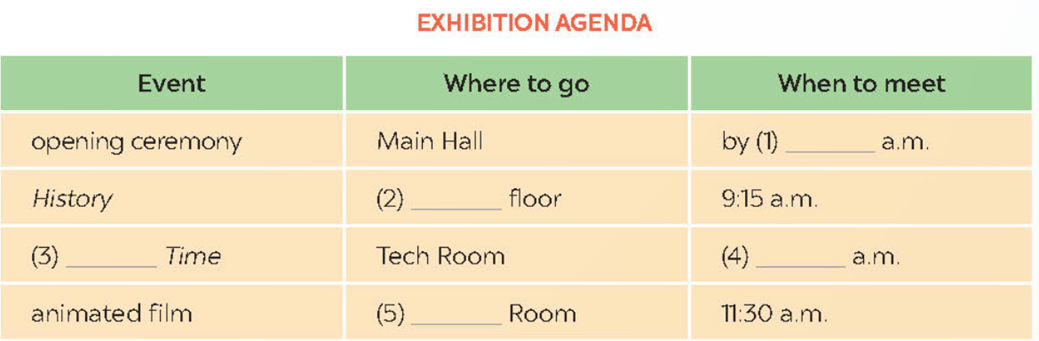
Answer:
| 1. 8:20 | 2. First | 3. Modern | 4. 10:15 | 5. Cinema |
Transcript:
Hi students, here's our plan for the exhibition tomorrow morning. First, the opening ceremony is at the main hall. We'll listen to Doctor Lam introduce the exhibition. The ceremony starts at 8:30 AM, so remember to meet me at the main hall by 8:20. Next, we'll visit the history section.
It's on the 1st floor. You'll see pictures of different ways people communicated in the past, such as smoke signals and carrier pigeons. We'll be there from 9:15 to 10:00. Then we'll move to the Modern Times section. It's in the tech room. You will see devices with Internet connections like smartphones and smartwatches. I'm sure you'll like it very much.
But we can only spend an hour there, from 10:15 to 11:15. Finally, we'll watch an animated film in the cinema room. The film is about communication devices in the future, like personal translation machines and holography. We must be at the cinema room by 11:30 AM now.
3. Listen again. Circle the correct answer A, B, or C.
1. Who is making the announcement?
A. A teacher.
B. Astudent
C. Dr Lam.
2. What is in the History section?
A. An introductory talk.
B. A documentary.
C. Many pictures.
3. What is NOT true about the Modern Time section?
A. Students won't like this section.
B. It shows smart devices.
C. They will be there for one hour.
4. What will the film in the Cinema Room be about?
A. Super smartwatches.
B. Translation devices for personal use.
C. Telepathy machines.
5. In general, what does the exhibition show?
A. Problems of modern technology.
B. History of smartphones.
C. Means of communication.
Answer:
- A _ (Explain: Hi students! )
2. C (Explain: Next, we'll visit the "History” section. It's on the first floor. You'll see pictures of... )
3. A ( Explain: I'm sure you'll like it very much…)
4. B (Explain: The film is about communication devices in the future, like personal translation machines and holography.)
WRITING
4. Work in pairs. Match the ideas (a - h) with parts of an outline (1- 4) for a paragraph about a video call.
1. What is it?
2. What are its advantages?
3. What are its disadvantages?
4. Will people use it in the future?
a. a phone call using Internet connection
b. needs a high-speed Internet access
c. saves time because people needn't travel to meet
d. transmits live images of the speakers with a webcam or camera on smart devices
e. may spend too much time chatting with each other
f. can be useful for family members and business partners
g. will still be a common tool of communication
h. can see and hear each other in real time
Answer:
1. What is it: a, d
2. Advantages: c, f, h
3. Disadvantages: b, e
4. Will people use it in the future: g
5. Write a paragraph (80 - 100 words) to describe a way of modern communication. You can use the ideas in 4 or your own ideas.
Answer:
One popular way of modern communication is using social media. Platforms like Facebook, Instagram, and Zalo allow people to send messages, share photos, and make video calls easily. It is fast, convenient, and helps people stay connected with family and friends, even if they live far away. Many people also use social media for work or study, such as joining online groups or attending virtual meetings. With just a smartphone and internet, people can communicate anytime and anywhere. That’s why social media has become an important part of modern life.
LOOKING BACK
VOCABULARY
1. Circle the correct option to complete each sentence below.
1. My classmates connect with each other on a(n) social network / emoji called Friends-connect.
2. Holography / Telepathy helps people communicate by thoughts.
3. Sending voice messages / text messages is convenient because you don't have to type.
4. In the future, everyone can carry a human translator / translation machine with them whenever they go abroad.
5. If you have a high-speed Internet connection, making a group call / meeting face to face is a piece of cake.
Answer:
| 1. social network | 2. Telepathy | 3. voice messages |
| 4. translation machine | 5. making a group call |
2. Fill in each gap with a word from the box to complete the passage.

In 30 years, social robots will become popular. This kind of robot is special because it can perform many human tasks. For example, it can send a (1) ___________ message to its owner to remind them of dinner time. Some social robots may even have (2) ______________ network accounts and interact with other users in (3) ____________ time. For these robots, (4) _____________ barriers are not a problem, so they can (5) ______________ reply to comments or messages in any language. It might be frightening because we won't know whether we are chatting with a human or a robot online!
Answer:
| 1. text | 2. social | 3. real | 4. language | 5. instantly |
Full paragraph:
In 30 years, social robots will become popular. This kind of robot is special because it can perform many human tasks. For example, it can send a text message to its owner to remind them of dinner time. Some social robots may even have social network accounts and interact with other users in real time. For these robots, language barriers are not a problem, so they can instantly reply to comments or messages in any language. It might be frightening because we won't know whether we are chatting with a human or a robot online!
GRAMMAR
3. Complete the sentences with the prepositions from the box. Tick (V) the sentences which have prepositions of time.

1. I talk to my mum _______ the phone every weekend.
2. Maria texted me that she would be home _______ 10 minutes.
3. Phong waited ________ an hour. Then he called Ann and said that he had to leave.
4. Where's Ms Lan? - She's in the _______ room. She's having a video conference.
5. Telepathy might be the most popular way to communicate ______ 2050.
Answer:
1. on - I talk to my mum on the phone every weekend.
2. in - Maria texted me that she would be home in 10 minutes.
3.for - Phong waited for an hour. Then he called Ann and said that he had to leave.
4. opposite - Where's Ms Lan? - She's in the opposite room. She's having a video conference.
5. by - Telepathy might be the most popular way to communicate by 2050.
4. Which of the underlined parts in each question is incorrect? Find and correct it.
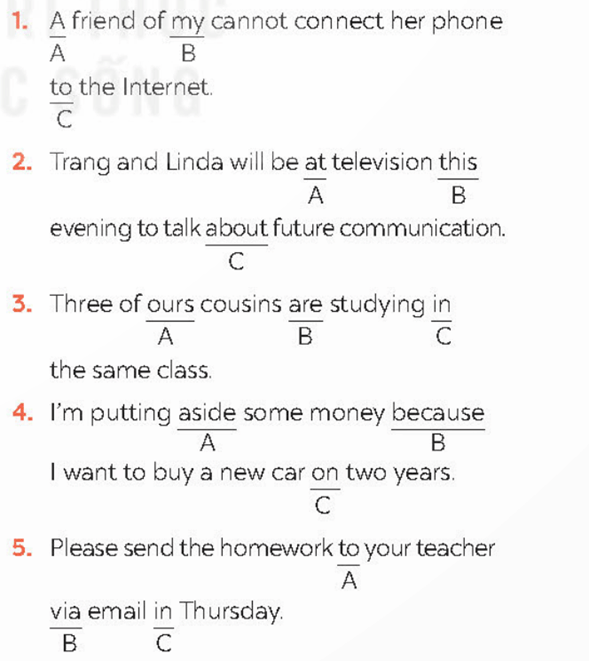
Answer:
1. B (my - mine)
Explain: Tính từ sở hữu không đứng trước động từ, chúng ta có cụm: mạo từ + danh từ + of + đại từ sở hữu.
Correction: A friend of mine cannot connect her phone to the Internet.
2. A (at - on)
Explain: Sử dụng sai giới từ
Correction: Trang and Linda will be on television this evening to talk about future communication.
3. A (ours - our)
Explain: Tính từ sở hữu đứng trước danh từ.
Correction: Three of our cousins are studying in the same class.
4. C (on - in)
Explain: Sử dụng sai giới từ.
Correct: I'm putting aside some money because I want to buy a new car in two years.
5. C (in - by / on)
Thứ ngày trong tuần đi với on.
Correction: Please send the homework to your teacher via email on Thursday.
PROJECT
Imagine a means of communication in 2050
Work in groups.
1. Imagine a means of communication in 2050.
Answer:
mind-to-mind messaging
1. Describe that means of communication.
- What is it?
- How will it help you communicate?
- What advantages might it have?
- Will it have any disadvantages? If yes, what are they?
Answer:
In 2050, people may use a new means of communication called mind-to-mind messaging. This technology allows people to send thoughts and emotions directly using brainwave signals, with the help of special headsets or brain chips. It helps communication become faster and easier because there is no need to speak, write, or type. The biggest advantages are instant understanding and no language barriers, since the device can translate brain signals into any language. However, it may also have disadvantages. For example, people may lose their privacy if the system is hacked or misused.
3. Present your idea to the class. You can make a poster or create a model for your presentation.
Answer:
Hello everyone! Today, I want to share a cool idea for future communication in the year 2050. It’s called mind-to-mind messaging. Instead of texting or calling, we can send our thoughts directly using special headsets or brain chips. This will help us communicate faster and understand each other better, even if we speak different languages. It’s also very helpful for people who can’t speak or write. But, we must be careful with privacy. If someone hacks the system, our thoughts could be stolen! I believe this idea will change the world!”
Tài liệu cùng môn học
Tài liệu khác
- Trắc nghiệm tiếng anh 2 Family and Friends
- Trắc nghiệm tiếng anh 2 Explore our world
- Trắc nghiệm tiếng anh 3 Family and Friends
- Trắc nghiệm tiếng anh 3 Explore our world
- Trắc nghiệm tiếng anh 4 Family and Friends
- Trắc nghiệm tiếng anh 4 Global Success
- Trắc nghiệm tiếng anh 4 Explore our world
- Trắc nghiệm tiếng anh 5 Family and Friends
- => Xem nhiều môn hơn