Giải tiếng anh 8 Global Success: Unit 12 Life on other planets
Hướng dẫn giải Tiếng anh 8 Global Success: Giải Unit 12 Life on other planets. Bài được giải chi tiết, rõ ràng, dễ hiểu. Bài giải giúp học sinh nắm vững kiến thức trong sách giáo khoa, rèn kĩ năng giải bài tập và có phương pháp học tập hiệu quả.
Nội dung chi tiết
GETTING STARTED
I’m keen on doing DIY (do - it - yourself)
1. Listen and read.
Mai: What book are you reading, Nick?
Nick: A joumey back to Soduka. I'm on the last page.
Mai: That’s a science fiction book, isn't it? What's it about?
Nick: Yes, it is. It's about four creatures Titu, Kaku, Hub, and Barb. They're travelling back to Soduka, a planet like Earth. Along the way they have to land on Earth because their spaceship breaks down. They meet Tommy and become friends with him.
Mai: What happens next?
Nick: Tommy helps the four creatures repair their spaceship, so they can travel back to their home planet. But their commander forces them to return to Earth to destroy it. Tommy and the four creatures try to oppose the commander.
Mai: Sounds thrilling!
Nick: Tommy and the four creatures manage to stop the commander from destroying Earth.
Mai: So it has a happy ending! What do you think about the possibility of aliens attacking Earth?
Nick: I'm not sure about it. But I’m starting to think about it. l sometimes ask myself what we would do if aliens took over our planet.
2. Read the conversation again and tick (V) T (True) or F (False)
1. Soduka is a planet that is very different from Earth.
2. Titu, Kaku, Hub, and Barb have to land on Earth because their spaceship breaks down.
3. Tommy helps the four creatures make a new spaceship so that they can return to Soduka.
4. The four creatures travel to Earth again to visit Tommy.
5. The novel makes Nick and Mai think about the possibility that Earth might be attacked by aliens.
Answer:
1. F | 2. T | 3. F | 4. F | 5. T |
Explain:
1. Nick: Yes, it is. It's about four creatures Titu, Kaku, Hub, and Barb. They're travelling back to Soduka, a planet like Earth. Along the way they have to land on Earth because their spaceship breaks down. They meet Tommy and become friends with him.
2. Nick: Yes, it is. It's about four creatures Titu, Kaku, Hub, and Barb. They're travelling back to Soduka, a planet like Earth. Along the way they have to land on Earth because their spaceship breaks down. They meet Tommy and become friends with him.
3. Nick: Tommy helps the four creatures repair their spaceship, so they can travel back to their home planet. But their commander forces them to return to Earth to destroy it. Tommy and the four creatures try to oppose the commander.
4. Nick: Tommy helps the four creatures repair their spaceship, so they can travel back to their home planet. But their commander forces them to return to Earth to destroy it. Tommy and the four creatures try to oppose the commander.
5.
Mai: So it has a happy ending! What do you think about the possibility of aliens attacking Earth?
Nick: I'm not sure about it. But I’m starting to think about it. I sometimes ask myself what we would do if aliens took over our planet.
3. Match the words (1 - 5) with their definitions (a - e).
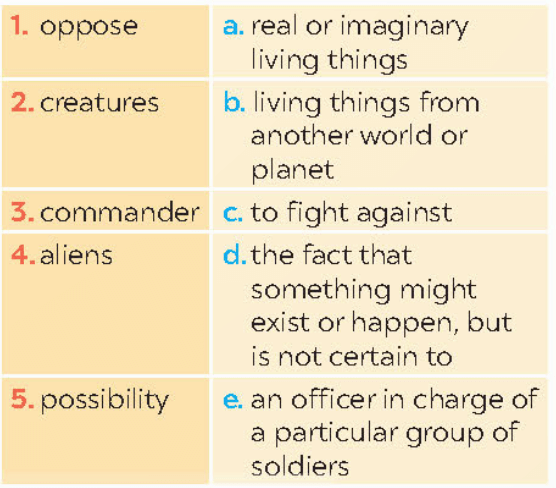
Answer:
1. c | 2. a | 3. e | 4. b | 5. d |
Explanation
1 - c: oppose - to fight against
2 - a: creatures - real or imaginary living things
3 - e: commander - an officer in charge of a particular group of soldiers
4 - b: aliens - living things from another world or planet
5 - d: possibility - the fact that something might exist or happen, but is not certain to
4. Complete the sentences with the words in 3.
1. There is a ________ that we might visit Mars in the near future.
2. The main character in the film is a boy who makes friends with some __________ from a planet.
3. Dogs are more social __________ than cats.
4. These soldiers were punished because they didn’t obey their ___________ .
5. Some people ____________ sending spaceships to explore other planets.
Answer:
1. possibility | 2. aliens | 3. creatures | 4. commander | 5. oppose |
5. Work in groups. Discuss the following questions. Then report your group’s answers to the class.
Do you believe that there is life on other planets? Why / Why not?
Answer:
I believe we’ll soon find life right here in our own solar system. Mars once had a warm, Earth-like climate, with a protective atmosphere and liquid water on the surface. Microbes from these early days might still survive on Mars in today’s harsh conditions by inhabiting hot springs or in warm aquifers and rocks below the surface, where there is energy, water, and probably organic material—the conditions for life as we know it.
A CLOSER LOOK 1
VOCABULARY
A thrilling science fiction novel
1. The following are the eight planets that go around the sun. Put them in order from the closest to the farthest from the sun. This sentence will help you learn the order of the planets

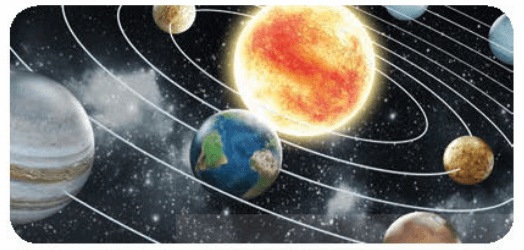
Answer:
1. Mercury | 2. Venus | 3. Earth | 4. Mars |
5. Jupiter | 6. Saturn | 7. Uranus | 8. Neptune |
2. Match the words (1 - 5) with the pictures (a - e).
into | keen | interested | about | fond |
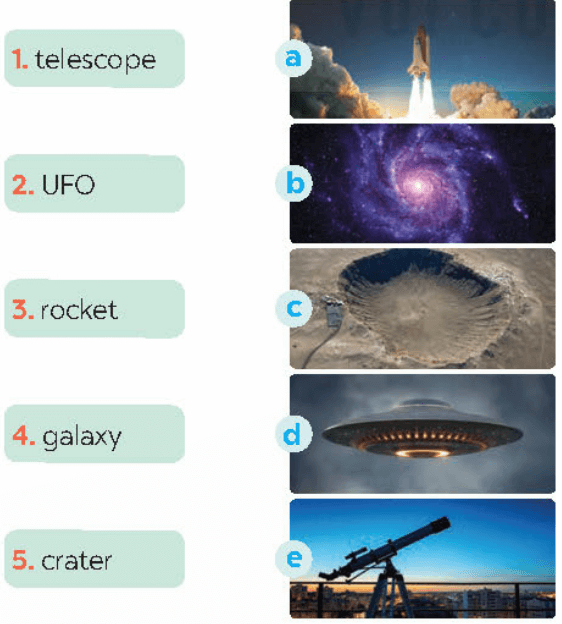
Answer:
1. e | 2. d | 3. a | 4. b | 5. c |
3. Complete the following sentences with the words from the box.

1. There are many _________ on the surface of the moon.
2. We use a _________, which is in the shape of a big tube, for travelling or carrying things into space.
3. We need to use a _________ to clearly see the surface of the moon.
4. The planet which is the second closest to the sun is ___________.
5. The Milky Way is the ___________ that includes our solar system.
Answer:
1. craters | 2. rocket | 3. telescope | 4. Venus | 5. galaxy |
PRONUNCIATION
Intonation for making lists
4. Listen and repeat the sentences. Pay attention to the tones of the underlined words in each sentence.
1. I'd like some eggs, some milk, some cheese, and some bread, please.
2. My father can speak four languages: English, French, Russian, and Spanish.
3. My favourite sports are football, tennis, basketball, and volleyball.
4. My kitten is cute, smart, playful, and noisy.
5. The outer planets, which are made up mostly of gas, include Jupiter, Saturn, Uranus, and Neptune.
Answer:
1. I'd like some eggs, some milk, some cheese, and some bread, please.
2. My father can speak four languages: English, French, Russian, and Spanish.
3. My favourite sports are football, tennis, basketball, and volleyball.
4. My kitten is cute, smart, playful, and noisy.
5. The outer planets, which are made up mostly of gas, include Jupiter, Saturn, Uranus, and Neptune.
5. Listen to the conversations. Do you think the voice goes up or down on the underlined words in each second sentence? Draw a suitable arrow on each underlined word.
1. A: Good evening! What can I get you, sir?
B: I'd like some pork, some chicken, some tofu, and some vegetables.
2. A: What did you buy at the clothing store yesterday?
B: I bought a T-shirt a jumper a tie, and a cap
3. A: What music do you like?
B: I like pop, blues, country and jazz
4. A: What do you think we should bring with us to Mars?
B: I think we should bring food, water, clothes and a tent
Answer:
Go up words | Go down words |
pork, chicken, tofu T-shirt, jumper, tie pop, blues, country food, water, clothes | vegetables cap jazz tent |
A CLOSER LOOK 2
GRAMMAR
Reported Speech (Questions)
1. Underline the correct word or phrase for each sentence.
1. He phoned to ask his mother what she was doing now / then.
2. Ann wondered what plants Vietnamese people grow / grew for food.
3. Peter phoned the shop to ask what specialities they are selling there / here.
4. The student asked his professor what forms of life can / could exist on Mars.
5. He wanted to know how many planets there were / were there in our solar system.
Answer:
1. then | 2. grew | 3. there | 4. could | 5. there were |
2. Put the words and phrases in the correct order to make reported questions.
1. how many moons / My little brother / asked me / had / Venus / .
2. which / She / planet / the closest / wanted to know / was / to the sun / .
3. asked the scientists / The journalist / what / for / were using / telescopes / in space / they / .
4. wanted to know / when / The scientists / travel to Mars / would be able to / humans /.
5. He / what / were / asked the professor / to have life / for a planet / the conditions / on it /.
Answer:
1. how many moons / My little brother / asked me / had / Venus / .
2. which / She / planet / the closest / wanted to know / was / to the sun / .
3. asked the scientists / The journalist / what / for / were using / telescopes / in space / they / .
4. wanted to know / when / The scientists / travel to Mars / would be able to / humans /.
5. He / what / were / asked the professor / to have life / for a planet / the conditions / on it /.
3. Change the following questions into reported questions.
1. “Who will be the first to step on Mars?” Mary asked the scientist.
2. “How fast can a UFO travel?” I asked my father.
3. The student asked his friend, “How many craters does the moon have?”
4. The pupils asked the teacher, “Where can we find information about the solar system?”
5. “What is the weather on Mars like?” I asked my teacher.
Answer:
1. Mary asked the scientist who would be the first to step on Mars.
2. I asked my father how fast a UFO could travel.
3. The student asked his friend how many craters the moon had.
4. The pupils asked the teacher where they could find information about the solar system.
5. I asked my teacher what the weather on Mars was like.
4. Report the conversation between An and Mai
An: What are you reading, Mai?
Mai: I'm reading Aliens, and I’m almost done.
An: What kind of book is it?
Mai: It's science fiction.
An: What's it about?
Mai: It's about three aliens who try to take over Earth.
Answer:
An asked Mai what she was reading. Mai told An that she was reading Aliens and she was almost done. Next, An asked Mai what kind of book it was. Mai said to An that it was science fiction. And An asked Mai what it was about. Mai told An that it was about three aliens who tried to take over Earth.
5. Work in pairs. Ask your partner five questions about his / her daily routine and make notes of his / her answers. Then report your questions and your partner’s answers to the class
Answer:
1. I asked Linh what time she got up in the morning and she told me (that) she got up at 7 a.m.
2. I asked Giang what time she had breakfast and she told me she had breakfast at 7.15 a.m.
3. I asked My what time she went to school and she told me that she went to school at 7.30 a.m.
4. I asked A what time he took a shower in the evening and he told me that he took a shower at 8.30 p.m.
5. I asked A what time he went to bed and he told me that he went to bed at 9 p.m.
COMMUNICATION
Everyday English
Expressing uncertainty
1. Listen and read the conversations. Pay attention to the highlighted sentences.
1.
Nick: Do you think Mars may support life?
Mark: I'm not sure about it. Scientists are trying to find life there.
2.
Mary: Do you think Ann will win tomorrow?
Tommy: I doubt it. She injured her arm in a match last week.
2. Work in pairs. Make similar conversations with the following situations.
1. You are not sure about the possibility of water on Mars.
2. You doubt that one of your friends will get a good mark on the English test.
3. You are not sure if the weather will be fine tomorrow.
Answer:
1.
A: Do you think Mars may have water?
B: I’m not sure about it. We haven’t seen water here yet.
2.
A: Do you think Brandon will get good marks on the English test?
B: I doubt it. He is lazy.
3.
A: Do you think the weather will be fine tomorrow?
B: It’s very unlikely. It’s raining today.
Three planets in the solar system
3. Read the information below and answer the questions that follow.
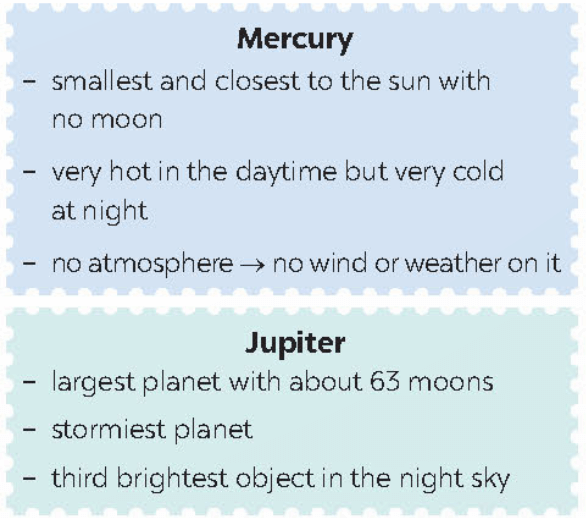
1. What planets have no moon?
2. What planet is similarin size to Earth?
3. What planet is the smallest and closest to the sun?
4. What planet is called the morning star?
5. What is the largest and stormiest planet?
Answer:
1. (They are) Mercury and Venus.
2. (It is) Venus.
3. (It is) Mercury.
4. (It is) Venus.
5. (It is) Jupiter.
4. Work in pairs. Discuss and match the three planets in 3 with the pictures (1 - 3) below.
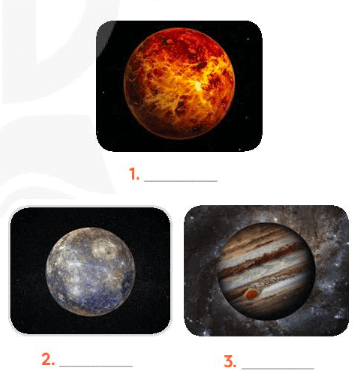
Answer:
1. Venus | 2. Mercury | 3. Jupiter |
5. Work in groups. Take turns to talk about one of the three planets in 3.
Report your group's answers to the class.
Answer:
- I would like to tell you about Mercury. It is the smallest planet. It is the closest planet to the sun, and it doesn’t have any moons. It is hot in the daytime but very cold at night. Mercury doesn’t have atmosphere so there is no wind or weather.
- I would like to tell you about Jupiter, which is the largest planet with about 63 moons. It is known as the stormiest planet and the third brightest object in the night sky.
SKILL 1
READING
1. Work in pairs. Discuss the following questions.
1. What do you know about other planets?
2. Would you like to live on another planet? Why / Why not?
Answer:
1. I would like to tell you about Jupiter, which is the largest planet with about 63 moons. It is known as the stormiest planet and the third brightest object in the night sky.
I would like to tell you about Venus. It is the hottest planet with no moon. Venus is also the planet nearly as big as Earth. People call it the morning star because it is often very bright in the early morning.
2. There's no place like home. We have yet to find another planet that fits us so perfectly. So, my first choice would be to stay here and fix the insane mess we are making on this planet.
2. Read the text and match the highlighted words in the text with their meanings.
Nowadays humans are still wondering what planets in outer space might support life.
Scientists say planets need to meet three main conditions to support life. Firstly, they must have liquid water, so their temperature must not be too high or too low. Secondly, the planets need to have the correct amount of air so that they can hold an atmosphere around. Finally, their size is also important. If a planet is too small, its gravity is not strong enough to hold an enough amount of air. If it is too big, its gravity will be so strong that it will hold too much air.
Scientists are using space telescopes to find habitable planets. According to them, Mars is one of the most promising planets for life in our solar system. It is a planet like Earth. Its days last for 24.5 hours and its seasons are similar to Earth's. Although scientists have not found actual water on Mars, there seems to be traces of it on the planet's surface. However, the climate on Mars is unsuitable for human life because it is too cold and Mars lacks oxygen to support human life.
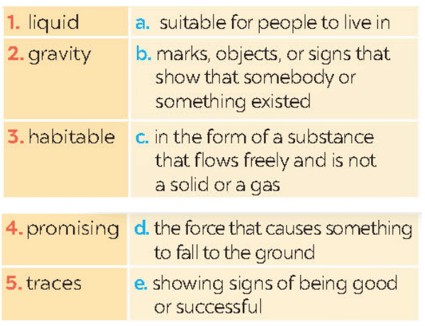
Answer:
1 - c: liquid - in a form of a substance that flows freely and is not a solid or a gas.
2 - d: gravity - the force that causes something to fall to the ground.
3 - a: habitable - suitable for people to live in.
4 - e: promising - showing signs of being good or successful.
5 - b: traces - marks, objects, or signs that show that somebody or something existed.
3. Read the text again and answer the following questions.
1. What are humans still wondering nowadays?
2. Why does a habitable planet need to have the correct amount of air?
3. What happens if a planet is too small?
4. How long does a day on Mars last?
5. Why can we not live on Mars?
Answer:
1. They are still wondering what planets in outer space might support life.
2. It needs to have the correct amount of air to hold an atmosphere around it.
3. Its gravity is not strong enough to hold an enough amount of air.
4. Its day lasts for 24.5 hours.
5. Because it is too cold and lacks oxygen
SPEAKING
4. Work in pairs. Tick (V) the boxes to show what conditions a planet needs to support human life.
1. There must be enough liquid water on the planet.
2. The planet must have craters on its surface.
3. The planet must hold an atmosphere.
4. The planet must have at least two moons.
5. The planet must have enough oxygen in the air.
Can you add other conditions for a habitable planet?
Answer:
– The planet must experience at least two seasons.
– The planet's temperature of the planet must be suitable for humans to live on it.
– There must be enough sources of energy on the planet.
– The planet must be a comfortable distance away from a star.
– The planet must rotate on its axis and revolve.
– The planet must hold an atmosphere.
– The stars around the planet must be stable.
– The planet must have carbon that is found in all living things.
5. Work in groups. Take turns to talk about the conditions you think are required for a planet to support human life. Use the information in 4 and your own ideas.
Answer:
There are some conditions planets must have to support human life on them. First, the most important condition is that there must be enough liquid water on the planet. Second, the planet must hold an atmosphere. And the planet must have enough oxygen in the air for people to survive.
SKILL 2
LISTENING
1. Work in pairs. Look at the picture and answer the following questions.
1. Where do you think this creature is from?
2. What do you think it can do?
Answer:
1. It is from another planet/ Mars/ Venus …
2. It can jump. It can catch 4 fish at the same time with his hands. It can do handstand …
2. You will hear a student talking about an imaginary planet that supports life. Listen and choose the correct answer A, B, or C
1. Planet Hope is located __________.
A. in the Milky Way Galaxy
B. in the Andromeda Galaxy
C. close to the Milky Way Galaxy
2. Planet Hope is ______________.
A. as big as Earth
B. half the size of Earth
C. three times the size of Earth
3. The climate on Planet Hope is ______________.
A. very hot all year around
B. very cold all year around
C. hot in the day but very cold at night
4. Hopeans have thick skin to protect then from ____________.
A. the heat
B. the cold
C. alien attacks
5. Hopeans drink _______________.
A. liquid water from the sea
B. petrol from under the ground
C. almost nothing
Answer:
1. A | 2. C | 3. A | 4. A | 5. B |
Transcript:
Good morning, everyone. Today I’d like to tell you about life on a planet called Planet Hope.
Planet Hope is in the Milky Way Galaxy. It is three times bigger than Earth. It has three suns and four moons, so the weather is hot all year round, and its surface is quite dry. Planet Hope has only one season. The creatures living there are Hopeans, and they don’t look like us. They have a big head, four eyes, two legs and four arms. They have thick skin to protect them from the heat. They are very friendly and hospitable. They are only dangerous to people who try to attack them. Hopeans grow special plants for food. They don’t drink liquid water; they drink a type of petrol from under the ground. Hopeans use rockets to travel at very high speeds. That is my description of Planet Hope and the creatures living on it. I hope you enjoyed it and thank you for listening.
3. Read the following information about Hopeans. Listen again and fill in each blank with ONE word or number that you hear
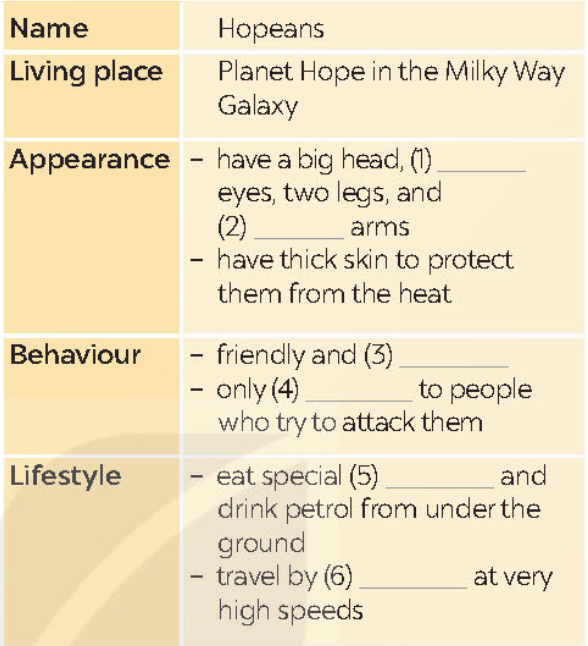
Answer:
1. 4 (four) | 2. 4 (four) | 3. hospitable |
4. dangerous | 5. plants | 6. rockets |
WRITING
4. Work in pairs. Use your imagination to make notes in the table below about what aliens living on another planet would be like.
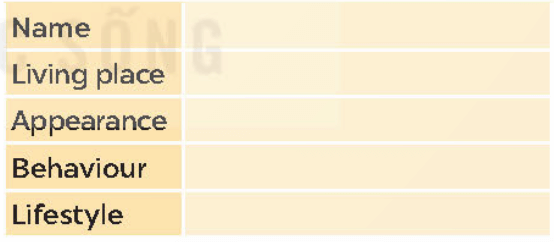
Answer:
Name | Enviamans |
Living place | Dreamy Planet in the Milky Way Galaxy |
Appearance | Have a small head, big eyes, two legs, long arms and a short tail They are blue, have a thick skin to protect them from the heat |
Behaviour | Friendly Only attack to people who try to attack them |
Lifestyle | Eat rocks and drink water from the ocean They can fly with high speeds |
5. Write a paragraph (80 - 100 words) describing aliens living on another planet. Use your notes in 4.
Answer:
Creatures living on Dreamy Planet are called Enviamans. They Have a small head, big eyes, two legs, long arms and a short tail. They are blue, have a thick skin to protect them from the heat. Enviamans are friendly. They only attack to people who try to attack them. This creature also has a special lifestyle. They eat rocks and drink water from the ocean to survive. And they can fly with high speeds.
LOOKING BACK
VOCABULARY
1. Write a word under each picture.
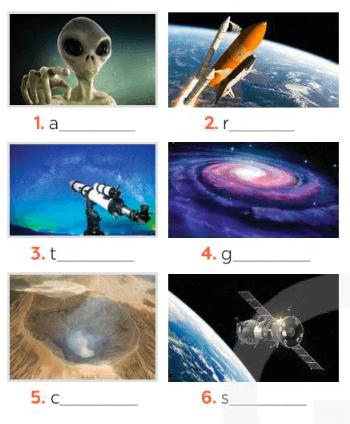
Answer:
1. alien | 2. rocket | 3. telecope |
4. galaxy | 5. crater | 6. satellite |
2. Circle the correct words to complete the sentences.
1. UFOs / Rockets are spaceships from another planet.
2. We have no possibility / condition of making our own spaceship.
3. We can't find any living craters / creatures in the solar system except for us.
4. Scientists are working to find a habitat / habitable planet.
5. The gravity / atmosphere of the Earth makes things fall to the ground when we drop them.
Answer:
1. UFOs | 2. possibility | 3. creatures | 4. habitable | 5. gravity |
GRAMMAR
3. Rewrite each sentence so that it is closest in meaning to the original one.
1. “What is this novel about?” said Mary.
Mary wanted to know _________________.
2. “Who's your favourite actor, Nick?” I said.
I asked Nick _________________________.
3. “What time does the next train leave?” Mai said to me.
Mai asked me _______________________.
4. “How do the scientists observe the other planets?” the students asked.
The students wondered ________________.
5. Mai wondered, “Why can't humans live on Mars?”
Mai wondered _______________________.
Answer:
1. Mary wanted to know what that novel was about.
2. I asked Nick who his favourite actor was.
3. Mai asked me what time the next train left.
4. The students wondered how the scientists observed the other planets.
5. Mai wondered why humans couldn’t live on Mars.
4. Which of the underline parts in each questions is incorrect? Find and correct it.
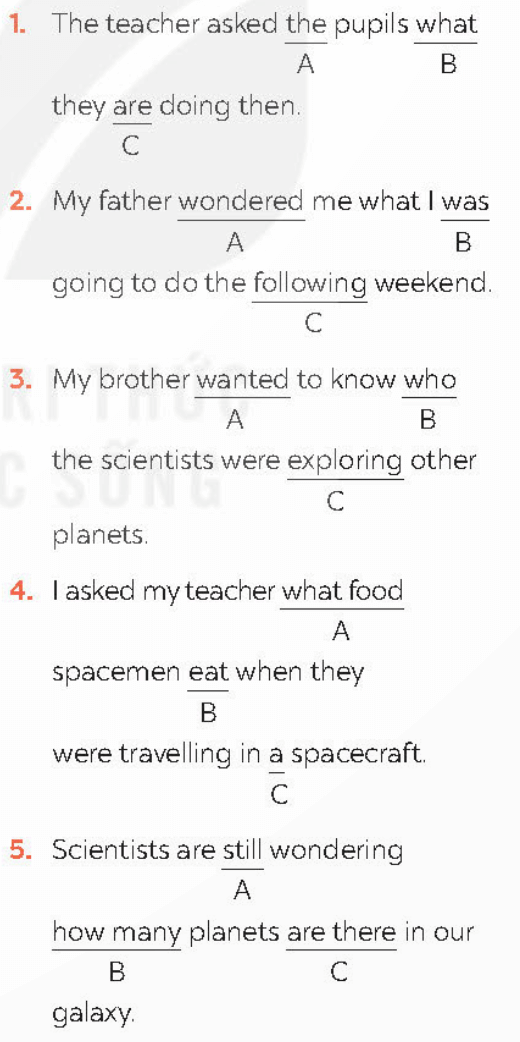
Answer:
1. C (are -> were)
2. A (wondered -> asked)
3. B (who -> how / why)
4. B ( eat -> ate)
5. C (are there -> there are)
PROJECT
Our favourite planet
Work in groups.
1. Choose a planet in our solar system that you like and search for the information about it.
Answer:
- A planet: Mars
- Information: The name of Mars originally comes from the name of the Roman god of war and argiculture.
Mars has two natural satellites, and their names are Phobos and Deimos.
With a radius of 2,106 miles (3,390 kilometers), Mars is about half the size of Earth.
The atmosphere of Mars is much thinner than Earth's. It contains more than 95% carbon dioxide and much less than 1%. oxygen.
Mar's temperatures are from -15°C to 20°C.
Mar's surface is rocky, with canyons, volcanoes, dry lake beds and craters all over it.
It's called Red Planet because iron minerals in the Martian soil oxidize, or rust, causing the soil and atmosphere to look red.
2. Design a poster about that planet, including
- The planet’s name: What does its name mean?
- Size: How big is it?
- Atmosphere: What is its atmosphere like? Is it a thick or a thin atmosphere?
- Temperature: What is its avcrage temperature? tow hot arici cold does it get?
- Appearance: What does it Iook like?
- Something special: Is there anything special about it?
Answer:
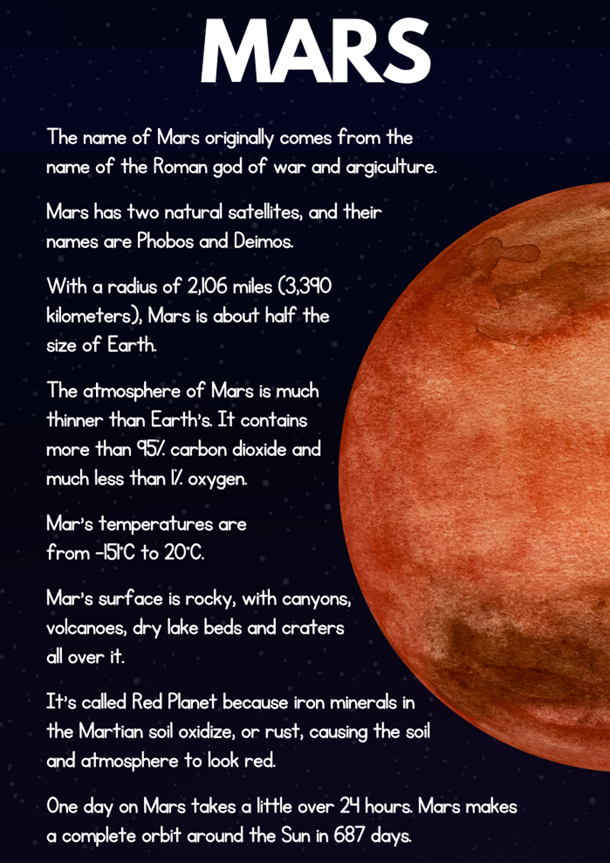
3. Report your group's findings to your class based on the following guiding questions:
Answer:
Hello everyone, today I will talk about Mars, the 4thplanet in our solar system. The name of Mars originally comes from the name of the Roman god of war and agriculture. It may not seem like these two things go together, but they do. Mars protected those who fought for their communities and stayed home to raise crops for food. Mars has two natural satellites, and their names are Phobos and Deimos. With a radius of 2,106 miles (3,390 kilometers), Mars is about half the size of Earth. The atmosphere of Mars is much thinner than Earth's. It contains more than 95% carbon dioxide and much less than 1% oxygen. Mar's temperatures are from -151°C to 20°C. Mars is colder than Earth. If you were to stand on the surface of Mars on the equator at noon, it would feel like spring at your feet and winter at your head. Mar's surface is rocky, with canyons, volcanoes, dry lake beds and craters all over it. It's called Red Planet because iron minerals in the Martian soil oxidize, or rust, causing the soil and atmosphere to look red. One day on Mars takes a little over 24 hours. Mars makes a complete orbit around the Sun in 687 days. Thanks for listening.
Tài liệu cùng môn học
Tài liệu khác
- Trắc nghiệm tiếng anh 2 Family and Friends
- Trắc nghiệm tiếng anh 2 Explore our world
- Trắc nghiệm tiếng anh 3 Family and Friends
- Trắc nghiệm tiếng anh 3 Explore our world
- Trắc nghiệm tiếng anh 4 Family and Friends
- Trắc nghiệm tiếng anh 4 Global Success
- Trắc nghiệm tiếng anh 4 Explore our world
- Trắc nghiệm tiếng anh 5 Family and Friends
- => Xem nhiều môn hơn