Giải Tiếng Anh 12 kết nối: Unit 3 Green living
Hướng dẫn giải Tiếng Anh 12 kết nối tri thức: Giải Unit 3 Green living. Bài được giải chi tiết, rõ ràng, dễ hiểu. Bài giải giúp học sinh nắm vững kiến thức trong sách giáo khoa, rèn kĩ năng giải bài tập và có phương pháp học tập hiệu quả.
Nội dung chi tiết
UNIT 3. GREEN LIVING
I. GETTING STARTED
1. Listen and read.
2. Read the conversation again and tick (✔) the green ideas mentioned in 1.
| 1. putting more plants in the classroom | |
| 2. asking students to bring single-use water bottles | |
| 3. placing a big water jug in the classroom | |
| 4. leaving lights and air conditioners on when leaving the classroom | |
| 5. placing reminders on saving electricity near doors |
Answer:
| 1. putting more plants in the classroom | ✔ |
| 2. asking students to bring single-use water bottles |
|
| 3. placing a big water jug in the classroom | ✔ |
| 4. leaving lights and air conditioners on when leaving the classroom |
|
| 5. placing reminders on saving electricity near doors | ✔ |
3. Find words and phrases in 1 with the following meanings.
| 1. c______ u______ | making a place completely clean and tidy |
| 2. e_____ - f______ | good for the environment |
| 3. d______ | to be destroyed gradually and naturally |
| 4. c_____ f_______ | a measure of the amount of CO₂ produced |
Answer:
1. cleaning up: making a place completely clean and tidy
2. eco – friendly: good for the environment
3. decompose: to be destroyed gradually and naturally
4. carbon footprint: a measure of the amount of CO₂ produced
4. Complete the sentences with words from 1.
1. Many students throw (1) _______ plastic water bottles after a single use, (2) _______ is not good for the environment.
2. We need to turn (3) ________ the lights and air conditioners before leaving the classroom.
3. Some students leave them (4) ______ when they rush out, (5) ________ is a waste of electricity.
Answer:
1. Many students throw (1) away plastic water bottles after a single use, (2) which is not good for the environment.
2. We need to turn (3) off the lights and air conditioners before leaving the classroom.
3. Some students leave them (4) on when they rush out, (5) which is a waste of electricity.
II. LANGUAGE
Pronunciation
1. Listen and repeat. Then practise saying the words.
/ɪə/ | /eə/ | /ʊə/ |
idea | awareness | sure |
years | air conditioners | ecotour |
2. Work in pairs. Underline the words that contain the /ɪə/, /eǝ/, and /ʊə/ sounds. Listen and check. Then practise saying the sentences.
1. There are many volunteers here to help clean up the beach.
2. Ecotourism encourages tourists to develop eco-friendly habits when travelling.
3. It is clear that not all people are aware of the negative impact of their daily habits on the environment.
Answer:
1. There are many volunteers here to help clean up the beach.
2. Ecotourism encourages tourists to develop eco-friendly habits when travelling.
3. It is clear that not all people are aware of the negative impact of their daily habits on the environment.
- /ɪə/: volunteers, here, clear
- /eǝ/: there, aware, their
- /ʊə/: ecotourism, tourists
Vocabulary
1. Match each word (1-5) with its meaning (a-e).
| 1. waste (n) | a. an area of land where waste materials are buried under the surface | 3. reuse (v) |
| 2. landfill (n) | b. materials used to wrap or protect things we buy from shops | 4. packaging (n) |
| c. something such as a box or bowl that you can use to keep things in | 5. container (n) | |
| d. to use something again | ||
| e. the act of using something in a careless way, causing it to be lost or destroyed |
Answer:
| 1. waste (n) | e. the act of using something in a careless way, causing it to be lost or destroyed |
| 2. landfill (n) | a. an area of land where waste materials are buried under the surface |
| 3. reuse (v) | d. to use something again |
| 4. packaging (n) | b. materials used to wrap or protect things we buy from shops |
| 5. container (n) | c. something such as a box or bowl that you can use to keep things in |
2. Complete the following sentences using the correct forms of the words in 1.
1. We should fix the leaking tap. It's a _______ of clean water!
2. Takeaway food includes a lot of unnecessary ________ such as single-use containers and plastic bags.
3. We always try to buy food packed in recyclable _________.
4. A creative way to_______ old greeting cards is to make gift tags and bookmarks.
5. The waste in open _______ sites can release harmful gases into the atmosphere.
Answer:
1. We should fix the leaking tap. It's a waste of clean water!
2. Takeaway food includes a lot of unnecessary packaging such as single-use containers and plastic bags.
3. We always try to buy food packed in recyclable containers.
4. A creative way to reuse old greeting cards is to make gift tags and bookmarks.
5. The waste in open landfill sites can release harmful gases into the atmosphere.
Grammar
1. Complete the sentences with the suitable prepositions.
1. Many people have now started to care ________ the environment.
2. The future of our planet depends ________ how we deal with climate change.
3. We should work _________ some solutions to reducing plastic pollution.
4. My sister is responsible for looking _________ the plants at home.
Answer:
1. Many people have now started to care about the environment.
2. The future of our planet depends on how we deal with climate change.
3. We should work out some solutions to reducing plastic pollution.
4. My sister is responsible for looking after the plants at home.
2. Combine the sentences using relative clauses.
1. Plastic takes hundreds of years to decompose in the ground. This explains why it is harmful to the environment.
→ Plastic takes hundreds of years to decompose in the ground, ______________________.
2. Public transport does not pollute the air as much as private vehicles. That's why more people should consider using it.
→ Public transport does not pollute the air as much as private vehicles, _______________.
3. All students work very hard to help clean up the school. The teacher encourages this.
→ All students work very hard to help clean up the school, _____________.
Answer:
1. Plastic takes hundreds of years to decompose in the ground. This explains why it is harmful to the environment.
→ Plastic takes hundreds of years to decompose in the ground, which is harmful to the environment.
2. Public transport does not pollute the air as much as private vehicles. That's why more people should consider using it.
→ Public transport does not pollute the air as much as private vehicles, which is why more people should consider using it.
3. All students work very hard to help clean up the school. The teacher encourages this.
→ All students work very hard to help clean up the school, which the teacher encourages.
3. Work in pairs. Talk about green things and activities you and your family often do. Use verbs with prepositions or phrasal verbs, and relative clauses referring to the whole sentence.
Answer:
1. We regularly pick up litter from the park near our house, which helps keep our local environment clean.
2. I always turn off the lights when I leave a room, which reduces our household's energy consumption.
III. READING
1. Work in pairs to solve the quiz.
1. It takes about years for one plastic bottle to decompose in the ground.
A. 4.5
B. 45
C. 450
2. Around plastic bottles are thrown away every year.
A. 13 thousand
B. 13 million
C. 13 billion
3. Plastic bags and other plastic waste kill around sea animals every year.
A. 100 million
B. 10 million
C. 1 million
4. Nearly of plastic ever made still exists today.
Α. 100%
B. 50%
C. 10%
Answer:
1. It takes about years for one plastic bottle to decompose in the ground.
A. 4.5
B. 45
C. 450
2. Around plastic bottles are thrown away every year.
A. 13 thousand
B. 13 million
C. 13 billion
3. Plastic bags and other plastic waste kill around sea animals every year.
A. 100 million
B. 10 million
C. 1 million
4. Nearly of plastic ever made still exists today.
Α. 100%
B. 50%
C. 10%
2. Read some extracts from the emails sent to the Teen magazine. Match the highlighted words and phrases (1-4) with the pictures (a-d).
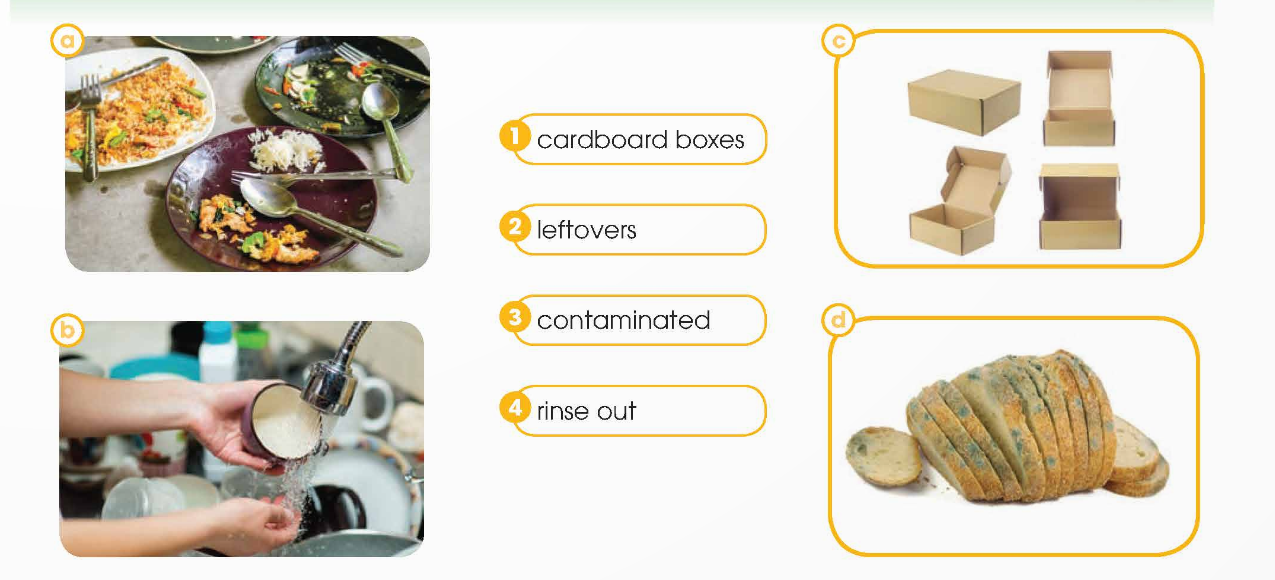
Answer:
1 - c. cardboard boxes
2 - a. leftovers
3 - d. contaminated
4 - b. rinse out
3. Read the email extracts again. Complete the summary notes with information from the text. Use no more than TWO words for each gap.
| Single-use plastics can be: | Tips |
| reduced |
|
| reused |
|
| recycled |
|
Answer:
| Single-use plastics can be: | Tips |
| reduced |
|
| reused |
|
| recycled |
|
4. Read the email extracts again. Match the following information with the right names.
| 1. This person has learnt from a past mistake how to recycle things properly. | a. Hai |
| 2. This person's green lifestyle is supported by a local business. | b. Phuong |
| 3. This person has learnt the recycling symbols to help the recycling process. | c. Hoang |
| 4. This person's green habit depends on local drinking water facilities. | d. Ha |
| 5. This person tries to reuse plastic takeaway containers. | e. Binh |
Answer:
| 1. This person has learnt from a past mistake how to recycle things properly. | e. Binh |
| 2. This person's green lifestyle is supported by a local business. | a. Hai |
| 3. This person has learnt the recycling symbols to help the recycling process. | d. Ha |
| 4. This person's green habit depends on local drinking water facilities. | b. Phuong |
| 5. This person tries to reuse plastic takeaway containers. | c. Hoang |
5. Work in pairs. Discuss the following questions.
Which of the green habits in 2 have also become your habits? Which one would you like to develop in the future?
Answer:
I have brought my reusable water bottle when I go to school and my family has already reused plastic containers by keeping leftovers and putting them in the fridge. I would like to learn about recycling symbols in the future, which will help the recycling process easier.
IV. SPEAKING
1. How can we save trees, energy, and water used to make paper? Sort these activities into Reduce, Reuse, or Recycle activities.
| a. Choosing recycled paper for daily use | |
| b. Sorting paper waste | |
| c. Printing on both sides of the paper | |
| d. Using old paper as compost | |
| e. Using reusable containers rather than paper for packaging | |
| f. Using smart devices to take notes instead of using paper | |
| g. Using the blank side of a sheet to take notes | |
| h. Avoiding printing things out as much as possible | |
| i. Keeping paper waste as clean as possible |
Answer:
| a. Choosing recycled paper for daily use | Reduce |
| b. Sorting paper waste | Recycle |
| c. Printing on both sides of the paper | Reduce |
| d. Using old paper as compost | Reuse |
| e. Using reusable containers rather than paper for packaging | Reduce |
| f. Using smart devices to take notes instead of using paper | Reduce |
| g. Using the blank side of a sheet to take notes | Reuse |
| h. Avoiding printing things out as much as possible | Reduce |
| i. Keeping paper waste as clean as possible | Recycle |
2. Work in pairs. Talk about how to reduce, reuse, and recycle paper. Use these questions to help you.
1. Which of the activities (a-i) above are you doing?
2. Can you suggest more ideas? How will they help save the environment?
Answer:
1. I am using reusable containers rather than paper for packaging helps to reduce waste and minimize the environmental impact of packaging materials. It also promotes sustainability by encouraging the use of durable and long-lasting packaging solutions. Additionally, it can lead to cost savings for businesses by eliminating the need to constantly purchase disposable packaging materials.
2. I suggest people should participate in community recycling programs to ensure that paper waste is properly collected and recycled.
3. Work in groups. Read the situations below and think of some possible responses to promote a greener lifestyle. Provide reasons for each answer.
1. After a club meeting, you notice that there are a lot of leaflets left, and they are only printed on one side. Your friend is asking you to help throw them away.
2. Your group is preparing for a presentation, and everyone has found a lot of useful online material. A group member is asking you to print out about 50 pages of information for the group to read.
3. Your club is organising a meeting, including a game in which people should write down something about themselves to share with others. The club president is asking you to buy a lot of Post-it notes for the game.
Answer:
1. Hey, instead of throwing these away, maybe we can leave them in a designated reuse bin for people to grab if they're interested! Since they're only printed on one side, they could be used for note-taking or scrap paper.
Reason: This reduces unnecessary waste. Leftovers can be reused for purposes that don't require clean, double-sided printing.
2. Great finds everyone! How about we compile the links to these online resources in a shared document instead of printing them all out? We can all access the information easily, and it's much more eco-friendly.
Reason: Saves paper and reduces printing costs. Digital resources are readily available and can be accessed by everyone without creating physical copies.
3. That's a fun game idea! To save paper, could we try using a whiteboard or a large sheet of paper where everyone can write something down? We can erase or reuse it afterwards.
Reason: Minimizes the use of disposable sticky notes. Whiteboards or large paper sheets are reusable and can be effectively used for group interactions.
4. Report your group's answers to the whole class. Vote for the most interesting responses.
V. LISTENING
1. Match the words and phrases (1-5) with the pictures (a-е).
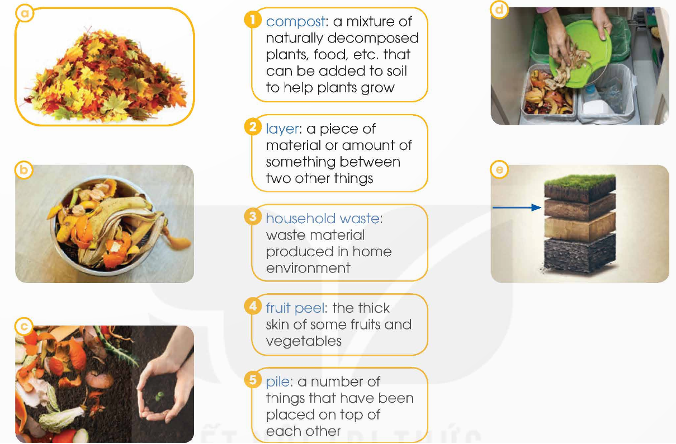
Answer:
1 – c: compost: a mixture of naturally decomposed plants, food, etc. that can be added to soil to help plants grow
2 – e: layer: a piece of material or amount of something between two other things
3 – d: household waste: waste material produced in home environment
4 – b: fruit peel: the thick skin of some fruits and vegetables
5 – a: pile: a number of things that have been placed on top of each other
2. Listen to a conversation about the main steps in creating a compost pile. Number the pictures in order.
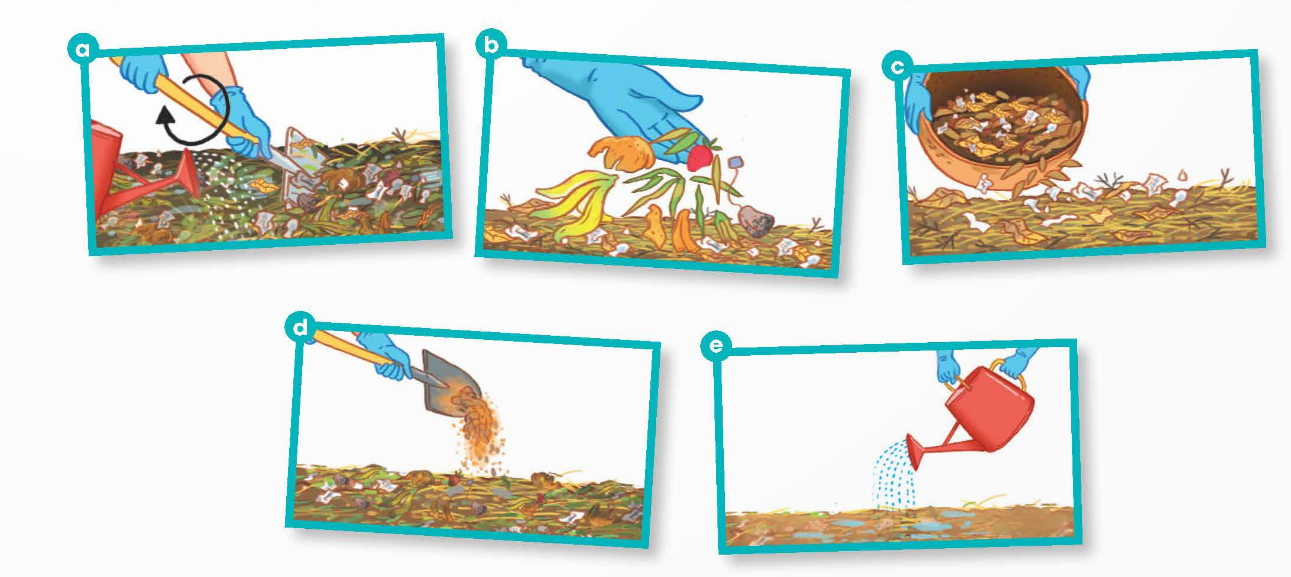
1. _________
2. _________
3. _________
4. e
5. _________
Answer:
….. ……… ……..
3. Listen again. Decide whether the statements are true (T) or false (F).
| T | F | |
| 1. Use dry leaves as green materials. | ||
| 2. Use fruit peels as green materials. | ||
| 3. Add additional layers in the same order. | ||
| 4. Leave the pile dry for many days. | ||
| 5. Add chemical fertilisers. |
Answer:
….. ……. ……..
4. Work in groups. Discuss these questions.
How do you manage your household and garden waste? Is it environmentally friendly?
Answer:
We manage our household and garden waste by separating organic waste for composting, recycling paper, glass, and plastic, and disposing of non-recyclable waste responsibly. We also use a compost bin for organic waste and avoid using chemical pesticides in the garden to maintain an environmentally friendly approach.
VI. WRITING
1. Work in pairs. Complete the notes using the words in the box.
compost automatic
public transport recycle
Problems consequences | Green solutions |
| Many single-use plastic products are thrown in rubbish bins. They take many years to decompose in landfills. | Use them in arts and crafts projects (e.g. making plant pots) or (1) _____ them. |
| People leave the lights on and the water running in restrooms. This is a waste of electricity and water. | Install (2) _________ lights and sensor taps that turn off when no one is around |
| Dry leaves are sometimes burnt in the schoolyard. This can cause air pollution and fires. | Create (3) ________ |
| Many parents drive their children to school and pick them up from school every day. This causes traffic jams, noise, and air pollution at the school gate. | Encourage more students to cycle or walk to school, or use (4) _____ to go to school (e.g. free bus tickets, cycle-to-school programme) |
Answer:
(1) recycle
(2) automatic
(3) compost piles
(4) public transport
2. Read a problem-solving report and match the sections (A-D) with the correct headings (1-4).
1. Conclusion
2. Problems
3. Introduction
4. Solutions
A. ___________
This report describes the problem of single-use plastics in our school and suggests three main solutions to the problem.
B. ___________
Many students at our school buy bottled water or takeaway food. As a result, hundreds of water bottles and single-use plastic containers are thrown away every day. Besides, students often put containers with leftovers in them into the recycling bin, which can lead to contaminating the recyclable waste. This means our school produces a lot of plastic waste that goes to landfills and has a harmful effect on the environment.
C. _________
To solve this problem, we propose the following solutions. First, we suggest that the school should provide more recycling bins. Second, the Youth Union should hold regular sessions to teach students how to recycle properly. Third, we recommend that we make use of plastic waste in arts and crafts projects, for example, for making plant pots or bird feeders.
D. _________
Reusing and recycling single-use plastics will lead to a greener school environment and help promote a green lifestyle among young people. Therefore, we recommend you put the suggested solutions into practice as soon as possible.
Answer:
A – 3. Introduction
B – 2. Problems
C – 4. Solutions
D – 1. Conclusion
3. Choose one of the problems in 1, and write a problem-solving report (180 words). Use the model in 2 and the outline with useful expressions below to help you.
Answer:
This report describes the problem of single-use plastic products being thrown in rubbish bins and the slow decomposition of these products in landfills. It suggests solutions to reduce the negative impact of plastic waste on the environment.
As a result, the accumulation of single-use plastic products in landfills can damage the environment and have a harmful effect on wildlife. Therefore, it is important to address this issue and find sustainable alternatives to single-use plastics.
To solve this problem, we suggest the following solutions. First, we recommend that individuals and organizations reduce the use of single-use plastic products by opting for reusable alternatives. Second, it is important for communities to implement recycling programs and educate the public about the importance of proper waste management.
Implementing these solutions will lead to a reduction in plastic waste and help promote a green lifestyle. Therefore, I recommend that everyone takes proactive steps to minimize their use of single-use plastics and support initiatives aimed at reducing plastic pollution.
VII. COMMUNICATION AND CULTURE/CLIL
Everyday English
1. Listen and complete the conversation with the expressions in the box. Then practise it in pairs.
A. will have a difficult decision
B. is going to impress
C. in the long run
D. It's hard to predict
Mark: Tomorrow, we'll get the results of the Green Classroom Competition. Do you think we will win?
Nam: (1) _________ so have very interesting who'll win. Other classes also have very interesting projects.
Mark: I agree. The Cycling-to-school programme proposed by Class 12C (2) ________ the judges.
Cycling to school will also lead to healthier lifestyles (3) _________.
Nam: True. There're so many great ideas. The judges (4)_________ to make.
Answer:
……. ……… ………
2. Work in pairs. Use the model in 1 to make similar conversations for these situations. One of you is A, the other is B. Use the expressions below to help you.
1. A wonders whether the Youth Union will accept their group proposal to install automatic lights and sensor taps in the school. B, a member of the same group, makes predictions about the decision.
2. B asks A about the Green Day event at their school next week (e.g. the number of people attending, the activity people will like the most, the impact of the event). A makes predictions.
Answer:
1.
A: I'm wondering if the Youth Union will accept our group's proposal to install automatic lights and sensor taps in the school. What do you think?
B: I think they'll accept it. The proposal addresses energy efficiency and water conservation, which are important issues.
A: I agree. These changes will likely make the school more environmentally friendly in the long term.
B: Absolutely. I believe the judges will recognize the positive impact on both the environment and the school community.
2.
B: Hey, how do you think the Green Day event at our school next week will turn out? How many people will attend?
A: It's hard to predict the exact number, but I think many students and teachers will show up to support the event.
B: True. I guess the recycling workshop might be the activity people will like the most. It's quite certain that students are becoming more conscious of environmental issues, and they'll find the workshop informative.
A: That's a good point. It's likely that the event will contribute to a more environmentally conscious atmosphere in the school.
Culture/CLIL
1. Read the following text. What are the environmental problems of each tradition as mentioned in the text? Put a tick (✔) where relevant.
| Polluting the air | Causing fires | Harming animals | Ending up in landfills | |
| Balloons and sky lanterns | ||||
| Fireworks | ||||
| Christmas trees |
Answer:
| Polluting the air | Causing fires | Harming animals | Ending up in landfills |
Balloons and sky lanterns |
| ✔ | ✔ |
|
Fireworks | ✔ | ✔ |
|
|
Christmas trees | ✔ |
|
| ✔ |
2. Work in pairs. Suggest some green solutions to replace one of the traditions.
Answer:
Instead of releasing balloons or sky lanterns, consider using biodegradable kites. Kites can still provide a visually stunning and joyful experience, and they won't harm the environment.
VIII. LOOKING BACK
Pronunciation
1. Read the words and choose the odd one out. Then listen and check.
| 1. A. fair | B. hair | C. container | D. pair |
| 2. A. near | B. ear | C. fear | D. pear |
| 3. A. sure | B. future | C. literature | D. culture |
| 4. A. bear | B. year | C. clear | D. hear |
Answer:
| 1. A. fair | B. hair | C. container | D. pair |
| 2. A. near | B. ear | C. fear | D. pear |
| 3. A. sure | B. future | C. literature | D. culture |
| 4. A. bear | B. year | C. clear | D. hear |
Vocabulary
1. Solve the crossword with the words you've learnt in this unit. What is the hidden word?
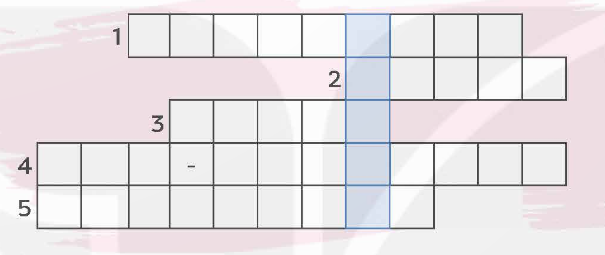
1. Many supermarkets try to reduce plastic _______.
2. Reduce, _______, and recycle waste whenever you can to protect and preserve the environment.
3. Household ________ is often taken to landfills and buried there.
4. We can reduce environmental pollution by choosing ________ products such as reusable shopping bags and bamboo straws.
5. We can reduce our carbon ______ by turning off lights and air conditioners when we leave the room.
Answer:
1. Many supermarkets try to reduce plastic packaging.
2. Reduce, reuse, and recycle waste whenever you can to protect and preserve the environment.
3. Household waste is often taken to landfills and buried there.
4. We can reduce environmental pollution by choosing eco - friendly products such as reusable shopping bags and bamboo straws.
5. We can reduce our carbon footprint by turning off lights and air conditioners when we leave the room.
The hidden word: GREEN
Grammar
1. Circle the mistake in each sentence. Then correct it.
1. Children should learn to recycling from an early age so that they will be
A
prepared to deal with plastic pollution in the future.
B C D
2. Many students are taking part in the Green Campaign this year, that shows
A B
that nowadays people care more about the environment.
C D
3. Many people neither believe in climate change nor want to understand what
A B
is happening with the environment, which is a big concern.
C D
4. Instead of throwing the plastic bottles over, why don't you make some plant
A B C
pots from them?
D
Answer:
1. Children should learn to recycling from an early age so that they will be
A
prepared to deal with plastic pollution in the future.
B C D
Correct: to => about
2. Many students are taking part in the Green Campaign this year, that shows
A B
that nowadays people care more about the environment.
C D
Correct: that => which
3. Many people neither believe in climate change nor want to understand what
A B
is happening with the environment, which is a big concern.
C D
Correct: with => to
4. Instead of throwing the plastic bottles over, why don't you make some plant
A B C
pots from them?
D
Correct: over => away
PROJECT
Work in groups. Design a leaflet to give away on Green Day at your school. The leaflet should promote an eco-friendly habit (e.g. saving water, reusing paper, recycling plastic).
Present the leaflet to the class. Use these questions as cues for your leaflet.
What is the habit?
How important is it for a greener lifestyle and the environment?
What should we do to develop the habit?
Answer:
What is the habit?
Reusing paper is the practice of finding alternative uses for paper products instead of discarding them after a single use.
How important is it for a greener lifestyle and the environment?
Reusing paper is an important habit for a greener lifestyle and the environment. It helps reduce the demand for new paper production, which in turn reduces the deforestation, water usage, and energy consumption associated with producing virgin paper. By reusing paper, we can conserve natural resources, minimize waste, and lower our carbon footprint.
What should we do to develop the habit?
- To develop the habit of reusing paper, consider the following steps:
- Identify opportunities: Look for ways to reuse paper in your daily life, such as using the blank side of printed pages for notes, scribbles, or to-do lists.
- Establish a collection system: Set up a designated area or container to collect paper that can be reused, such as one-sided printed sheets or packaging materials.
- Encourage reuse: Inspire others in your household, workplace, or community to reuse paper by sharing the benefits and providing practical tips.
- Implement creative reuse: Find innovative ways to repurpose paper, such as turning it into notepads, gift tags, origami, or even using it for arts and crafts projects.
- Educate and lead by example: Share information about the environmental impact of paper waste and demonstrate your own paper-reusing habits to encourage others to follow suit.
- Support paper-recycling initiatives: Complement your paper-reuse efforts by also participating in paper-recycling programs to ensure any paper that can't be reused is properly processed.
Tài liệu cùng môn học
Tài liệu khác
- Trắc nghiệm tiếng anh 2 Family and Friends
- Trắc nghiệm tiếng anh 2 Explore our world
- Trắc nghiệm tiếng anh 3 Family and Friends
- Trắc nghiệm tiếng anh 3 Explore our world
- Trắc nghiệm tiếng anh 4 Family and Friends
- Trắc nghiệm tiếng anh 4 Global Success
- Trắc nghiệm tiếng anh 4 Explore our world
- Trắc nghiệm tiếng anh 5 Family and Friends
- => Xem nhiều môn hơn