Giải Tiếng Anh 12 kết nối: Unit 4 Urbanisation
Hướng dẫn giải Tiếng Anh 12 kết nối tri thức: Giải Unit 4 Urbanisation. Bài được giải chi tiết, rõ ràng, dễ hiểu. Bài giải giúp học sinh nắm vững kiến thức trong sách giáo khoa, rèn kĩ năng giải bài tập và có phương pháp học tập hiệu quả.
Nội dung chi tiết
UNIT 4. URBANISATION
I. GETTING STARTED
1. Listen and read.
2. Read the conversation again. Decide whether the following statements are true (T) or false (F).
| T | F | |
| 1. The last time Mark visited Nam's place was three years ago. | ||
| 2. There used to be a park opposite Nam's house. | ||
| 3. There aren't any new leisure or shopping facilities in Nam's neighbourhood. | ||
| 4. Traffic jams and rising cost of living are the two problems that Nam mentioned. |
Answer:
| T | F | |
| 1. The last time Mark visited Nam's place was three years ago. | x | |
| 2. There used to be a park opposite Nam's house. | x | |
| 3. There aren't any new leisure or shopping facilities in Nam's neighbourhood. | x | |
| 4. Traffic jams and rising cost of living are the two problems that Nam mentioned. | x |
3. Match the words to make phrases mentioned in 1.
| 1. urban | a. residents |
| 2. leisure | b. hour |
| 3. local | c. areas |
| 4. rush | d. activities |
Answer:
1 – c: urban areas
2 – d: leisure activities
3 – a: local residents
4 – b: rush hour
4. Complete the sentences using phrases from 1.
1. They _______ several high-rise buildings opposite Nam's house.
2. The city where Nam lives is getting _________.
3. _________ Mark has been on an electric bus.
4. _________ crowded the area becomes, __________ traffic jams get.
Answer:
1. They have built several high-rise buildings opposite Nam's house.
2. The city where Nam lives is getting bigger and bigger.
3. It’s the first time Mark has been on an electric bus.
4. The more crowded the area becomes, the worse traffic jams get.
II. LANGUAGE
Pronunciation
1. Listen and repeat. Pay attention to to the the pronunciation of the unstressed words.
1. It's been three years since your last visit.
2. Fresh air and a walk sound nice.
3. It's the first time I've been on an electric bus.
4. I guess urbanisation can also cause problems.
2. Listen and identify the unstressed words in the following sentences. Then practise saying the sentences in pairs.
1. A new convenience store has been opened near my house.
2. There are still a lot of problems in our cities today.
3. It is much more expensive to buy a house in a big city.
4. My father was offered a new job and his office will be in a high-rise building.
Answer:
1. A new convenience store has been opened near my house.
2. There are still a lot of problems in our cities today.
3. It is much more expensive to buy a house in a big city.
4. My father was offered a new job and his office will be in a high-rise building.
Vocabulary
1. Match the words with their meanings.
| 1. afford (v) | a. to become larger in size, number, or importance |
| 2. housing (n) | b. the number of people not having a job |
| 3. expand (v) | c. to have enough money to buy or do something |
| 4. seek (v) | d. houses, flats, etc. that people live in |
| 5. unemployment (n) | e. to look for something or somebody |
Answer:
1 – c: afford (v): to have enough money to buy or do something
2 – d: housing (n): houses, flats, etc. that people live in
3 – a: expand (v): to become larger in size, number, or importance
4 – e: seek (v): to look for something or somebody
5 – b: unemployment (n): the number of people not having a job
2. Complete the sentences using the correct forms of the words in 1.
1. Higher _______ can result in increasing crime rates in big cities.
2. Not many young couples can _________ to buy their own house in big cities.
3. There is a shortage of affordable ________ in big cities.
4. Since they started using farmland for building houses, many towns have ________ into cities.
5. Many people are leaving the countryside in order to _________ better opportunities in big cities.
Answer:
1. Higher unployment can result in increasing crime rates in big cities.
2. Not many young couples can afford to buy their own house in big cities.
3. There is a shortage of affordable housing in big cities.
4. Since they started using farmland for building houses, many towns have expanded into cities.
5. Many people are leaving the countryside in order to seek better opportunities in big cities.
Grammar
1. Circle the underlined part that is incorrect in each of the following sentences. Then correct it.
1. This is the first time I saw such a fall building in my life.
A B C D
2. Mount Fuji in Japan is the most beautiful place we had ever visited.
A B C D
3. This has been the second time my mother has warned me not to spend all my
A B C
money on clothes.
D
Answer:
1. This is the first time I saw such a fall building in my life.
A B C D
Correct: saw => have seen
2. Mount Fuji in Japan is the most beautiful place we had ever visited.
A B C D
Correct: had => have
3. This has been the second time my mother has warned me not to spend all my
A B C
money on clothes.
D
Correct: has been => is
2. Choose the sentence that has the closest meaning to the given sentence.
1. Housing is getting more and more expensive in big cities, so many local residents can't afford to buy their own place.
A. Many local residents in big cities can't buy their own place because housing is becoming more expensive every day.
B. More and more local residents can't afford their own place in big cities because housing is too expensive.
C. Housing is getting affordable enough for many local people to buy their own place.
D. Housing in big cities has become the most expensive these days, so many local residents can't afford their own place.
2. The more people move into big cities, the higher the unemployment is.
A. The higher the unemployment is, the more people move into big cities.
B. More people moving into big cities causes higher unemployment.
C. More people move into big cities despite the high rate of unemployment.
D. More people move into big cities because there are more employment opportunities there.
3. The more houses are built, the less space we have for plants and trees.
A. Although more houses are built, we still have some space for plants and trees.
B. The fewer houses we build, the less space we have for plants and trees.
C. We have less space for plants and trees because more houses are built.
D. Plants and trees are the reasons why more houses can't be built.
Answer:
1. B: More and more local residents can't afford their own place in big cities because housing is too expensive.
2. B: More people moving into big cities causes higher unemployment.
3. C: We have less space for plants and trees because more houses are built.
3. Work in pairs. Make true sentences about urbanisation in an area that you know, using double comparatives and the present perfect.
Answer:
- The population density in the city centre has grown far more densely packed than it had ever been before.
- The number of high-rise buildings constructed here has increased far more substantially than the local authorities had anticipated.
III. READING
1. Work in pairs. Look at the pictures in the article in 2 below. Discuss the following questions.
1. What can you see in each picture?
2. What do the pictures tell you about Ha Noi and people's life in the city?
Answer:
1. I can see the differences between the past and now in Ha Noi.
2. People’s life in the city is more modern and crowded.
2. Read the article. Choose the correct meanings of the highlighted words.
1. residents
A. people who live in a particular place
B. buildings in a particular place
2. colonial
A. connected with the native country
B. connected with a country that controls another country
3. gradually
A. slowly, over a period of time
B. quickly, over a short time
4. modernising
A. making something attractive
B. making use of the latest technology, design, etc.
5. concern
A. a feeling of satisfaction
B. a feeling of worry about something important
Answer:
1. A. people who live in a particular place
2. B. connected with a country that controls another country
3. A. slowly, over a period of time
4. B. making use of the latest technology, design, etc.
5. B. a feeling of worry about something important
3. Read the article again. Put the main ideas in the order they appear in the article.
The correct order is:
1. _____________
2. _____________
3. _____________
4. _____________
A. Ha Noi's modern infrastructure and architecture
B. The challenges of urban growth
C. Ha Noi as a small city with old streets selling different products
D. 20th-century transport and architecture
Answer:
1 – C: Ha Noi as a small city with old streets selling different products
2 – D: 20th-century transport and architecture
3 – A: Ha Noi's modern infrastructure and architecture
4 – B: The challenges of urban growth
4. Read the article again and complete the table using no more than THREE words and/or a number for each gap.
Ha Noi | 20th century | Now |
| Area | - about (1) _____ sq km (1954) | - over 3,000 sq km |
| Population | - about 530,000 people (1954) | - over (2) ______ people |
| Public transport | - (3) _______ and buses | - modern buses and (4) _______ |
| Architecture | - mainly (5) _________ | more high-rise buildings |
Answer:
Ha Noi | 20th century | Now |
| Area | - about (1) 152 sq km (1954) | - over 3,000 sq km |
| Population | - about 530,000 people (1954) | - over (2) 8 million people |
| Public transport | - (3) trams and buses | - modern buses and (4) electric ones |
| Architecture | - mainly (5) low-rise buildings | more high-rise buildings |
5. Work in pairs. Discuss the following questions.
Which one do you prefer to live in: Ha Noi in the past or Ha Noi at present? Why?
Answer:
- I prefer to live in Ha Noi at present because:
+ It provides access to modern technology and a faster pace of life.
+ It has better infrastructure, transportation, and healthcare facilities.
+ It offers more economic opportunities, job prospects, and a higher standard of living.
IV. SPEAKING
1. The pictures show how River City has changed over time. Work in pairs. Read the words and phrases and decide which describe the city in the past (P) and which now (N).
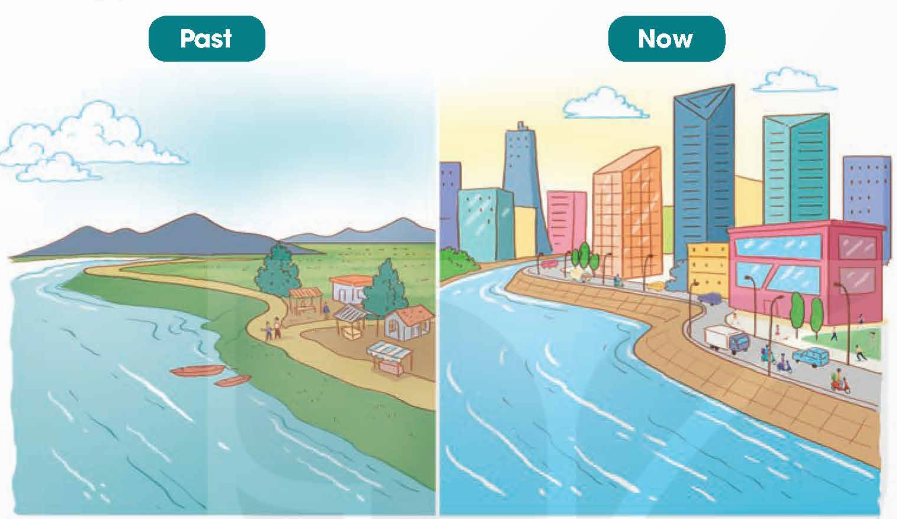
old
parks
modern
rice field
empty roads
wet markets
busy streets
convenience stores
high-rise buildings
low-rise buildings
supermarkets
Answer:
Past | Now |
| Old, rice field, empty roads, wet markets, low-rise buildings | Parks, modern, busy streets, convenience stores, high-rise buildings, supermarkets |
2. Work in pairs. Talk about the changes in River City. Use the words and phrases in 1.
Answer:
- In the past, River City had empty roads. However, at present, this place has busy streets.
- In the past, this place only had wet markets. However, many convenience stores and supermarkets have been built in the city.
3. Report your answers to the whole class. Vote for the best description.
V. LISTENING
1. Choose the correct meanings of the underlined words.
1. House prices in big cities are increasing rapidly because too many people want to buy their own house.
A. very quickly
B. very slowly
2. The rural population is decreasing because more and more people are moving from the countryside to cities.
A. going up
B. going down
3. The public transport is not very reliable, so many people use their private vehicles.
A. can be trusted
B. can be expensive
Answer:
1. House prices in big cities are increasing rapidly because too many people want to buy their own house.
A. very quickly
B. very slowly
2. The rural population is decreasing because more and more people are moving from the countryside to cities.
A. going up
B. going down
3. The public transport is not very reliable, so many people use their private vehicles.
A. can be trusted
B. can be expensive
2. Listen to a radio talk about urbanisation. Choose the correct answer A, B, or C.
1. What is the talk about?
A. Urban population.
B. Advantages of urbanisation.
C. The world's urbanisation.
2. How has the urban population changed over the past few decades?
A. It has grown rapidly.
B. It has decreased gradually.
C. It has increased slightly.
3. Which chart shows the percentage of the world's urban population now?

4. Which of the following is mentioned as an advantage of urbanisation?
A. City residents have better health.
B. City dwellers can afford expensive houses.
C. Buses and trains run more often.
5. What does the speaker say about the air quality in big cities?
A. City residents can develop health problems if exposed to air pollution over a long period.
B. Air quality is improving because the number of private cars has decreased.
C. Smog and higher carbon emissions in the air are making traffic conditions worse.
Answer:
….. ……… ……..
3. Listen to the talk again and answer the questions. Use no more than THREE words and/or a number.
1. What was the percentage of the world's urban population in 1950?
2. By which year is it expected that about 70% of the world's population will live in cities?
3. What are good schools and modern hospitals examples of?
4. Apart from housing, what is more expensive in cities?
Answer:
….. ……. ……..
4. Work in groups. Discuss the following question.
What do you think is the biggest advantage of urbanisation?
Answer:
I think the biggest advantage of urbanisation is job opportunities. Urban areas typically offer a wide range of job opportunities in diverse sectors. The concentration of businesses and services attracts a diverse workforce, leading to a more dynamic job market.
VI. WRITING
1. Work in pairs. Look at the line graph. Match the sentences with the information in the graph.
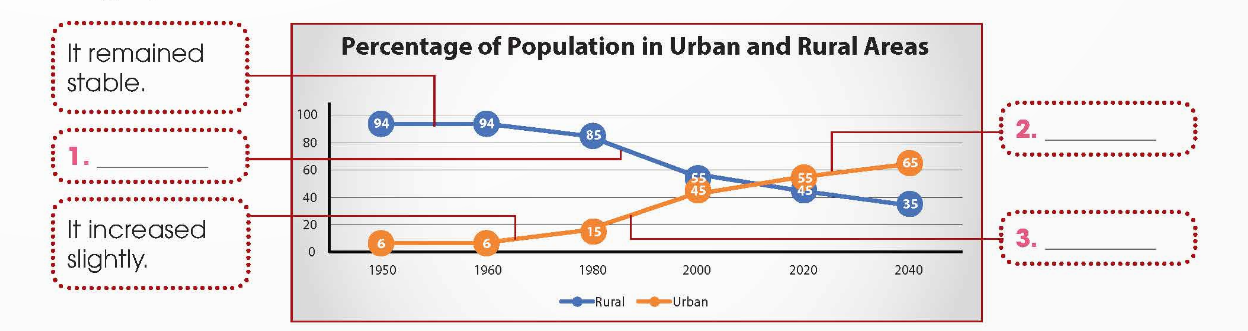
a. It is expected to go up gradually.
b. It fell steadily.
c. It rose steadily.
Answer:
1. b. It fell steadily.
2. a. It is expected to go up gradually.
3. c. It rose steadily.
2. Look at the line graph and put the paragraphs in the correct order.
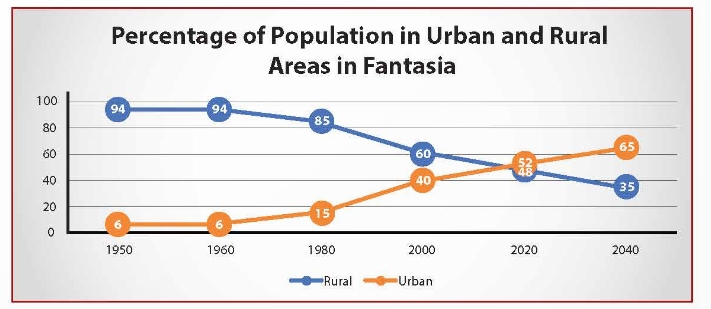
A. By contrast, the urban population rose throughout the same period. In 1950, the percentage of urban population was just around 6 per cent. It increased slightly to 15 per cent in 1980. After that, the figure rose steadily and in 2000 it stood at 40 per cent. The upward trend continued and in 2020, more than half of its population lived in urban areas. In the next twenty years, the urban population is expected to reach 65 per cent of the total population.
B. The line graph shows population trends in Fantasia's urban and rural areas over the 1950-2040 period. Overall, the urban population has increased and will continue to grow while the rural population has decreased and will continue to fall.
C. In 1950, 94 per cent or most of Fantasia's population lived in rural areas. This figure remained stable until 1960. However, from 1960 to 1980, the percentage of rural population fell slightly to 85 per cent. This figure went down steadily to 48 per cent in 2020 and is expected to drop to 35 per cent in 2040.
Answer:
B – C – A
3. The line graph below illustrates population trends in Viet Nam from 1960 to 2020. Write a description (120-150 words) of the graph. Use the expressions in 1, the model and tips in 2, and the suggestions below to help you.
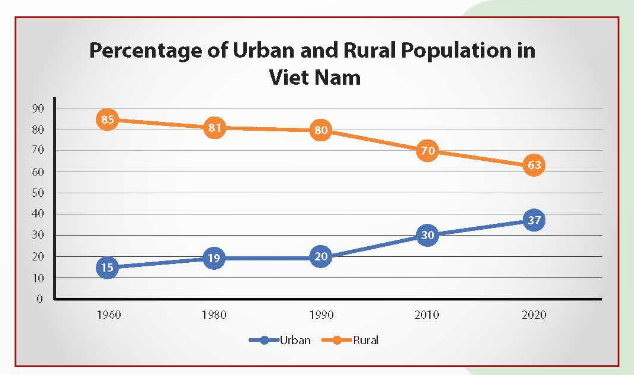
The line graph shows population trends in Viet Nam from 1960 to 2020. Overall, the urban population...
In 1960, most Vietnamese people...
However, from 1960 to 1980, ... From 1990 ….
By contrast, the urban population rose throughout the same period. In 1960, ...
In 1980, ... From 1990 …
Answer:
The line graph illustrates the percentage of urban and rural population in Viet Nam from 1960 to 2020. Overall, the urban population has increased and will continue to grow while the rural population has decreased and will continue to fall.
In 1960, only about 15% of Vietnamese people lived in urban areas. By 1980, this figure saw a slight rise to around 19%. From 1990 onwards, there was a more pronounced growth in urban population, reaching approximately 20% in that year and continuing to climb to about 37% by 2020.
By contrast, the rural population experienced an overall decrease throughout the same period. In 1960, a significant majority of around 85% resided in rural areas. By 1980, this percentage decreased slightly to roughly 81%. From 1990 onwards, there was a more noticeable decline; by 2020, it had dropped to approximately 63%.
VII. COMMUNICATION AND CULTURE/CLIL
Everyday English
1. Listen and complete the conversations with the expressions in the box. Then practise them in pairs.
A. I promise
B. I want to complain about
C. I'm sorry to have to say this
D. there's nothing we can do about it
1. Ms Lan: Hi, Mai. (1) _________ but there is always loud music coming from your flat very late at night. I can't sleep because of the noise.
Mai: Oh, I'm so sorry, Ms Lan. (2) ________ this will never happen again.
2. Nam: Excuse me, (3) _______ the bus services in the neighbourhood. Buses are always running late, especially during rush hour.
Conductor: I'm sorry, but (4) _______. There are so many vehicles on the roads now that traffic moves very slowly
Answer:
… ….. ……
2. Work in pairs. Use the models in 1 to make similar conversations for these situations. One of you is A, the other is B. Use the expressions to help you.
1. A has recently moved to a busy urban area. He/She is attending a community meeting chaired by B, who is an urban planner. A is complaining to B about the frequent traffic jams in the area. B is giving a response.
2. B is attending a talk by A, a local government official, who is discussing problems in their city. B is complaining to A about the city's overcrowded living conditions. A is giving a response.
Answer:
1.
A: Excuse me, I want to complain about the frequent traffic jams in the area. It affects the mutual space in our area, especially during rush hours.
B: I'm so sorry, but this will never occur again. We are currently working on a comprehensive traffic management plan to address these concerns.
2.
B: I'm afraid I have a complaint to make, A. The living conditions in our city have become unbearable due to overcrowding. It's getting difficult to find affordable housing, and the infrastructure is strained.
A: Sorry, there is nothing we can do about it. Many people move to our city out of control.
Culture/CLIL
1. Read the text and complete the table.
| Urbanisation in Malaysia | Urbanisation in Australia | |
| Started | In the early 1970s | (1) _______ |
| Urban population when urbanisation started | (2) _________ | Over 60 per cent |
| Urban population growth | Rapid growth | (3) _______ |
| At present | (4) _______ | One of the most urbanised countries in the world |
| Current urban population | Over 77 per cent | (5) _________ |
Answer:
| Urbanisation in Malaysia | Urbanisation in Australia | |
| Started | In the early 1970s | (1) At the end of the 19th cetury |
| Urban population when urbanisation started | (2) Around 26 per cent | Over 60 per cent |
| Urban population growth | Rapid growth | (3) Gradual growth |
| At present | (4) One of the most urbanised countries in East Asia and one of the most rapidly urbanised regions around the world. | One of the most urbanised countries in the world |
| Current urban population | Over 77 per cent | (5) Almost 90 per cent |
2. Work in groups. Compare urbanisation in Viet Nam with that in Malaysia and/or Australia. Use the information in Writing and Culture/CLIL and the questions below to help you.
- Was the proportion of urban population in Viet Nam higher or lower than that in Malaysia/Australia in the 1970s?
- Which country has a faster urbanisation rate?
- Which one is more urbanised?
- What is the overall trend in urbanisation in each country?
Answer:
Proportion of Urban Population in the 1970s:
Vietnam: In the 1970s, Vietnam had a relatively low proportion of urban population, with around 19% of the total population living in urban areas.
Malaysia: In the 1970s, Malaysia's urban population was around 28% of the total population, which was higher than Vietnam's.
Australia: In the 1970s, Australia had a significantly higher proportion of urban population, with around 86% of the population living in urban areas.
Urbanisation Rates:
Vietnam: Vietnam has experienced a rapid urbanisation process since the 1970s, with an average annual urbanisation rate of around 3.5% between 1970 and 2020.
Malaysia: Malaysia has also undergone a rapid urbanisation process, with an average annual urbanisation rate of around 2.5% between 1970 and 2020.
Australia: Australia's urbanisation rate has been relatively stable, with an average annual rate of around 1.2% between 1970 and 2020.
Level of Urbanisation:
Vietnam: As of 2020, Vietnam's urban population accounted for around 37% of the total population, which is still relatively low compared to other Southeast Asian countries.
Malaysia: As of 2020, Malaysia's urban population accounted for around 76% of the total population, making it more urbanised than Vietnam.
Australia: As of 2020, Australia's urban population accounted for around 86% of the total population, making it the most urbanised among the three countries.
Overall Urbanisation Trends:
Vietnam: Vietnam has experienced a steady increase in urbanisation, with the urban population growing rapidly due to economic development, industrialisation, and rural-to-urban migration.
Malaysia: Malaysia has also seen a continuous increase in urbanisation, driven by economic growth, industrialisation, and the expansion of urban areas.
Australia: Australia's urbanisation process has been relatively stable, with a high proportion of the population living in urban areas throughout the past decades.
VIII. LOOKING BACK
Pronunciation
1. Listen and underline the unstressed words in the following sentences. Then practise saying the sentences in pairs.
1. There are more than fifty new skyscrapers in the city.
2. People can get around easily by the new metro instead of getting stuck in traffic jams.
3. Many young people go to big cities looking for better job opportunities and higher salaries.
4. There have been a lot of changes in my home town, and most of them have been welcomed by residents.
Answer:
1. There are more than fifty new skyscrapers in the city.
2. People can get around easily by the new metro instead of getting stuck in traffic jams.
3. Many young people go to big cities looking for better job opportunities and higher salaries.
4. There have been a lot of changes in my home town, and most of them have been welcomed by residents.
Vocabulary
1. Complete the text, using the correct forms of the words in the box.
housing afford
unemployment expand seek
Urbanisation brings a lot of changes. First, people living in rural areas move to cities to (1) ____ better jobs and improve their lives. As a result, urban areas are (2) ______. Second, more high-rise buildings are built to provide (3) ______ for the increasing number of urban residents. However, it is too expensive, so many people cannot (4) _______ to buy their own house. In addition, many people find it hard to find jobs in overcrowded cities, so (5) ________ rates there are rising.
Answer:
Urbanisation brings a lot of changes. First, people living in rural areas move to cities to (1) seek better jobs and improve their lives. As a result, urban areas are (2) expanding. Second, more high-rise buildings are built to provide (3) housing for the increasing number of urban residents. However, it is too expensive, so many people cannot (4) afford to buy their own house. In addition, many people find it hard to find jobs in overcrowded cities, so (5) unployment rates there are rising.
Grammar
1. Choose the correct answer A, B, C, or D.
1. This is the best experience I in this city.
A. have had
B. have
C. had
D. will have
2. That is the second house they this year.
A. buy
B. have bought
C. bought
D. had bought
3. The more we use private vehicles, polluted the air becomes.
A. less and less
B. the less
C. the more
D. more and more
4. Life in rural areas is becoming vegetables and agricultural products. difficult for farmers because of falling prices of
A. less and less
B. fewer and fewer
C. more and less
D. more and more
Answer:
1. This is the best experience I in this city.
A. have had
B. have
C. had
D. will have
2. That is the second house they this year.
A. buy
B. have bought
C. bought
D. had bought
3. The more we use private vehicles, polluted the air becomes.
A. less and less
B. the less
C. the more
D. more and more
4. Life in rural areas is becoming vegetables and agricultural products. difficult for farmers because of falling prices of
A. less and less
B. fewer and fewer
C. more and less
D. more and more
PROJECT
Work in groups. Do some research on a newly- created urban area in Viet Nam. Present your findings to the class.
Use these questions as cues for your presentation:
- Where is the place?
- What was it like in the past?
- How has it changed since urbanisation started? ited?
- What are the positive and negative effects of urbanisation?
Answer:
Researching a Newly-Created Urban Area in Vietnam: Vinhomes Riverside, Hanoi
Location: Vinhomes Riverside is a master-planned urban development located in Long Bien District, Hanoi, the capital city of Vietnam.
Past Conditions:
Prior to urbanisation, the area was predominantly rural, consisting of rice fields, small villages, and agricultural land on the outskirts of Hanoi.
Changes since Urbanisation:
- Vinhomes Riverside was developed by Vinhomes, a leading real estate developer in Vietnam, as a modern, high-end residential and commercial area.
- The development features a mix of high-rise residential towers, townhouses, villas, commercial centers, recreational facilities, and public green spaces.
- The area has transformed from a rural landscape to a vibrant, master-planned urban community with a focus on sustainable and modern living.
Positive Effects of Urbanisation:
- Improved infrastructure and public amenities: The development has brought new roads, public transport, utilities, schools, hospitals, and other essential infrastructure to the area.
- Economic opportunities: The urbanisation has created new employment opportunities in the real estate, retail, and service sectors, attracting both domestic and foreign investment.
- Enhanced living standards: Residents of Vinhomes Riverside enjoy a higher quality of life with access to modern facilities, green spaces, and a well-planned living environment.
Negative Effects of Urbanisation:
- Displacement of local communities: The development has led to the displacement of some local residents who previously lived in the area, causing disruption to their livelihoods and communities.
- Increased cost of living: The high-end nature of Vinhomes Riverside has led to a significant increase in property prices and living costs, making it less affordable for lower-income residents.
- Environmental concerns: The rapid development has put pressure on the local environment, with potential impacts on water resources, air quality, and biodiversity.
In conclusion, Vinhomes Riverside in Hanoi represents a newly-created urban area in Vietnam that has transformed a previously rural landscape into a modern, master-planned community. While the urbanisation has brought positive effects such as improved infrastructure and economic opportunities, it has also led to challenges related to displacement, affordability, and environmental sustainability.
Tài liệu cùng môn học
Tài liệu khác
- Trắc nghiệm tiếng anh 2 Family and Friends
- Trắc nghiệm tiếng anh 2 Explore our world
- Trắc nghiệm tiếng anh 3 Family and Friends
- Trắc nghiệm tiếng anh 3 Explore our world
- Trắc nghiệm tiếng anh 4 Family and Friends
- Trắc nghiệm tiếng anh 4 Global Success
- Trắc nghiệm tiếng anh 4 Explore our world
- Trắc nghiệm tiếng anh 5 Family and Friends
- => Xem nhiều môn hơn