Giải tiếng anh 8 Explore English: Unit 12 Which is the biggest planet?
Hướng dẫn giải Tiếng anh 8 Explore English: Giải Unit 12 Which is the biggest planet?. Bài được giải chi tiết, rõ ràng, dễ hiểu. Bài giải giúp học sinh nắm vững kiến thức trong sách giáo khoa, rèn kĩ năng giải bài tập và có phương pháp học tập hiệu quả.
Nội dung chi tiết
UNIT 12: WHICH IS THE BIGGEST PLANET?
PREVIEW
A. Listen. A teacher is helping students remember the planets. Write the sentence she teaches them. Then match the planets with the numbers.
______ Mars ______ Mercury ______ Neptune ______ Earth
______ Uranus ______ Saturn ______ Jupiter ______ Venus
Answer:
…………………………………………………………………………………..
B. Listen. Complete the summary with words from the picture.
Our (1) __________ is called the Milky Way. The (2) _________ is one of many (3) in the Milky Way. Eight (4) _________ move around the sun. These, together with the sun, make up our (5) ___________.
Answer:
…………………………………………………………………………………..
C. Talk with a partner. Take turns asking and answering questions about our solar system.

Answer:
A: How many planets are there in our solar system?
B: There are eight planets in our solar system.
A: Which planet is closest to the sun?
B: The planet closest to the sun is Mercury.
A: Which planet is the largest in our solar system?
B: The largest planet in our solar system is Jupiter.
LANGUAGE FOCUS
A. Listen and read. Then repeat the conversation and replace the words in blue.
Answer:
…………………………………………………………………………………..
B. Practice with a partner. Replace any words to make your own conversation.
Answer:
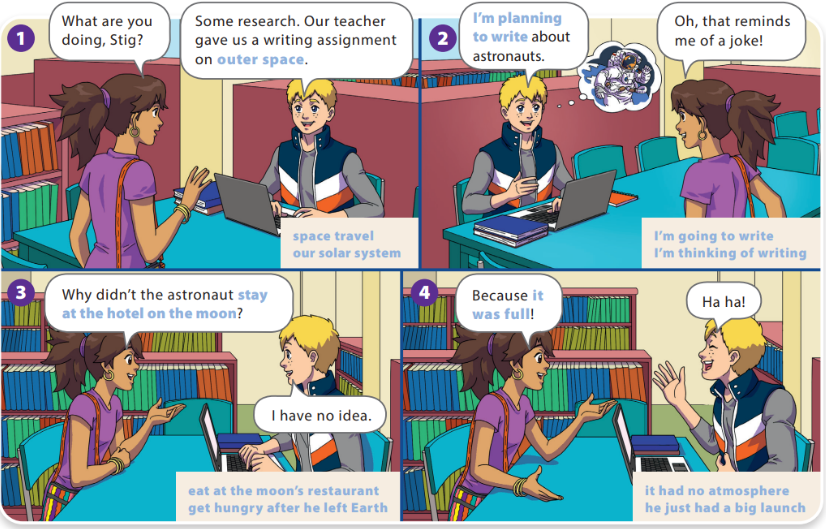
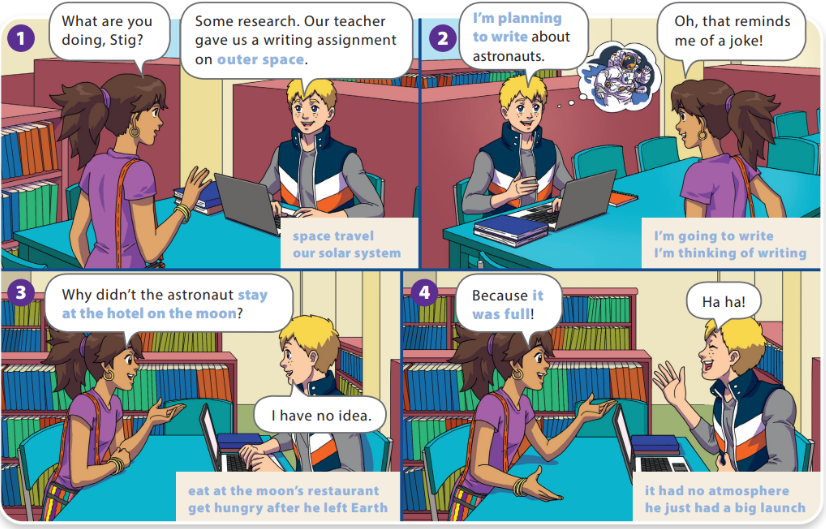
1. What are you doing, Stig?
Some research. Our teacher gave us a writing assignment on “space travel”.
2. “I’m thinking of writing” about astronauts.
Oh, that reminds me of a joke!
3. Why didn’t the astronaut “eat at the moon's restaurant?”
I have no idea.
4. Because “he just had a big launch!”
Ha ha!
C. Complete the conversation by circling words. Then listen and check.
Chris: What (1) (do you do / are you doing)?
Beth: (2) (I give / I'm giving) a presentation next week, so (3) (I’m researching / I used to research) my topic.
Chris: Oh, yeah? What (4) (are you planning / did you use to plan) to talk about?
Beth: (5) (I’ve talked / I'm going to talk) about the spacecraft Voyager 1.
(6) (l used to be / I’ve been) interested in space ever since I was in elementary school.
My third-grade teacher (7) (taught / has taught) us about it.
Chris: (8) (I don’t know / I’m not going to know) anything about it.
Beth: Well, NASA (9) (launched / was launching) Voyager 1 in 1977.
From 1977 to 2012, it (10) (traveled / has traveled) through our solar system.
It carried all kinds of things from Earth, like recordings of languages, music, and photos.
If aliens (11) (find / will find) this spacecraft, (12) (they learn / they’Il learn) a lot about Earth.
Well, (13) (they learn / they'll learn) about Earth in 1977.
Chris: What (14) (happened / has happened) in 2012?
Beth: (15) (It left / It’s going to leave) our solar system. Since then it (16) (was continuing / has continued) to travel.
But scientists think (17) (it runs out of / it'll run out of) power around 2025.
Answer:
1. do you do
2. I’m giving
3. I’m researching
4. are you planning
5. I’m going to talk
6. I’ve been
7. taught
8. I don’t know
9. launched
10. travele
11. find
12. they’ll learn
13. they’ll learn
14. happened
15. It left
16. has continued
17. it’ll run out of
D. Complete the sentences. Use the correct form of words. Listen and check.
In 1969, the spacecraft Apollo 11(1) ___________ (land) on the moon for the first time. Since then, scientists (2) ___________ (learn) many things about our closest neighbor. Only 12 people (3) ___________ (be ever) to the moon. Those astronauts (4) ____________ (go) there between 1969 and 1972. This was during a period of time when scientists (5) ___________ (study) the moon very closely.
Today, NASA astronauts (6) ___________ (plan) another trip to the moon. They (7) _____________ (want) to go before 2020. If they (8) ____________ (go), they (9) __________ (learn) more about the moon than ever before. Other countries (10) ___________ (make) preparations to go to the moon, too. India, China, Japan, and Russia all (11) __________ (have) plans in place. Some private companies (12) ___________ (hope) to make a profit from moon tourism. They (13) ____________ (begin) to take reservations for future flights.
Answer:
1. landed
2. have learned
3. have ever been
4. went
5. were studying
6. are planning
7. want
8. go
9. will learn
10. are making
11. have
12. hope
13. are beginning
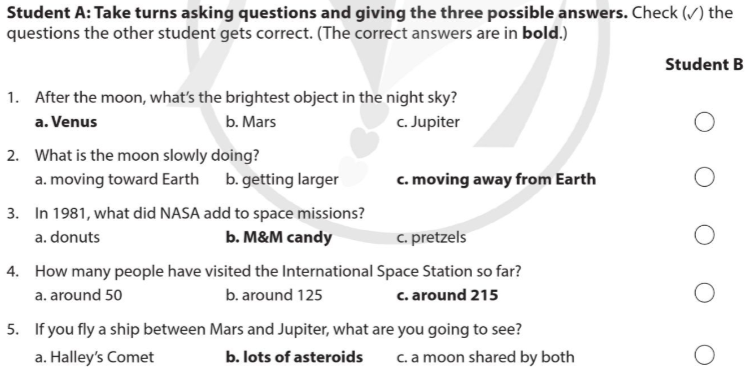
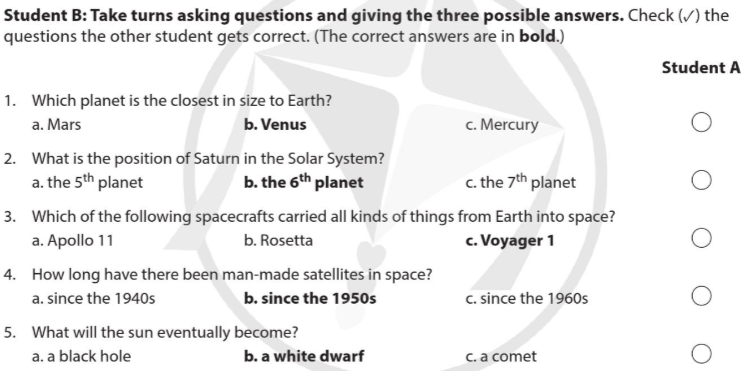
E. Work in pairs. Student A: Turn to page 134. Student B: Turn to page 138. You are going to see how much you know about space.
Answer:
(Học sinh tự thực hành trên lớp)
THE REAL WORLD
A. Look at the inventions below. Here are some products that use space technology. What problems do you think their technology solved in space? Discuss with a partner. Then listen and check your answers.

Answer:
…………………………………………………………………………………..
B. Listen again. Circle T for True or F for False.
1. Some companies use NASA's water filtering technology to make water bottles.
2. Infrared thermometers measure a person's temperature from inside their mouth.
3. The new thermometers can measure temperature in two seconds.
4. The problem with plastic glasses is that they break easily.
5. Coating eyeglasses with thin plastic makes them scratch-proof.
Answer:
…………………………………………………………………………………..
PRONUNCIATION
DO YOU KNOW?
What sport have astronauts played on the moon?
a. golf
b. baseball
c. tennis
Answer:
a. golf
A. Listen and repeat. Notice the /w/ and /y/ sounds between some words.
1. Your movements are slow in space.
/ w /
2. Pluto is not a planet anymore.
/ w /
3. Mercury and Venus are closer to the sun than Earth.
/ y /
4. The astronauts have to be at the launchpad by 7:00.
/ y /
Answer:
…………………………………………………………………………………..
B. Listen to the sentences. Circle the places you hear /w/ or /y/ sounds.
1. The spacecraft finally entered Earth's atmosphere.
2. You can see over 2,000 stars at night.
3. Scientists didn’t know about Pluto until 1931.
4. In 1969, two Americans landed on the moon in Apollo 11.
5. Do you think there will be a space colony on the moon someday?
6. Astronauts have to do a lot of training before they can go into space.
Answer:
…………………………………………………………………………………..
C. Work with a partner. Take turns to read the sentences in B.
Answer:
(Học sinh tự thực hành trên lớp)
COMMUNICATION
Make a group decision. Work in a small group. Imagine your spacecraft has to make an emergency landing on the moon. You will live there for one month. The space station has food and water. As a group, choose eight things to take with you.

Ex: We’ll need something to read. Why don’t we take some magazines?
→ That sounds good. And let’s take a game console
How about bringing a camera? We can take many photos of the moon’s surface.
Answer:
A: We’ll need something to read. Why don’t we take some magazines?
B: That sounds good. And let’s take a game console so we don’t get bored.
C: How about bringing a camera? We can take many photos of the moon’s surface.
A: Great idea! We should also bring a laptop in case we need to keep records or communicate.
B: Right. And a knife might be useful for repairs or safety.
C: What about a mirror? It could be helpful for signaling or checking our suits.
A: Good thinking. Let’s also bring a pen and paper to write notes or draw maps.
READING
A. Scan. Underline the year in which a spacecraft first landed on a comet.
LANDING on a COMET
On November 12, 2014, the European Space Agency (ESA) achieved a feat by successfully landing a spacecraft on a comet. This marked the end of a 10-year journey.
The Mission
Before the 1980s, everything we knew about comets came from looking through telescopes. In 1986, scientists sent several spacecraft to study Halley's Comet. But they needed another mission to answer further questions. In 1993, the ESA planned another mission: to land on a four-kilometer-long comet called 67P. In 2004, the ESA launched Rosetta into space. After 10 years, Rosetta reached the comet and began its orbit.
The Landing
On board Rosetta was Philae, a lander that depends on sunlight to recharge its battery. On November 12, Philae separated from Rosetta and approached the comet. Some scientists say the most difficult part of the mission was the touchdown because of the speed and surface of the comet. After landing, Philae bounced twice before stopping seven hours later and began to send data back to Earth.
The Findings
Philae managed to gather a huge amount of useful data for scientists. Scientists learned, for example, that some organic materials exist on comets. It’s also possible that a comet brought water to Earth billions of years ago. This could even help explain the origin of life on Earth.
Answer:
On November 12, 2014, a spacecraft landed on a comet for the first time.
B. Look at the headings. Match the detail to the correct heading. Then scan and check your predictions.
| 1. Rosetta would fly for 10 years. | The Mission |
| 2. Organic materials exist on comets. | The Landing |
| 3. Philae bounced twice on the comet. | The Findings |
Answer:
1. The Mission
2. The Findings
3. The Landing
C. Read the passage. Find answers to the two questions in the first paragraph.
1. When did the European Space Agency (ESA) successfully land a spacecraft on a comet?
2. How long did it take for Rosetta to reach the comet?
Answer:
1. On November 12, 2014.
2. It took 10 years for Rosetta to reach the comet.
COMPREHENSION
IDIOM
When you are “over the moon”, you are ____.
a. serious
b. lost
c. very happy
Answer:
c. very happy
A. Answer the questions about Landing on a Comet.
1. What does the word “feat” mean? (line 2)
a. an achievement
b. a mission
c. a historical event
2. Scientists needed another mission to a comet because the first mission ________.
a. didn’t return useful data
b. raised more questions
c. wasn't able to collect any data
3. If the lander’s battery runs out of power, Rosetta will __________.
a. have to land on 67P
b. replace the battery
c. stop receiving data from Philae
4. According to the article, which part of the mission was the hardest?
a. the journey to 67P
b. the landing on 67P
c. analyzing the results from Rosetta
5. Scientists believe that the comet's data may help explain the origins of ____.
a. our solar system
b. life on Earth
c. the Milky Way
Answer:
1. a
2. b
3. c
4. b
5. b
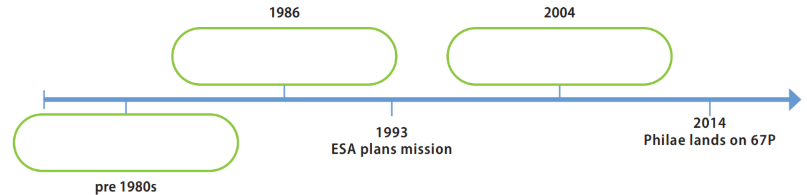
B. Complete the timeline. Use information from the passage.
Answer:
Pre 1980s: Only information about comets comes from telescopes.
1986: Several spacecraft sent to study Halley's Comet.
1993: ESA plans mission to land on 67P comet.
2004: The ESA launches Rosetta spacecraft into space.
2014: Philae lands on 67P comet, marking the end of a 10-year journey.
C. CRITICAL THINKING. Talk with a partner. Do you think life may exist on other planets? What other space missions do you know about?
Answer:
A: Do you think life may exist on other planets?
B: I think it’s possible. There are so many planets and moons that we can’t be the only ones in the universe.
A: I agree. Scientists have found signs of water on Mars, and water is important for life.
B: Right. And I’ve heard of space missions like Mars Rovers, especially Perseverance, which is looking for signs of ancient life.
A: I also know about Voyager 1. It’s gone far beyond our solar system!
PROJECT
Work with a partner. Make a poster presentation about space.
Instructions:
- You should work with a classmate on this project.
- Choose a topic about space and research it (e.g., the flight pattern when the
- Space Shuttle flew, what astronauts eat in outer space, life on the
- International Space Station, how astronauts prepare to go to outer space).
- Make a poster with a summary of key ideas and some photos.
- In the next class, present your poster to the class.
Answer:
(Học sinh tự thực hiện)
WRITING
1. Complete the sentences with the correct form of the verbs in parentheses.
a. The United States (launch) __________ its first artificial satellite Explorer 1 in 1958.
b. NASA (prepare) __________ for another moon mission for many years.
c. He fell off the ladder while he (train) __________ for the program.
d. The plane (take off) __________ in 20 minutes.
e. I think soon we (know) __________ more about the origin of life on Earth.
Answer:
a. launched
b. has been preparing
c. was training
d. will take off
e. will know
2. Read the paragraph and complete the notes.
The Rosetta mission is amazing in many ways. First of all, landing a spacecraft on a comet is not easy, but scientists at ESA did it The comet was traveling very fast, and its shape was uneven. Nevertheless, Rosetta managed to land its device on the comet. Second, the mission's data will be useful for studies about life on Earth and other planets. It may help us understand the origin of life on our planet. I hope it will also prove that there may be life on other planets as well. Programs like the Rosetta mission encourage me to learn more about space.
a. The name of the mission: ___________________________________
b. Two reasons the author thinks it is amazing: ____________________
Reason1: __________________________________________________
Explanation: _______________________________________________
Reason 2: _________________________________________________
Explanation: _______________________________________________
c. Conclusion: ______________________________________________
Answer:
a. The name of the mission: Rosetta mission
b. Two reasons the author thinks it is amazing:
Reason 1: The scientists at ESA successfully landed a spacecraft on a comet, despite the comet's high speed and uneven shape.
Explanation: Landing a spacecraft on a comet is not easy.
Reason 2: The data from the mission will be useful for studies about life on Earth and other planets, and may help us understand the origin of life on our planet.
Explanation: The mission's data will be useful for studies about life on Earth and other planets.
c. Conclusion: The author is encouraged to learn more about space and hopes that missions like Rosetta will prove that there may be life on other planets as well.
3. Write a short paragraph on a separate sheet of paper. Say what you think about a space program. Write 80-100 words. Use the sample in 2 to help you.
Answer:
The Perseverance rover mission is an exciting step in space exploration. First, it landed safely on Mars in 2021 and began searching for signs of ancient life. That’s important because it may help scientists understand whether life ever existed on the Red Planet. The rover also collects rock samples that could be brought back to Earth in the future. In addition, it carries a small helicopter called Ingenuity, which was the first aircraft to fly on another planet. I think missions like Perseverance inspire people to explore and learn more about our universe.
Tài liệu cùng môn học
Tài liệu khác
- Trắc nghiệm tiếng anh 2 Family and Friends
- Trắc nghiệm tiếng anh 2 Explore our world
- Trắc nghiệm tiếng anh 3 Family and Friends
- Trắc nghiệm tiếng anh 3 Explore our world
- Trắc nghiệm tiếng anh 4 Family and Friends
- Trắc nghiệm tiếng anh 4 Global Success
- Trắc nghiệm tiếng anh 4 Explore our world
- Trắc nghiệm tiếng anh 5 Family and Friends
- => Xem nhiều môn hơn