Giải tiếng anh 8 Explore English: Unit 9 Phones used to be much bigger
Hướng dẫn giải Tiếng anh 8 Explore English: Giải Unit 9 Phones used to be much bigger. Bài được giải chi tiết, rõ ràng, dễ hiểu. Bài giải giúp học sinh nắm vững kiến thức trong sách giáo khoa, rèn kĩ năng giải bài tập và có phương pháp học tập hiệu quả.
Nội dung chi tiết
UNIT 9: PHONES USED TO BE MUCH BIGGER
PREVIEW
A. Listen. Three people are discussing communication. Complete the sentences using the words from the box
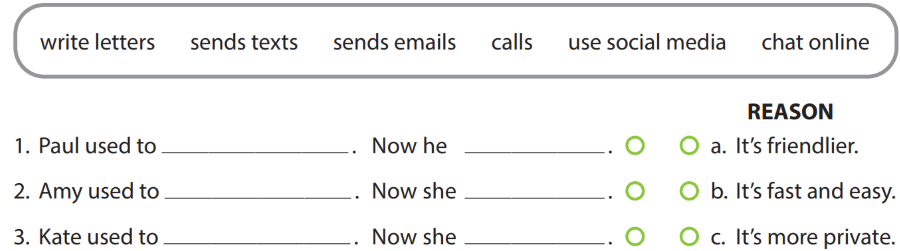
Answer:
…………………………………………………………………………………..
B. Listen again. Match the person to the reason for their preference.
Answer:
…………………………………………………………………………………..
C. Talk with a partner. How did you use to communicate? How do you communicate now?

Answer:
1. I used to send text to my friend.
→ But now, I'm using social media.
2. I used to write letters to my relatives.
→ But now, I'm chatting online with them.
3. I used to send emails to my friends.
→ But now, I'm using video calls.
LANGUAGE FOCUS
A. Listen and read. Then repeat the conversation and replace the words in blue.
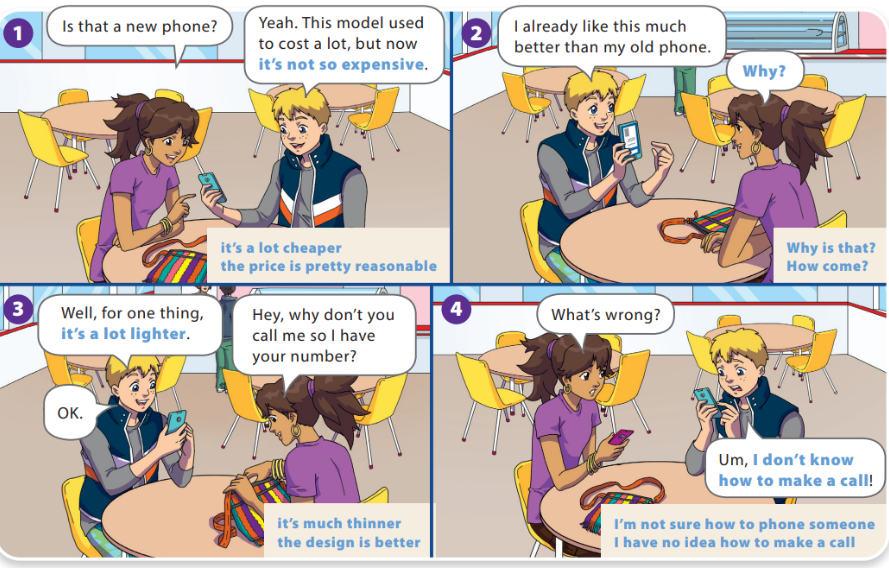
Answer:
…………………………………………………………………………………..
B. Practice with a partner. Replace any words to make your own conversation.
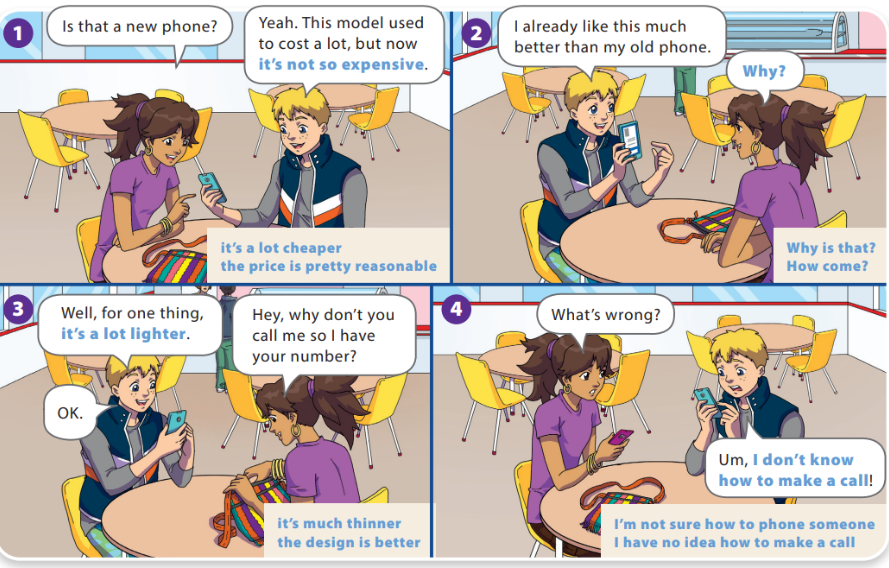
Answer:
1. Is that a new phone?
Yeah. This model used to cost a lot, but now “the price is pretty reasonable”.
2. I already like this much better than my old phone.
“Why is that?”
3. Well, for one thing. “The design is better”.
Hey, why don’t you call me so I have your number?
4. What’s wrong?
Um. “I not sure how to phone someone”.
C. Complete the conversations with the correct form of "used to" and the verbs given. Then listen and check your answers.
1. Susan: Look at these old records. Are they yours?
Paulo: No, they're my father’s. He has a huge collection. He (1) ___________ (buy) them all the time.
Susan: Does he still play them?
Paula: No, he (2) ____________ (play) them after dinner sometimes, but not anymore. We don't even have a record player now.
2. Terry: (3) __________ your sister ____________ (live) in Montreal?
Caitlin: Actually, she still lives there.
Terry: Oh yeah? Do you talk to her much?
Caitlin: Sure. I (4) _____________ (never / like) video chatting, but now I love it. When we lived in the same town, we (5) ___________ (talk) maybe once a week. Now we talk every couple of days!
Answer:
…………………………………………………………………………………..
D. Complete the sentences. Write your own ideas.
1. I was doing my homework while _______________
2. He was _______________ when it started to rain.
3. They were using their cellphones when _______________
4. She _______________ while her father was reading a newspaper.
5. We ______________ when there was a loud noise.
Answer:
1. I was doing my homework while my mother called me.
2. He was playing basketball when it started to rain.
3. They were using their cellphones when teacher came to class.
4. She cleaned her room while her father was reading a newspaper.
5. We studied when there was a loud noise.
E. Work with a partner. Student A: Turn to page 135. Student B: Turn to page 137. You are going to compare two pictures of someone.
Student A: Look at this picture of Rick from ten years ago. Your partner has a picture of Rick today. Ask and answer questions to find out what's different. Find at least five differences.
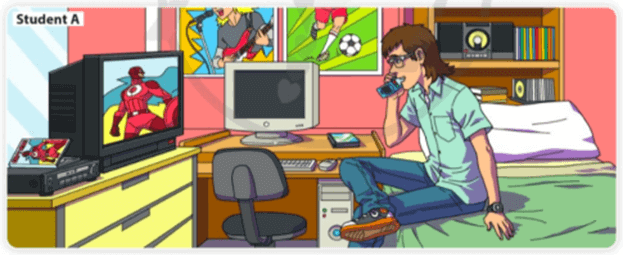
Student B: Look at this picture of Rick today. Your partner has a picture of Rick from ten years ago. Ask and answer questions to find out what's different. Find at least five differences.
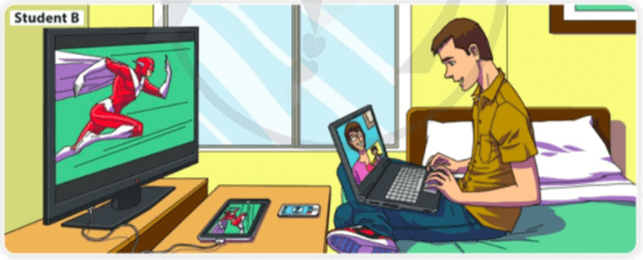
Answer:
Rick used to have long hair. Does he still have long hair?
No, now he has short hair. Did he use to have a tablet?
No, he didn't use to have a tablet. Did he use to have mobile phone?
Yes, he used to have mobile phone. But now he has smartphone. Did he use to have a television?
Yes, he used to have a television. But now he has a flat screen television. Did he use to have a radio?
Yes, he used to has a radio. But now he hasn't. Did he use to have a computer?
Yes, he used to have a computer. But now he has a laptop.
THE REAL WORLD
A. Listen. Circle T for True or F for False.
1. Case studies the relationship between humans and machines.
2. According to Case, many people are dependent on information technology.
3. Case wants to find out more about the importance of technology in our lives.
4. Information technology requires people to work in an office.
Answer:
…………………………………………………………………………………..
B. Listen again and check (V) the things she mentions. According to Case, technology is helping us ______________.
[ ] choose the career of our choice
[ ] keep our worktime separate from playtime
[ ] access information at any given time
[ ] connect to many people any time
Answer:
…………………………………………………………………………………..
PRONUNCIATION
DO YOU KNOW?
Cell phones used to weigh around 1 kilogram and took about 10 hours to charge.
a. True
b. False
Answer:
a. True
A. Listen and repeat.
1. pronounce 3. tablet 5. stuff
2. program 4. black 6. student
Answer:
…………………………………………………………………………………..
B. Listen. Write the words you hear.
1. We need to _____________ English every day.
2. Everyone in this class _____________ hard.
3. There are many good ______________ on TV these days.
4. _____________ are very expensive.
5. People often ____________ on their cellphones in restaurants.
6. My favorite color is ____________.
Answer:
…………………………………………………………………………………..
C. Work with a partner. Take turns to read the sentences in B. Do you agree with them?
Answer:
(Học sinh tự thực hiện)
COMMUNICATION
A. Guess who wrote it. On three pieces of paper, write three different things about yourself that used to be true. These could be surprising or embarrassing. Then mix them up and put them in a pile.
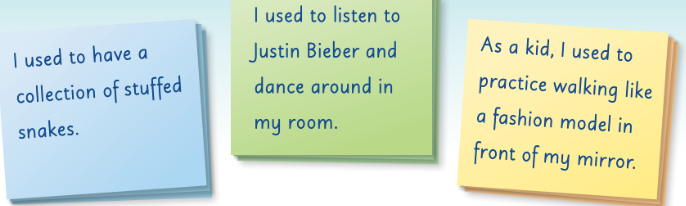
Answer:
1. I used to have a kitten.
I used to watch Disney Chanel and my favourite program is Jack and Cody.
When I was a child, I used to visit the Zoo with my family every weekend.
2. I used to live in France.
I used to have a new pink bicycle which is a birthday present that my mother gave me.
I used to not good at English.
B. Take three pieces of paper and walk around the class. Ask questions to find the person who wrote each sentence. Ask follow-up questions to get more information.

Answer:
Did you use to have a kitten?
No, I didn't. Did you use to watch Disney Chanel and your favourite program is Jack and Cody?
Yes, I did. Did you use to visit the Zoo with your family every weekend?
No, I didn't. Did you use to live in France?
Yes, I did. Did you use to have a new pink bicycle which is a birthday present that your mother gave you?
Yes, I did. Did you use to not good at English?
Yes, I did.
READING
A. Read the title and look at the pictures. What do you think the article is about?
What makes a FAD?
A fad is something that becomes very popular among a large number of people, but only for a short time. When it is no longer “cool,” a fad goes away. Anything can become a fad—fashion, food, entertainment, technology, or even language.
In the late 1970s, a Hungarian professor, Erno Rubik, invented a six-color plastic object called the Rubik's Cube. The challenge was to get each side of the cube to show one color. At the toy’s sudden peak of popularity in 1982, everyone had one. Then, suddenly the craze ended. By 1983, people were not interested anymore, perhaps because so many people already had one Rubik’s Cube in their homes.
In 2012, a South Korean musician, Psy, released a song called “Gangnam Style.” In six months, it became the first YouTube video ever to reach a billion views. Six months later, it went on to reach two billion views. “Gangnam Style” had a huge influence on world popular culture, similar to the “Macarena” dance fad from the 1990s. Although “Gangnam Style” faded in popularity, the “Korean Wave" of culture remains internationally popular.
Answer:
The article is about FAD. A fad is something that becomes very popular among a large number of people, but only for a short time.
B. Read the first paragraph. Underline the meaning of “fad”.
Answer:
A fad is something that becomes very popular among a large number of people, but only for a short time.
C. Discuss. Work with a partner. What are some fads you have heard of?
Answer:
The virtual game Among Us became an internet sensation in 2020. The perfect solution for when boredom strikes, Among Us has also given rise to some of our favorite memes on social media platforms like TikTok, Instagram, Twitter, and Snapchat. In a true testament to its addictiveness, celebrities and small–time players alike have posted lighthearted videos of them recreating the mafia–style game IRL perfect for a laugh. Rep. Alexandria Ocasio–Cortez (D–N.Y.) even used the popular streaming platform Twitch to broadcast her experience playing Among Us to the world wide web in a move to relate with young audiences and encourage them to get out and vote in the 2020 election.
COMPREHENSION
IDIOM
Another way to say something is very popular is to say “it’s ____”.
a. up
b. in
c. on
Answer:
b. in
A. Answer the questions about What Makes a Fad?
1. What is the purpose of the first paragraph?
a. to give examples of fads
b. to explain what a fad is
c. to show how fads become popular
2. A fad stops being a fad when _________.
a. it becomes very popular
b. older people start to like it
c. people don't think it’s cool anymore
3. According to the article, people stopped buying the Rubik's Cube in 1983 because ________.
a. it was very difficult to solve
b. books gave away the secrets to solving it
c. so many people already had one
4. What helped “Gangnam Style” become such a huge worldwide hit?
a. the Internet
b. television
c. the radio
5. In line 17, what does “faded in popularity” mean?
a. became less popular
b. continued to be popular
c. became a fad
Answer:
1. b
2. c
3. c
4. a
5. a
B. Complete the notes.
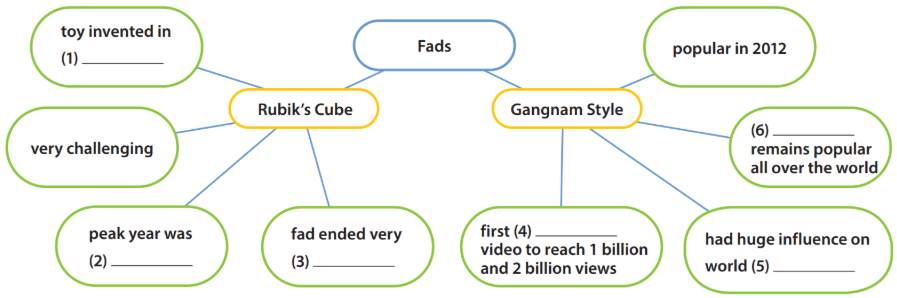
Answer:
1. the late 1970s
2. in 1982
3. suddenly
4. Youtobe
5. popular culture
6. culture
C. CRITICAL THINKING. Talk with a partner. Why do you think fads start and end so quickly? Can you think of any other fads?
Answer:
A: Hey, do you remember how we used to communicate back in the day?
B: Yeah, it's crazy how much things have changed! We used to rely on landline phones and even had to use payphones when we were outside.
A: Oh, I remember those days! We had to memorize each other's phone numbers since we didn't have contact lists on our phones.
B: Absolutely! And texting wasn't as popular back then. We mostly communicated through voice calls, leaving messages on answering machines, or even writing letters.
A: It's hard to imagine now because technology has transformed the way we communicate. Nowadays, we have smartphones that do so much more than just make calls. We can text, video call, and even use social media to keep in touch.
B: That's true! Texting has become the norm. It's so convenient to send quick messages and get instant replies. Plus, we can stay connected with friends and family through various messaging apps.
A: And let's not forget about social media platforms like Instagram and Facebook. They've become essential for sharing updates, photos, and staying connected with a broader network of people.
B: Definitely! It's amazing how technology has made communication faster and more accessible. We can now reach out to anyone across the globe with just a few taps on our phones.
A: It's a whole new world compared to the past. While I miss some aspects of the old ways, I can't deny how much easier and more efficient communication has become with the advancements in technology.
B: I agree. It's a different experience now, but I appreciate the convenience and opportunities that modern communication methods offer. It's fascinating to see how far we've come!
PROJECT
Work with a partner. Make a poster presentation about two fads.
Instructions:
- You should work with a classmate on this project.
- Choose two fads and research them (their history and interesting facts).
- Make a poster with a concept map to compare the two fads.
- In the next class, present your poster to the class.
Answer:
(Học sinh tự thực hiện)
WRITING
1. Complete the sentences. Circle the correct words.
a. Did he (used to / use to) have a large collection of comics?
b. Although we were in the same class, I never (used to / use to) hang out with Mai.
c. Snacks (use to / didn’t use to) be so expensive when I was a child.
d. When I was a high school student, I didn’t (used to / use to) have time for outdoor activities.
e. When I was a child, I (used to / didn’t use to) read science books, but now I read them in most of my free time.
Answer:
a. use to
b. used to
c. didn’t use to
d. use to
e. didn’t use to
2. Read the paragraph and answer the questions.
My favorite fad was the Angry Birds game. which was very popular a few years ago. It was very easy to play and the graphics were beautiful. The music was fun, too. I think that’s why it was so popular. I downloaded the app and used to play the game for hours. Most of my friends knew and played the game, too. When we hung out, we used to compare our scores and talk about how to solve a difficult level. There was even a movie based on the game.
a. What was the fad?
b. Why was it popular?
c. What does the writer remember doing with his friend?
d. What did people make based on the fad?
Answer:
a. The fad was Angry Birds game.
b. Because it was very easy to play and the graphics were beautiful. The music was fun, too.
c. They used to compare our scores and talk about how to solve a difficult level.
d. There was even a movie based on the game.
3. Write a short paragraph about your favorite fad. Write 80-100 words on a separate sheet of paper. Use the sample in 2 to help you.
Answer:
Gangnam Style was a popular music fad that gained global attention in 2012. I often danced and sang along to the catchy tune with my friends, and we shared videos of ourselves doing the famous "horse-riding" dance. Me and my friends have also attended dance parties or concerts featuring the song or watched and shared humorous parodies or mashups online. Like many fads, Gangnam Style provided a sense of shared excitement and community among those who enjoyed it, and friends may have bonded over their mutual appreciation of the song and dance craze.
Tài liệu cùng môn học
Tài liệu khác
- Trắc nghiệm tiếng anh 2 Family and Friends
- Trắc nghiệm tiếng anh 2 Explore our world
- Trắc nghiệm tiếng anh 3 Family and Friends
- Trắc nghiệm tiếng anh 3 Explore our world
- Trắc nghiệm tiếng anh 4 Family and Friends
- Trắc nghiệm tiếng anh 4 Global Success
- Trắc nghiệm tiếng anh 4 Explore our world
- Trắc nghiệm tiếng anh 5 Family and Friends
- => Xem nhiều môn hơn