Giải tiếng anh 8 Explore English: Unit 4 How do sloths move?
Hướng dẫn giải Tiếng anh 8 Explore English: Giải Unit 4 How do sloths move?. Bài được giải chi tiết, rõ ràng, dễ hiểu. Bài giải giúp học sinh nắm vững kiến thức trong sách giáo khoa, rèn kĩ năng giải bài tập và có phương pháp học tập hiệu quả.
Nội dung chi tiết
UNIT 4: HOW DO SLOTHS MOVE?
PREVIEW
A. Listen. Match the animals with the places.
1. sloths 2. bees 3. owls 4. dolphins | a. South Africa b. the Amazon rain forest c. the United States d. Mexico |
Answer:
…………………………………………………………………………………..
B. Listen again. Complete the sentences with the words in the box.

1. Sloths move ____ in trees but ____ in water.
2. Bees work very _____ to make honey.
3. Owls wait _____ for their food.
4. Dolphins swim _____. They jump _____ out of the water.
Answer:
…………………………………………………………………………………..
C. Talk with a partner. Name other animals that do these things.

Ex: I think lions wait patiently.
Answer:
1. Banana slugs move very slowly.
2. Parrots sing loudly.
3. Panthers run quickly.
4. Owls wait patiently
5. Dolphins swim gracefully
LANGUAGE FOCUS
A. Listen and read. Then repeat the conversation and replace the words in blue.
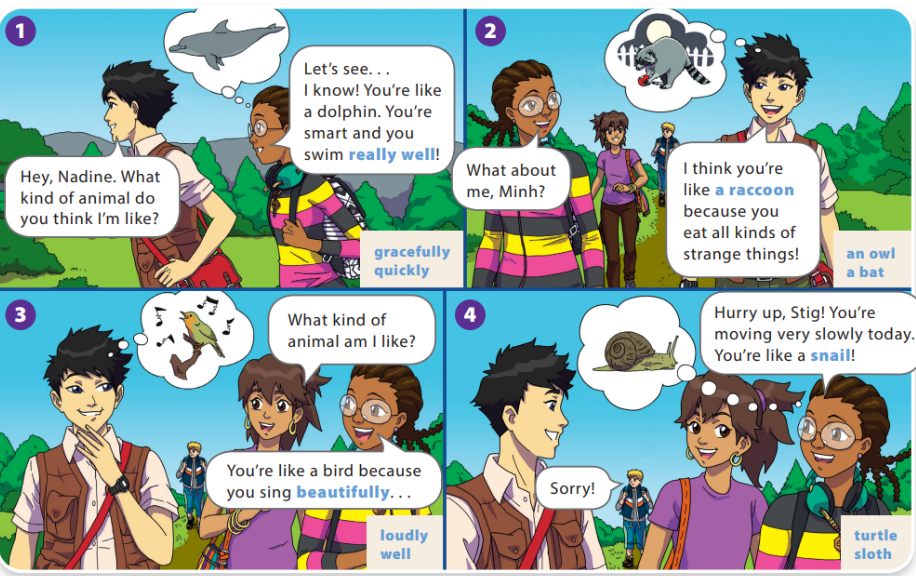
Answer:
…………………………………………………………………………………..
B. Practice with a partner. Replace any words to make your own conversation.
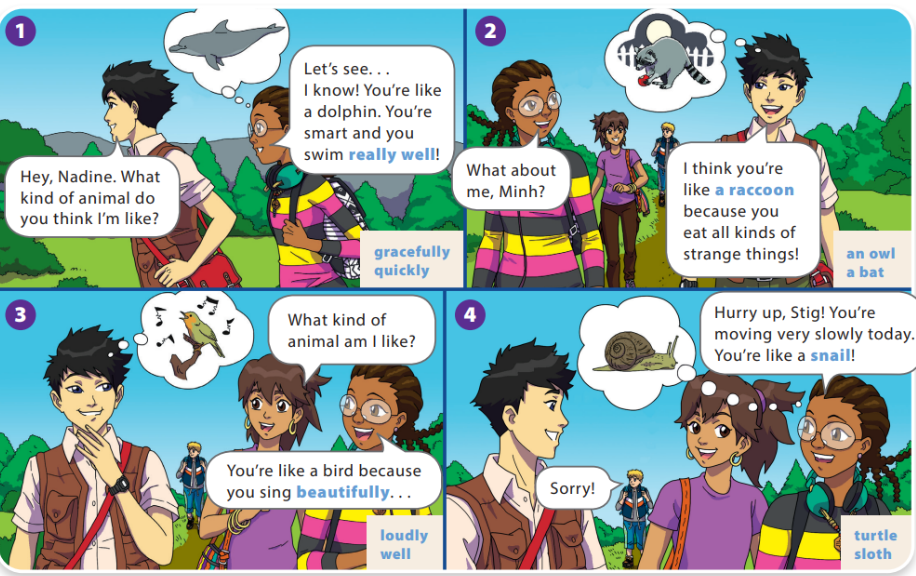
Answer:
1. Hey, Nadine. What kind of animal do you think I’m like?
Let’s see … I know! You’re like a dolphin. You’re smart and you swim “quickly”!
2. What about me, Minh?
I think you’re like “a bat” because you eat all kinds of strange things.
3. What kind of animal am I like?
You’re like a bird because you sing “well” …
4. Hurry up, Stig! You’re moving very slowly today. You’re like a “sloth”!
Sorry!
C. Circle the correct words.
Snowy owls live in the Arctic. It's not 1. (easy / easily) to find food there, but these 2. (beautiful / beautifully) birds are very 3. (good / well) hunters. They wait for their prey 4. (more patient / more patiently) than other species. They sit 5. (quiet / quietly) and wait until they see a mouse, a rabbit, or another small animal. Then they move in 6. (quick / quickly). Snowy owls also hear 7. (well / better) than other birds. This is important when they are trying to find food under the snow.
Answer:
1. easy
2. beautiful
3. good
4. more patiently
5. quietly
6. quickly
7. better
D. Complete the conversation with the correct form of the words in parentheses. Then listen and check your answers.
Maya: What are you reading, Stig?
Stig: Oh, it's a book about elephants. Did you know elephants can communicate (1) ____ (easy) with other elephants up to eight kilometers away?
They make a (2) ___ (loud) sound with their trunk.
Maya: So they have a (3) ___ (good) sense of hearing?
Stig: Yeah, but their eyesight is (4) ___ (bad). I also learned that they don't run. They just walk (5) ___ (quick).
Maya: I know something interesting about elephants.
Stig: What's that?
Maya: They swim (6) ___ (good). I saw a video of it. It was (7) ___ (beautiful).
Answer:
1. easily
2. loud
3. good
4. bad
5. quickly
6. well
7. beautiful
E. Complete the sentences about yourself. Then join a group and share the information. Suggest what animal each person is like.
1. I run ______________.
2. I eat ______________.
3. I jump _____________.
4. I swim _____________.
5. I work _____________.
Answer:
1. I run very fast. → From your answers, I think you’re like a rabbit.
2. I eat strange things. → From your answers, I think you’re like a raccoon.
3. I jump very high. → From your answers, I think you’re like a kangaroo.
4. I swim gracefully. → From your answers, I think you’re like a dolphin.
5. I work hard. → From your answers, I think you’re like a bee.
THE REAL WORLD
A. Work with a partner. What do you know about frogs? Check (v) the statements you think are true. Frogs _____.

Answer:
- can change color
- never close their eyes
B. Listen. Circle T for True or F for False.
1. Hayes started studying frogs when he was a young boy.
2. The male frogs changed color because of water pollution.
3. The water was dangerous for frogs, but it was safe for humans.
4. Watching these frogs regularly can save human lives.
Answer:
…………………………………………………………………………………..
PRONUNCIATION
DO YOU KNOW
What is a group of frogs called?
a. a flock of frogs
b. a school of frogs
c. an army of frogs
Answer:
c. an army of frogs
A. Listen and repeat.
/ə/ /ə/ /ə/ /ə/
animal elephant around national
Answer:
…………………………………………………………………………………..
B. Underline the reduced vowel in each word. Then, listen and check your answers. Say each word.

Answer:
…………………………………………………………………………………..
C. Work with a partner. Take turns to read the sentences in B.
Answer:
(Học sinh tự thực hành)
COMMUNICATION
Play charades. Work in small groups. Choose one item from each column and act it out. Other students guess the activity. Take turns.
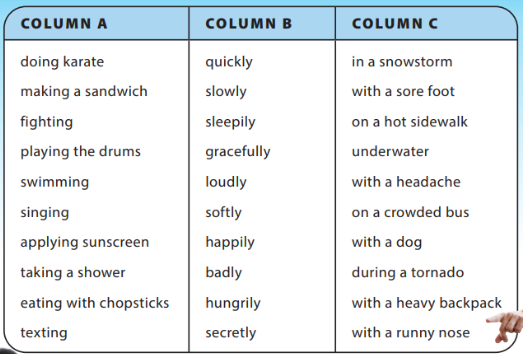
Ex: Are you fighting gracefully with a runny nose?
No? Are you applying sunscreen quickly underwater?
Answer:
Are you fighting gracefully with a runny nose?
No? Are you applying sunscreen quickly underwater?
Are you eating with chopsticks secretly with a heavy backpack?
No? Are you taking a shower slowly with a headache?
Are you playing the drums loudly during a tornado?
Are you doing karate badly with a dog?
Are you texting happily on a hot sidewalk?
READING
A. Discuss. Look at the title. Do you think animals can be nice? If so, give an example.
Answer:
I think animals can be nice.
For example:
- A hippo ran quickly to the crocodile and chased it away. Paoilillo says hippos sometimes protect other animals from crocodiles.
- The healthy elephant took a bush and put it carefully into his new friend's mouth.
B. Skim the text. Match the sentences.
1. A fox 2. A hippo 3. An elephant | a. gave food to another animal. b. protected another animal. c. played with another animal. |
Answer:
1 - c
2 - b
3 - a
C. Scan the text. Then underline the opposites for the words below.

Answer:
gently - unkind
loudly - silently
slowly - quickly
COMPREHENSION
IDIOM
“As wise as a(n) ____”.
a. owl
b. mouse
c. dolphin
Answer:
a. owl
A. Answer the questions about Can Animals Be Nice?
1. What is the main idea of the reading?
a. Animals that live in groups follow rules.
b. Some animals can be nice to other animals.
c. Most animals are nice to people.
2. In line 5, what does "do just that" mean?
a. be nice b. play roughly c. walk away
3. We can say that animals can be nice __.
a. because they have to follow rules
b. when they live in groups
c. even when they don't have to
4. Why did the elephant need help?
a. The tree was too tall. b. It could not use its trunk. c. It had no food.
5. In line 15, what does "it" refer to?
a. the crocodile b. the chimpanzee c. the monkey
Answer:
1. b 2. c 3. c 4. b 5. c
B. Identify which statements are causes and which are effects. Circle C for Cause or E for Effect.
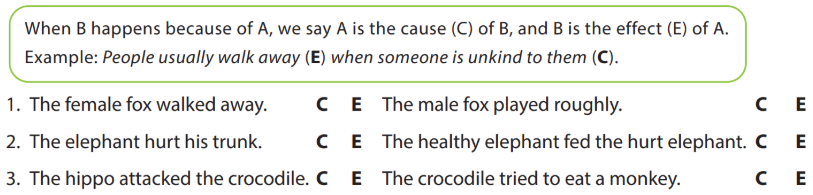
Answer:
C:
- The female fox walked away.
- The elephant hurt his trunk.
- The crocodile tried to eat a monkey.
E:
- The male fox played roughly.
- The healthy elephant fed the hurt elephant.
- The hippo attacked the crocodile.
C. CRITICAL THINKING. Work with a partner. Which animal from the article do you think was the nicest? Why? Can animals be unkind? Can you think of an example?
Answer:
I think hippo was the nicest animal.
The hippo tried to protect monkey. It attacked the crocodile because the crocodile tried to eat a monkey.
I don't think that animals be unkind.
If we treated them with a rudely behave, it would treat us like the way we did.
PROJECT
Work with a partner. Make a report about an animal.
Instructions:
- You should work with a classmate on this project.
- Choose an animal and research it. (Where does it live? What does it eat? What is speacial about the animal?)
- Compare your ideas with your partner and decide on the three most important pieces of information.
- Write a report about why the animal is special. Find a picture of the animal and include it in your report.
- In the next class, share your report with a group of 5-6 students.
Answer:
(Học sinh tự thực hành)
WRITING
1. Correct one mistake on each line.
a. Turtles are slowly and quiet animals.
b. Most sharks swim slow than dolphins.
c. It's easily for elephants to communicate with other elephants far away.
d. Snowy owls have a good sense of hearing than many other birds.
e. Bees work harder as ants.
Answer:
a. Turtles are slow and quiet animals.
b. Most sharks swim slower than dolphins.
c. It’s easy for elephants to communicate with other elephants far away.
d. Snowy owls have a good sense of hearing than many other birds.
e. Bees work harder than ants.
2. Underline the adjectives and adverbs for describing behavior in the paragraph.
In my house, there are Cashew the dog and Libby the cat. One day, Cashew hurt his eyes and couldn't see clearly. Libby became a guide cat for Cashew. Now she guides Cashew carefully around the house. Libby is a smart cat. Although she may not understand Cashew, she knows where to take him with his barking. One bark means the water. Two barks mean the food. Libby always waits patiently for Cashew to finish drinking or eating. Then she guides him back to his bed. They live happily together. I love both of my pets.
Answer:
In my house, there are Cashew the dog and Libby the cat. One day, Cashew hurt his eyes and couldn't see clearly. Libby became a guide cat for Cashew. Now she guides Cashew carefully around the house. Libby is a smart cat. Although she may not understand Cashew, she knows where to take him with his barking. One bark means the water. Two barks mean the food. Libby always waits patiently for Cashew to finish drinking or eating. Then she guides him back to his bed. They live happily together. I love both of my pets.
3. Write a short story about an animal that's nice to another animal. Write 80-100 words on a separate sheet of paper. Use the sample in 2 to help you.
Answer:
I very love my dog named Pull. The dog is an Alaska dog with straight brown hair, blue eyes and big ear. He is said to be intelligent, loyal and obedient. Moreover, Pull is friendly and well-trained when I said “sit down” or “run around” he will do absolutely true. I remember the first day I have met Pull-my 12 birthday, he is a present given by my father. At that time, Pull was 2 years old, he was small and unfamiliar with my family’s members. Nowadays, he is an adult dog with good health and he seems to be one important member of my whole family. Pull and I usually have wonderful time together we eat, go shopping, walk in the sunrise and sunset, and play in a local park. Whenever I have trouble or whatever mistake I do, I always have him by my side. Although he is not able to talk, I feel the love and caring of him for me. Besides, Pull helps my mother much in household, he can hold a heavy bucket of water. As I’m the only child in my family, Pull is my best friend.
Tài liệu cùng môn học
Tài liệu khác
- Trắc nghiệm tiếng anh 2 Family and Friends
- Trắc nghiệm tiếng anh 2 Explore our world
- Trắc nghiệm tiếng anh 3 Family and Friends
- Trắc nghiệm tiếng anh 3 Explore our world
- Trắc nghiệm tiếng anh 4 Family and Friends
- Trắc nghiệm tiếng anh 4 Global Success
- Trắc nghiệm tiếng anh 4 Explore our world
- Trắc nghiệm tiếng anh 5 Family and Friends
- => Xem nhiều môn hơn