Giải Tiếng Anh 12 kết nối: Unit 6 Artificial intelligence
Hướng dẫn giải Tiếng Anh 12 kết nối tri thức: Giải Unit 6 Artificial intelligence. Bài được giải chi tiết, rõ ràng, dễ hiểu. Bài giải giúp học sinh nắm vững kiến thức trong sách giáo khoa, rèn kĩ năng giải bài tập và có phương pháp học tập hiệu quả.
Nội dung chi tiết
UNIT 6: Artificial Intelligence
I. GETTING STARTED
A visit to a high - tech center
1. Listen and read.
Teacher: Hello, class. Please meet Jessica. She's a human-like robot and will be your guide today.
Jessica: Good morning, everybody. Welcome to the New Tech Centre.
Nam: Hi, Jessica. I'm so excited as I've never met a talking robot before. Let's have a photo taken together!
Jessica: OK, I'll get someone to take a picture of us, but let's go first to the robot exhibition where you'll see a collection of human-like robots from around the world. Please follow me. ... OK, do you have any questions?
Mai: They look so real! Can we interact with them?
Jessica: Yes, you can. They're all capable of answering questions and translating from different languages. Let me get this robot activated so you can talk to him.
Mai: Hello, what's your name? What languages can you speak? Where do you live?
Robby: Hello, my name's Robby. I can speak English, Vietnamese, Chinese, and German. I live in the New Tech Centre.
Mai: Wow! You're so smart, Robby.
Nam: Jessica, where shall we go next?
Jessica: Next, we'll visit the Research and Development area. Please follow me. Here scientists and engineers explore and create new AI technologies. AI has many practical applications such as facial recognition and virtual assistants.
Mai: I noticed a facial recognition screen at the entrance of the centre.
Jessica: That's right. We have all visitors' identity checked to improve the center's security. Now, what else would you like to see?
2. Read the conversation again and answer the questions.
1. Why is Nam excited?
2. What can human-like robots do?
3. What are some examples of AI applications?
4. Where did Mai see a facial recognition screen?
Answer:
1. Nam is excited because he has never met a talking robot before. (The text mentions “Nam: Hi, Jessica. I'm so excited as I've never met a talking robot before. Let's have a photo taken together!”)
2. They can answer questions and translate from different languages. (The text mentions “Jessica: Yes, you can. They're all capable of answering questions and translating from different languages. Let me get this robot activated so you can talk to him.”)
3. Facial recognition and virtual assistants. (The text mentions “AI has many practical applications such as facial recognition and virtual assistants.”)
4. Mai saw a facial recognition screen at the entrance of the centre. (The text mentions “Mai: I noticed a facial recognition screen at the entrance of the centre.”)
3. Find words in 1 with the following meanings.
1. c_______: able to do things well
2. a_______: caused to work or act
3. a_______: the practical uses of something
4. f_______: the act of identifying what something is
Answer:
1. capable of: able to do things well
2. activated: caused to work or act
3. applications: the practical uses of something
4. facial recognition: the act of identifying what something is
4. Complete the sentences with words or a phrase from 1.
1. Let's have a photo ________ together.
2. I'll get someone ________ a picture of us
3. Let me get this robot ________, so you can talk to him.
4. We have all visitors' identity ________ to improve the centre security.
Answer:
1. taken - Let's have a photo taken together.
2. to take - I'll get someone to take a picture of us.
3. activated - Let me get this robot activated, so you can talk to him.
4. checked - We have all visitors' identity checked to improve the centre security.
II. LANGUAGE
PRONUNCIATION
Homophones
1. Listen and repeat the following homophones.
| 1 | to | two |
| 2 | there | their |
| 3 | where | wear |
| 4 | board | bored |
| 5 | hour | our |
| 6 | allowed | aloud |
| 7 | know | no |
| 8 | right | write |
Answer:
| 1 | to /tuː/ | two /tuː/ |
| 2 | there /ðɛər/ | their /ðɛər/ |
| 3 | where /wɛər/ | wear /wɛər/ |
| 4 | board /bɔːrd/ | bored /bɔːrd/ |
| 5 | hour /aʊər/ | our /aʊər/ |
| 6 | allowed /əˈlaʊd/ | aloud /əˈlaʊd/ |
| 7 | know /noʊ/ | no /noʊ/ |
| 8 | right /raɪt/ | write /raɪt/ |
2. Choose the correct words to complete the sentences. Listen and repeat. Then practise saying the sentences in pairs.
1. There are more than two/to types of robots.
2. We want to know wear/where AI technologies are used today.
3. There/Their have been some worries about AI taking over the world.
4. Robots can work for long ours/hours without feeling tired.
5. We have no/know idea about the future of AI in space exploration.
Answer:
1. two - There are more than two types of robots. - (Có nhiều hơn hai loại robot.)
2. where - We want to know where AI technologies are used today. - (Chúng tôi muốn biết ngày nay công nghệ AI được sử dụng ở đâu.)
3. There - There have been some worries about AI taking over the world. - (Đã có một số lo ngại về việc AI chiếm lĩnh thế giới.)
4. hours - Robots can work for long hours without feeling tired. - (Robot có thể làm việc nhiều giờ mà không cảm thấy mệt mỏi.)
5. no - We have no idea about the future of AI in space exploration. - (Chúng ta không biết gì về tương lai của AI trong việc khám phá không gian.)
VOCABULARY
Science and technology
1. Match the words with their meanings.
| 1. advanced (adj) | a. a computer programme that can have a conversation with a human being, usually over the Internet |
| 2. chatbot (n) | b. to examine the nature or structure of something |
| 3. artificial intelligence (n) | c. modern and recently developed |
| 4. programme (v) | d. to tell a machine to operate in a specific way |
| 5. analyse (v) | e. the study and development of computer systems that can copy human behavior. |
Answer:
1 - c. advanced (adj): modern and recently developed
2 - a. chatbot (n): a computer programme that can have a conversation with a human being, usually over the Internet
3 - e. artificial intelligence (n): the study and development of computer systems that can copy human behaviour
4 - d. programme (v): to tell a machine to operate in a specific way
5 - b. analyse (v): to examine the nature or structure of something
2. Complete the sentences using the correct forms of the words from 1.
1. _________ is now part of our everyday lives.
2. With its human-like appearance and ability to walk and talk, Sophia is considered the most _________ robot in the world.
3. Robots must be _________ to perform human-like activities
4. This programme uses students' answers to _________ their language proficiency.
5. Many businesses use _________ to offer real-time customer support.
Answer:
1. Artificial intelligence - Artificial intelligence is now part of our everyday lives.
2. advanced - With its human-like appearance and ability to walk and talk, Sophia is considered the most advanced robot in the world.
3. programmed - Robots must be programmed to perform human-like activities.
4. analyze - This programme uses students' answers to analyze their language proficiency.
5. chatbots - Many businesses use chatbots to offer real-time customer support.
GRAMMAR
Active and passive causatives
1. Rewrite the sentences using active or passive causatives.
1. A robot cleans my house every day.
=> I _______________________________.
2. My dad arranged for someone to repair our robot vacuum cleaner.
=> My dad __________________________.
3. The shop arranged for a robot to put together our furniture in 10 minutes.
=> We _____________________________.
4. They will upgrade his computer to improve its performance.
=> He______________________________.
Answer:
1. A robot cleans my house every day.
=> I have a robot clean my house every day.
2. My dad arranged for someone to repair our robot vacuum cleaner.
=> My dad had someone repair our robot vacuum cleaner.
3. The shop arranged for a robot to put together our furniture in 10 minutes.
=> We had a robot put together our furniture in 10 minutes.
4. They will upgrade his computer to improve its performance.
=> He will get his computer upgraded to improve its performance.
2. Work in pairs. Make predictions about applications of robots in the future, using causatives.
Examples: (Ví dụ)
People will have robots do all the delivery services for them.
People will have all dangerous jobs done by robots.
Answer:
Doctors will have surgeries performed by robots
Businesses will have customer service handled by AI-powered robots
Families will have robots prepare meals and clean homes to save time
Farmers will have robots harvest crops to optimize yield and minimize labor costs.
III. READING
AI applications in education
1. Work in groups. Discuss what the pictures in the article below show and where you might see them.

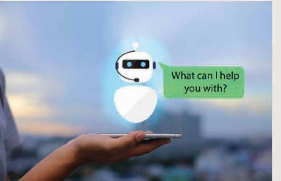
Answer:
The pictures show some examples of AI: chatbots, virtual reality,… We can see them on some online platforms and websites dedicated to these technologies and educational approaches such as ChatGPT, and SteamVR.
2. Read the article. Choose the correct meanings of the highlighted words.
TECH NEWS
Artificial Intelligence (AI) has had a huge impact on education. Here are some examples from around the world.
A. Digital portfolio
To apply for a university or a job, secondary school students usually need to support their applications with a list of relevant qualifications and work experience. Thanks to AI, they can now effortlessly do that online. A team from two famous universities in Singapore has invented an AI digital portfolio. This app collects data from the learning and working experience that students upload onto the app. Then the data is sorted into sets of skills which students can use for their job or university applications.
B. Educational chatbots
AI chatbots are being used in many schools and universities around the world. They can help keep students engaged in their learning by providing a more interactive experience. These virtual tutors can explain concepts clearly, answer specific questions, and give feedback on homework. Students can seek support from AI chatbots during and after classes so that they can understand the lessons better. They can also create groups on chatbots to share ideas about projects and activities. Engaging with each other using conversational AI can help students create a better and friendlier learning environment.
C. Virtual reality
Schools in Hong Kong are bringing fascinating learning to the classroom through the power of virtual reality (VR). This new way of teaching helps students learn valuable skills, provides 'hands-on’ experiences when studying history or geography, and limits potential dangers of chemistry or physics experiments. Guided virtual tours transport students back in time to study the history of Hong Kong or take them to tropical forests to explore endangered species.
D. Personalized learning
Experts in Israel have created a technology platform to support personalized learning. It collects data from students about what they know and do not know, analyzes performances using AI, then offers them suitable assignments. This app has served as the main distance-learning platform for many Israeli secondary school students who are preparing for advanced examinations in physics. There are also thousands of chemistry and biology students who benefit from this software.
1. portfolio
A. collection of someone's prizes
B. collection of someone's work such as drawings or documents
C. collection of someone's learning and working experience
2. virtual
A. not made of natural things
B. made, done, or seen on the Internet or a computer rather than the real world
C. very similar to the real world but appearing in a different form
3. hands-on
A. doing something yourself rather than just talking about it
B. asking people to do something
C. doing something by hand
4. platform
A. a floor of a building
B. a kind of computer system or software
C. a working area
Answer:
1. B - portfolio (hồ sơ năng lực) - collection of someone's work such as drawings or documents
2. B - virtual (ảo) = made, done, or seen on the Internet or a computer rather than the real world
3. A - hands-on (thực tiễn) - doing something yourself rather than just talking about it (tự mình làm điều gì đó thay vì chỉ nói về nó)
4. B - platform (nền tảng) - a kind of computer system or software (một loại hệ thống máy tính hoặc phần mềm)
3. Read the article again and choose the correct answer A, B, C, or D.
1. What can students in Singapore upload on their digital portfolio?
A. Their curriculum vitae.
B. Their test results.
C. Their study and work experience.
D. Descriptions of their skills.
2. Which of the following can AI chatbots NOT do according to Paragraph B?
A. Explain lessons.
B. Provide physical support.
C. Answer questions.
D. Comment on homework.
3. Which is one benefit of using VR in Hong Kong schools?
A. Organising field trips that take place online.
B. Replacing real-life travel.
C. Reducing the costs of doing experiments.
D. Creating more ways of communication.
4. Which group of students do NOT benefit from personalized learning app?
A. Physics.
B. Language
C. Biology.
D. Chemistry.
5 . Which AI applications are useful for students who need additional tutoring?
A. Digital portfolio and personalized learning.
B. All the apps mentioned above.
C. Educational chatbots and virtual reality.
D. Personalized learning app and educational chatbots.
Answer:
1. C - Their study and work experience (Kinh nghiệm học tập và làm việc)
The text mentions “This app collects data from the learning and working experience that students upload onto the app.”
2. B - Provide physical support. (Cung cấp hỗ trợ vật chất)
The text mentions “These virtual tutors can explain concepts clearly, answer specific questions, and give feedback on homework. Students can seek support from AI chatbots during and after classes so that they can understand the lessons better.”
3. A - Organising field trips that take place online. - (Tổ chức các chuyến đi thực tế diễn ra trực tuyến.)
The text mentions “Guided virtual tours transport students back in time to study the history of Hong Kong or take them to tropical forests to explore endangered species.”
4. B - Language (Ngôn ngữ)
The text mentions “This app has served as the main distance-learning platform for many Israeli secondary school students who are preparing for advanced examinations in physics. There are also thousands of chemistry and biology students who benefit from this software.”
5. B - All the apps mentioned above.
The text mentions “Artificial Intelligence (AI) has had a huge impact on education.”
4. Complete each of the following sentences with ONE word from the article.
1. _______ at Singaporean secondary schools can benefit from the digital portfolio.
2. Learners create project groups on _______ so that they can engage with each other.
3. Students in Hong Kong can go on virtual trips to learn about the _______ of their city.
4. The Al application in Israel has been used as the primary distance-learning _______ by advanced physics students.
Answer:
1. Students - Students at Singaporean secondary schools can benefit from the digital portfolio.
The text mentions “To apply for a university or a job, secondary school students usually need to support their applications with a list of relevant qualifications and work experience. Thanks to AI, they can now effortlessly do that online.”
2. chatbots - Learners create project groups on chatbots so that they can engage with each other.
The text mentions “They can also create groups on chatbots to share ideas about projects and activities. Engaging with each other using conversational AI can help students create a better and friendlier learning environment.”
3. history - Students in Hong Kong can go on virtual trips to learn about the history of their city.
The text mentions “Guided virtual tours transport students back in time to study the history of Hong Kong or take them to tropical forests to explore endangered species.”
4. platform - The Al application in Israel has been used as the primary distance-learning platform by advanced physics students.
The text mentions “This app has served as the main distance-learning platform for many Israeli secondary school students who are preparing for advanced examinations in physics.”
5. Work in groups. Discuss the following question. Which of the Al applications do you think your school can adopt?
Answer:
I believe our school could benefit from integrating educational chatbots to enhance student learning outcomes. These chatbots can provide instant responses, aiding students in promptly resolving queries regarding assignments. Furthermore, they offer continuous support, enabling students to access information and help whenever needed, thereby nurturing a learning environment that is both adaptable and tailored to individual needs. This capability addresses a challenge that teachers may find difficult to manage, ensuring students receive timely assistance and facilitating a more personalized approach to learning.
IV. SPEAKING
Applications of AI in education
1. Work in pairs. Match each AI application (1-5) with its purpose in learning (a-f). There can be multiple correct answers.
1. speech recognition
2. educational robots
3. virtual reality
4. AI-powered games
5. chatbots
| a. support students with disabilities
b. develop problem-solving skills
c. check pronunciation
d. develop programming skills
e. provide personalised support
f. provide interactive forms of learning |
Answer:
1 - c. speech recognition: check pronunciation
2 - a. educational robots: support students with disabilities
3 - f. virtual reality: provide interactive forms of learning
4 - d. AI-powered games: develop problem-solving skills, d. develop programming skills
5 - e. chatbots: provide personalized support
2. Work in groups. Discuss the questions.
1. How can each application in 1 be used in education?
2. What are the advantages and disadvantages of each application?
Example:
A: What do you think about chatbots?
B: I think a chatbot app is an effective application because it can help students understand difficult concepts and provide instant and personalised support throughout the course.
C: I agree. If available, we can use it during and after classes to clarify points and get feedback on homework.
A: Yes, but there are also disadvantages. Chatbots may not be able to answer complex questions that need making decisions.
B: In addition, if learners always wait for ready-made answers, they may become lazy and may not develop critical thinking skills.
C: That's a good point. Chatbots can't replace human interaction and lack personal connections.
Answer:
Speech Recognition:
A: How can speech recognition be used in education?
B: Speech recognition technology can assist students by transcribing lectures and discussions in real-time, helping those with hearing impairments and supporting language learning through pronunciation feedback.
C: I agree. It can also automate grading for oral exams and provide speech-to-text features for note-taking.
A: What are the advantages and disadvantages?
B: One advantage is its accessibility benefits, but a disadvantage could be inaccuracies in understanding accents or dialects.
C: I see and it might raise concerns about privacy if recordings are stored.
Educational Robots:
A: How can educational robots be used in education?
B: Educational robots can facilitate interactive learning experiences, teach programming and robotics concepts, and even provide one-on-one tutoring.
C: They could also assist in tasks like classroom management and delivering personalized lessons.
A: What are the advantages and disadvantages?
B: An advantage is their ability to engage students, but they may be costly and require technical maintenance.
C: Besides, robots might not adapt well to sudden changes in curriculum or student needs.
Virtual Reality:
A: How can virtual reality be used in education?
B: Virtual reality can create immersive simulations for historical events, scientific experiments, and virtual field trips, enhancing experiential learning.
C: It can also provide training in high-risk environments like medical procedures or industrial settings.
A: What are the advantages and disadvantages?
B: Advantages include enhanced engagement and understanding, but disadvantages may include costs and the need for specialized equipment.
C: I think VR experiences might cause motion sickness or sensory overload for some users.
AI-powered Games:
A: How can AI-powered games be used in education?
B: AI-powered games can adapt difficulty levels based on student performance, reinforce learning concepts through gameplay, and provide instant feedback.
C: They can also foster collaboration and problem-solving skills.
A: What are the advantages and disadvantages?
B: Advantages include motivational benefits and personalized learning experiences, but they may distract from traditional learning objectives.
C: In my opinion, developing effective educational games requires significant investment and expertise.
Chatbots:
A: How can chatbots be used in education?
B: Chatbots can provide immediate responses to student queries, offer personalized tutoring support, and assist in administrative tasks like course registration.
C: They can also facilitate communication between students and teachers outside of regular class hours.
A: What are the advantages and disadvantages?
B: Advantages include accessibility and scalability, but chatbots may struggle with complex queries and lack empathy in interactions.
C: Moreover, over-reliance on chatbots might diminish interpersonal communication skills.
3. Prepare a summary of your discussion and report to the whole class.
Answer:
Today, we explored several AI applications that can transform education. We discussed speech recognition, which aids in transcription, language learning, and accessibility, though challenges such as accuracy and privacy concerns were noted. Educational robots were highlighted for their interactive teaching capabilities and potential for personalized learning, yet their cost and maintenance requirements pose drawbacks. Virtual reality emerged as a tool for immersive learning experiences and training simulations, though issues like equipment costs and user discomfort were acknowledged. AI-powered games were seen as beneficial for adaptive learning and engagement, but concerns about distraction and development complexity were raised. Lastly, chatbots were recognized for their instant support and scalability in tutoring and administrative tasks, yet limitations in handling complex queries and fostering interpersonal skills were pointed out. All in all, while these AI applications offer promising opportunities to enhance education through innovation and efficiency, careful consideration of their implementation and potential challenges is essential for maximizing their benefits in educational settings.
V. LISTENING
Operating a home robot
1. Work in pairs. Discuss the following questions.
1. Would you like to have a robot to help you in your daily life?
2. What would you like it to do for you?
Answer:
- Personally, I think having a robot to assist in daily life could be beneficial. Robots can potentially handle routine tasks efficiently, freeing up time for more meaningful activities or relaxation. They could also provide assistance to those with physical limitations or disabilities, enhancing independence and quality of life. However, there are concerns about over-reliance on technology, potential job displacement, and privacy issues that would need careful consideration.
- If I had a robot, I would appreciate it helping with household chores such as cleaning, cooking, and organizing. Having a robot that could manage these tasks reliably and efficiently would be a significant time-saver. Additionally, I would value a robot that could assist in managing schedules and reminders, providing updates on weather, news, or traffic, and perhaps even offering personalized recommendations based on my preferences. Importantly, I would want the robot to be able to adapt to changing needs and preferences over time.
2. Listen to the first part of a conversation between Nam and an Al expert. Decide whether the following statements are true (T) or false (F).
| T | F | |
| 1. They are talking about an educational robot. | ||
| 2. Ally is the most advanced robot using AI at the New Tech Centre. | ||
| 3. Ally can see, hear, speak, and even teach maths and science. | ||
| 4. This robot runs on batteries. |
Answer:
……………………………………………………………………………………
3. Listen to the second part of the conversation and complete each gap in the diagram with no more than TWO words.
HOW TO OPERATE ALLY
Download the Ally connect app or use (1) _______ to control it.
Log in the app using the (2) _______ at the back of Ally's head.
Press the Start button and choose a function.
To ask questions, just say (3) _______ and ask your questions.
Open the (4) _______ and choose the Standby mode.
Answer:
……………………………………………………………………………………
4. Work in pairs. Discuss the following questions.
Do you want to have the same type of robot? Why/Why not?
Answer:
I don’t want to have the same type of robot. I think the different types of robots have advantages for my life. Different robots may specialize in various tasks or offer unique features that better suit specific needs. Moreover, technological advancements continually introduce innovations that could provide improved functionalities or better user experiences. Therefore, while continuity and familiarity are advantageous, exploring diverse types of robots ensures flexibility in meeting evolving preferences and needs for efficient and effective integration into daily life.
VI. WRITING
An essay about the advantages and disadvantages of home robots
1. Work in pairs. Decide whether the following ideas (A-D) are advantages (+) or disadvantages (-) of home robots. Then complete the notes using the sentences (a-d) in the box.
A. They may lose their critical thinking skills.
B. They can work without a break and provide 24/7 service.
C. They can interact and play games with people.
D. They need to be programmed to perform each task.
Advantages/ Disadvantages | Ideas |
| ____________ | People will have more time for leisure activities and family bonding. • Robots can do repetitive and boring jobs. • (1) _____________ |
| ____________ | Humans can become dependent on AI technologies. • (2) _____________ • They may become lazy. |
| ____________ | The cost of development and maintenance of robots is high. • Robots need expensive spare parts. • (3) _____________ |
| ____________ | They can answer questions about many topics. • (4) _____________ • They can provide information and entertainment. |
Answer:
Advantages/ Disadvantages | Ideas |
People will have more time for leisure activities and family bonding. • Robots can do repetitive and boring jobs. • (1) B. They can work without a break and provide 24/7 service. | |
Humans can become dependent on AI technologies. • (2) A. They may lose their critical thinking skills. • They may become lazy. | |
The cost of development and maintenance of robots is high. • Robots need expensive spare parts. • (3) D. They need to be programmed to perform each task. | |
They can answer questions about many topics. • (4) C. They can interact and play games with people. • They can provide information and entertainment. |
2. Write an essay (180-200 words) about the advantages and disadvantages of home robots, using the ideas in 1 and the suggested outline below.
Introduction • People are beginning to use home robots. • They have advantages and disadvantages. _____________________ Body • Advantages: Using home robots has several advantages.__________ • Disadvantages: ___________________________________________ Conclusion • Home robots may make lives easier and happier, but there are certain problems as well. |
Answer:
People are beginning to use home robots, and this trend is transforming everyday life. While these robots offer numerous advantages, they also come with certain disadvantages that need to be considered.
Using home robots has several advantages. Firstly, robots can handle repetitive and boring tasks, allowing people to have more time for leisure activities and family bonding. Additionally, robots can work without a break and provide 24/7 service, ensuring that household chores are done efficiently at any time. They can also interact and play games with people, offering entertainment and companionship, and they can answer questions on various topics, providing valuable information and support.
However, there are disadvantages to consider as well. One significant drawback is that humans can become overly dependent on AI technologies, potentially leading to a loss of critical thinking skills and increased laziness. Furthermore, the development and maintenance of robots are costly, with expensive spare parts adding to the financial burden. Another issue is that robots need to be programmed for each specific task, which can be time-consuming and requires technical expertise.
In conclusion, home robots may make lives easier and happier by handling mundane tasks and providing entertainment and support. However, it is important to address the potential problems of dependency, cost, and the need for constant programming. Balancing these factors will be crucial as home robots become more integrated into daily life.
VII. COMMUNICATION AND CULTURE/ CLIL
Everyday language
Getting attention and interrupting
1. Listen and complete the conversations with the expressions in the box. Then practice them in pairs.
A. I'm sorry for interrupting B. Do you mind C. Hey D. May I have your attention |
1
Nam: (1) _________, Nick!
Nick: Yes, Nam.
Nam: (2) _________ if I ask you a few questions about our project on robots?
Nick: Not at all. Go ahead.
2
Speaker: (3) _________, please? Today, I'm going to talk about some
applications of AI in education.
Phong: (4) _________, but could you please explain the topic of your talk?
Speaker: Sure, we're going to find out how AI can support teachers and students.
Phong: I understand now. Thanks.
Answer:
1. C - Hey, Nick!
2. B - Do you mind if I ask you a few questions about our project on robots?
3. D - May I have your attention, please?
4. A - I'm sorry for interrupting, but could you please explain the topic of your talk?
2. Work in pairs. Use the models in 1 to make similar conversations for these situations. One of you is A, the other is B. Use the expressions below to help you.
1. A is at a museum or robot exhibition where he/she can see B in the crowd, A wants to get B's attention.
2. A is a scientist giving a talk on the use of AI at home. B is in the audience, and he/she wants to interrupt the scientist to ask a question.
Useful expressions | |
| Getting attention | Interrupting |
Formal • May I have your attention, please? • Could I ask you a question? • Can I have a few seconds/a moment of your time? Informal • Look!/Listen!/Watch! • Excuse me! • Sorry to bother you. • Hey! | Formal/ Semiformal • I'm sorry for interrupting/to interrupt, but I don't quite understand... • Sorry for the interruption, but could you (repeat)... • This will only take a minute. Would you mind (telling me)... • I apologize for the interruption, but I have an important question about... • Pardon me/Excuse me, I have… Informal • Hold on! • Just a second. |
Answer:
1.
A: Hey, B!
B: Oh, hi A! What's up?
A: Sorry to bother you, but can I have a moment of your time? I wanted to ask you about the new robot model we just saw.
B: Sure, no problem. What do you want to know?
2.
A: May I have your attention, please? Today, I will discuss the various applications of AI in our homes.
B: Excuse me, I apologize for the interruption, but I have an important question about the integration of AI in smart homes.
A: Certainly, what would you like to know?
B: Could you explain how AI can improve energy efficiency in household appliances?
A: That's a great question. AI can optimize energy consumption by learning usage patterns and adjusting the operation of appliances accordingly. This helps in reducing energy waste and lowering utility bills.
B: Thank you, that clarifies it.
CLIL
1. Read the text and complete the timeline showing the evolution of robots.
THE EVOLUTION OF ROBOTS
The word 'robot' was first used in 1920. It comes from the Czech word 'robota', which means 'forced labour' used in a play by Karel Čapek to describe artificial people.
In 1949, the British inventor William Grey Walter introduced the first machine which could slowly move in response to light stimulus. Ten years later, the first industrial robotic arm was installed at a General Motors plant in the US. Such robots are mostly used in car and computer industries.
The first robot to use Artificial Intelligence was known as Shakey. It was developed at Stanford Research Institute between 1966 and 1972. Shakey could observe its surroundings, create a plan, and find its way across a room or push a box along the floor. Twenty years later, a walking robot called Dante, which was capable of climbing steep slopes, was built to go into active volcanoes. The late 1990s marked a milestone in the history of robots when Kismet, a robotic head designed to provoke and react to emotions, was created.
Since the beginning of the 21st century, more robots have been created to improve our life. The first self-driving car was launched on 8 October 2005 when a Volkswagen Touareg named "Stanley' won a racing competition across the desert. In 2012, the AI expert Geoffrey Hinton and his team created the first accurate visual recognition system.
In 2016, Sophia, a human-like robot was introduced. Sophia can imitate human gestures and facial expressions and is able to answer certain questions and to make simple conversations.
In the future, we may see more robots and AI applications. Whether we accept them or not, they will continue to play an important role in all aspects of our lives.
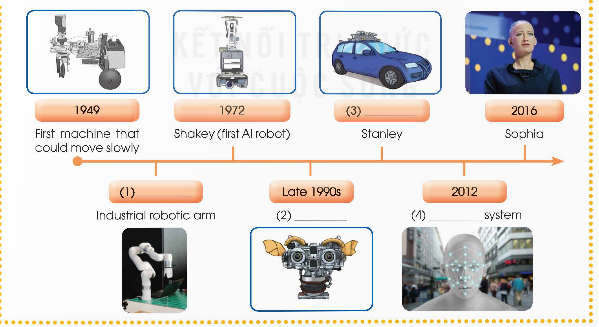
Answer:
(1) 1959 - 1959: Industrial robotic arm
(2) - Kismet - Late 1990s: (2) Kismet
(3) 8 October 2005 - 8 October 2005: Stanley
(4) accurate visual recognition - 2012: (4) accurate visual recognition system
2. Work in pairs. Discuss the following questions. What types of AI are widely used in Viet Nam? How do you think robots and AI will develop in VietNam in the future?
Answer:
- In Vietnam, AI is widely used across various sectors, including customer service, healthcare, smart cities, agriculture, and e-commerce. Businesses leverage AI-powered chatbots and virtual assistants to enhance customer interactions, while the healthcare industry utilizes AI for diagnostics and predictive analytics. Smart city initiatives in Hanoi and Ho Chi Minh City employ AI for traffic management and urban planning. In agriculture, AI aids in crop monitoring and yield forecasting, and in e-commerce, it improves personalized shopping experiences and inventory management.
- In the future, AI and robotics in Vietnam are expected to advance significantly. Manufacturing will see increased automation, healthcare will benefit from telemedicine and personalized medicine, and education will be transformed by AI-driven learning platforms. Smart city projects will continue to expand, enhancing urban efficiency and sustainability. The rise of AI startups will drive innovation, supported by government investment and research. However, the growth of AI will necessitate robust ethical and regulatory frameworks to address privacy, security, and societal impacts. Overall, AI and robotics promise a transformative future for Vietnam, marked by technological advancements and improved quality of life.
VIII. LOOKING BACK
Pronunciation
Listen and underline the homophone of the word in bold in each sentence. Then practise saying the sentences in pairs.
1. People are not allowed to talk aloud in the library.
2. Students felt very bored when their teacher kept writing on the board.
3. Where can I buy some new clothes to wear to the party?
4. Robots don't know how to say 'No'.
Answer:
1. People are not allowed to talk aloud in the library.
2. Students felt very bored when their teacher kept writing on the board.
3. Where can I buy some new clothes to wear to the party?
4. Robots don't know how to say 'No'.
VOCABULARY
Complete the sentences using the correct forms of the words in the box.
activate artificial intelligence application virtual |
1. In the future, we might see more ___________ of AI in every aspect of life
2. Websites use ___________ to learn about users' shopping preferences and recommend products or services.
3. It is quite simple to ___________ this robot and ask it to perform some tasks.
4. Computer software is used by travel agents to create ___________ tours of popular destinations.
Answer:
1. applications - In the future, we might see more applications of AI in every aspect of life.
2. artificial intelligence - Websites use artificial intelligence to learn about users' shopping preferences and recommend products or services.
3. activate - It is quite simple to activate this robot and ask it to perform some tasks.
4. virtual - Computer software is used by travel agents to create virtual tours of popular destinations.
GRAMMAR
Choose the option A, B, C, or D that is closest in meaning to each of the given sentences.
1. I am going to have my broken laptop fixed by the computer shop.
A. I am going to ask the computer shop to fix my broken laptop.
B. I am going to learn how to fix my broken laptop at the computer shop.
C. I am going to fix my laptop with the computer shop.
D. Someone advised me to fix my broken laptop at the computer shop.
2. When we were away, our home robot walked and fed our pets.
A. We had our pets walk and feed our home robots when we were away.
B. We bought a robot when we were away, which could walk and feed our pets.
C. We had our home robot walk and feed our pets when we were away.
D. Our pets walked and ate with our home robot when we were away.
3. A mechanic installed a smart lock on her front door yesterday.
A. A mechanic had her install a smart lock on her front door yesterday.
B. A mechanic had a smart lock installed on her front door yesterday.
C. She and a mechanic installed a smart lock on her front door yesterday.
D. She got a mechanic to install a smart lock on her front door yesterday.
4. We often use an app called Essy to check our essays.
A. An app called Essy often has us check our essays.
B. We often get our essays checked by an app called Essy.
C. An app called Essy often has our essay checked for us.
D. We often have an app called Essy checked by our essays.
Answer:
1. A
I am going to have my broken laptop fixed by the computer shop. - (Tôi sắp mang chiếc máy tính xách tay bị hỏng của mình đi sửa ở cửa hàng máy tính.)
= A. I am going to ask the computer shop to fix my broken laptop. - (Tôi định nhờ cửa hàng máy tính sửa chiếc máy tính xách tay bị hỏng của tôi.)
2. C
When we were away, our home robot walked and fed our pets. - (Khi chúng tôi đi vắng, robot gia đình của chúng tôi sẽ cho thú cưng đi dạo và cho thú cưng ăn.)
= C. We had our home robot walk and feed our pets when we were away. - (Chúng tôi nhờ robot gia đình cho thú cưng đi dạo và ăn khi chúng tôi đi vắng.)
3. D
A mechanic installed a smart lock on her front door yesterday. - (Hôm qua một người thợ cơ khí đã lắp ổ khóa thông minh vào cửa trước của nhà cô ấy.)
= D. She got a mechanic to install a smart lock on her front door yesterday. - (Hôm qua cô ấy nhờ thợ sửa khóa thông minh ở cửa trước.)
4. B
We often use an app called Essy to check our essays. - (Chúng tôi thường sử dụng một ứng dụng có tên Essy để kiểm tra bài luận của mình.)
= B. We often get our essays checked by an app called Essy. - (Chúng tôi thường kiểm tra bài luận của mình bằng một ứng dụng có tên Essy.)
PROJECT
AI in our daily lives
Your class is organizing a Technology Fair. The theme is 'AI in our daily lives'. Work in groups. Think of a way of using AI in your daily life. This can be an existing or a new application. Use these questions as cues.
- What is the AI application? (If it's a new application, give it a name.)
- What is its purpose?
- How does it work?
- How will it improve your life?
Present your idea to the class in the form of an oral presentation, a poster, or a leaflet.
Answer:
- AI Application: HealthGuardian
- Purpose:
HealthGuardian is an AI-powered application designed to monitor and improve individual health and wellness daily.
It provides personalized health insights, tracks vital signs, and offers preventive healthcare suggestions to ensure a healthier lifestyle.
- How It Works:
HealthGuardian integrates with wearable devices like smartwatches and fitness trackers to collect data on vital signs such as heart rate, blood pressure, and physical activity levels.
The AI processes this data to analyze trends and detect anomalies.
It uses machine learning algorithms to offer personalized health advice, send reminders for medication, schedule regular health check-ups, and even suggest diet and exercise plans tailored to the user’s needs.
The app also features a chatbot that can answer health-related queries and provide instant support.
- How It Will Improve Your Life:
HealthGuardian can significantly enhance your life by providing continuous health monitoring and proactive healthcare.
It helps in early detection of potential health issues, thus enabling timely medical intervention.
The personalized advice and reminders ensure you stay on track with your health goals, leading to improved overall well-being.
By offering a comprehensive view of your health, HealthGuardian empowers you to make informed decisions and adopt healthier lifestyle habits, ultimately reducing the risk of chronic diseases and improving your quality of life.
Tài liệu cùng môn học
Tài liệu khác
- Trắc nghiệm tiếng anh 2 Family and Friends
- Trắc nghiệm tiếng anh 2 Explore our world
- Trắc nghiệm tiếng anh 3 Family and Friends
- Trắc nghiệm tiếng anh 3 Explore our world
- Trắc nghiệm tiếng anh 4 Family and Friends
- Trắc nghiệm tiếng anh 4 Global Success
- Trắc nghiệm tiếng anh 4 Explore our world
- Trắc nghiệm tiếng anh 5 Family and Friends
- => Xem nhiều môn hơn