Giải Tiếng Anh 12 kết nối: Unit 10 Lifelong learning
Hướng dẫn giải Tiếng Anh 12 kết nối tri thức: Giải Unit 10 Lifelong learning. Bài được giải chi tiết, rõ ràng, dễ hiểu. Bài giải giúp học sinh nắm vững kiến thức trong sách giáo khoa, rèn kĩ năng giải bài tập và có phương pháp học tập hiệu quả.
Nội dung chi tiết
UNIT 10: Lifelong learning
I. GETTING STARTED
Learning for life
1. Listen and read.
Mark: Hello, Grandma!
Grandma: Oh hi, Mark. I'm glad you're here! Can you help me increase the font size of this text on my laptop? It's too small for me to read.
Mark: Let me show you ... You need to press these two keys together ... See? It's easy, isn't it?
Grandma: It works! Everything's so easy to read now. Thanks, dear. I still have trouble using the laptop. You know, it's taken me so much time to learn computer skills.
Mark: That's fine, Grandma. My teacher says it's never too late to learn something new, especially new technology, because it's rapidly developing. Grandma, you've typed a lot of text! What are you working on?
Grandma: Well, I'm writing a summary of a book I've read recently. You see, my doctor advised me to read every day to boost my memory. And I want to brush up on my French before I visit my friend in Paris.
Mark: You're amazing, Grandma! Learning languages can improve your thinking skills. Our language teacher has also asked us to try to maintain our language skills after leaving school. Do you know that you can use the Internet to learn a language or watch the news?
Grandma: Really? This could help me stay informed about current events. Can you show me some news sites after I finish my book summary?
Mark: No problem, Grandma. But why do you have to type it?
Grandma: It's for the reading club I've just joined. The club leader encourages us to prepare our book reports and share them with all members in advance.
Mark: Are all club members your age?
Grandma: No, there're some young people as well. Are you interested in joining the next meeting?
Mark: Yes, I'd love to.
Grandma: OK, I'll put your name on the list of attendees then.
2. Read the conversation again. Decide whether the following statements are true (T) or false (F).
| T | F | |
| 1. Mark's grandma is very good at using technology. | ||
| 2. Mark's grandma is working on a book summary for her reading club. | ||
| 3. After typing up her book report, Mark's grandma will learn how to make the text size bigger on her laptop. | ||
| 4. Mark wants to attend the next meeting of his grandma's reading club. |
Answer:
1. F
Mark's grandma is very good at using technology.
=> The text mentions “You know, it's taken me so much time to learn computer skills.”
2. T
Mark's grandma is working on a book summary for her reading club.
The text mentions “ I'm writing a summary of a book I've read recently.”
3. F
After typing up her book report, Mark's grandma will learn how to make the text size bigger on her laptop.
The text mentions “Can you show me some news sites after I finish my book summary?”
4. T
Mark wants to attend the next meeting of his grandma's reading club.
The text mentions “Grandma: No, there're some young people as well. Are you interested in joining the next meeting? - Mark: Yes, I'd love to.”
3. Find words and phrase in 1 with the following meanings.
| 1. b_____ | to make something become better |
2. b_____ u_____ (on)
| to practise and quickly improve a skill or knowledge of something learnt in the past
|
| 3. m_____ | to make something continue at the same level |
| 4. i_____ | having a lot of knowledge about something
|
Answer:
| 1. boost | to make something become better |
2. brush up (on)
| to practise and quickly improve a skill or knowledge of something learnt in the past
|
| 3. maintain | to make something continue at the same level |
| 4. informed | having a lot of knowledge about something
|
4. Match the beginnings with the endings to make complete sentences.
| 1. The doctor of Mark's grandma advised her | a. to put his name on the list of attendees. |
2. Mark's language teacher has asked him
| b. to read every day to boost her memory. |
3. The club leader encourages members
| c. to try to maintain his language skills after leaving school. |
4. Mark's grandma offered
| d. to prepare their book reports in advance. |
Answer:
1 - b. The doctor of Mark's grandma advised her to read every day to boost her memory.
2 - c. Mark's language teacher has asked him to try to maintain his language skills after leaving school.
3 - d. The club leader encourages members to prepare their book reports in advance.
4 - a. Mark's grandma offered to put his name on the list of attendees.
II. LANGUAGE
PRONUNCIATION
Intonation in questions (revision)
1. Listen and repeat. Pay attention to the intonation of the following questions.
1. It's easy, isn't it?
2. What are you working on?
3. Are all club members your age?
4. But why do you have to type it?
5. Are you interested in joining the next meeting?
Answer:
Học sinh chú ý lắng nghe để lặp lại theo mẫu, chú ý vào ngữ điệu lên hay xuống.
2. Mark the intonation in the following questions using (rising intonation) or (falling intonation). Then listen and check. Practise saying them in pairs.
1. What does lifelong learning mean?
2. Do you have to pay for this online course?
3. Do students prefer online courses or face-to-face classes?
4. This is your book, isn't it? I saw your signature on the first page.
Answer:
1. What does lifelong learning mean? (falling intonation - Wh - questions)
2. Do you have to pay for this online course? (rising intonation - Yes/ No questions)
3. Do students prefer online courses or face-to-face classes? (rising intonation in “ online courses” and falling intonation in last sentence - Choice questions)
4. This is your book, isn't it? I saw your signature on the first page. (Falling intonation - statement and the tag question with the certainty of answer)
VOCABULARY
Lifelong learning journey
1. Match the parts of the words to make words and phrases that mean the following.
| 1. night | a. -rounded: having a variety of experiences and a range of skills and interests |
| 2. distance | b. education: education for adults that is available outside schools and universities |
3. well
| c. school: classes for adults, held in the evening |
| 4. learning | d. learning: a method of education in which people study at home and send their work to their teachers |
| 5. adult | e. community: a group of learners who share learning goals and often connect with one another |
Answer:
1 - c. night school: classes for adults, held in the evening
2 - d. distance learning: a method of education in which people study at home and send their work to their teachers
3 - a. well-rounded: having a variety of experiences and a range of skills and interests.
4 - e. learning community: a group of learners who share learning goals and often connect with one another
5 - b. adult education: education for adults that is available outside schools and universities
2. Complete the sentences using the words and phrases in 1.
1. Lifelong learning can help you to become a _____ person.
2. Continuing education or _____ helps people keep their knowledge and skills up-to-date.
3. As my mother worked during the day, she went to_____ to get nursing qualifications.
4. Joining a _____ is a great way to meet people with similar interests.
5. Thanks to the power of the Internet, _____ or remote learning has become very popular.
Answer:
1. well-rounded - Lifelong learning can help you to become a well-rounded person.
2. adult education - Continuing education or adult education helps people keep their knowledge and skills up-to-date.
3. night school - As my mother worked during the day, she went to night school to get nursing qualifications.
4. learning community - Joining a learning community is a great way to meet people with similar interests.
5. distance learning - Thanks to the power of the Internet, distance learning or remote learning has become very popular.
GRAMMAR
Reported speech: reporting orders, requests, offers, and advice
1. Rewrite the sentences in reported speech, using the correct forms of the verbs in the box.
| ask offer tell advise |
1. 'Find more information about the course you want to apply,' my mother told me.
=> My mother _____________________.
2. 'Can you send me the list of available online courses?' my friend asked.
=> My friend _______________________.
3. 'I'll teach you how to use mobile applications,' my brother said.
=> My brother ______________________.
4. 'You shouldn't waste so much time on social media,' the head teacher said.
=> The head teacher ________________.
Answer:
1. 'Find more information about the course you want to apply,' my mother told me.
=> My mother told me to find more information about the course I wanted to apply for.
2. 'Can you send me the list of available online courses?' my friend asked.
=> My friend asked me to send him the list of available online courses.
3. 'I'll teach you how to use mobile applications,' my brother said.
=> My brother offered to teach me how to use mobile applications.
4. 'You shouldn't waste so much time on social media,' the head teacher said.
=> The head teacher advised me not to waste so much time on social media.
2. Work in pairs. Talk about what people around you often say to encourage you to learn new things every day. Use reported speech to report their orders, requests, offers, and advice.
Example:
My parents asked me to read for an hour every day. They also advised me to join the school English club to improve my English. They encouraged me to start a learning journal. They told me to write down my thoughts about what I am studying in the journal.
Answer:
My teachers have been actively supporting my learning journey by providing valuable guidance. They emphasized the importance of going beyond the textbook, urging me to dedicate at least an hour daily to reading supplementary materials. Additionally, they encouraged me to enhance my language skills by joining the school's English club. Understanding my academic needs, they kindly offered to supply extra study materials whenever necessary. Furthermore, recognizing the benefits of reflection in learning, they advised me to maintain a learning journal. This journal serves as a tool to document and analyze my thoughts on daily study topics, fostering a deeper understanding and engagement with the subjects. Their continuous support and thoughtful recommendations have significantly contributed to my academic growth and development.
III. READING
Head teacher's message to school-leavers
1. Work in pairs. Discuss the following questions.
1. Have you ever thought of continuing learning after finishing your secondary education?
2. If yes, how will you continue your learning?
Answer:
1. Have you ever thought of continuing learning after finishing your secondary education?
- Yes, I have definitely thought about continuing my learning after finishing secondary education. I believe that education is a lifelong process, and there is always more to learn beyond the structured curriculum of secondary school. Continuing education can open up new opportunities, deepen my knowledge in areas of interest, and enhance my skills for future career paths.
2. If yes, how will you continue your learning?
- I plan to continue my learning through several avenues. Firstly, I aim to pursue higher education by enrolling in a university or college program that aligns with my career goals and interests. Additionally, I will actively seek out online courses, workshops, and seminars to expand my knowledge in specific subjects or acquire new skills. Engaging in internships or practical work experience opportunities will also be crucial to applying theoretical knowledge in real-world settings. Furthermore, I intend to join professional associations or clubs related to my field of study to network with peers and professionals and stay updated on industry trends. Continuous self-study and reading will complement these efforts, ensuring that I remain informed and adaptable in an ever-changing world.
2. Read a letter written by a head teacher to her students on the school website. Circle the phrases with the closest meaning to the highlighted words.
Dear students,
In a few weeks' time, you'll complete your secondary education. Some of you may have already made plans for continuing your studies at university or vocational school, while others may wish to start working right away. Whatever choice you make, remember to keep on learning new knowledge and skills.
'Haven't we learnt enough in secondary school?', many may wonder. In fact, learning does not stop after graduation. It is a lifelong process. It involves creating and maintaining a positive attitude to learning for both professional and personal development. Lifelong learning is especially relevant in today's changing world. It allows you to adapt to changes in the modern workplace and widens your employment opportunities. It helps you make better, informed decisions and become a more well-rounded individual. In addition, it keeps your brain healthy and boosts your memory. Lifelong learning also helps you stay connected with modern ideas and meet new people as you participate in various forms of adult education.
'Does that mean I have to go to classes again?". The answer is 'yes' and 'no'. Yes, because when you start working, you may decide to go to night school or enrol on a distance learning course to learn a skill or get a degree. The answer is also No, because lifelong learning happens all the time. As long as you are motivated, you can learn new knowledge and develop new skills anywhere. Uncle Ho is a great role model for lifelong learning. He never stopped learning throughout his life despite all the hardships and challenges. He learnt to speak different languages, including English, French, Russian, Italian, German, and Chinese mainly by himself. He even wrote poems in Chinese when he was imprisoned in China to keep his mind sharp. He took regular physical exercise, did traditional martial arts, and enjoyed activities such as swimming and mountain climbing throughout his life. We can all learn from Uncle Ho's lifelong efforts to improve himself.
Remember that learning is a lifelong journey. Enjoy every moment of it.
Mrs Le Minh Ngoc
Head teacher
1. wonder
A. to think about something and try to guess what is true or will happen
B. to walk slowly around an area without a clear purpose
2. relevant
A. relatively close
B. valuable and useful
3. widens
A. makes something larger in degree or range
B. makes something smaller in degree or range
4. hardships
A. large boats that are hard to operate
B. conditions of life that cause difficulty and suffering
5. imprisoned
A. released from a prison
B. put in a prison
Answer:
1. A
wonder (v): thắc mắc/ tự hỏi
= A. to think about something and try to guess what is true or will happen
(nghĩ về điều gì đó và cố gắng đoán điều gì là đúng hoặc sẽ xảy ra)
2. B
relevant (adj): liên quan/ thích hợp
= B. valuable and useful (có giá trị và hữu ích)
3. A
widens (mở rộng)
= A. makes something larger in degree or range - (làm cho cái gì đó lớn hơn về mức độ hoặc phạm vi)
4. B
hardships (n): gian khổ
= B. conditions of life that cause difficulty and suffering - (những điều kiện sống gây khó khăn và đau khổ)
5. B
imprisoned (V-ed): bị cầm tù
= B. put in a prison (đưa vào tù)
3. Read the letter again. Choose the correct answer A, B, C, or D.
1. What is the main message of the letter?
A. Continue your studies at university or night school after leaving school.
B. Continue learning after leaving school to improve yourself and career.
C. Don't be afraid of the challenges of lifelong learning.
D. It's important to get a degree for your professional development.
2. Which of the following options is NOT mentioned as a choice for school-leavers?
A. Going to university.
B. Finding a job.
C. Going to a vocational school.
D. Volunteering abroad to learn languages.
3. Which of the following is NOT mentioned as a benefit of lifelong learning?
A. You have a better understanding of the world and can make good decisions.
B. It helps you to become successful in the present-day world.
C. It keeps your brain healthy and improves your memory.
D. It helps you stay connected with people and current ideas.
4. Why do some people choose distance learning according to the letter?
A. They may want to earn a degree, but still have a full-time job.
B. It is easier to enrol on a distance learning course.
C. There are many online courses to choose from.
D. It is the easiest way to stay connected with your friends from school.
5. Which of the following is NOT mentioned as an example of Uncle Ho's lifelong learning?
A. He regularly exercised, did traditional martial arts, and enjoyed outdoor activities.
B. He learnt to use different languages through self-study.
C. He regularly attended evening classes and joined a learning community.
D. He wrote poems in prison to keep his mind sharp.
Answer:
1. B. Continue learning after leaving school to improve yourself and career.
=> The letter emphasizes the importance of lifelong learning for both personal and professional development (improving yourself and career). It doesn't solely focus on university or night school (A), nor does it dwell on challenges (C), or prioritize degrees (D).
2. D
=> The text mentions “Some of you may have already made plans for continuing your studies at university or vocational school, while others may wish to start working right away.”
3. B
=> The text mentions “It helps you make better, informed decisions and become a more well-rounded individual.”and “In addition, it keeps your brain healthy and boosts your memory.” and “Lifelong learning also helps you stay connected with modern ideas and meet new people as you participate in various forms of adult education.”
4. A
=> The text mentions “Yes, because when you start working, you may decide to go to night school or enroll on a distance learning course to learn a skill or get a degree.”
5. C
=> The text mentions “ He took regular physical exercise, did traditional martial arts, and enjoyed activities such as swimming and mountain climbing throughout his life.” and “He learnt to speak different languages, including English, French, Russian, Italian, German, and Chinese mainly by himself.” and “He even wrote poems in Chinese when he was imprisoned in China to keep his mind sharp.”
4. Work in pairs. Discuss the following questions.
Imagine this letter is addressed to you. How would you reply to the head teacher? What would you say to her?
Answer:
Dear Mrs. Le Minh Ngoc,
Thank you for your thoughtful letter addressing our imminent completion of secondary education and the importance of lifelong learning. Your words have resonated deeply with me as I contemplate my future path.
Indeed, your encouragement to continue learning beyond secondary school is both timely and inspiring. While some of my peers may already have concrete plans for university or vocational school, I appreciate the reminder that learning does not cease with formal education. Your emphasis on lifelong learning as a continuous process for personal and professional development is invaluable. It reminds me that acquiring new knowledge and skills is essential not only for adapting to the evolving workplace but also for enriching my understanding of the world.
I am particularly moved by the example of Uncle Ho and his dedication to lifelong learning, despite facing numerous challenges. His commitment to mastering languages and maintaining physical health serves as a powerful testament to the benefits of lifelong learning in enhancing one's abilities and perspectives.
As I embark on this next phase of my journey, I am committed to embracing opportunities for learning wherever they may arise. Whether through further education, professional development courses, or independent study, I am eager to cultivate a mindset of continual growth and discovery.
Thank you once again for your guidance and encouragement. I look forward to applying these principles of lifelong learning as I navigate the exciting possibilities ahead.
Warm regards,
[Your Name]
IV. SPEAKING
Great role models for lifelong learning
1. Work in pairs. One of you is A, and the other is B. A reads the information card about Uncle Ho. B reads the information card about Marie Curie below.
Student A's card
Uncle Ho as a lifelong learner
- Managed to learn every day throughout his life (e.g. by reading and writing until midnight after a working day)
- Learnt to speak French, English, Chinese, Italian, German, and Russian (mainly through self-study, had an effective way to learn new words: writing them on pieces of paper or his arms and revising them throughout the day)
- Kept fit and healthy (e.g. by doing exercise every day, doing traditional martial arts, and enjoying physical activities)
Student B's card
Marie Curie as a lifelong learner
- Managed to go to university (because there were no universities accepting women in her country, Poland, she moved to France and studied physics and maths at the Sorbonne University)
- Spent a lot of time studying (e.g. studied on her own while working as a governess or tutor, borrowed books from the library, registered for many different courses at university)
- Won prizes (was the first woman to win a Nobel Prize, and the only woman to win a Nobel Prize twice, won a Nobel Prize in Physics in 1903 and another Nobel Prize in Chemistry in 1911)
Answer:
Học sinh thay phiên nhau đọc đồng thời đổi vai cho nhau để có cơ hội luyện tập nhiều hơn
2. A talks about Uncle Ho as a lifelong learner. B listens and completes the notes. Then compare your notes.
Answer:
Uncle Ho is a great role model for lifelong learning. He managed to learn every day throughout his life. He often learnt by reading and writing until midnight after a working day. He learnt to speak French, English, Chinese, Italian, German, and Russian. He mainly learned through self-study. He had an effective way to learn new words: writing them on pieces of paper or his arms and revising them throughout the day. Besides, he kept fit and healthy by doing exercise every day, doing traditional martial arts, and enjoying physical activities.
3. Switch roles. B talks about Marie Curie as a lifelong learner. A listens and completes the notes. Then compare your notes.
Answer:
Marie Curie is a great role model for lifelong learning. She managed to go to university because in her country, Poland, women were not allowed to go to university to study. Marie moved to France and studied physics and maths in Sorbonne University. She spent a lot of time studying. She studied on her own while working as a governess or tutor, borrowed books from the library, registered for many different courses at university. Finally, she won prizes and was the first woman to win a Nobel Prize, and the only woman to win a Nobel Prize twice. She won a Nobel Prize in Physics in 1903 and another Nobel Prize in Chemistry in 1911.
4. Use your notes to talk about Uncle Ho or Marie Curie as great role models for lifelong learning. What can you learn from them? Present your talk to the class.
Answer:
- Uncle Ho, also known as Ho Chi Minh, is a remarkable example of a lifelong learner. He dedicated himself to learning every day throughout his life. Despite his busy schedule, he would often read and write until midnight after a full day's work. His thirst for knowledge led him to learn multiple languages including French, English, Chinese, Italian, German, and Russian, primarily through self-study. Uncle Ho had a unique method for learning new words by writing them on pieces of paper or his arms and revising them throughout the day. Additionally, he maintained his physical health by exercising daily, practicing traditional martial arts, and enjoying various physical activities.
- Marie Curie exemplifies lifelong learning through her tenacity and dedication. Born in Poland where women were not allowed to attend university, she moved to France to pursue her studies in physics and mathematics at the Sorbonne University. Despite facing significant challenges, Marie Curie spent countless hours studying on her own while working as a governess and tutor. She voraciously borrowed books from libraries and enrolled in numerous university courses. Her perseverance and passion for science eventually led her to become the first woman to win a Nobel Prize, receiving the Nobel Prize in Physics in 1903 for her work on radiation. She later received the Nobel Prize in Chemistry in 1911 for her discovery of radium and polonium.
=> Both Uncle Ho and Marie Curie teach us valuable lessons about the importance of lifelong learning. They demonstrate that dedication, perseverance, and a thirst for knowledge are essential traits for personal growth and achievement. Their stories inspire us to embrace challenges, continuously expand our skills and knowledge, and contribute positively to society. By following their examples, we can cultivate a mindset of lifelong learning that enriches our lives and empowers us to make significant contributions to the world around us.
V. LISTENING
Challenges of lifelong learning
1. Choose the correct meanings of the underlined words.
1. Her job was difficult, but she didn't give up and showed great determination to succeed.
A. the desire to do something challenging without any support
B. the ability to continue trying to do something even when it is difficult
2. My mother managed to go to university despite many obstacles.
A. difficult situations
B. supporting conditions
3. There were too many distractions at home, so I started going to the library to study.
A. things that you pay close attention to
B. things that stop you from paying attention to what you are doing
4. We tried to apply the knowledge we acquired from the course into practice.
A. gained
B. discussed
5. We need to work together in order to solve complex problems.
A. difficult to deal with
B. easy to deal with
Answer:
1. B
Her job was difficult, but she didn't give up and showed great determination to succeed. - (Công việc của cô ấy tuy khó khăn nhưng cô ấy không bỏ cuộc và thể hiện quyết tâm cao độ để thành công.)
= B. the ability to continue trying to do something even when it is difficult (khả năng tiếp tục cố gắng làm điều gì đó ngay cả khi khó khăn)
2. A
My mother managed to go to university despite many obstacles. - (Mẹ tôi đã cố gắng vào đại học dù gặp nhiều trở ngại.)
= A. difficult situations (tình huống khó khăn)
3. B
There were too many distractions at home, so I started going to the library to study. - (Ở nhà có quá nhiều thứ khiến tôi mất tập trung nên tôi bắt đầu đến thư viện để học.)
= B. things that stop you from paying attention to what you are doing (những điều khiến bạn không thể chú ý đến việc bạn đang làm)
4. A
We tried to apply the knowledge we acquired from the course into practice.
(Chúng tôi đã cố gắng áp dụng kiến thức thu được từ khóa học vào thực tế.)
= A. gained (đạt được)
5. A
We need to work together in order to solve complex problems. - (Chúng ta cần làm việc cùng nhau để giải quyết những vấn đề phức tạp.)
= A. difficult to deal with (khó giải quyết)
2. Listen to a talk about lifelong learning. Put the main ideas in the order you hear them
a. You need money, time, and space to continue your pursuit of knowledge and skills. b. You need to have a strong motivation and determination to become a lifelong learner. c. Lifelong learning is effective only when you put what you've learnt into practice. |
1. _____________
2. _____________
3. _____________
Answer:
…………………………………………………………………………………..
3. Listen to the talk again and complete the sentences. Use no more than THREE words for each gap.
1. Lifelong learners are motivated to expand their _________ and develop new skills.
2. To become a lifelong learner, you need to be determined to _________.
3. Reading books and _________ are not enough for effective lifelong learning.
4. You must be able to use the new knowledge and skills to find a solution to a _________ or create something new.
5. Not having enough money, time, or space should not prevent you from continuing learning and becoming a _________ person.
Answer:
…………………………………………………………………………………..
4. Work in groups. Discuss the following question.
How do you think we can overcome these challenges and become lifelong learners?
Answer:
Becoming a lifelong learner involves overcoming various challenges that can arise throughout our educational and professional journeys. There are some strategies to overcome these challenges and foster a mindset of lifelong learning:
Set Clear Goals: Define specific goals for your learning journey. Whether it's mastering a new skill, gaining expertise in a particular field, or simply broadening your knowledge base, setting clear objectives helps you stay focused and motivated.
Develop Effective Learning Habits: Establish routines and habits that support learning. This may include dedicating time each day or week to study, practice, or explore new topics. Effective learning habits also involve seeking feedback, reflecting on your progress, and adjusting your approach as needed.
Utilize Diverse Learning Resources: Take advantage of a variety of learning resources available today. This includes online courses, books, podcasts, workshops, and mentorship opportunities. Diversity in resources allows for a well-rounded learning experience and caters to different learning styles.
Stay Persistent and Resilient: Recognize that learning is a journey that involves setbacks and challenges. Stay persistent in pursuing your goals despite obstacles. Develop resilience to bounce back from failures or difficulties encountered along the way.
Break down learning into smaller, more manageable chunks. This allows for flexible scheduling.
=> By incorporating these strategies into our daily lives, we can overcome challenges and cultivate a mindset of lifelong learning. This approach not only enhances personal and professional growth but also equips us to navigate a rapidly changing world with confidence and resilience.
VI. WRITING
An article about the benefits and challenges of lifelong learning
1. Work in pairs. Complete the table about the benefits and challenges of lifelong learning. Use the ideas in Reading and Listening to help you.
| Benefits | Challenges |
- You have a better understanding of the world and can make good decisions.
- (1) _____________________
- (2) _____________________ | - You need to have strong motivation and determination to become a lifelong learner.
- (3) _____________________
- (4) _____________________ |
Answer:
| Benefits | Challenges |
- You have a better understanding of the world and can make good decisions.
- (1)Lifelong learning enhances personal growth and development.
- (2)Lifelong learners often have greater career opportunities and advancement. - Continuously acquiring new skills and knowledge keeps the mind sharp and engaged. - Have a better understanding of the world and can make good decision | - You need to have strong motivation and determination to become a lifelong learner.
- (3)Need money, time and health to continue your pursuit of knowledge and skills
- (4) Know the way of balancing learning with other commitments and responsibilities => overwhelmed - Overcoming self-doubt and fear of failure. - Adapting to new technologies and learning methods. |
2. Write an article (180-200 words) about the benefits and challenges of lifelong learning. Use the ideas in 1 and the outline below to help you.
Benefits and Challenges of Lifelong Learning
Lifelong learning is self-motivated learning that is focused on both personal and professional development. This type of learning is essential in today's rapidly changing world. It brings many benefits as it helps us understand the world around us and provides us with better opportunities. Lifelong learners can also face challenges. So, what are these benefits and challenges?
Let's start with the benefits.___________________
_________________________________________
What about the challenges?___________________
_________________________________________
In conclusion, lifelong learning has many benefits, but it can also be challenging. In my opinion,_________________________________________
Answer:
Benefits and Challenges of Lifelong Learning
Lifelong learning, the pursuit of knowledge and skills throughout one's life, is increasingly vital in our dynamic world. It offers numerous advantages, enhancing both personal growth and professional success. Firstly, lifelong learners gain a deeper understanding of the world, enabling them to make informed decisions and navigate complexities effectively. Moreover, continuous learning fosters adaptability, keeping individuals relevant in rapidly evolving industries and expanding career opportunities.
However, lifelong learning is not without its challenges. It demands strong motivation and self-discipline to sustain learning efforts amidst busy schedules and competing priorities. Additionally, overcoming setbacks and maintaining enthusiasm over the long term can be daunting. Technological advancements also necessitate ongoing skill upgrades, posing a constant need for adaptation.
In conclusion, while the benefits of lifelong learning are profound, navigating its challenges requires resilience and commitment. Personally, I believe that embracing lifelong learning empowers individuals to remain agile and proactive in shaping their personal and professional lives. By embracing this mindset, we not only enrich our knowledge but also contribute positively to our communities and society at large. Thus, investing in lifelong learning is a valuable endeavor that yields both personal fulfillment and lasting impact.
VII. COMMUNICATION AND CULTURE/ CLIL
Everyday language
Thanking and accepting thanks
1. Listen and complete the conversations with the expressions in the box. Then practise them in pairs.
A. Don't mention it B. I really appreciate it C. It's my pleasure D. Thank you for inviting |
1.
Ms Lan: Mai, the information about the online courses is very useful. Thank you for presenting it. (1) ________.
Mai: (2) ________, Ms Lan. I'm glad you found it useful.
2.
Nam: Mark, I like the activities of the science club very much. (3) ________ me to join the club.
Mark: (4) ________. Glad to help.
Answer:
1. B - Thank you for presenting it. I really appreciate it.
2. C - It's my pleasure, Ms Lan. I'm glad you found it useful.
3. D - Mark, I like the activities of the science club very much. Thank you for inviting me to join the club.
4. A - Don't mention it. Glad to help.
1.
Ms Lan: Mai, the information about the online courses is very useful. Thank you for presenting it. I really appreciate it.
Mai: It's my pleasure, Ms Lan. I'm glad you found it useful.
2.
Nam: Mark, I like the activities of the science club very much. Thank you for inviting me to join the club.
Mark: Don't mention it. Glad to help.
2. Work in pairs. Use the models in 1 to make similar conversations for these situations. One of you is A, the other is B. Use the expressions below to help you.
1. A attends a cooking class taught by B. A thanks B for teaching her/him to cook a traditional dish. B replies by accepting thanks.
2. A and B are friends. B thanks A for sharing information about an app for learning English. A reply by accepting thanks.
| Useful expressions | |
| Thanking | Accepting thanks |
| Formal | Formal |
I can’t thank you enough for…. I’m really/ so grateful for…. I really appreciate it. | You’re welcome It’s my pleasure My pleasure |
| Informal | Informal |
Thank you/ Thanks for… Many thanks! Thanks a million! | No problem Don’t mention it Glad to help |
Answer:
Scenario 1: Cooking Class
A: B, I want to thank you for teaching me how to cook that delicious traditional dish in our cooking class. It was really enjoyable!
B: It's my pleasure, A. I'm glad you enjoyed it and found it useful.
Scenario 2: Sharing Information about an English Learning App
A: Hey B, thanks a lot for telling me about that English learning app. It's been really helpful!
B: You're welcome, A. I'm glad you found it useful.
Culture
1. Read the text and complete the diagram with information from the text.
One of the oldest university graduates
Bertie Gladwin became one of Britain's oldest graduates after receiving his Master's degree in intelligence history from the University of Buckingham at 91. He started his degree at the age of 89 together with his wife, who was then aged 77. 'I feel very satisfied to think that I've done an MA at my age,' he said at the time. 'When you're 90, you sit around and not a lot happens, so it's important to carry on learning and to broaden your horizons.'
Gladwin left school at the age of 14 and never finished his secondary education or went to university. But he still found a satisfying job. When Gladwin retired, he became less active and thought getting back into learning would delay the negative symptoms of old age. He wanted to keep his brain active and learn more about something that had always interested him. Then at the age of 60, he earned a BA in Psychology. By the time he was 70, he had also completed a BSc in Molecular Biology. 'They're fascinating subjects,' he said. "I did them just because I was interested in them and wanted to know more about them.'

Answer:
(1) earned a BA in Psychology (The text mentions “Then at the age of 60, he earned a BA in Psychology.”)
(2) completed a BSc in molecular Biology (The text mentions “By the time he was 70, he had also completed a BSc in Molecular Biology.”)
(3) started Master’s degree in intelligence history (The text mentions “He started his degree at the age of 89 together with his wife”)
(4) received his Master’s degree in intelligence history (The text mentions “Bertie Gladwin became one of Britain's oldest graduates after receiving his Master's degree in intelligence history from the University of Buckingham at 91”)
2. Work in groups. Share stories of people you know who keep learning despite their old age.
Answer:
I’d like to talk about my neighbouhood. He is 75 years old and still attends computer classes at the local community center. Ever since he retired, he has been looking for ways to stay engaged and connected with the world. Growing up in an era when technology was not as prevalent, he always felt a bit left out when we talked about our digital activities. He wanted to understand how to use modern technology so he could stay in touch with us more effectively and explore new hobbies.
A few years ago, he decided to take computer classes to bridge this gap. Despite his initial apprehension, he embraced the challenge with enthusiasm. He started with the basics, like learning how to turn on a computer and use a mouse. Gradually, he moved on to more complex tasks such as browsing the internet, using social media, and managing emails. Now, he can video call us, send emails, and even shop online with ease. He has even learned how to use various apps and platforms to stay updated with news, manage his finances, and even play online games.
Seeing his determination and success in mastering new skills despite his age is incredibly motivating. It reminds me that it's never too late to learn something new and that perseverance and a positive attitude can overcome any obstacle. His story is a testament to the power of lifelong learning and the boundless possibilities it brings.
VIII. LOOKING BACK
Pronunciation
Mark the intonation in the following questions. Then listen and check. Practice saying them in pairs.
1. When was the last meeting of your reading club?
2. Is lifelong learning important for career development?
3. You don't attend night school classes, do you? I've never seen you before.
4. Is the course held on weekdays or at the weekend?
Answer:
1. When was the last meeting of your reading club? (falling intonation - Wh - questions)
2. Is lifelong learning important for career development? (rising intonation - Yes/ No questions)
3. You don't attend night school classes, do you? I've never seen you before. (falling intonation - tag questions with the certainty of answer)
4. Is the course held on weekdays or at the weekend? (rising intonation in ‘ on weekend” and falling in the end of sentence)
VOCABULARY
Complete the text. Use the correct forms of the words and phrases in the box.
| learning community well-rounded relevant adult education distance learning |
Lifelong learning is especially (1) ______ in today's fast changing world. There are many ways to engage in lifelong learning. First, you can attend courses at (2) ______ institutions. Second, you can also take remote or (3) ______ courses with the help of technology. Third, you can join a (4) ______ of people who share common learning goals. And, finally, you can learn by reading widely and researching topics. This will help you become (5) ______ and prepare you to face future challenges.
Answer:
(1) relevant
(2) adult education
(3) distance learning
(4) learning community
(5) well-rounded
Lifelong learning is especially (1) relevant in today's fast changing world. There are many ways to engage in lifelong learning. First, you can attend courses at (2) adult education institutions. Second, you can also take remote or (3) distance learning courses with the help of technology. Third, you can join a (4) learning community of people who share common learning goals. And, finally, you can learn by reading widely and researching topics. This will help you become (5) well-rounded and prepare you to face future challenges.
GRAMMAR
Choose the sentence that has the closest meaning to the given sentence.
1. 'You should continue learning after leaving school,' my grandfather said.
A. My grandfather advised me to continue learning after leaving school.
B. I advised my grandfather to continue learning after leaving school.
C. My grandfather didn't want me to continue learning after leaving school.
D. I didn't want my grandfather to continue learning after leaving school.
2. 'I'll help you register for the course,’ my sister said.
A. My sister forced me to register for her course.
B. My sister offered to help me register for the course.
C. I wanted to help my sister register for the course
D. I wanted my sister to register for the course.
3. 'Can you show me how to download this video?’ my mother asked.
A. I asked my mother to show me how to download that video.
B. I showed my mother how to download that video.
C. My mother asked me to show her how to download that video.
D. My mother showed me how to download that video.
4. 'Don't enter your sister's room. She is studying,’ my father told me.
A. My sister ordered me not to enter her room because she was studying.
B. My sister ordered my father not to enter her room because she was studying.
C. I ordered my father not to enter my sister's room because she was studying.
D. My father ordered me not to enter my sister's room because she was studying.
Answer:
1. A
'You should continue learning after leaving school,' my grandfather said.
= A. My grandfather advised me to continue learning after leaving school.
=> Explanation: The verb "advised" accurately reflects the meaning of giving a suggestion or recommendation, which is what "You should continue learning" implies.
2. B
'I'll help you register for the course,’ my sister said.
= B. My sister offered to help me register for the course.
=> Explanation: The verb "offered" reflects the intention to provide assistance, which is what "I'll help you" indicates.
3. C
'Can you show me how to download this video?’ my mother asked.
= C. My mother asked me to show her how to download that video.
=> Explanation: The structure "My mother asked me" directly corresponds to "Can you show me," which is a request for assistance.
4. D
'Don't enter your sister's room. She is studying,’ my father told me.
= D. My father ordered me not to enter my sister's room because she was studying.
=> Explanation: The verb "ordered" indicates a strong directive or command, which aligns with "Don't enter" as an authoritative instruction from a parent.
PROJECT
A leaflet about a lifelong learning habit
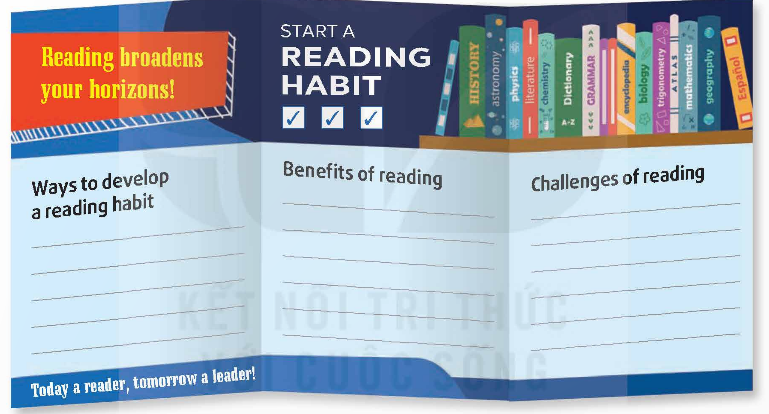
Work in groups. Do some research and choose a lifelong learning habit such as reading, self - education, taking courses or having a variety of hobbies
Design a leaflet about the habit and present it to the class
Use these questions as cues for your leaflet.
What does the lifelong learning habit involve?
How can this habit be developed?
What are the benefits of this habit?
Does this habit present any challenges?
Answer:
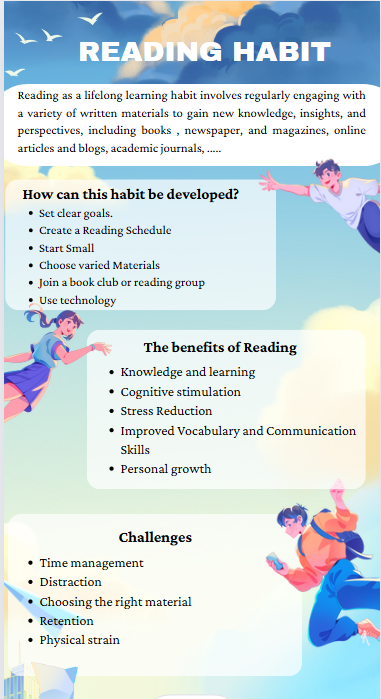
Reading as a lifelong learning habit involves regularly engaging with a variety of written materials to gain new knowledge, insights, and perspectives. This can include books (fiction and nonfiction), newspaper, and magazines, online articles and blogs, academic journals, E - book and audiobooks
It involves setting aside dedicated time for reading, making it a part of daily or weekly routine and continuous seeking out new and diversity materials to broaden your understanding of different subjects
- How can this habit be developed?
Set clear goals: Decide what you want to achieve through reading. It could be improving your knowledge in a specific field, staying updated on current events or simply enjoying literature.
Create a Reading Schedule: Dedicate specific ties of the day to read, such as during your morning commute, before bed or during lunch breaks.
Start Small: Begin with short articles or book chapters. Gradually increase the amount of time you spend reading as you become more comfortable.
Choose varied Materials: Diversify your reading materials to include different genres, subjects and authors. This keeps this habit interesting and broadens your knowledge base
Join a book club or reading group: Sharing your reading experiences with others can enhance understanding and make the habit more enjoyable.
Use technology: Utilize e - readers, audiobooks, and reading apps to make reading more accessible, especially during busy times
- What are the benefits of this habit?
Knowledge and learning: Reading exposes you to new ideas, information and different viewpoints, enhancing your understanding of the world.
Cognitive stimulation: Regular reading keeps your brain active and engaged, improving mental functions such as memory, focus and critical thinking
Stress Reduction: Reading can be a relaxing activity that helps reduce stress and anxiety by allowing you to escape from everyday pressures
Improved Vocabulary and Communication Skills: Exposure to new words and writing styles enhances your vocabulary and improves your ability to articulate thoughts clearly.
Personal growth: Reading about diverse cultures, experiences, and philosophies fosters empathy, open mindedness and personal development.
- Does this habit present any challenges?
Time management: FInding time to read regularly can be difficult, especially with a busy schedule. It requires deliberate effort to incorporate reading into your routine.
Distractions: In today’s digital age, distractions from smartphones, social media and other digital entertainment can make it hard to focus on reading
Choosing the right material: with so much content available, selecting materials that are both interesting and beneficial can be overwhelming
Retention: Remembering and applying what you’re read can be challenging. Taking notes, discussing what you’re read with others, or teaching the material can help reinforce your mitigate this
Physical strain: Long periods of reading can cause eye strain or discomfort, especially with improper lightning or screen use. Ensuring good lighting and taking breaks can help mitigate this
=> By understanding these aspects, you can better appreciate the importance of reading as a lifelong learning habit and find ways to integrate it effectively into your daily life.
Tài liệu cùng môn học
Tài liệu khác
- Trắc nghiệm tiếng anh 2 Family and Friends
- Trắc nghiệm tiếng anh 2 Explore our world
- Trắc nghiệm tiếng anh 3 Family and Friends
- Trắc nghiệm tiếng anh 3 Explore our world
- Trắc nghiệm tiếng anh 4 Family and Friends
- Trắc nghiệm tiếng anh 4 Global Success
- Trắc nghiệm tiếng anh 4 Explore our world
- Trắc nghiệm tiếng anh 5 Family and Friends
- => Xem nhiều môn hơn