Giải tiếng anh 8 Explore English: Unit 3 Please don't feed the monkeys
Hướng dẫn giải Tiếng anh 8 Explore English: Giải Unit 3 Please don't feed the monkeys. Bài được giải chi tiết, rõ ràng, dễ hiểu. Bài giải giúp học sinh nắm vững kiến thức trong sách giáo khoa, rèn kĩ năng giải bài tập và có phương pháp học tập hiệu quả.
Nội dung chi tiết
UNIT 3: PLEASE DON’T FEED THE MONKEYS
PREVIEW
A. Listen to students learning about rules. Number the signs (1-4) in the order the rules are discussed.

Answer:
…………………………………………………………………………………..
B. Listen again and match.
1. You have to turn off your phone in the 2. You can't take photos in the 3. You're not allowed to eat or drink on the 4. You have to be quiet in the | a. bus b. library c. movie theater d. museum |
Answer:
…………………………………………………………………………………..
C. Talk with a partner. What are some other rules around town?

Answer:
You have to keep your bag safe.
You should negotiate and get a fixed price.
You should learn how to use chopsticks correctly.
You have to observe the altars.
You shouldn't hesitate when crossing a road.
LANGUAGE FOCUS
A. Listen and read. Then repeat the conversation and replace the words in blue.
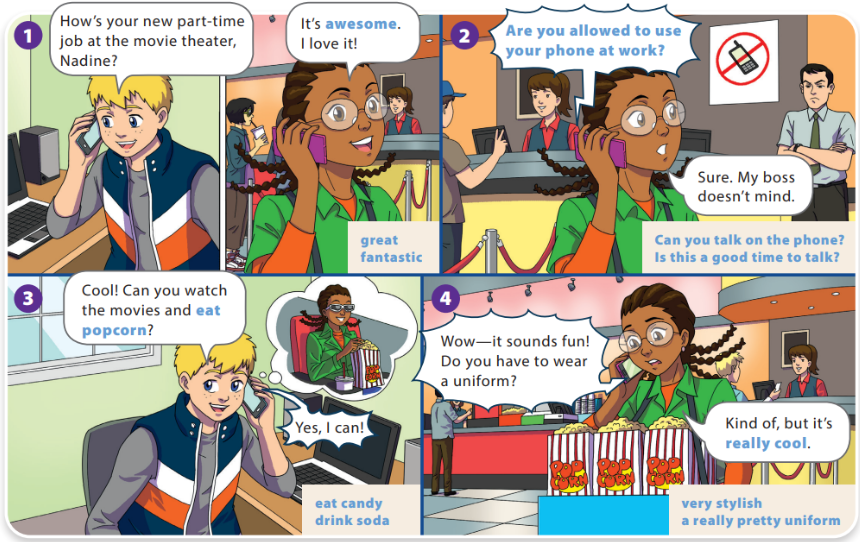
Answer:
…………………………………………………………………………………..
B. Practice with a partner. Replace any words to make your own conversation.
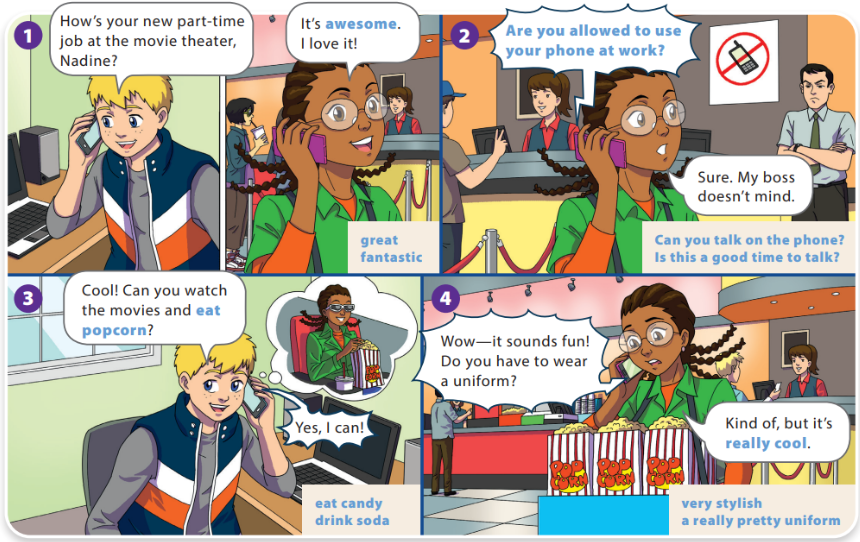
Answer:
1. How’s your new part-time job at the movie theater, Nadine?
It’s ‘wonderful’. I love it!
2. ‘Can you talk on the phone right now?’ - Sure. My boss doesn’t mind.
3. Cool! Can you watch the movies and ‘eat chips’? - Yes, I can!
4. Wow - it sounds fun! Do you have to wear a uniform?
Kind of, but it’s ‘really comfortable’.
C. Read the rules. Rewrite them using can't or have to.
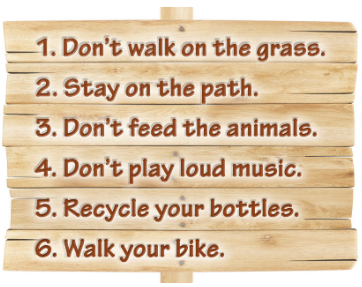
Answer:
1. You can't walk on the grass.
2. You have to stay on the path.
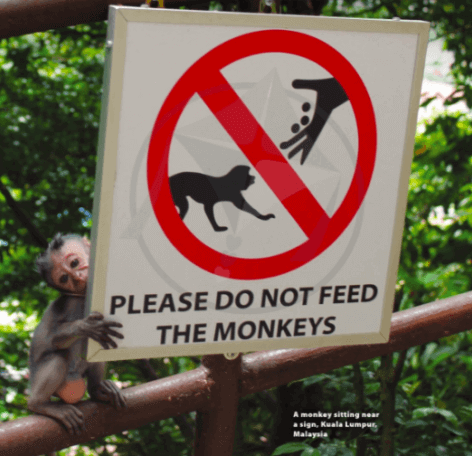
3. You can't feed the animals.
4. You can't play loud music.
5. You have to recycle your bottles.
6. You have to walk your bike.
D. Rewrite the following sentences using reported speech.
1. Are you allowed to park your bike at the bus stop?
- She asked me _____________________________.
2. You have to put your bike in the parking lot next to the bus stop.
- She said that _______________________________________.
3. You are not allowed to bring food to the library.
- The rule says __________________________.
4. Where can I buy a bus ticket?
- Jack asked me ____________.
5. You can't buy a bus ticket from the driver.
- He told me that ____________________.
Answer:
1. She asked me if I was allowed to park my bike at the bus stop.
2. She said that I had to put my bike in the parking lot next to the bus stop.
3. The rule says we weren't allowed to bring food to the library.
4. Jack asked me where he could buy a bus ticket.
5. He told me that I couldn't buy a bus ticket from the driver.
E. Think about the rules in your school, home, or another place. Write three true and three false rules. Then share them in a group. Can the others guess the false rules?

Answer:
1. You have to be respectful in ethnic minority villages.
2. You have to dress appropriately.
3. You have to respect at temples.
4. You should remove unnecessary jewelry.
5. You have to keep your bag safe.
6. You should negotiate and get a fixed price.
THE REAL WORLD
A. What do you think these signs mean? Check (V) the signs you think are real.
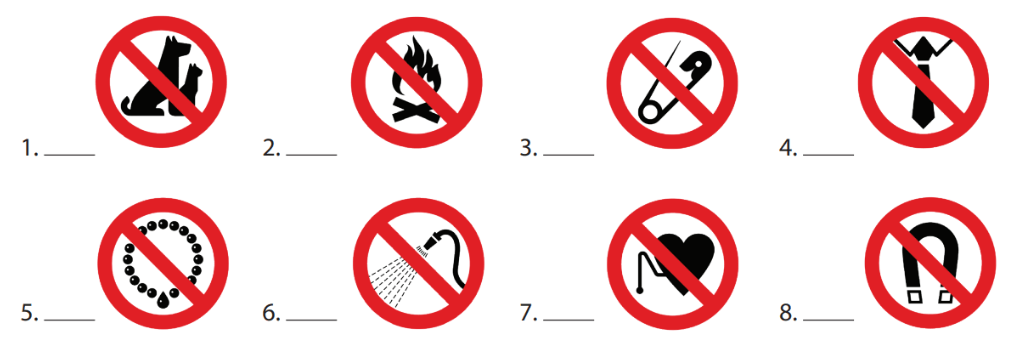
Answer:
Real signs:
1. No dogs allowed
2. No campfires
8. No magnets
Unreal signs:
4. No ties
5. No jewelry
6. No shower
7. No love
3. No safety pins
B. Listen to some unusual rules. Complete each rule. Listen again and check.
1. In Thailand, you aren't allowed to step on (money / books).
2. In Greece, women in (high heels / leather clothing) can't go inside monuments.
3. In Italy, you can't feed the (pigeons / cats) in St. Mark's Square, Venice.
4. In Spain, you can't drive a car (if you are under 25 / while wearing flip flops).
5. In Canada, one in every five songs on the radio must be sung by a (Canadian / woman).
Answer:
…………………………………………………………………………………..
PRONUNCIATION
DO YOU KNOW?
What thing should you avoid when visiting a Chăm family/
a. Offering them pork
b. Eating local food with them
c. Weaering green clothes
Answer:
a. Offering them pork
A. Listen to the sentences. Notice how has to is pronounced /hasta/ and have to is pronounced /hafta/.
1. My sister has to take her lunch to school.
2. In some countries, students have to go to school on Saturdays.
Answer:
…………………………………………………………………………………..
B. Listen and complete the sentences.
1. My little brother ____ to bed at 8:00.
2. What do you _____ this week?
3. I ______ a presentation at the science fair.
4. We _____ uniforms at our school.
5. I don't _____ in my room.
6. My sister ______ her homework every day.
Answer:
…………………………………………………………………………………..
C. Work with a partner. Take turns to read the sentences in B.
Answer:
(Học sinh tự thực hành)
COMMUNICATION
A. Make rules for a club. Work in groups. Find an interest you all share (e.g. music, sports, art, languages). Form an after-school club. Give your club a name and decide on four rules.
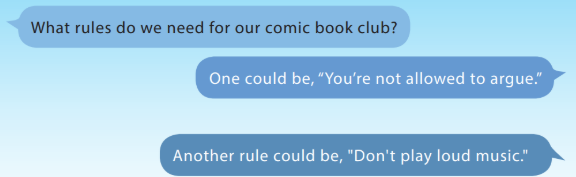
Answer:
What rules do we need for our music club?
One could be: "You must be no older than 25".
Another rule could be: "All new members must audition".
And it could be: "Late applications will not be accepted".
B. Make signs. Draw four signs for your club rules.
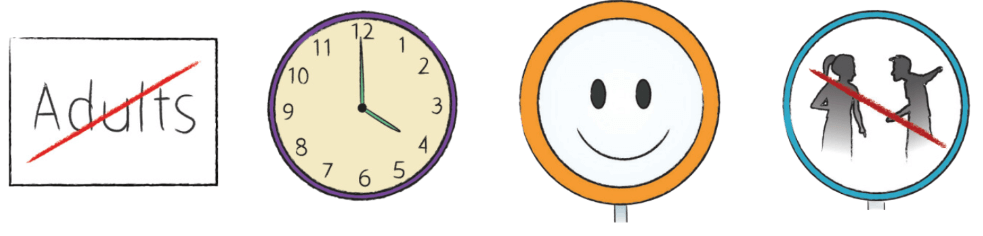
Answer:
(Học sinh tự thực hành)
C. Share your signs with another group. Can they guess the rules? Do they want to join?
Answer:
(Học sinh tự thực hành)
READING
A. Look at the photos and the title. What do you think the article is about?
Answer:
The article is about breaking the rules in photograph. And you can learn some basic rules. They will show you one of some techniques for the perfect shot.
B. Match. Match the captions (a-d) to the correct photos (1-4).
a. Red barn against the sky
c. Morning exercise in Shanghai
b. Two women
d. Amish women on the beach
Answer:
a. Red barn against the sky [4]
b. Two women [2]
c. Morning exercise in Shanghai [1]
d. Amish women on the beach [3]
C. Scan. In your notebook, write all the words that mean “photo.”
Answer:
photograph, picture, mug, snap, image, film, shoot, videotape, …
COMPREHENSION
IDIOM
If you do something “by the book”, you ____.
a. follow all the rules
b. break all the rules
c. read all the rules
Answer:
a. follow all the rules
A. Answer the questions about Breaking the Rules.
1. Mainides The reading is about how breaking rules can make ___.
a. photos look more interesting
b. photography difficult
c. photos look poor
2. Which of these would make a poor photo? Shooting ___.
a. with light behind you
b. with light behind the subject
c. directly into the sun
3. Most photographers ____.
a. focus on the main subject
b. pay more attention to secondary details
c. try to create a layered effect
4. The active space rule says you should leave empty space for people to ____.
a. move into
b. move away from
c. create an illusion
5. To create an element of surprise, you should ____.
a. take pictures outdoors
b. keep lines straight
c. create an unusual angle
Answer:
1. a 2. c 3. a 4. a 5. c
B. Sort. Write R for the rules photographers follow and B for rules that they've broken.
1. Turn the camera and point it upwards.
2. Leave space for people to move into.
3. Point your camera directly into the light.
4. Shoot with the light behind you.
5. Focus on the main subject of the photo.
6. Keep lines straight.
Answer:
1. R 2. B 3. B 4. B 5. R 6. B
C. CRITICAL THINKING. Work in a group. Find a photo in this book that you like. Then explain why. Do you think the photographer broke any rules?
Answer:
The main subject is in focus
PROJECT
Work with a group. Make a poster presentation about the five most important classroom rules.
Instructions:
- You should work with at least two other classmates on this project.
- Think of five classroom rules that you think are important.
- Compare your ideas with your group members and decide on the five most important rules.
- Make a poster for these five rules and decorate it.
- In the next class, share your poster with the class. Explain why the rules you chose are the most important.
Answer:
(Học sinh tự thực hành)
WRITING
1. Rewrite the classroom rules using be (not) allowed to or have to.
1. Keep the classroom clean.
2. Raise your hand to speak.
3. Don't run in the classroom.
4. Wear a uniform.
5. Don't make noise.
Answer:
1. You have to keep the classroom clean.
2. You have to raise your hand to speak
3. You are not allowed to run in the classroom
4. You have to wear a uniform
5. You are not allowed to make noise
2. Number the sentences in order (1-9) to make a complete paragraph.
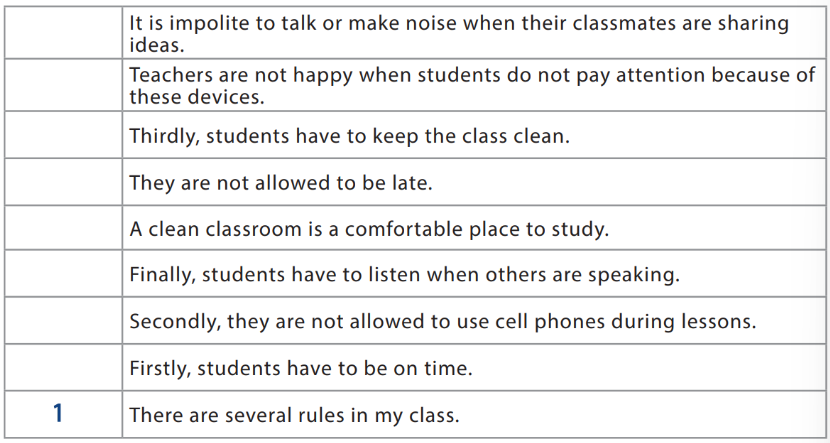
Answer:
1. There are several rules in my class.
2. Firstly, students have to be on time.
3. They are not allowed to be late.
4. Secondly, they are not allowed to use cell phones during lessons.
5. Teachers are not happy when students do not pay attention because of these devices.
6. Thirdly, students have to keep the class clean.
7. A clean classroom is a comfortable place to study.
8. Finally, students have to listen when others are speaking.
9. It is impolite to talk or make noise when their classmates are sharing ideas.
3. Imagine you are a teacher. Write a short paragraph to explain four classroom rules to students. Write 80-100 words on a separate sheet of paper. Use the sample in 2 to help you.
Answer:
Classroom rules are important to our class community. Firstly, you have to be on time at the beginning of the day and after lunch or recess breaks. Arriving on time shows that you value whatever it is you’re about to take part in. Secondly, always remember to keep your hands and feet to yourself. Students who can keep their hands and feet to themselves are able to demonstrate respect for their teachers and classmates. Other students are more likely to want to associate and be friends with them. Thirdly, listen to the teacher and classmates, and follow directions. And finally, you are not allowed to break all school rules. You have to obey the rules and follow them respectfully.
Tài liệu cùng môn học
Tài liệu khác
- Trắc nghiệm tiếng anh 2 Family and Friends
- Trắc nghiệm tiếng anh 2 Explore our world
- Trắc nghiệm tiếng anh 3 Family and Friends
- Trắc nghiệm tiếng anh 3 Explore our world
- Trắc nghiệm tiếng anh 4 Family and Friends
- Trắc nghiệm tiếng anh 4 Global Success
- Trắc nghiệm tiếng anh 4 Explore our world
- Trắc nghiệm tiếng anh 5 Family and Friends
- => Xem nhiều môn hơn