Giải tiếng anh 11 Global Success: Unit 5 Communication and Culture / CLIL
Hướng dẫn giải tiếng anh 11 Global Success: Giải Unit 5 Communication and Culture / CLIL. Bài được giải chi tiết, rõ ràng, dễ hiểu. Bài giải giúp học sinh nắm vững kiến thức trong sách giáo khoa, rèn kĩ năng giải bài tập và có phương pháp học tập hiệu quả.
Nội dung chi tiết
Everyday English
Giving and responding to warnings
1. Listen and complete the conversation with the expressions in the box. Then practice it in pairs.
(Nghe và hoàn thành cuộc hội thoại với các biểu thức trong hộp. Sau đó thực hành nó theo cặp)
A. Thanks so much B. I must warn you
C. Don’t worry D. Watch out
Jane: Hi, Nga. Is that a coal-burning stove?
Nga: Hi. Yes, my dad bought it last week. It heats up our home very quickly. Let me put in some more coal.
Jane: (1) _________________! You’re too close and will burn yourself!
Nga: (2) __________________. I’m very careful.
Jane: Yes, it feels very warm, but (3) _____________ burning coal produces soot.
Nga: Oh no, I didn’t know that. (4) ______________. I’ll tell my dad.
Answer:
Jane: Hi, Nga. Is that a coal-burning stove?
Nga: Hi. Yes, my dad bought it last week. It heats up our home very quickly. Let me put in some more coal.
Jane: (1) D. Watch out! You’re too close and will burn yourself!
Nga: (2) C. Don’t worry. I’m very careful.
Jane: Yes, it feels very warm, but (3) B. I must warn you burning coal produces soot.
Nga: Oh no, I didn’t know that. (4) A. Thanks so much. I’ll tell my dad.
2. Work in pairs. Use the model in 1 to make similar conversations for these situations. One of you is Student A, the other is Student B. Use the expressions below to help you.
(Làm việc theo cặp. Sử dụng mô hình trong phần 1 để tạo các hội thoại tương tự cho các tình huống này. Một trong số các bạn là Học sinh A, người kia là Học sinh B. Sử dụng các biểu thức dưới đây để giúp bạn)
1. Student A is burning rubbish. Student B is warning him/her about the dangers of open waste burning to people's health and the environment.
2. Student B is building a campfire. Student A is warning him/her about the risk of starting a forest fire and the health risks.
Answer:
1. Student A is burning rubbish. Student B is warning him/her about the dangers of open waste burning to people's health and the environment.
Student A: Hey, have you seen me burning some rubbish here?
Student B: Yeah, I see that. But do you know that burning waste like that can be dangerous to people's health and the environment?
Student A: Really? How come?
Student B: When you burn waste like that, it releases harmful toxins into the air, which can cause respiratory problems and other health issues. It can also harm the environment and pollute the air and soil.
Student A: Oh, I had no idea. Thanks for letting me know. I'll stop doing it and find a proper way to dispose of my waste.
2. Student B is building a campfire. Student A is warning him/her about the risk of starting a forest fire and the health risks.
Student B: Hey, I'm building a campfire. Do you want to join me?
Student A: Sure, but be careful. Starting a fire in a forest can be risky, especially if it's dry and windy.
Student B: Don't worry, I know what I'm doing.
Student A: But even a small spark can start a big forest fire, which can be difficult to control and cause a lot of damage. It's also not safe for our health, as the smoke can cause respiratory problems.
Student B: I see your point. Maybe we should find a safer spot to make a fire or just use a portable stove instead.
Student A: Yes, that's a better idea. We can enjoy our time outdoors without putting ourselves and the environment at risk.
CLIL
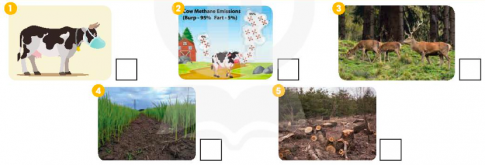
1. Read the text and tick ( v ) the pictures that show ways to reduce global warming.
(Đọc văn bản và đánh dấu ( v ) vào những bức tranh chỉ ra những cách để giảm sự nóng lên toàn cầu)
REDUCING THE ENVIRONMENTAL IMPACT OF FARMING
Farming provides us with the food that we eat every day. But farming activities also have a strong warming impact on the global temperature. The good news is that experts have already started thinking about how to reduce it.
Raising farm animals like cows, goats, and sheep makes the planet hotter. There are billions of them and they release methane, a greenhouse gas that is much more dangerous than carbon dioxide. That is why scientists are developing methane-catching face masks for cows. They are intended to reduce methane emissions by up to 50 per cent per cow.
Another farming activity that heats the atmosphere is growing rice. According to research, emissions from rice farms have the same warming effect as about 600 coal plants. Flooded rice fields also make it easier for soil bacteria to produce greenhouse gases. New farming methods have allowed rice to grow well in drier fields, limit the amount of greenhouse gases, use less water, and produce better crops.
In addition, land-use increases the global temperature. Plants and trees use CO2 to grow and store large amounts of carbon underground. Cutting down or burning forests to create farm fields and land for feeding animals releases tonnes of carbon dioxide and other greenhouse gases into the atmosphere every year. Luckily, many countries and world leaders have agreed to protect the forests and end deforestation.
In short, there are some positive signs that farmers can meet the environmental challenges. However, although the impact of farming on the global temperature has been reduced, there is still much to do.
Answer:
GIẢM TÁC ĐỘNG MÔI TRƯỜNG CỦA NGÀNH NÔNG NGHIỆP
Nông nghiệp cung cấp cho chúng ta thực phẩm mà chúng ta ăn mỗi ngày. Nhưng hoạt động nông nghiệp cũng có tác động làm nóng toàn cầu. Tin tốt là các chuyên gia đã bắt đầu nghĩ về cách giảm thiểu nó.
Việc nuôi gia súc như bò, dê và cừu làm cho hành tinh nóng hơn. Có hàng tỷ con gia súc và chúng thải ra khí methane, một loại khí nhà kính nguy hiểm hơn nhiều so với carbon dioxide. Đó là lý do tại sao các nhà khoa học đang phát triển khẩu trang bắt khí methane cho bò. Chúng được thiết kế để giảm thiểu lượng khí methane thải ra đến 50% cho mỗi con bò.
Một hoạt động nông nghiệp khác là trồng lúa gạo. Theo nghiên cứu, khí thải từ các trang trại lúa có tác động làm nóng tương tự như khoảng 600 nhà máy nhiệt điện than. Các cánh đồng lúa ngập nước cũng làm cho việc vi khuẩn đất sản xuất khí nhà kính dễ dàng hơn. Phương pháp trồng trọt mới đã cho phép lúa phát triển tốt trong các cánh đồng khô hơn, giới hạn lượng khí nhà kính, sử dụng ít nước hơn và tăng năng suất.
Ngoài ra, việc sử dụng đất cũng làm tăng nhiệt độ toàn cầu. Cây cối và rừng trồng dùng CO2 để phát triển và lưu trữ lượng lớn carbon trong lòng đất. Việc chặt hạ hoặc đốt rừng để tạo đất trồng trọt và đất nuôi gia súc thải ra hàng tấn carbon dioxide và khí nhà kính khác vào không khí mỗi năm. May mắn thay, nhiều quốc gia và các nhà lãnh đạo thế giới đã đồng ý bảo vệ các khu rừng và chấm dứt việc phá rừng.
Tóm lại, có một số tín hiệu tích cực rằng người nông dân có thể đối mặt với thách thức môi trường. Tuy nhiên, mặc dù ảnh hưởng của nông nghiệp đối với nhiệt độ toàn cầu đã được giảm nhẹ, vẫn còn rất nhiều việc phải làm.
2. Work in groups. Discuss the following questions.
(Làm việc nhóm. Thảo luận các câu hỏi sau)
What farming activities in Viet Nam do you think have negative impact on the global temperature? What do you think are the alternatives to those activities?
Answer:
There are several farming activities in Vietnam that can have a negative impact on the global temperature, including:
Rice cultivation: Rice cultivation is a major source of greenhouse gas emissions, primarily due to the production of methane during the decomposition of organic matter in flooded rice paddies.
Livestock production: Livestock production, particularly from cattle and buffalo, is a significant contributor to greenhouse gas emissions through the production of methane from enteric fermentation and manure management.
Pesticide use: Pesticide use in agriculture can lead to the emission of greenhouse gases, particularly nitrous oxide, as well as contribute to soil degradation.
Deforestation: Deforestation for agriculture, particularly for expanding rice paddies or livestock grazing areas, can contribute to the release of carbon dioxide into the atmosphere.
To address these negative impacts, some alternatives that can be considered include:
Sustainable rice cultivation: Alternative rice cultivation methods, such as aerobic rice cultivation or the use of alternate wetting and drying methods, can significantly reduce methane emissions from rice paddies.
Improved livestock management: Improved livestock management practices, such as better feeding and manure management, can reduce the emissions of methane and other greenhouse gases.
Organic farming: Organic farming practices, including the use of natural pest control methods and composting, can reduce the use of pesticides and fertilizers, as well as promote soil health.
Forest conservation and reforestation: Conservation and reforestation efforts can help to reduce the release of carbon dioxide from deforestation and promote carbon sequestration in new forest areas.
Overall, a shift towards sustainable agriculture practices and land use management can help to mitigate the negative impacts of farming activities on the global temperature.
Tài liệu cùng môn học
Tài liệu khác
- Trắc nghiệm tiếng anh 2 Family and Friends
- Trắc nghiệm tiếng anh 2 Explore our world
- Trắc nghiệm tiếng anh 3 Family and Friends
- Trắc nghiệm tiếng anh 3 Explore our world
- Trắc nghiệm tiếng anh 4 Family and Friends
- Trắc nghiệm tiếng anh 4 Global Success
- Trắc nghiệm tiếng anh 4 Explore our world
- Trắc nghiệm tiếng anh 5 Family and Friends
- => Xem nhiều môn hơn