Giải tiếng anh 11 Global Success: Unit 9 Speaking
Hướng dẫn giải tiếng anh 11 Global Success: Giải Unit 9 Speaking. Bài được giải chi tiết, rõ ràng, dễ hiểu. Bài giải giúp học sinh nắm vững kiến thức trong sách giáo khoa, rèn kĩ năng giải bài tập và có phương pháp học tập hiệu quả.
Nội dung chi tiết
Experiencing peer pressure
1. Order the examples of peer pressure below from 1 (most powerful) to 6 (least powerful).
(Sắp xếp các ví dụ về áp lực bạn bè dưới đây từ 1 (mạnh mẽ nhất) đến 6 (kém mạnh mẽ nhất)
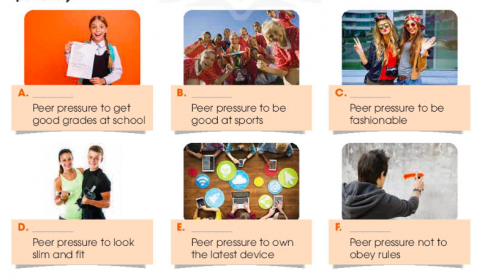
A. Peer pressure to get good grades at school
B. Peer pressure to be good at sports
C. Peer pressure to be fashionable
D. Peer pressure to look slim and fit
E. Peer pressure to own the latest device
F. Peer pressure not to obey rules
Answer:
1. Peer pressure not to obey rules
2. Peer pressure to be fashionable
3. Peer pressure to look slim and fit
4. Peer pressure to own the latest device
5. Peer pressure to be good at sports
6. Peer pressure to get good grades at school
2. Work in pairs. Talk about your experiences of peer pressure. Use the following guiding questions.
(Làm việc theo cặp. Nói về kinh nghiệm của bạn về áp lực ngang hàng. Sử dụng các câu hỏi hướng dẫn sau đây)
- Which example of peer pressure (A-F) in 1 affects you most? Why?
- Which one affects you the least? Why?
- Which are examples of positive peer pressure?
Answer:
Positive peer pressure is when your friends encourage you to do something that benefits you or others, or when you inspire each other to achieve common goals. Some examples of positive peer pressure are:
Encouraging your friend to exercise regularly and join you in a fitness class.
Supporting your friend who wants to quit smoking or drinking and avoiding situations where they might be tempted.
Volunteering with your friends for a local charity or community project.
Studying together and helping each other to understand difficult concepts or prepare for exams.
Standing up to bullying or discrimination together and promoting a culture of respect and inclusion.
Expressing your creativity and sharing your talents with each other, such as writing, singing, or drawing.
Positive peer pressure can build trust, self-esteem, and social skills, and foster a sense of belonging and purpose. It can also contribute to a healthier and more positive school or community culture.
3. Work in groups. Read the situations below and think of some possible responses. Provide reasons for each answer.
(Làm việc nhóm. Đọc các tình huống dưới đây và nghĩ về một số phản ứng có thể. Cung cấp lý do cho mỗi câu trả lời)
1. Your friend wants to skip a test, so he/she asks you to pretend that you are his/her parent(s) and wiite a letter to his/her teacher asking permission to be absent from school.
Example: “No way! I'm not lying. You should try to revise and take the test. Lies can have serious consequences and people will always find out the truth.*
2. Your friend has just got the latest smartphone. He/She makes fun of your old smartphone and says that you should buy a new one.
3. Your friend is getting good grades in English. He/She wants you to join his/her study group so that you can also improve your English.
4. Your friend is skipping classes frequently. He/She says that every teen does it sometimes, and you should do it as well.
Answer:
Response 1: "I cannot do that. It's not right to lie and pretend to be someone else. If you're having difficulty with the test, I can help you study and prepare better for it."
Reason: This response shows that you value honesty and integrity and that you are willing to help your friend in a more appropriate way. Lying to a teacher can have serious consequences and is not a solution to the problem.
Response 2: "I cannot help you with that. It's not ethical to lie and pretend to be someone else. You should talk to your teacher and try to find a better solution to your problem."
Reason: This response emphasizes the importance of honesty and suggests an alternative solution to the problem that is more ethical.
Response: "I am happy with my phone. It still works perfectly fine, and I don't see any need to upgrade it just because you did."
Reason: This response shows that you are confident in your own choices and that you are not easily influenced by what others say. It also suggests that material possessions do not define a person's worth or value.
Response: "That's a great idea! I would love to join your study group and improve my English. Thank you for inviting me."
Reason: This response shows that you are open to new ideas and willing to learn from others. It also highlights the positive aspect of peer pressure, where friends can encourage each other to improve and achieve their goals.
Response 1: "No, I don't think it's a good idea to skip classes. It's important to attend classes regularly and make the most of our education. If you need help, we can talk to our teacher and find a better solution."
Reason: This response emphasizes the importance of education and encourages the friend to find a better solution to their problem instead of skipping classes.
Response 2: "I'm sorry, but I can't skip classes. I want to make the most of my education and attend classes regularly. I can help you catch up on what you missed if you need it."
Reason: This response shows that you value education and that you are willing to help your friend in a more appropriate way. It also suggests that peer pressure should not influence your decisions when it comes to your education.
4. Report your answers to the whole class. Vote for the most interesting responses.
(Báo cáo câu trả lời của bạn cho cả lớp. Bình chọn cho câu trả lời thú vị nhất)
Answer:
HS tự thực hiện.
Tài liệu cùng môn học
Tài liệu khác
- Trắc nghiệm tiếng anh 2 Family and Friends
- Trắc nghiệm tiếng anh 2 Explore our world
- Trắc nghiệm tiếng anh 3 Family and Friends
- Trắc nghiệm tiếng anh 3 Explore our world
- Trắc nghiệm tiếng anh 4 Family and Friends
- Trắc nghiệm tiếng anh 4 Global Success
- Trắc nghiệm tiếng anh 4 Explore our world
- Trắc nghiệm tiếng anh 5 Family and Friends
- => Xem nhiều môn hơn