Giải Tiếng Anh 9 kết nối: Review unit 4, 5, 6
Hướng dẫn giải Tiếng Anh 9 kết nối tri thức: Giải Review unit 4, 5, 6. Bài được giải chi tiết, rõ ràng, dễ hiểu. Bài giải giúp học sinh nắm vững kiến thức trong sách giáo khoa, rèn kĩ năng giải bài tập và có phương pháp học tập hiệu quả.
Nội dung chi tiết
Review 2 (Units 4 - 5 - 6)
LANGUAGE
PRONUNCIATION
1. Read the sentences. Pay attention to the underlined words. Then listen and repeat.
1. The water overflowed from the dam and flooded the area.
2. African American musicians created jazz about 100 years ago.
3. The children thought all the food at the party was yummy.
4. The presentation focused on the values of teamwork.
5. He sometimes remembers his younger days in the mountain village.
Answer:
1. The water overflowed from the dam and flooded the area.
water /ˈwɔːtə(r)/
overflowed /ˌəʊvəˈfləʊd/
2. African American musicians created jazz about 100 years ago.
African /ˈæfrɪkən/
American /əˈmerɪkən/
years /jɪə(r)z/
3. The children thought all the food at the party was yummy.
children /ˈtʃɪldrən/
all /ɔːl/
yummy /ˈjʌmi/
4. The presentation focused on the values of teamwork.
values /ˈvæljuːz/
teamwork /ˈtiːmwɜːk/
5. He sometimes remembers his younger days in the mountain village.
younger /ˈjʌŋɡə(r)/
mountain /ˈmaʊntən/
VOCABULARY
2. Choose the correct answer A, B, C, or D to complete each sentence.
1. Angkor Wat in Cambodia is a World _______ Site.
A. Camping
B. Construction
C. Heritage
D. Building
2. Watching the forest from the top of the mountain is an amazing _______.
A. experience
B. habit
C. sight
D. accident
3. In my grandfather's _______, people travelled mostly on foot or by bike.
A. age
B. generation
C. past
D. year
4. The word _______ is new to most elderly people. They didn't know about it in their time.
A. 'eco-tour'
B. 'dance'
C. 'festival'
D. 'community'
5. Nowadays, _______ books have significantly replaced paper books.
A. science
B. picture
C. comic
D. online
Answer:
1. C - Angkor Wat in Cambodia is a World Heritage Site.
2. A - Watching the forest from the top of the mountain is an amazing experience.
3. B - In my grandfather's generation, people travelled mostly on foot or by bike.
4. A - The word ‘eco-tour’ is new to most elderly people. They didn't know about it in their time.
5. D - Nowadays, online books have significantly replaced paper books.
3. Write the correct form of the word in brackets to complete each sentence.
1. I have _______ memories about my trip to Sentosa in Singapore. (forget)
2. Children nowadays are more aware of environment _______ than we did in the past. (protect)
3. The most memorable part of our _______ was the boat ride on the River Cam. (tourism)
4. England is very good at _______ its historic buildings and monuments. (preserve)
5. We are getting ready for our graduation _______. (perform)
Answer:
1. forgotten - I have forgotten memories about my trip to Sentosa in Singapore.
2. protection - Children nowadays are more aware of environment protection than we did in the past.
3. tour - The most memorable part of our tour was the boat ride on the River Cam.
4. preserving - England is very good at preserving its historic buildings and monuments.
5. performance - We are getting ready for our graduation performance.
GRAMMAR
4. Choose the correct answer A, B, C, or D to complete each sentence.
1. Do you ______ not showing this photo in your presentation?
A. wish
B. mind
C. decide
D. think
2. We ______ we had more time to research changes in our village.
A. fancy
B. decide
C. wish
D. like
3. How was your ceramic course?
Fantastic. I ______ how to make simple items.
A. have learnt
B. was learning
C. am learning
D. learn
4. I went to the Exhibit Hall while my friend Mark ______ to the museum attendant.
A. talked
B. was talking
C. has talked
D. talks
5. I wish I ______ visit Angkor Wat in Cambodia.
A. can
B. should
C. will
D. could
Answer:
1. B - Do you mind not showing this photo in your presentation?
2. C - We wish we had more time to research changes in our village.
3. A - How was your ceramic course? -Fantastic. I have learnt how to make simple items.
4. B - I went to the Exhibit Hall while my friend Mark was talking to the museum attendant.
5. D - I wish I could visit Angkor Wat in Cambodia.
5. Use the correct forms of the verbs in brackets to complete the sentences.
1. We (walk) ______ down the hill when we saw the castle. It was so beautiful in the sunset.
2. I wish I (have) ______ more time to spend at the Viet Nam National Village for Ethnic Culture and Tourism.
3. ______ you (ever / make) ______ a handicraft item?
4. We all decided (choose) ______ the Return to the Past class.
5. Do you mind (search) ______ for more information about Japanese cartoons?
Answer:
1. were walking - We were walking down the hill when we saw the castle. It was so beautiful in the sunset.
2. had - I wish I had more time to spend at the Viet Nam National Village for Ethnic Culture and Tourism.
3. Have… ever made - Have you ever made a handicraft item?
4. to choose - We all decided to choose the Return to the Past class.
5. searching - Do you mind searching for more information about Japanese cartoons?
SKILL
READING
1. Read the passage and choose the correct answer A, B, C, or D.
Not long ago, open-air markets played an important part in the lives of the Vietnamese. Wherever there was open space, the local people could start their own market. There, you could find almost everything from local home-made and home-grown products to those that the sellers bought wholesale from somewhere and resold them for a profit. Since the locals went there nearly every day, they knew one another, and the sellers even remembered the customers’ preferences.
Then supermarkets came and soon became popular. There are many reasons to explain their popularity. First, they offer a cool and large shopping site. Shoppers can spend hours in them without worrying about heat or rain. Second, they provide shoppers with a wide range of goods, from foods and kitchenware to cosmetics and pet care products. People do not have to move from shop to shop to collect all the things they need. Nowadays, many supermarkets even offer home delivery service and online shopping, which makes shopping even easier.
1. In the past, the local people could start an open-air market when _______.
A. they paid the rent
B. they found a spacious spot
C. they had products to sell
D. they didn't want to shop elsewhere
2. The relationship between the sellers and the market-goers at an open-air market was _______.
A. healthy
B. distant
C. formal
D. close
3. The writer mentions two _______ the supermarket.
A. of his experiences with
B. types of goods in
C. benefits of
D. types of shoppers in
4. The supermarket also offers _______.
A. pet food
B. pets
C. pet shops
D. pet vets
5. Which statement is true according to the information in this passage?
A. Now you can Find open-air markets in the countryside only.
B. Every supermarket offers home-delivery service.
C. It's more convenient to shop in a supermarket than in an open-air market
D. Supermarkets offer everything we need.
Answer:
1. B - In the past, the local people could start an open-air market when they found a spacious spot.
Explain: Wherever there was open space, the local people could start their own market.
2. D - The relationship between the sellers and the market-goers at an open-air market was close.
Explain: Since the locals went there nearly every day, they knew one another, and the sellers even remembered the customers’ preferences.
3. C - The writer mentions two benefits of the supermarket.
Explain: There are many reasons to explain their popularity. First, they offer a cool and large shopping site... Second, they provide shoppers with a wide range of goods.
4. A - The supermarket also offers pet food.
Explain: Second, they provide shoppers with a wide range of goods, from foods and kitchenware to cosmetics and pet care products.
5. C - Which statement is true according to the information in this passage?
Explain: People do not have to move from shop to shop to collect all the things they need. Nowadays, many supermarkets even offer home delivery service and online shopping, which makes shopping even easier.
SPEAKING
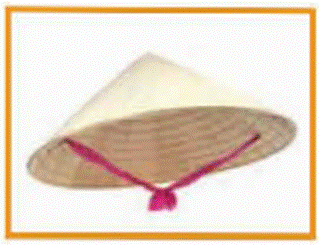
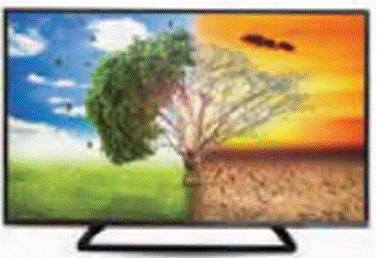
2. Work in groups. Choose ONE of the things below and discuss it, using the cues. Then present it to your class.
1. conical hat
2. smart TV
3. open wood fire
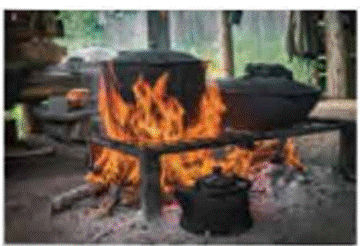
- Does the thing in the picture represent the past, present, or both?
- Has it changed over time? If it has, how is it different?
- What do you think about the change?
Answer:
1. Conical Hat
- Past, Present, or Both?: The conical hat, known as "nón lá" in Vietnam, represents both the past and the present.
- Change Over Time: While the design has largely remained the same, the materials and decorative elements may have evolved. In the past, these hats were made strictly from natural materials like palm leaves and bamboo. Nowadays, some versions might include synthetic materials or be used more as cultural symbols and souvenirs rather than everyday wear.
- Thoughts on the Change: The conical hat remains an iconic symbol of Vietnamese culture. The preservation of its traditional design while adapting to modern contexts is a positive change, as it keeps cultural heritage alive while accommodating contemporary uses.
2. Smart TV
- Past, Present, or Both?: The smart TV is a representation of the present.
- Change Over Time: Television has drastically changed over time. From bulky black-and-white sets to color TVs, then to flat-screen LCDs and now smart TVs with internet connectivity and advanced features.
- Thoughts on the Change: The evolution of TV technology has significantly enhanced the viewing experience, offering high-definition content, streaming services, and interactive features. This change is beneficial as it provides more convenience, a wider range of entertainment options, and better picture quality.
3. Open Wood Fire
- Past, Present, or Both?: The open wood fire primarily represents the past but is still used in some contexts today.
- Change Over Time: In the past, open wood fires were a common means of cooking and heating. Today, they have been largely replaced by modern stoves and heating systems in many parts of the world. However, they are still used in rural areas, for camping, or for traditional cooking methods.
- Thoughts on the Change: The shift to modern heating and cooking methods has made life more convenient and safer by reducing the risk of fire hazards and respiratory issues caused by smoke. However, the open wood fire remains a nostalgic and culturally significant practice in many communities, preserving a connection to traditional ways of life
LISTENING
3. Listen to a talk about entertainment for Vietnamese children in the past and complete each sentence with ONE word.
1. Games in the past required little _______.
2. We floated paper boats on imagined 'rivers' formed from _______.
3. Thanks to making our own toys, we became _______.
4. We played most games in _______ outdoors.
5. Team games helped develop _______ bonds among us.
Answer:
1. equipment
2. rainwater
3. creative
4. groups
5. strong
WRITING
4. Make complete sentences from the clues. Make any changes and add more words if necessary.
1. I / wish / I can / attend / traditional festivals / minority people / Viet Nam.
=>
2. When we / arrive / fair, / rice-cooking competition / taking place.
=>
3. He promise / help me / PowerPoint presentation / but he / not.
=>
4. We / never see / sight / as beautiful as / mountain at sunset.
=>
5. he / fancy / become / fashion designer / when / he / child?
=>
Answer:
1. I wish I could attend traditional festivals of minority people in Vietnam.
Explain:
- Câu ước cho hiện tại: S1 + wish + S2 + Ved/V2 (quá khứ đơn) => I wish I could
- can + V => could attend
- Cụm danh từ: traditional festivals of minority people
2. When we arrived at the fair, a rice-cooking competition was taking place.
Explain: Thì quá khứ tiếp diễn dùng để diễn tả hành động đang xảy ra trong quá khứ, hành động khác xen vào dùng thì quá khứ đơn: When + S1 + Ved/V2 , S2 + was/were V-ing
3. He promised to help me with the PowerPoint presentation, but he did not.
Explain
- Câu kể về sự việc đã xảy ra nên dùng thì quá khứ đơn: Ved/V2 => He promised
- promise + to V: hứa làm việc gì => promise to help
- Cấu trúc: help someone with something (giúp ai làm việc gì) => help me with PowerPoint presentation
- but + S + V: Liên từ “but” nối hai mệnh đề cùng thì của động từ => but he didn’t: nhưng anh ấy đã không
4. We had never seen a sight as beautiful as the mountain at sunset.
Explain:
- Trong câu có “never” nên dùng thì hiện tại hoàn thành: We have never Ved/V3 => We have never seen
5. Did he fancy becoming a fashion designer when he was a child?
Explain:
- Thì quá khứ đơn với “when” để diễn tả sự việc đã xảy ra trong quá khứ: S1 + Ved/V2 (quá khứ đơn) + WHEN + S2 + Ved/V2 (quá khứ đơn) => Câu hỏi thì quá khứ đơn: Did he fancy – when he was
- fancy + V-ing: thích làm việc gì => fancy becoming
Tài liệu cùng môn học
Tài liệu khác
- Trắc nghiệm tiếng anh 2 Family and Friends
- Trắc nghiệm tiếng anh 2 Explore our world
- Trắc nghiệm tiếng anh 3 Family and Friends
- Trắc nghiệm tiếng anh 3 Explore our world
- Trắc nghiệm tiếng anh 4 Family and Friends
- Trắc nghiệm tiếng anh 4 Global Success
- Trắc nghiệm tiếng anh 4 Explore our world
- Trắc nghiệm tiếng anh 5 Family and Friends
- => Xem nhiều môn hơn