Giải Tiếng Anh 9 kết nối: Unit 6 Vietnamese lifestyles then and now
Hướng dẫn giải Tiếng Anh 9 kết nối tri thức: Giải Unit 6 Vietnamese lifestyles then and now. Bài được giải chi tiết, rõ ràng, dễ hiểu. Bài giải giúp học sinh nắm vững kiến thức trong sách giáo khoa, rèn kĩ năng giải bài tập và có phương pháp học tập hiệu quả.
Nội dung chi tiết
UNIT 6: Vietnamese lifestyle: Then and Now
GETTING STARTED
We didn’t do it in my day
1. Listen and read
Phong: Grandpa, do you mind telling me how our lives are different from yours in the past?
Grandpa: Well, there are many differences. In my day, we mostly played outdoors. The games were simple and cost little. We made our own toys from natural materials.
Phong: That sounds interesting. Nowadays, most leisure games depend on electronic devices.
Grandpa: Right, but that is mostly true in the city only. Many children in the countryside still play traditional games.
Phong: I know.
Grandpa: Another thing is that children nowadays have more freedom of choice. They wear short dresses and jeans with holes. They also dye their hair purple and green.
Phong: Ha ha... Not many, Grandpa.
Grandpa: Hm... And many children of my generation left school early to support their families. Moreover, there were not many schools then.
Phong: You mean we have more opportunities to learn now?
Grandpa: That's right.
Phong: Do you think these changes are for the better?
Grandpa: Yes, they mostly are. They have improved our living conditions.
Phong: Thank you, Grandpa.
2. Read the conversation again and circle the correct answers.
1. Phong and his grandpa are talking about some differences between _______.
A. children in the city and the countryside
B. the living standards in the past and now
C. life in the past and now
D. past and present entertainment
2. Phong's grandpa mentions _______ differences.
A. two
B. three
C. four
D. five
3. Phong's grandpa sees most of the changes as _______.
A. positive
B. negative
C. unnecessary
D. necessary
Answer:
1. C - Phong and his grandpa are talking about some differences between life in the past and now.
Explain: Phong: Grandpa, do you mind telling me how our lives are different from yours in the past?
2. B - Phong's grandpa mentions three differences.
Explain:
- Well, there are many differences. In my day, we mostly played outdoors.
- Another thing is that children nowadays have more freedom of choice.
- And many children of my generation left school early to support their families.
3. A - Phong's grandpa sees most of the changes as positive.
Explain:
Phong: Do you think these changes are for the better?
Grandpa: Yes, they mostly are. They have improved our living conditions.
3. Write the expressions from the conversation in the correct column.
a. depend on electronic devices b. leave school early c. dye their hair d. have more opportunities to learn e. make toys from natural materials
|
The past | The present |
|
|
Answer:
The past | The present |
b. leave school early (Nghỉ học sớm) e. make toys from natural materials (làm đồ chơi từ vật liệu thiên nhiên) | a. depend on electronic devices (Phụ thuộc vào các thiết bị điện tử) c. dye their hair (nhuộm tóc) d. have more opportunities to learn (có nhiều cơ hội để học hỏi) |
4. Complete the sentences with the words from the box
opportunity freedom dyed generation materials |
1. A few teenagers in my village have _______ their hair brown.
2. Young people's lifestyle today is different from that of the previous _______.
3. Nowadays, nearly all young people have a(n) _______ to go to school.
4. He wants to live green, so he uses products made from natural _______.
5. My parents give me _______ to pursue my own interests.
Answer:
1. dyed - A few teenagers in my village have dyed their hair brown.
2. generation - Young people's lifestyle today is different from that of the previous generation.
3. opportunity - Nowadays, nearly all young people have an opportunity to go to school.
4.materials - He wants to live green, so he uses products made from natural materials.
5. freedom - My parents give me freedom to pursue my own interests.
5. QUIZ. Work in pairs. Decide if the statements below are true or false about life in VietNam 40 years ago. Share your answers with the class.
40 years ago, _______
1. school children didn't wear uniforms.
2. no Vietnamese student could go and study abroad.
3. most people wrote letters instead of writing emails or texting messages.
4. bicycles were the main means of transportation.
5. people lit firecrackers at Tet and weddings.
Answer:
1. False - school children didn't wear uniforms.
2. False - no Vietnamese student could go and study abroad.
3. True - most people wrote letters instead of writing emails or texting messages.
4. True - bicycles were the main means of transportation.
5. True - people lit firecrackers at Tet and weddings.
A CLOSER LOOK 1
VOCABULARY
1. Match the verbs or phrasal verbs with their meanings
A | B |
1. take notes | a. learn something carefully so that you can remember it exactly
|
2. depend on | b. take the position of something/somebody
|
3. memorise | c. write down some key information when listening to a talk, a lecture
|
4. pursue | d. rely on something/ somebody
|
5. replace | e. try to achieve something over a period of time
|
Answer:
1 - c. take notes: write down some key information when listening to a talk, a lecture
2 - d. depend on: rely on something/ somebody
3 - a. memorise: learn something carefully so that you can remember it exactly
4 - e. pursue: try to achieve something over a period of time
5 - b. replace: take the position of something/somebody
2. Work in pairs. Discuss and fill each blank with an adjective from the box.
democratic personal various extended family-oriented |
1. Four generations live in my house: my great grandparents, my grandparents, my parents, and me. It's a(n) _______ family.
2. In our group, everybody has equal rights to speak and work. We have a(n) _______ relationship.
3. Children in the past played a lot of traditional outdoor games such as hide-and-seek, tug of war, and marbles. There were _______ outdoor games for children.
4. I don't make public my telephone number, home address, or birthday. They are my _______ information.
5. He values his family and spends a lot of time with them. He's a(n) _______ person.
Answer:
1. extended - Four generations live in my house: my great grandparents, my grandparents, my parents, and me. It's an extended family.
2. democratic - In our group, everybody has equal rights to speak and work. We have a democratic relationship.
3. various - Children in the past played a lot of traditional outdoor games such as hide-and-seek, tug of war, and marbles. There were various outdoor games for children.
4. personal - I don't make public my telephone number, home address, or birthday. They are my personal information.
5. family-oriented - He values his family and spends a lot of time with them. He's a family-oriented person.
3. Circle the correct answer A,B,C or D to complete each sentence
1. Most of the events at the fair are _______, i.e. they are designed for the family.
A. family-oriented
B. exciting
C. democratic
D. various
2. In the past, girls had little opportunity to _______ their interests.
A. know
B. replace
C. pursue
D. promise
3. Hi-tech appliances used for housework have _______ our old-fashioned tools.
A. made
B. replaced
C. stopped
D. given up
4. The relationship between parents and children is now more _______ than in the past.
A. independent
B. private
C. democratic
D. extended
5. Protect your personal _______ online by using strong and unique passwords.
A. tast
B. experience
C. opinions
D. privacy
Answer:
1. A - Most of the events at the fair are family-oriented, i.e. they are designed for the family.
2. C - In the past, girls had little opportunity to pursue their interests.
3. B - Hi-tech appliances used for housework have replaced our old-fashioned tools.
4. C - The relationship between parents and children is now more democratic than in the past.
5. D - Protect your personal privacy online by using strong and unique passwords.
PRONUNCIATION
/fl/ and /fr/
4. Listen and tick (✔) the words you hear. Then listen again and repeat.
1. | □ a. fruit
| □ b. flute
|
2. | □ a. frame
| □ b. flame
|
3. | □ a. free | □ b. flea
|
4. | □ a. fright | □ b. flight |
5. | □ a. fresh | □ b. flesh
|
6. | □ a. frog | □ b. flog |
Answer:
1. a
2. b
3. a
4. b
5. a
6. a
5. Listen and repeat the sentences. Pay attention to the underlined words.
1. The photos of their fight for freedom are on the second floor.
2. Who suffers most from generation conflicts?
3. The man is reflecting on his frightening trip.
4. How does the past influence your friends?
5. When I was small, I caught the flu frequently.
Answer:
1. The photos of their fight for freedom are on the second floor.
freedom /ˈfriːdəm/
floor /flɔː(r)/
2. Who suffers most from generation conflicts?
from /frəm/
conflicts /ˈkɒnflɪkts/
3. The man is reflecting on his frightening trip.
reflecting /rɪˈflektɪŋ/
frightening /ˈfraɪtnɪŋ/
4. How does the past influence your friends?
influence /ˈɪnfluəns/
friends /frendz/
5. When I was small, I caught the flu frequently.
flu /fluː/
frequently /ˈfriːkwəntli/
A CLOSER LOOK 2
GRAMMAR
Verbs + to-infinitive
Verbs + V-ing
1. Write the correct form of the verbs in brackets.
1. fancy (ride) _______ a buffalo
2. learn (use) _______ traditional farming tools
3. mind (not touch) _______ the displays
4. decide (make) _______ a kite
5. avoid (play) _______ on the streets
6. promise (learn) _______ more about the history of our village
Answer:
1. fancy riding a buffalo (fancy + V-ing: thích làm gì)
2. learn to use traditional farming tools (learn + to V: học làm gì)
3. mind not touching the displays (mind + V-ing: bận tâm, phiền)
4. decide to make a kite (decide + to V: quyết định làm gì)
5. avoid playing on the streets (avoid + V-ing: tránh làm gì)
6. promise to learn more about the history of our village (promise + to V: hứa làm gì)
2. Underline the correct verb form for each sentence.
1. I really fancy to wear / wearing this traditional cone hat at our Fashion Show
2. My brother has decided to enter / entering the Back to Our Past Competition.
3. Do you mind to replay / replaying that folk music? It's lovely.
4. My uncle always avoids to tell / telling stories about his past.
5. They plan to do / doing research about life in Hue in the 19th century.
Answer:
1. wearing - I really fancy wearing this traditional cone hat at our Fashion Show. (fancy + V-ing: thích làm gì)
2. to enter - My brother has decided to enter the Back to Our Past Competition. (decide + to V: quyết định làm gì)
3. replaying - Do you mind replaying that folk music? It's lovely. (mind + V-ing: bận tâm, phiền)
4. telling - My uncle always avoids telling stories about his past. (avoid + V-ing: tránh làm gì)
5. to do - They plan to do research about life in Hue in the 19th century (plan + to V: lên kế hoạch làm gì)
3. Complete each sentence with the correct form of a verb from the box.
make learn give work teach |
1. We want _______ how to make toys from natural materials.
2. Yesterday, we finished _______ on the poster for our Good Old Days project.
3. I have promised _______ my grandfather how to find news online.
4. My grandmother suggested _______ a traditional long dress for the wedding.
5. Our group agreed _______ a presentation about school uniforms in the 20th century.
Answer:
1. to learn - We want to learn how to make toys from natural materials. (want + to V: muốn làm gì)
2. working - Yesterday, we finished working on the poster for our Good Old Days project.
(finish + V-ing: hoàn thành)
3. to teach - I have promised to teach my grandfather how to find news online.( promise + to V: hứa làm gì)
4. making - My grandmother suggested making a traditional long dress for the wedding. (suggest + V-ing: gợi ý làm gì)
5. to give - Our group agreed to give a presentation about school uniforms in the 20th century. (agree + to V: đồng ý làm gì)
4. Choose the incorrect underlined word or phrase in each sentence.
1. Just a few years ago, I would never fancy to have a smart TV in my home.
A B C D
2. Tom promised adding some information about the past to his presentation.
A B C D
3. I've decided learning how ethnic minority people use natural materials to dye cloth.
A B C D
4. My children plan researching and make our family tree for the past hundred years.
A B C D
5. Do you mind not to talk about the past in such a negative way?
A B C D
Answer:
1. D
Explain: fancy + V-ing: thích làm gì
Just a few years ago, I would never fancy having a smart TV in my home.
2. A
Explain: promise + to V: hứa làm gì
=> Tom promised to add some information about the past to his presentation.
3. B
Explain: decide + to V: quyết định làm gì
=> I've decided to learn how ethnic minority people use natural materials to dye cloth.
4. B
Explain: plan + to V: lên kế hoạch làm gì
=> My children plan to research and make our family tree for the past hundred years.
5. C
Explain: mind + V-ing: phiền, bận tâm làm gì
=> Do you mind not talking about the past in such a negative way?
5. Work in pairs. Take turns to complete the sentences.
1. For my future career, I want ___________________.
2. Do you mind not ___________________?
3. We all agreed ___________________.
4. I have never fancied ___________________.
5. For our two-day holiday, I suggest ___________________.
Answer:
1. For my future career, I want to become a banker.
(Vì sự nghiệp tương lai của tôi, tôi muốn trở thành nhân viên ngân hàng.)
2. Do you mind not interrupting me while I'm speaking? (Bạn có phiền không ngắt lời tôi khi tôi đang nói không?)
3. We all agreed to meet at the restaurant for lunch. (Tất cả chúng tôi đều đồng ý gặp nhau ở nhà hàng để ăn trưa.)
4. I have never fancied living in a forest. (Tôi chưa bao giờ thích sống trong rừng.)
5. For our two-day holiday, I suggest visiting a nearby beach and enjoying some relaxing time by the sea. (Đối với kỳ nghỉ hai ngày của chúng ta, tôi khuyên bạn nên ghé thăm một bãi biển gần đó và tận hưởng thời gian thư giãn bên bờ biển.)
COMMUNICATION
Everyday English
Making promises
1. Listen and read the conversations. Pay attention to the highlighted parts.
1. Mike: I will share with you the links about the ancient village of Duong Lam. Phong: Thank you |
2. Mi: I promise not to bring my dog to the picnic Ann: Great! I appreciate it |
2. Work in pairs. Make promises for the following situations.
1. You are going out with friends. Promise your parents to return before 9 p.m.
2. Promise your friend that you will be on time for the performance.
Answer:
1. You are going out with friends. Promise your parents to return before 9 p.m.
(Bạn đang đi chơi với bạn bè. Hãy hứa với bố mẹ bạn sẽ về trước 9 giờ tối.)
=> I promise to be back home before 9 p.m tonight, Mom and Dad.
(Con hứa sẽ về nhà trước 9 giờ tối nay bố mẹ nhé.)
2. Promise your friend that you will be on time for the performance.
(Hứa với bạn bè rằng bạn sẽ đến buổi biểu diễn đúng giờ.)
=> I will be on time for the performance. (Tôi sẽ đến buổi trình diễn đúng giờ)
Changes around you
3. Read the passages about changes. Then match the people with the topics they are talking about.
1. Aki from Tokyo
Children used to go to temple schools. Monks, samurai, doctors, and people of other professions served as teachers. Nowadays, children study in modern schools with teachers who get professional training in the subjects they teach.
2. Sanjay from New Delhi
Once, it was easy to say which country a person was from because people wore their own traditional costumes. Now, trends, comfort, and style are more important. More people are wearing western clothes like jeans and T-shirts instead.
3. Asim from Cairo
In the past, people used animals such as horses and camels for travelling. Now, airplanes, ships, and trains have replaced them. Transportation has become faster and easier.
People | Topics |
| a. Transportation |
| b. Education |
| c. Clothes |
Answer:
1 – b. Aki – Education (Giáo dục) (Explain: Children used to go to temple schools. Monks, samurai, doctors, and people of other professions served as teachers)
2 – c. Sanjay – Clothes (Quần áo) (Explain: Once, it was easy to say which country a person was from because people wore their own traditional costumes)
3 – a. Asim – Transportation (Giao thông) (Explain: Transportation has become faster and easier.)
4. Work in groups. Read the passages in 3 again and discuss:
- what aspects of life in the past you want to experience.
- what change you think is for the better, and why.
Answer:
- I am drawn to experiencing the aspect of life in the past where individuals adorned their own traditional attire. This fascination stems from the uniqueness and cultural significance inherent in these costumes, which served as poignant symbols of identity and heritage. These costumes were deeply meaningful, expressing pride in one's roots, connecting with history, and fostering a sense of community.
- The change I think is for the better is “Now, airplanes, ships, and trains have replaced them. Transportation has become faster and easier.” Because this shift has made transportation faster, safer, and more convenient. With modern transportation, people can travel longer distances in shorter amounts of time, saving time and money.
5. Work in pairs. Read the list below. Tell your partners which of them has remained the same and which has changed over the past five years. Take notes of your partner's answers and report them to the class.
Your style off clothes
Your eating habits
Your hobbies
Your favourite actor/singe/ book/ movie
Answer:
- My style of clothes has changed over the past five years. I used to prefer more casual and comfortable attire, but now I find myself gravitating towards a more professional and polished look for work.
- As for my eating habits, they have remained relatively the same. I've always been conscious of what I eat and strive to maintain a balanced diet with plenty of fruits and vegetables.
- My hobbies have also remained consistent over the past five years. I still enjoy reading, hiking, and painting in my free time.
- Regarding my favorite actor/singer/book/movie, there have been some changes. While I still have some favorites from five years ago, I've also discovered new ones that have become my current favorites. For example, I used to have a favorite actor, but now I'm more interested in a different actor's work.
SKILL 1
READING
1. Work in groups. Discuss if each of the following phrases describes past or present learning.
- Depending on textbooks
- Using the Internet
- Learning under an oil lamp
- Being independent and active
Answer:
Past learning | Present learning |
- Depending on textbooks (Phụ thuộc vào sách giáo khoa) - Learning under an oil lamp (Học dưới ánh đèn dầu) | - Using the Internet (sử dụng mạng Internet) - Being independent and active (Độc lập và năng động) |
2. Two people of different generations are talking about their learning styles. Read the passages and choose the correct answer A, B, C, or D.
Mr Nam, grandfather, a 70-year-old farmer
I was one of the few children in my village who was still at school at the age of 15. Every day, I got up early and walked to school. Learning then depended mostly on our teachers and textbooks. We had no library or lab. The nearest bookshop was six kilometres away. I learned simply by taking notes during class, memorising them, and doing the homework. Life then was simple. We rarely travelled outside our village, so we didn't know much about the world around us.
Mai, granddaughter, a 15-year-old student
Learning today is very different from my grandfather's time. It is easier and more convenient. Besides learning from teachers and textbooks, we use the Internet. It provides us with various online sources such as documents, clips, and programmes. Google helps us find the answers to almost any questions we have. The Internet also allows us to pursue our own interests. Learning has become more independent. Although most children in my village have fewer private learning facilities than the students in the city, we are still luckier than my grandfather's generation. We have TVs to watch at home and a library and computers at school.
1. In Mr Nam's time, __________.
A. teachers played an important role
B. there were no bookshops
C. students did experiments in labs
D. all children stayed on at school until they were 15
2. Few people travelled outside their village, so __________.
A. life in the village was simple
B. his school didn't have any learning facilities
C. the villagers didn't know much about the world aroun
D. none of the villagers knew about city life
3. Learning now __________.
A. does not require textbooks
B. uses some online programmes
C. depends only on the Internet
D. does not require students to take notes
4. The word "It" refers to __________.
A. leaming today
B. my grandfather's time
C. learning facilities
D. the Internet
5. The word "we" refers to __________
A. learning facilities
B. students at my grandfather's generation
C. students in the city
D. children in the village
Answer:
1. A - In Mr Nam's time, teachers played an important role.
Explain: Learning then depended mostly on our teachers and textbooks.
2. C
Few people travelled outside their village, so the villagers didn't know much about the world around.
Explain: We rarely travelled outside our village, so we didn't know much about the world around us.
3. B - Learning now uses some online programmes.
Explain: Besides learning from teachers and textbooks, we use the Internet. It provides us with various online sources such as documents, clips, and programmes.
4. A - The word “It” refers to learning today.
Explain: Learning today is very different from my grandfather's time. It is easier and more convenient.
5. D - The word “we” refers to children in the village.
Explain: Although most children in my village have fewer private learning facilities than the students in the city, we are still luckier than my grandfather's generation.
3. Fill in each blank with ONE word from the passage.
1. Mr Nam learned mainly from teachers and _______.
2. He learned by _______ the information he got in class.
3. Nowadays, students can learn from _______ online sources.
4. An example of an online source is _______.
5. The Internet helps children _______ their interests.
Answer:
1. textbooks - Mr Nam learned mainly from teachers and textbooks.
Explain: Learning then depended mostly on our teachers and textbooks.
2. memorising - He learned by memorising the information he got in class.
Explain: I learned simply by taking notes during class, memorising them, and doing the homework.
3.various- Nowadays, students can learn from various online sources.
Explain: It provides us with various online sources such as documents, clips, and programmes.
4. Google- An example of an online source is Google.
Explain: Google helps us find the answers to almost any questions we have.
5. pursue - The Internet helps children pursue their interests.
Explain: The Internet also allows us to pursue our own interests.
SPEAKING
4. Work in groups. Discuss and make a list of the changes in your learning over the past five years.
You can mention:
- number of subjects
- teachers
- learning facilities
- learning style (dependent/independent...)
Answer:
- number of subjects: more subjects, increased variety, including Literature, Chemistry, Physics, Biology,...(số lượng môn học: nhiều môn hơn, đa dạng hơn, bao gồm Văn, Hóa, Lý, Sinh,...)
- teachers: each teacher for one specific subject (giáo viên: mỗi giáo viên phụ trách một môn học cụ thể)
- learning facilities: classrooms are larger, having specialized rooms such as laboratories, music rooms, and art rooms (cơ sở vật chất học tập: phòng học rộng hơn, có các phòng chuyên biệt như phòng thí nghiệm, phòng âm nhạc, phòng mỹ thuật)
- learning style: more independent learning with self-study and research (phong cách học tập: học tập độc lập hơn với việc tự học và nghiên cứu)
5. Share with the class the list your group has made in 4.
Answer:
Aspects | The change |
number of subjects | more subjects, increased variety, including Literature, Chemistry, Physics, Biology, |
teachers | each teacher for one specific subject |
learning facilities | classrooms are larger, having specialized rooms such as laboratories, music rooms, and art rooms |
learning style | more independent learning with self-study and research |
SKILL 2
LISTENING
1. You are going to listen to a talk about family life. Work in pairs. Choose the aspect(s) that you think will be mentioned in the talk.
a. Family types
b. Parents' working places
c. Family holidays
d. Birthday parties
e. Parents-children relations
Answer:
The aspects that I think will be mentioned in the talk:
a. Family types - (Các kiểu gia đình)
c. Family holidays - (Kỳ nghỉ gia đình)
e. Parents-children relations - (Mối quan hệ giữa cha mẹ và con cái)
2. Listen to the talk and tick (✓) the correct column.
Facts | The past | The present |
1. Popularity of extended families |
|
|
2. More holidays away from home |
|
|
3. More time spent doing things together |
|
|
4. More sources to learn from |
|
|
5. More democratic parent-children relationships |
|
|
Answer:
Facts | The past | The present |
1. Popularity of extended families | ✓ |
|
2. More holidays away from home |
| ✓ |
3. More time spent doing things together | ✓ |
|
4. More sources to learn from |
| ✓ |
5. More democratic parent-children relationships |
| ✓ |
3. Listen again and fill each blank with a word or a number.
1. The speaker mentions _______ types of families.
2. In an extended family, there is/are _______ generation(s) living together.
3. The speaker describes Vietnamese people as _______.
4. Children in the past usually came to their _______ to share their experiences.
5. Today's children want their parents to respect their independence and _______.
Answer:
1. two
2. three
3. family-oriented
4. elders
5. privacy
WRITING
4. Read the list and tick (✓) the thing(s) that has/have changed in your family in the past five years. Make notes of those which have changed.
List | Change |
□ 1. Family type/ members | Still nuclear. One more member: my brother |
□ 2. Home facilities |
|
□ 3. Ways of spending free time |
|
□ 4. Relationships among members |
|
Answer:
List | Change |
✓ 1. Family type/ members | Still nuclear. One more member: my brother |
✓ 2. Home facilities | smart home technology for convenience |
✓ 3. Ways of spending free time
| Sometimes, use of digital entertainment Usually go out together |
✓ 4. Relationships among members | Strengthening of bonds through sharing, open communication and listening.
|
5. Write an email (100-120 words) to your penfriend about the changes in your family. Use the ideas in 4.
Start and end the email as follows:
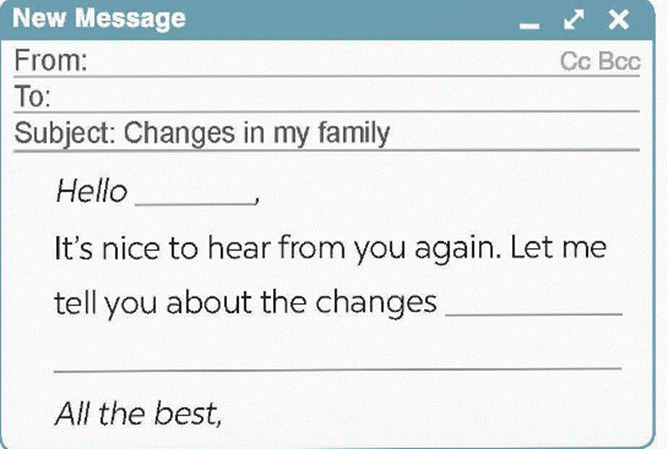
Answer:
Hi Linh,
I hope this email finds you well. I wanted to share some exciting changes that have occurred within my family over the past few years.
Firstly, our family structure remains nuclear, but we've welcomed a new member recently—my younger brother. It's been a joy having him around and seeing him grow within our family unit.
In terms of home facilities, we've embraced smart home technology for added convenience. It's made managing household tasks much easier and efficient.
As for our ways of spending free time, we've found a balance between digital entertainment and outdoor activities. While we sometimes enjoy binge-watching shows or playing video games together, we also make it a point to go out and explore new places as a family.
Lastly, I'm pleased to say that our relationships among family members have only strengthened. We've prioritized open communication, sharing, and listening, which has deepened our bonds and made our family dynamic even stronger.
I'd love to hear about any changes in your family as well!
Take care,
Huyền
LOOKING BACK
VOCABULARY
1. Choose the correct answer A, B, C, or D to complete each sentence.
1. I love animals and I'm determined to ______ my dream of becoming a vet.
A. have
B. pursue
C. do
D. depend on
2. ______ people tend to put the needs of their families ahead of their own.
A. Independent
B. Democratic
C. Kind
D. Family-oriented
3. Rapid changes in society and lifestyle have made the ______ in many families wider.
A. generation gap
B. family relation
C. family values
D. experiences
4. She has found ______ sources of information about life in Viet Nam a
century ago.
A. extended
B. alive
C. various
D. long
5. Like adults, children sometimes want some ______.
A. opportunity
B. relations
C. values
D. privacy
Answer:
1. B - I love animals and I'm determined to pursue my dream of becoming a vet.
2. D - Family-oriented people tend to put the needs of their families ahead of their own.
3. A - Rapid changes in society and lifestyle have made the generation gap in many families wider.
4. C - She has found various sources of information about life in Viet Nam a century ago.
5. D - Like adults, children sometimes want some privacy.
2. Complete the sentences with the correct forms of the words in brackets.
1. My parents taught me not to listen to other people's _______ conversations. (privacy)
2. It's amazing that the boy can _______ all the information in such a short time. (memory)
3. Living away from home to attend college has made me more _______. (independence)
4. In a modern society, we learn to value a person's _______. (free)
5. In a _______ classroom, every student has the right to speak as well as the responsibility to listen to others. (democracy)
Answer:
1. private - My parents taught me not to listen to other people's private conversations.
2. memorize - It's amazing that the boy can memorize all the information in such a short time.
3. independent - Living away from home to attend college has made me more independent.
4. freedom - In a modern society, we learn to value a person's freedom.
5. democratic - In a democratic classroom, every student has the right to speak as well as the responsibility to listen to others.
GRAMMAR
3. Circle the correct words or phrases to complete the following sentences.
1. Do you mind turning / to turn the volume down? I'm studying.
2. We decided spending / to spend this whole week learning to cook traditional foods.
3. If you want seeing / to see the differences between the past and the present of a city, visit its museum.
4. He stayed in his room to avoid meeting / to meet his parents' guests.
5. My brother promised taking / to take me to the exhibition of traditional farming tools.
Answer:
1. Do you mind turning the volume down? I'm studying. (mind + V-ing: bận tâm, phiền lòng làm gì)
2. We decided to spend this whole week learning to cook traditional foods. (decide + to V: quyết định làm gì)
3. If you want to see the differences between the past and the present of a city, visit its museum. (want +to V: muốn làm gì)
4. He stayed in his room to avoid meeting his parents' guests. (avoid + V-ing: tránh làm gì)
5. My brother promised to take me to the exhibition of traditional farming tools. (promise + to V: hứa làm gì)
4. Make complete sentences from the clues. Make any changes and add more words if necessary.
1. we / plan / visit / historical places / Cao Bang.
=>
2. we / hope / have / bus station / near / village / soon.
=>
3. even / grandmother /enjoy / use / Facebook / communicate / her friends.
=>
4. last year / I / learn / make cakes / watch / cooking videos / Internet.
=>
5. this morning / I / suggest / do a survey / northern women's traditional costumes.
=>
Answer:
1. We plan to visit historical places in Cao Bang.
Explain:
Câu miêu tả sự việc ở hiện tại nên dùng thì hiện tại đơn => we + V (nguyên thể)
plan + to V: dự định làm việc gì => plan to visit
in + địa điểm (tỉnh/ thành phố) => in Cao Bang
2. We hope to have a bus station near our village soon.
Explain:
Câu miêu tả sự việc ở hiện tại nên dùng thì hiện tại đơn => we + V (nguyên thể)
hope + to V: hi vọng việc gì => hope to have
a + danh từ số ít trong câu miêu tả => a bus station: một trạm xe buýt
chủ ngữ “we” nên dùng tính từ sở hữu trước danh từ phía sau để xác định sự vật => our village: làng của chúng tôi
3. Even my grandmother enjoys using Facebook to communicate with her friends.
Explain:
Trước danh từ số ít “grandmother” cần dùng tính từ sở hữu để xác định => my grandmother: bà của tô
Câu miêu tả sự việc ở hiện tại nên dùng thì hiện tại đơn => chủ ngữ số ít + V-s/es => enjoys
enjoy +V-ing: thích làm việc gì => enjoys using
Cấu trúc chỉ mục đích “to V” (để mà) => to communicate: để giao tiếp
Cụm từ: communicate with someone (giao tiếp với ai)
4. Last year, I learned to make cakes by watching cooking videos on the Internet.
Explain:
Trong câu có “last year” nên dùng thì quá khứ đơn: Ved/V2 => I learned
learn + to V: học cách làm gì => learn to make cakes: học làm bánh
by + V-ing: bằng cách gì => by watching: bằng cách xem
Cụm từ: on the Internet (trên mạng)
5. This morning, I suggested doing a survey on northern women's traditional costumes.
Explain:
Trong câu có “this morning” nên dùng thì quá khứ đơn: Ved/V2 => I suggested
suggest + V-ing: đề nghị làm việc gì => suggested doing
a survey on + N: khảo sát về cái gì
PROJECT
I KNOW MY _____ WELL!
Work individually.
1. Interview one of your family members about his/her life when he/she was your age now.
Take notes of his/her answers. You may focus on:
- what school he/she went to
- what learning was like then
- how he/she spent his / her free time
- what relations among family members were like then
Answer:
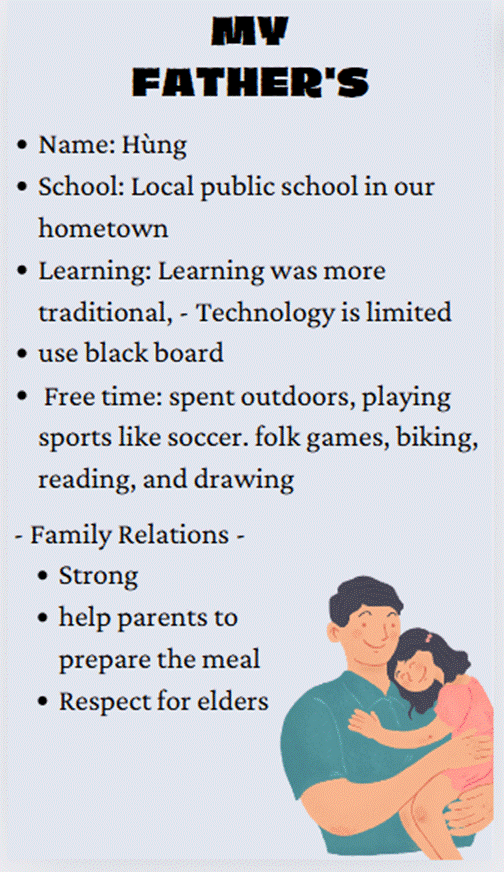
Name: Hùng - My father
- What school he went to: Local public school in our hometown (ABC secondary school)
- What learning was like then: Learning was more traditional, with a strong emphasis on memorization and textbook-based instruction; Technology was limited; there were no computers or internet access in classrooms; Teachers used blackboards and overhead projectors for lessons
- How he spent his free time: spent outdoors, playing sports like soccer, folk games, biking, reading, and drawing
- What relations among family members were like then: Family bonds were strong - usually help parents to prepare the meal; Communication was mostly face-to-face, with more emphasis on personal interactions; Respect for elders
2. Make a poster, including his / her photo and the information you have noted.
3. Present your poster to the class
Answer:
Good morning guys. Today I want to share about my father’s life when he was young
His name is Hung. He attended a local public high school that focused heavily on academics and extracurricular activities. Learning was more traditional, with an emphasis on memorization and textbook-based instruction, and there was no access to modern technology like computers or the internet in classrooms. In his free time, he often plays outdoor sports such as soccer with friends, read books, plays folk games, biking, and drawing. Relationships among family members were strong, with frequent helping parents prepare the meals. He also shows respect for elders.
Tài liệu cùng môn học
Tài liệu khác
- Trắc nghiệm tiếng anh 2 Family and Friends
- Trắc nghiệm tiếng anh 2 Explore our world
- Trắc nghiệm tiếng anh 3 Family and Friends
- Trắc nghiệm tiếng anh 3 Explore our world
- Trắc nghiệm tiếng anh 4 Family and Friends
- Trắc nghiệm tiếng anh 4 Global Success
- Trắc nghiệm tiếng anh 4 Explore our world
- Trắc nghiệm tiếng anh 5 Family and Friends
- => Xem nhiều môn hơn