Giải Tiếng Anh 9 kết nối: Unit 9 World englishes
Hướng dẫn giải Tiếng Anh 9 kết nối tri thức: Giải Unit 9 World englishes. Bài được giải chi tiết, rõ ràng, dễ hiểu. Bài giải giúp học sinh nắm vững kiến thức trong sách giáo khoa, rèn kĩ năng giải bài tập và có phương pháp học tập hiệu quả.
Nội dung chi tiết
UNIT 9: World Englishes
GETTING STARTED
What do you mean?
1. Listen and read.
Teacher: Hi class. I'd like to introduce an exchange student who comes from New York. Welcome Jack!
Students: Hello, Jack. Nice to meet you.
Jack: Nice to meet you all. This is my first time in Viet Nam.
Teacher: Now you can ask Jack any questions you would like to ask.
Phong: Do American students wear school uniforms every day, Jack?
Jack: No, most American students don't wear school uniforms. Most students at my school wear pants and T-shirts.
Phong: What do you mean by 'pants, Jack?
Jack: Ah, I mean trousers. In American English, 'pants' mean trousers!
Phong: I see.
Teacher: Yeah, there are some differences in vocabulary between American English and British English. Are there any more questions?
Mi: Yes. I want to know about the students in your school. Are all of you American? And do all of you speak English?
Jack: Good question. Most of us are American, but some are immigrants
from other countries like VietNam, India, Cand Mexico. Their first language is not English, but they all speak English at school.
Mi: That's interesting!
2. Read the conversation again. Fill in each blank with no more than TWO words from the conversation.
1. Jack is an exchange student from__________
2. This is the _______ Jack has visited Việt Nam.
3. Most students at Jack's school wear _________ and T-shirts.
4. American English and British English have ___________ in vocabulary.
5. Not all students in Jack's school are ______, but they all speak English.
Answer:
1. Jack is an exchange student from New York. (Explanation: Teacher: Hi class. I'd like to introduce an exchange student who comes from New York. Welcome Jack!)
2. This is the first time Jack has visited Việt Nam. (Explanation: Jack: Nice to meet you all. This is my first time in Viet Nam.)
3. Most students at Jack's school wear pants and T-shirts. (Explanation: Jack: No, most American students don't wear school uniforms. Most students at my school wear pants and T-shirts.)
4. American English and British English have differences in vocabulary. (Explanation: Teacher: Yeah, there are some differences in vocabulary between American English and British English. Are there any more questions?)
5. Not all students in Jack's school are American, but they all speak English.
(Explanation: Jack: Good question. Most of us are American, but some are immigrants from other countries like VietNam, India, Cand Mexico. Their first language is not English, but they all speak English at school.)
3. Match the words and phrases with their definitions.
1. exchange student | a. all the words in a language |
2. mean | b. a student who attends a school in a foreign country for a period of time |
3. vocabulary | c. people who have come to live permanently in a different country |
4. immigrants | d. the language someone learns to speak from birth |
5. first language | e. to express or represent something |
Answer:
1 - b - exchange student - b. a student who attends a school in a foreign country for a period of time
2 - e - mean - e. to express or represent something
3 - a - vocabulary - a. all the words in a language
4 - c - immigrants - c. people who have come to live permanently in a different country
5 - d - first language - d. the language someone learns to speak from birth
4. Fill in each blank with a word or phrase from 3.
1. - What does your name_________, Mi?
- It's the name of a bird.
2. English _______ is increasing because it borrows words from other languages.
3. In Australia, there are a lot of_________ who have come from other countries.
4. His___________ is Vietnamese, but he can speak English and French fluently.
5. This year our school has a(n)________ from Britain. She will study with us for one month.
Answer:
1. mean
What does your name mean, Mi?
It's the name of a bird.
2.vocabulary - English vocabulary is increasing because it borrows words from other languages.
3. immigrants - In Australia, there are a lot of immigrants who have come from other countries.
4. first language - His first language is Vietnamese, but he can speak English and French fluently.
5. exchange student - This year our school has a(n) exchange student from Britain. She will study with us for one month.
5. QUIZ Match the words in British English with those in American English so that they mean the same. Who is the quickest?
British English | American English |
flat | sweater |
holiday | apartment |
jumper | soccer |
chips | vacation |
football | French fries |
Do you know any other pairs of words?
Answer:
1. flat - apartment
2. holiday - vacation
3. jumper - sweater
4. chips - French fries
5. football - soccer
Other pairs of words that have different terms in British and American English include:
1. biscuit (British) - cookie (American)
2. crisps (British) - potato chips (American)
3. lift (British) - elevator (American)
4. lorry (British) - truck (American)
5. nappy (British) - diaper (American)
6. petrol (British) - gas or gasoline (American)
7. postcode (British) - zip code (American)
A CLOSER LOOK 1
VOCABULARY
1. Match a word or phrase in A with its meaning in B.
A | B |
1. variety | a. a language which has legal status in a country |
2. bilingual | b. a different type of something |
3. fluent | c. (of circles) having the same centre |
4. concentric | d. able to speak two languages equally well |
5. official language | e. able to speak, read, or write a language, especially a foreign language, easily and well |
Answer:
1 - b - variety - a different type of something
2 - d - bilingual - able to speak two languages equally well
3 - e - fluent - able to speak, read, or write a language, especially a foreign language, easily and well
4 - c - concentric - (of circles) having the same centre
5 - a - official language - a language which has legal status in a country
2. Match a verb in A with a phrase in B to make a meaningful expression.
A | B |
1. translate | a. over the grammatical points |
2. copy | b. up a new language |
3. pick | c. up new words in an English - English dictionary |
4. look | d. from Vietnamese into Enlish |
5. go | e. words into a notebook |
Answer:
1. d- translate - from Vietnamese into English
2. e - copy - words into a notebook
3. b - pick - up a new language
4. c - look - up new words in an English - English dictionary
5. a - go - over the grammatical points
3. Choose the correct word to complete each sentence.
1. English is a(n) official/ first language in Singapore besides Malay, Mandarin and Tamil.
2. Although he was born in Britain, he is fluent/bilingual in Vietnamese.
3. After you pick / look up a word in the dictionary, remember to make an example with it.
4. How many books have you picked/ translated from English into Vietnamese?
5. Remember to go / copy over the words you have learnt in class.
Answer:
1. official - English is an official language in Singapore besides Malay, Mandarin and Tamil.
2. fluent - Although he was born in Britain, he is fluent in Vietnamese.
3. look up - After you look up a word in the dictionary, remember to make an example with it.
4. translated - How many books have you translated from English into Vietnamese?
5. go - Remember to go over the words you have learnt in class.
PRONUNCIATION
Stress in words ending in -ion and -ity
4. Listen and repeat the words. Pay attention to the word stress
|
|
relation | charity |
decision | quality |
position | clarity |
education | ability |
operation | obesity |
Answer:
|
|
relation (/rɪˈleɪ.ʃən/) | charity ( /ˈtʃær.ə.ti/) |
decision (/dɪˈsɪʒ.ən/) | quality ( /ˈkwɒl.ə.ti/) |
position ( /pəˈzɪʃ.ən/) | clarity (/ˈklær.ə.ti/) |
education (/ˌedʒ.ʊˈkeɪ.ʃən/) | ability (/əˈbɪl.ə.ti/) |
operation (/ˌɒp.ərˈeɪ.ʃən/) | obesity (/əʊˈbiː.sə.ti/) |
5. Listen and repeat the sentences. Mark the stress in the underlined
words.
1. They had a discussion about the quality of the courses at their language centre.
2. Pay attention to her ability to express herself in English.
3. I have an intention of organising an English class for the community.
4. Let's do a revision activity before the exam.
5. What is the function of the word 'identity' in this sentence?
Answer:
1. They had a disCUSSion about the QUALity of the courses at their language centre.
2. Pay atTENtion to her aBIlity to express herself in ENglish.
3. I have an inTENtion of organizing an English class for the COMmunity.
4. Let's do a reVIsion acTIVity before the exam.
5. What is the FUNCtion of the word 'iDENtity' in this sentence?
A CLOSER LOOK 2
GRAMMAR
1. Choose the correct answer A, B, C, or D to complete each sentence.
1. English is the language ________ is known as a global language.
A. who
B. which
C. whose
D. what
2. People_______ speak English well can find jobs in international companies more easily.
A. who
B. which
C. whose
D. why
3. People from countries _______ do not share a common language use English to work together effectively.
A. who
B. which
C. whose
D. where
4. The woman ______ son won the English speaking contest felt very proud.
A. who
B. which
C. whose
D. when
5. I met a man _____ first language is Arabic at the conference.
A. who
B. which
C. what
D. whose
Answer:
1. B. which - English is the language which is known as a global language
2. A. who - People who speak English well can find jobs in international companies more easily.
3. D. where - People from countries where do not share a common language use English to work together effectively
4. C. whose - The woman whose son won the English speaking contest felt very proud
5. D. whose - I met a man whose first language is Arabic at the conference
2. Underline the relative clause in each sentence. Decide if the relative pronoun is the subject (S) or object (0) of the relative clause and if we can or cannot omit it.
1. The new vocabulary items which we learnt yesterday are difficult to remember.
2. I don't like the grammar exercises which are in this book.
3. The man who translated this novel into Vietnamese must be proficient in English.
4. The students who love languages can join our Reading Club.
5. The teacher who we admire can speak three languages.
Answer:
1. The new vocabulary items which we learnt yesterday are difficult to remember.
Relative pronoun: which
Role: Object (O)
Omit: Yes
2. I don't like the grammar exercises which are in this book.
Relative pronoun: which
Role: Object (O)
Omit: Yes
3. The man who translated this novel into Vietnamese must be proficient in English.
Relative pronoun: who
Role: Subject (S)
Omit: No
4. The students who love languages can join our Reading Club.
Relative pronoun: who
Role: Subject (S)
Omit: No
5. The teacher who we admire can speak three languages.
Relative pronoun: who
Role: Object (O)
Omit: Yes
3. Are these sentences right or wrong? Correct them if necessary.
1. My sister doesn't like films have unhappy endings.
2. What is the name of the man who is the director of the language centre?
3. One of the four official languages people use in Singapore is English.
4. I like the English lesson which Ms Oanh taught yesterday.
5. Students who grades are high can compete in this contest.
Answer:
1. Wrong - Have" needs a subject
=> My sister doesn't like films that have unhappy endings
2. Right - What is the name of the man who is the director of the language centre?
3. Wrong
=> One of the four official languages that people use in Singapore is English
4. Right
=> I like the English lesson which Ms Oanh taught yesterday.
5. Wrong - Grades" is possessive, so "whose" is the appropriate pronoun.
=> Students whose grades are high can compete in this contest.
4. Combine the two sentences into one, using a relative pronoun.
1. I met a woman. Her husband is a famous linguist.
2. My friend's father gave us the tickets. He owns a travel agency.
3. The grammar exercise was very complicated. Nobody could do it.
4. I study English in a language school. It is in the center of the city.
5. The student completed the quiz the fastest. The teacher praised him.
Answer:
1. I met a woman. Her husband is a famous linguist.
=> I met a woman whose husband is a famous linguist.
2. My friend's father gave us the tickets. He owns a travel agency.
=> My friend's father, who owns a travel agency, gave us the tickets.
3. The grammar exercise was very complicated. Nobody could do it.
=> The grammar exercise, which was very complicated, nobody could do.
4. I study English in a language school. It is in the center of the city.
=> I study English in a language school that is in the center of the city
5. The student completed the quiz the fastest. The teacher praised him.
=> The teacher praised the student who completed the quiz the fastest
5. GAME Clues for you
Work in two teams. A student from each team gives clues about an object or a person in class, using a relative clause. Students from the other team guess which object or person it is.
For example:
This is something which we write with
Is it a pen?
Yes, it is.
Answer:
1.
A: This is someone who teaches us English.
B: Is it Ms. Smith/Mr. Jones?
A: Yes, it is
2.
A: This is something that we use to write on the board.
B: Is it a marker/chalk?
A: Yes, it is.
COMMUNICATION
Everyday English
Saying good luck and responding
1. Listen and read the conversations. Pay attention to the highlighted parts.
1. Tom: Good luck with your English exam. Mi: Thanks. I’ll try my best. |
2. Phong: I've heard that you're moving to the US. I wish you all the best of luck. Neighbour: Thank you so much. |
Answer:
1. Tom: Good luck with your English exam. (Chúc may mắn với bài kiểm tra tiếng Anh) Mi: Thanks. I’ll try my best. (Cảm ơn bạn. Tôi sẽ cố gắng hết cố sức) |
2. Phong: I've heard that you're moving to the US. I wish you all the best of luck. (Tôi nghe nói bạn sắp chuyển đến Mỹ. Tôi chúc bạn những điều may mắn nhất) Neighbour: Thank you so much. (Cảm ơn bạn rất nhiều) |
2. Work in pairs. Practice saying good luck and responding in the following situations.
1. Your friend is giving a presentation in English this week.
2. Your cousin is taking the university entrance exam next week.
3. Your English teacher is going to the UK for further study.
Answer:
1. Situation: Your friend is giving a presentation in English this week.
You: Hey, good luck with your presentation in English this week!
Your friend: Thanks a lot! I'm a bit nervous, but I'll do my best.
2.
Situation: Your cousin is taking the university entrance exam next week.
You: I heard you're taking the university entrance exam next week. Good luck with that!
Your cousin: Thank you! Yeah, it's a bit nervous, but I'll do my best.
3.
Situation: Your English teacher is going to the UK for further study.
You: Ms. Johnson, I heard you're going to the UK for further study. That's exciting! Good luck with everything!
Your teacher: Yes, I am! Thank you so much for your kind words.
Interesting facts about English
3. Work in pairs. Read the interesting facts below about English. Order them from the most interesting to the least interesting.
1. The most common letter in English is 'e!
2. Only two English words in current use and in '-gry. They are 'angry' and hungry.
3. The word 'uncooyrightacle' is the longest English word in normal use which contains no letter more than once.
4. The longest English word without a true vowel (a, e, i, o, or u) is 'rhythms'.
5. 'Queueing' and 'cooeeing' are the two words with five consecutive vowels (five vowels in a row).
Answer:
5. 'Queueing' and 'cooeeing' are the two words with five consecutive vowels (five vowels in a row). (Queueing' và 'cooeeing' là hai từ có năm nguyên âm liên tiếp (năm nguyên âm liên tiếp))
3. The word 'uncooyrightacle' is the longest English word in normal use which contains no letter more than once. (Từ 'uncooyrightacle' là từ tiếng Anh dài nhất được sử dụng thông thường và không có chữ cái nào quá một lần.)
1. The most common letter in English is 'e'. ( Chữ cái phổ biến nhất trong tiếng Anh là 'e'.)
4. The longest English word without a true vowel (a, e, i, o, or u) is 'rhythms'. ( Từ tiếng Anh dài nhất không có nguyên âm thực (a, e, i, o hoặc u) là “nhịp điệu”)
2. Only two English words in current use end in '-gry. They are 'angry' and 'hungry'. (Chỉ có hai từ tiếng Anh được sử dụng hiện nay kết thúc bằng '-gry. Họ đang 'tức giận' và 'đói'.)
Câu trả lời đa dạng phụ thuộc vào sở thích, cảm xúc của từng học sinh.
4. QUIZ Work in groups. Work out the answers to the questions in the quiz.
1. Which of these languages has the highest number of native speakers?
A. English.
B. Chinese.
C. Spanish.
2. Which language do people use the most at international events?
A. English.
B. Chinese.
C. Spanish.
3. Americans call it "truck". What do the British call it?
A. Car.
B. Bus.
C. Lorry.
4. The British call it "chemist's". What do Americans call it?
A. Shop.
B. Drugstore.
C. Store.
5. Which is the longest word in English which has only one vowel?
A. Length.
B. Strengths.
C. Depth.
Answer:
1. B - Which of these languages has the highest number of native speakers? - Chinese
2. A. - Which language do people use the most at international events? - English
3. C - Americans call it "truck". What do the British call it? - Lorry
4. B - The British call it "chemist's". What do Americans call it? - Drugstore.
5. C - Which is the longest word in English which has only one vowel? – Depth
5. Share your group's answers with the class. Which group has the most correct answers?
Answer:
1. B - Which of these languages has the highest number of native speakers? - Chinese
2. A. - Which language do people use the most at international events? - English
3. C - Americans call it "truck". What do the British call it? - Lorry
4. B - The British call it "chemist's". What do Americans call it? - Drugstore.
5. C - Which is the longest word in English which has only one vowel? – Depth
SKILL 1
READING
1. Look at the diagram. Put the names of the countries where English is spoken in the correct circle
Vietnam Singapore Russia New Zealand Malaysia The UK |
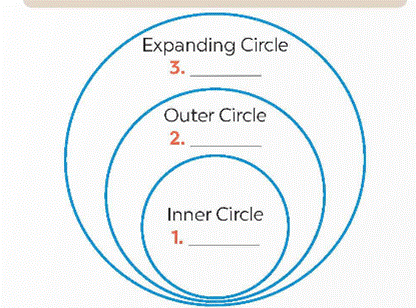
Answer:
1. The UK, New Zealand
2. Singapore
3. Vietnam, Russia, Malaysia
Now read the text quickly to check your answers.
2. Read the text and choose the correct answer A, B, C, or D.
Braj Kachru was a Professor of Linguistics who invented the term 'World Englishes'. The term refers to the fact that English has become a global means of communication with a lot of varieties.
In 1985, Kachru proposed a model of the different uses of English around the world. There are three concentric circles in the model.
The first of these circles is the Inner Circle, which consists of the traditional English- speaking countries, such as the UK, the USA, Australia, New Zealand, and Canada. In these regions, English is the first language, and their speakers provide the standards of English.
The next circle is the Outer Circle where English is not the first language but the second or official language. The countries in this circle include India, Singapore, the Philippines, Pakistan, Malaysia, etc. The speakers of these places follow the standards which the countries in the Inner Circle provide.
The last circle is the Expanding Circle. People in this circle speak English as a foreign language. Some of the countries in the Expanding Circle are Brazil, Japan, Russia, and Viet Nam. Speakers of English in these places follow the rules which the people in the Inner Circle have established.
1. What is the text mainly about?
A. Professor Braj Kachru.
B. The three circles of World Englishes.
C. Native speakers of English.
D. The development of English.
2. The word "model" in paragraph 2 means.
A. an excellent person
B. an example to copy
C. a small copy of something
D. a description of a system
3. The phrase "this circle" in paragraph 5 refers to the
A. model
B. Inner Circle
C. Outer Circle
D. Expanding Circle
Answer:
1. B. The three circles of World Englishes (Explanation: The first of these circles is the Inner Circle…..; The next circle is the Outer Circle….; The last circle is the Expanding Circle)
2. D. A description of a system (Explanation: In 1985, Kachru proposed a model of the different uses of English around the world. There are three concentric circles in the model)
3. D. Expanding Circle (Explanation: The last circle is the Expanding Circle. People in this circle speak English as a foreign language)
3. Read the text again and fill in each blank in the summary with no more than TWO words.
Kachru’s Model
Inner Circle | - English is the (1)_____________. - Countries: The UK, the USA, Australia, etc. - Speakers provide the standards |
Outer Circle | - English is the second or (2) _____ language - Countries: India, Singapore, the Philippines, etc. - Speakers (3) _____ the standards |
Expanding Circle | - English is a (4) ________ - Countries: Brazil, Russia, Vietnam, etc. - Speaker follow the (5) _______ established. |
Answer:
1. First - English is the (1) first language (Explanation: In these regions, English is the first language, and their speakers provide the standards of English.)
2. official - English is the second or (2) official language (Explanation: The next circle is the Outer Circle where English is not the first language but the second or official language)
3. follow - Speakers (3) follow the standards (Explanation: The speakers of these places follow the standards which the countries in the Inner Circle provide.)
4. foreign - English is a (4) foreign language (Explanation: People in this circle speak English as a foreign language)
5. rules - Speakers follow the (5) rules established (Explanation: Speakers of English in these places follow the rules which the people in the Inner Circle have established.)
SPEAKING
4. Work in pairs. Read the following words. What do all the words have in common?
banh mi, sushi, robot, plano, kung fu
Answer:
- All the words you listed are loanwords.
- A loanword is a word that is adopted from another language and incorporated into the vocabulary of a new language.
+ banh mi: Borrowed from Vietnamese
+ sushi: Borrowed from Japanese
+ robot Borrowed from Czech ("robota", meaning "drudgery")
+ plano : Borrowed from Spanish
+ kung fu: Borrowed from Chinese
5. Work in groups. Discuss and write the meaning / explanation of each word and choose the language of origin for each word from the given list. Then present your answers to the class.
Chinese - Japanese Vietnamese - Italian - Czech
Words | Meaning/Explanation | Language of origin |
banh mi | A type of Vietnamese sandwich filled with cold meats, páté, and vegetables | Vietnamese |
sushi |
|
|
kung fu |
|
|
robot |
|
|
piano |
|
|
Answer:
Words | Meaning/Explanation | Language of origin |
banh mi | A type of Vietnamese sandwich filled with cold meats, páté, and vegetables | Vietnamese |
sushi | A Japanese dish consisting of vinegared rice combined with various ingredients such as seafood, vegetables, and occasionally tropical fruits | Japanese |
kung fu | A Chinese martial art and a form of self-defense or attack widely practiced for its health benefits and training of the mind and body | Chinese |
robot | A machine capable of carrying out complex series of actions automatically, especially one programmable by a computer | Czech |
piano | A large keyboard musical instrument with a wooden case enclosing a soundboard and metal strings, played by pressing keys that cause hammers to strike the strings | Italian |
SKILL 2
LISTENING
1. Work in pairs. Look at the pictures and answer the questions.
1. What is the person in each picture doing?
2. How can these activities help them learn English?

Answer:
Picture a:
Activity: The person is using a dictionary to finding/ learning a new words
How it helps: Using a dictionary helps expand vocabulary and understanding of word meanings, pronunciation, and usage. It also aids in learning synonyms, antonyms, and example sentences, which are crucial for language development.
Picture b:
Activity: The person is doing exercises.
How it helps: Completing exercises reinforces grammar rules, vocabulary sentence structure, and skills listening, reading, writing. It provides practice in applying language concepts, helps identify areas needing improvement, and enhances overall language proficiency through repeated practice and application.
2. Listen to Trang talking. Decide if the statements are true (T) or false (F).
| T | F |
1. Trang has studied English for seven years. |
|
|
2. She talks about how she has learnt English vocabulary and grammar. |
|
|
3. She has learnt new words from reading English books. |
|
|
4. She is confident about her English vocabulary now. |
|
|
Answer:
1. F 2. F 3. T 4. T
3. Listen again and fill in each blank with no more than TWO words
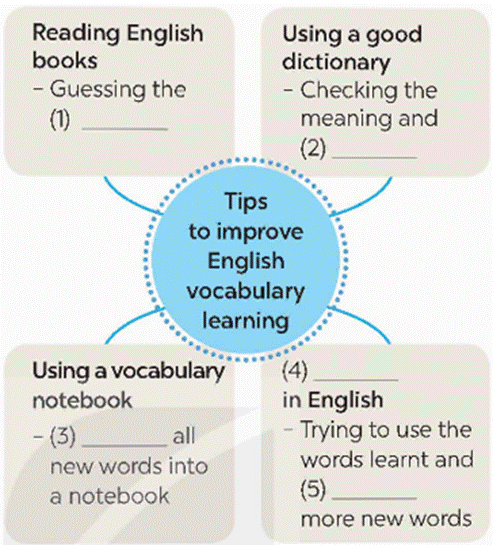
Answer:
1. meaning
2. pronunciation
3. copying
4. speaking
WRITING
4. Work in pairs. Discuss the questions below.
1. What is the thing you find most challenging when learning English?
2. What have you done to improve it?
Answer:
1. For me, the most challenging thing when learning English is probably pronunciation. English has so many different sounds, and they can vary quite a bit depending on regional accents. Sometimes it's hard to know if I'm saying a word correctly or not.
2. To improve my pronunciation, I've tried some ways. First, I practice listening to English everyday through videos or podcasts. I try to mimic their pronunciation and pay attention to the way they form sounds. I've also practiced with tongue twisters and used pronunciation apps or websites that provide feedback on my speaking. Additionally, I've found it helpful to work with a language partner or tutor who can give me guidance and correct my mistakes.
5. Write a paragraph (100-120 words) about the most challenging thing you face when learning English and what you have done to improve it.
You can start your paragraph as follows:
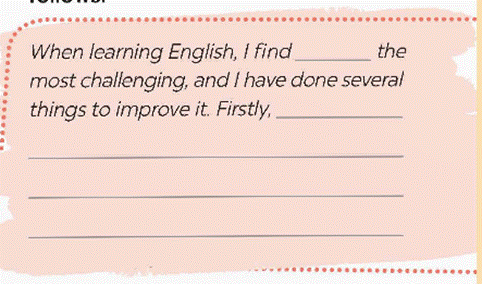
Answer:
When learning English, I find English grammar the most challenging. Because English grammar can be intricate, with numerous exceptions and nuances that can be overwhelming to grasp. To overcome this problem, I have done several things to improve it. Firstly, I've dedicated ample time to studying grammar rules systematically, using textbooks, online resources, and language learning apps. Additionally, I've actively engaged in practice exercises and quizzes to reinforce my understanding. Seeking feedback from language tutors or native speakers has also been invaluable, as they provide insights into common mistakes and offer tailored guidance. Through consistent practice and feedback, I've gradually enhanced my proficiency in English grammar, enabling me to communicate more effectively.
LOOKING BACK
VOCABULARY
1. Fill in each blank with a word from the box.
bilingual mean immigrants concentric fluent |
1. What does this word ______ in English?
2. The Kachru's model has three.__________ circles.
3. The little boy talks to his mum in Vietnamese and to his dad in English. He's ______
4. Many children in this area are _________ English speakers, but they can't write in English.
5. The number of __________ in this country has increased quickly for the last three years.
Answer:
1. mean - What does this word mean in English?
2. concentric - The Kachru's model has three concentric circles.
3. bilingual. - The little boy talks to his mum in Vietnamese and to his dad in English. He's bilingual.
4. fluent - Many children in this area are fluent English speakers, but they can't write in English.
5. immigrants - The number of immigrants in this country has increased quickly for the last three years.
2. Choose the correct answer A, B, C, or D to complete each sentence.
1. My students usually go_______ their homework before they hand it in.
A. into
B. over
C. in
D. up
2. Do you know how many. _____________ of English are there?
A. grammars
B. vocabulary
C. varieties
D. official languages
3. For homework, please copy these English sentences _____ your notebook.
A. into
B. over
C. on
D. up
4. She's good at ______ English short stories into Vietnamese.
A. translating
B. picking
C. looking
D. copying
5. After living in Singapore for several years, she has _____ up some Singaporean English.
A. copied
B. gone
C. looked
D. picked
Answer:
1. B - My students usually go over their homework before they hand it in.
2. C - Do you know how many varieties of English are there?
3. A - For homework, please copy these English sentences into your notebook.
4. A - She's good at translating English short stories into Vietnamese.
5. D - After living in Singapore for several years, she has picked up some Singaporean English.
GRAMMAR
3. Read each sentence and circle the relative pronoun which can be omitted.
1. These are the words which are the same in both British English and American English.
2. English is the language which people use the most in the world.
3. The boy who is giving a presentation in English on the stage is my student.
4. Spanish is the language which has the second largest number of native
speakers.
5. The exchange student who we invited to join our club comes from the Philippines, so his English is so good
Answer:
- The relative pronouns that can be omitted in these sentences are:
1. which (These are the words that are the same in both British English and American English.)
2. which (English is the language that people use the most in the world.)
=> Because the relatives pronouns is role as objective in sentences
- However, in sentences 3, 4, and 5, the relative pronouns cannot be omitted because they are the subjects of their respective clauses.
3. The boy who is giving a presentation in English on the stage is my student.
4. Spanish is the language which has the second largest number of native 5. speakers. (Which can be omitted here because it's the object of the verb "has".)
5. The exchange student who we invited to join our club comes from the Philippines, so his English is so good.
4. Combine the two sentences, using a relative pronoun. Start the new sentence with the given phrase.
1. The English-English dictionary is on the table. My dad gave it to me last year.
→ The English-English dictionary.________________________________
2. She used some words in her speech. These words are from French.
→ She used some ______________________________________________
3. He has learnt English on a website. I recommended the website to him two years ago.
→He has learnt________________________________________________
4. Some languages have a lot of speakers. English is one of them..
→English is one of_____________________________________________
5. My sister is learning English at a language centre. It has the best teachers in our town.
→ My sister is learning__________________________________________
Answer:
1. The English-English dictionary is on the table. My dad gave it to me last year.
→ The English-English dictionary that my dad gave me last year is on the table.
2. She used some words in her speech. These words are from French.
→ She used some words which are from French in her speech.
3. He has learnt English on a website. I recommended the website to him two years ago
→ He has learnt English on a website that I recommended to him two years ago.
4. Some languages have a lot of speakers. English is one of them..
→ English is one of the languages that have a lot of speakers
5. My sister is learning English at a language centre. It has the best teachers in our town.
→ My sister is learning English at a language centre which has the best teachers in our town.
PROJECT
English around the world
Work in groups.
1. Choose a country where people use English as a second or an official language.
Answer:
Country: India where English is used as second language.
2. Collect information about:
- its number of English speakers
- any other languages its people speak
- the roles of English in the country
Answer:
- Number of English speakers: India has approximately 125 million English speakers. This includes those who speak English fluently and those who use it as a second language.
- Other languages spoken: India is a linguistically diverse country with 22 officially recognized languages, including Hindi, Bengali, Telugu, Marathi, Tamil, Urdu, Gujarati, Malayalam, Kannada, Odia, Punjabi, and Assamese. Additionally, there are hundreds of other languages and dialects spoken across the country.
- Roles of English in the country: English plays a significant role in India. English is extensively used in business, education, law, and government administration. It serves as a lingua franca, facilitating communication between people from different linguistic backgrounds. English is also the medium of instruction in many schools and universities, and it is crucial for higher education and professional opportunities. In the media, English newspapers, television channels, and online platforms are widely consumed.
3. Make a poster about this country.
Answer:
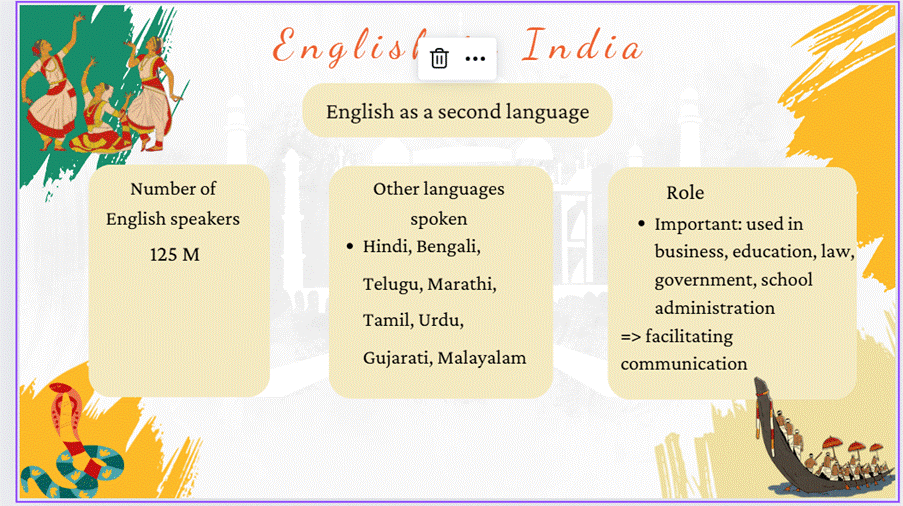
4. Present your group's poster to the class.
Answer:
India is a country with approximately 125 million English speakers, encompassing those who speak English fluently and those who use it as a second language. As a linguistically diverse nation, India boasts 22 officially recognized languages, including Hindi, Bengali, Telugu, Marathi, Tamil, Urdu, Gujarati, Malayalam, Kannada, Odia, Punjabi, and Assamese, among many others. English plays a significant role in India, serving as one of the two official languages of the central government, alongside Hindi. It is extensively used in business, education, law, and government administration, acting as a lingua franca that bridges communication gaps between different linguistic groups. English is the medium of instruction in numerous schools and universities, making it essential for higher education and professional opportunities. Additionally, English is prevalent in the media, with newspapers, television channels, and online platforms widely consumed by the population.
Tài liệu cùng môn học
Tài liệu khác
- Trắc nghiệm tiếng anh 2 Family and Friends
- Trắc nghiệm tiếng anh 2 Explore our world
- Trắc nghiệm tiếng anh 3 Family and Friends
- Trắc nghiệm tiếng anh 3 Explore our world
- Trắc nghiệm tiếng anh 4 Family and Friends
- Trắc nghiệm tiếng anh 4 Global Success
- Trắc nghiệm tiếng anh 4 Explore our world
- Trắc nghiệm tiếng anh 5 Family and Friends
- => Xem nhiều môn hơn