Giải Tiếng Anh 9 kết nối: Unit 12 Career choices
Hướng dẫn giải Tiếng Anh 9 kết nối tri thức: Giải Unit 12 Career choices. Bài được giải chi tiết, rõ ràng, dễ hiểu. Bài giải giúp học sinh nắm vững kiến thức trong sách giáo khoa, rèn kĩ năng giải bài tập và có phương pháp học tập hiệu quả.
Nội dung chi tiết
UNIT 12: CAREER CHOICES
GETTING STARTED
What will you do in the future?
1. Listen and read.
Mi: Did you attend the career orientation session yesterday?
Nick: No, I didn't. I had to complete my project. How was it?
Mi: It was really informative. There were three guest speakers from vocational colleges. They introduced their job training courses for lower secondary leavers.
Nick: My teacher told us that if we didn't like academic subjects, we should apply for courses which would prepare us for a job such as mechanic, hairdresser, or garment worker. That way, we could start working and earn a living earlier.
Mi: My cousin did that. He learnt bartending after finishing grade 9. Now he's a skilful bartender and makes lots of money.
Nick: And you? What will you be in five years from now?
Mi: Well, I'll be studying at a teachers' college because I want to be a teacher. How about you?
Nick: I'll be a fashion designer.
Mi: You really want to be a fashion designer?
Nick: Yeah. My art teacher says I have such a good sense of style that I should get formal training in fashion design after high school.
Mi: Hope you'll achieve your dream.
Nick: Thanks. I think we should know our passions and abilities to make a good career choice.
2. Read the conversation again and answer the following questions.
1. Where did the guest speakers come from?
2. According to Nick's teacher, who should apply for vocational courses?
3. What did Mi's cousin do after finishing grade 9?
4. What quality does a fashion designer need to have?
5. What do we need to know to make a good career choice?
Answer:
1. The guest speakers came from vocational colleges. (Explanation: There were three guest speakers from vocational colleges)
2. According to Nick's teacher, students who don't like academic subjects should apply for vocational courses. (Explanation: My teacher told us that if we didn't like academic subjects, we should apply for courses which would prepare us for a job such as mechanic, hairdresser, or garment worker)
3. Mi's cousin learned bartending after finishing grade 9 (Explanation: My cousin did that. He learnt bartending after finishing grade 9. Now he's a skilful bartender and makes lots of money.)
4. A fashion designer needs to have a good sense of style. (Explanation: Yeah. My art teacher says I have such a good sense of style that I should get formal training in fashion design after high school.)
5. We need to know our passions and abilities to make a good career choice. (Explanation: Thanks. I think we should know our passions and abilities to make a good career choice.)
3. Match the words and phrases in the conversation with their pictures.
1. bartender
2. fashion designer
3. garment worker
4. hairdresser
5. mechanic
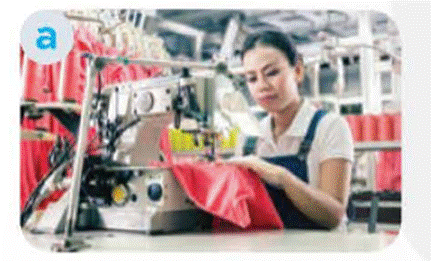

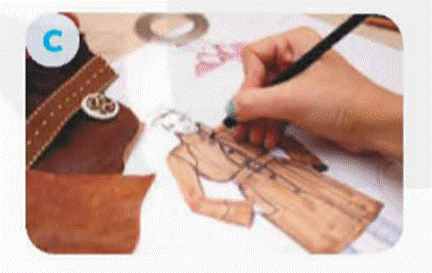

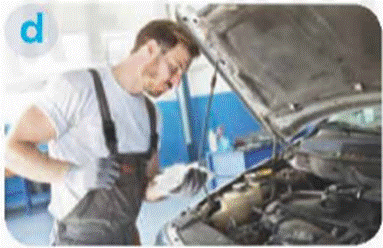
Answer:
1. b - bartender
2. c - fashion designer
3. a - garment worker
4. e - hairdresser
5. d – mechanic
4. Choose the correct answer A, B, C, or D to complete each sentence.
1. Subjects like maths, physics, English, and literature are called_____subjects.
A. theoretical
B. art
C. academic
D. physical
2. She earns a________ by selling home-made foods.
A. life
B. salary
C. money
D. living
3. He went to college to get __________training in business management.
A. life-long
B. informal
C. formal
D. online
4. Finding a _________ job in big cities is rather difficult.
A. teacher
B. teaching
C. taught
D. teach
5. Career __________ programmes are useful because they help students make good decisions about their future jobs.
A. orientation
B. pressure
C. tradition
D. income
Answer:
1. C - Subjects like maths, physics, English, and literature are called academic subjects
2. D - She earns a living by selling home-made foods
3. C - He went to college to get formal training in business management.
4. B - Finding a teaching job in big cities is rather difficult.
5. A - Career orientation programmes are useful because they help students make good decisions about their future jobs.
5. GAME Guess my job.
Work in two groups. Take turns to explain and guess the jobs the teacher shares. The group with more correct answers wins.
Example: (T shows a picture of a mechanic)
Group members: This person works in a garage. He repairs cars or motorbikes.
Student A: A mechanic.

Answer:
Phụ thuộc vào giáo viên sẽ đưa ra tranh, ảnh về nghề nghiệp gì.
A CLOSER LOOK 1
VOCABULARY
1. Match the jobs in A with their descriptions in B to make complete sentences.
A | B |
1. A tailor | a. receives and pays out money in a shop, bank, restaurant, etc. |
2. A surgeon
| b. performs a particular task in the process of making a product in a factory. |
3. An assembly worker | c. designs and develops computer software.
|
4. A cashier
| d. performs medical operations.
|
5. A software engineer | e. makes clothes.
|
Answer:
1. e - A tailor: makes clothes
2. d - A surgeon: performs medical operations.
3. b - An assembly worker: performs a particular task in the process of making a product in a factory.
4. a - A cashier: receives and pays out money in a shop, bank, restaurant, etc.
5. c - A software engineer: designs and develops computer software.
2. Choose the correct answer A, B, C, or D to complete each sentence.
1. My brother is applying for a _______ as a customer manager in a supermarket.
A. job
C. career
B. duty
D. work
2. Mr Hoang was a police officer. He had a successful______ in the police force.
A. work
B. job
C. career
D. task
3. A cashier has to do __________ tasks, such as receiving money and printing receipts.
A. effective
B. creative
C. decisive
D. repetitive
4. A tailor can have a _________ job if he/she is creative and knowledgeable about fabric.
A. boring
B. basic
C. well-paid
D. difficult
5. A surgeon's job is_________. He/She works long hours and occasionally deals with life-and-death situations.
A. easy
B. demanding
C. rewarding
D. stress-free
Answer:
1. A - My brother is applying for a job as a customer manager in a supermarket.
2. C - Mr Hoang was a police officer. He had a successful career in the police force.
3. D - A cashier has to do repetitive tasks, such as receiving money and printing receipts
4. C - A tailor can have a well-paid job if he/she is creative and knowledgeable about fabric.
5. B - A surgeon's job is demanding. He/She works long hours and occasionally deals with life-and-death situations.
3. Complete the texts, using the words from the box.
demanding repetitive software engineer well-paid assembly worker |
Mr Lam: I'm a(n) (1)___________ . I design and develop programmes for computers. My job is (2) _________. I work long hours on the computer, especially when deadlines approach. However, it's a ______ job, so I'm happy with it.
Ms Nga: I'm a(n) (4)________. I'm in charge of sticking labels on the products.
Besides basic skills, I must be able to stand for a long time and do (5)_______ tasks at a reasonable speed.
Answer:
1. software engineer - I'm a(n) software engineer
2. demanding - My job is demanding.
3. well-paid - However, it's a well-paid job, so I'm happy with it.
4. assembly worker - I'm a(n) assembly worker
5. repetitive - Besides basic skills, I must be able to stand for a long time and do repetitive tasks at a reasonable speed.
PRONUNCIATION
Intonation in statements used as questions
4. Listen to the conversations. Pay attention to the intonation in the statement questions. Then practice the conversations with a partner.
1. Minh: It's 4:20 now. I must go. Hoa: It's 4:20? Oh dear, I must go, too! |
2. Mai: Mum, Ms Lan has invited you to a party. Mother: She invited me to a party? |
Answer:
1. Minh: It's 4:20 now. I must go. ➘ Hoa: It's 4:20?➚ Oh dear, I must go, too!➘ |
2. Mai: Mum, Ms Lan has invited you to a party.➘ Mother: She invited me to a party?➚ |
5. Complete each conversation with a statement question. Then practise the conversations with a partner. Pay attention to the intonation of each sentence.
1. Nick: Minh is very happy with the vocational test. Trang: ______ ? He told me something different. |
2. Elena: I want to become a surgeon. Tom: _______ ? Do you have skillful hands? |
Answer:
1. Nick: Minh is very happy with the vocational test.➘ Trang: He is happy with the vocational test ?➚ He told me something different.➘➘ |
2. Elena: I want to become a surgeon.➘ Tom: You want to become a surgeon?➚ Do you have skillful hands?➚ |
A CLOSER LOOK 2
GRAMMAR
Adverbial clauses of concession, result, and reason
1. Choose the correct word to complete each sentence.
1. Although / But footballers are well-paid, they have short careers.
2. She still applied for the job so/though she had almost no chance to get it.
3. Although/However she went to the cinema early, she couldn't buy the ticket.
4. She has to do repetitive tasks in her job, although/ but she still likes it.
5. Though / But Mike felt tired, he managed to finish his homework.
Answer:
1. Although - Although footballers are well-paid, they have short careers.
2. though - She still applied for the job though she had almost no chance to get it.
3. Although - Although she went to the cinema early, she couldn't buy the ticket.
4. but - She has to do repetitive tasks in her job, but she still likes it.
5. though - Though Mike felt tired, he managed to finish his homework.
2. Complete the sentences with so or such.
1. The factory was _______ far from his home that he couldn't go there to work.
2. Katie was _______a lazy worker that no manager wanted to hire her.
3. They are _______ creative designers that everyone admires them.
4. Can you speak louder? Your voice is ______ soft that I can't hear you.
5. He is ______ a handsome man that many people think he could be an actor.
Answer:
1. so - The factory was so far from his home that he couldn't go there to work.
2. such - Katie was such a lazy worker that no manager wanted to hire her.
3. such - They are such creative designers that everyone admires them.
4. so - Can you speak louder? Your voice is so soft that I can't hear you.
5. such - He is such a handsome man that many people think he could be an actor.
3. Join the sentences, using the given words in brackets.
1. Jenny didn't attend the job fair. She was ill. (because)
________________________________________________________________
2. Henry is excellent at maths. Everyone thinks he will become a mathematician. (since)
________________________________________________________________
3. Mai practised speaking English a lot. She wanted to get a high score on the
speaking test. (because)
________________________________________________________________
4. Ms Nga is away this week. We'll put off the next class meeting. (since)
________________________________________________________________
5. I couldn't go to the office on time. There was a traffic jam. (because)
________________________________________________________________
Answer:
1. Jenny didn't attend the job fair. She was ill. (because)
→ Jenny didn't attend the job fair because she was ill.
2. Henry is excellent at maths. Everyone thinks he will become a mathematician. (since)
→Since Henry is excellent at maths, everyone thinks he will become a mathematician.
3. Mai practised speaking English a lot. She wanted to get a high score on the
speaking test. (because)
→Mai practised speaking English a lot because she wanted to get a high score on the speaking test.
4. Ms Nga is away this week. We'll put off the next class meeting. (since)
→ Since Ms Nga is away this week, we'll put off the next class meeting.
5. I couldn't go to the office on time. There was a traffic jam. (because)
→I couldn't go to the office on time because there was a traffic jam.
4. Rewrite each sentence. Use the given word in brackets.
1. I forgot to bring money, so I couldn't buy the career guidebook. (because)
→ I couldn't___________________________________________________
2. My navigation skill is very bad. I could never work as a taxi driver. (so)
→ I'm________________________________________________________
3. Sally couldn't use the computer. There was a power cut. (since)
→Since_______________________________________________________
4. She had a university degree, but she couldn't find a good job. (although)
→ Although ___________________________________________________
5. The florist was very skillful. Her flower shop attracted many customers. (such)
→ She was___________________________________________________
Answer:
1. I forgot to bring money, so I couldn't buy the career guidebook. (because)
→ I couldn't buy the career guidebook because I forgot to bring money.
2. My navigation skill is very bad. I could never work as a taxi driver. (so)
→ I'm so bad at navigation that I could never work as a taxi driver.
3. Sally couldn't use the computer. There was a power cut. (since)
→ Since there was a power cut, Sally couldn't use the computer.
4. She had a university degree, but she couldn't find a good job. (although)
→ Although she had a university degree, she couldn't find a good job.
5. The florist was very skillful. Her flower shop attracted many customers. (such)
→ She was such a skillful florist that her flower shop attracted many customers.
5. Complete the sentences with your own ideas. Then exchange them with a partner.
1. Although my sister is a fashion designer,
_______________________________________________________________
2. I want to become a pilot because
_______________________________________________________________
3. My father has such a hard job that
_______________________________________________________________
4. Since most vocational courses take a short time to finish,
_______________________________________________________________
5. The garment worker felt so bored that
_______________________________________________________________
Answer:
1. Although my sister is a fashion designer,
→ Although my sister is a fashion designer, she prefers wearing simple and comfortable clothes.
2. I want to become a pilot because
→ I want to become a pilot because I have always been fascinated by flying and love the idea of traveling the world to different destinations
3. My father has such a hard job that
→ My father has such a hard job that he often comes home exhausted.
4. Since most vocational courses take a short time to finish,
→ Since most vocational courses take a short time to finish, students can quickly enter the workforce and start earning money.
5. The garment worker felt so bored that
→ The garment worker felt so bored that she started looking for a more challenging and creative job.
COMMUNICATION
Everyday English
Expressing hope and responding
1. Listen and read the conversations below. Pay attention to the highlighted parts.
1. Minh: I've filled in the registration form. Hopefully, I'll be a member of the science club. Duong: I hope so, too. |
2. Student: Here's my teacher's reference letter. I hope I'll get the job. Staff: Thank you. Good luck. |
Answer:
1. Minh: I've filled in the registration form. Hopefully, I'll be a member of the science club. (Mình đã điền vào mẫu đăng ký. Hy vọng mình sẽ là thành viên của câu lạc bộ khoa học.) Duong: I hope so, too. ( Mình cũng hy vọng vậy) |
2. Student: Here's my teacher's reference letter. I hope I'll get the job. (Đây là thư giới thiệu của giáo viên tôi. Em hy vọng em sẽ nhận được việc.) Staff: Thank you. Good luck. (Cảm ơn. Chúc may mắn) |
2. Work in pairs. Make similar conversations with the following situations.
1. A friend has just taken part in a design competition. She is looking forward to the result.
2. A teacher is asking a student to give a teacher-parent conference invitation to his/her parents. She hopes that the parents will come.
Answer:
1.
A: I've submitted my design for the competition. I really hope I win.
B: I hope so too. Your design is amazing, so I'm sure you have a good chance.
2.
Teacher: Please take this invitation for the teacher-parent conference and give it to your parents. I hope they can come.
Student: I'll make sure to give it to them. I hope they can make it too.
What’s your future job?
3. Work in pairs. Read about the jobs that Khang and An want to do. Then complete the summary table.
Khang: I've always dreamt of this job. I'll enter a medical university. This seems to be a suitable job for me because I have good hand-eye coordination. Besides, I'm calm and decisive, so I can lead a surgical team. |
An: I hope I can do this job as soon as possible. I've got hands-on training on how to use the scanner and calculator. I can do this job well because I have good basic maths skills. I'm patient and helpful to customers even when the store is busy. |
| Training | Skills | Personal qualities |
Khang | (1) _____ degree | hand -eye coordination | (2) _____ and decisive |
An | (3) _____ Training | using some equipment having basic (4) _____ | patient and (5) _______ |
Answer:
(1) - medical (Explanation: I've always dreamt of this job. I'll enter a medical university.)
(2) - Calm (Explanation: Besides, I'm calm and decisive, so I can lead a surgical team.)
(3) - Hands-on (Explanation: I've got hands-on training on how to use the scanner and calculator)
(4) - Maths (Explanation: I can do this job well because I have good basic maths skills)
(5) - Helpful (Explanation: I'm patient and helpful to customers even when the store is busy.)
4. Work in pairs. Look at the jobs below. Which job might be appropriate for each person in 3? Explain your choice.
1. surgeon
2. mechanic
3. nurse
4. cashier
Answer:
- For Khang, the job of a surgeon might be appropriate. He mentioned having good hand-eye coordination and being calm and decisive, which are important qualities for a surgeon who performs delicate operations and needs to make quick decisions in critical situations.
- For An, the job of a cashier might be suitable. An mentioned having hands-on training on using equipment and having good basic math skills. These are essential qualities for a cashier who operates cash registers and handles transactions, requiring accuracy and efficiency. Additionally, An mentioned being patient and helpful to customers, which are valuable attributes for a cashier dealing with various customer interactions throughout the day.
5. Work in groups. Think of a job that you like or know well. Discuss the type of training, skill(s), and personal qualities which are necessary for it.
Now present your group's ideas and have the class guess the job you are
describing.
Answer:
Let's talk about the job of a software engineer.
For a software engineer, a strong foundation in computer science or a related field is essential. This typically requires a degree in computer science, software engineering, or a similar discipline. The type of training required often involves formal education at a university or college, where students learn programming languages, algorithms, data structures, software development methodologies, and other relevant concepts.
In terms of skills, a software engineer needs to be proficient in programming languages such as Python, Java, C++, or JavaScript, depending on the specific requirements of the job. They should have problem-solving skills to analyze complex problems and devise effective solutions through code. Additionally, they need strong analytical and critical thinking abilities to debug and optimize software applications.
Personal qualities that are necessary for a software engineer include attention to detail, patience, and perseverance. Writing code requires meticulous attention to detail to avoid errors and bugs. Software development projects can be challenging and require patience to overcome obstacles and setbacks. Perseverance is also important because debugging code and troubleshooting issues can sometimes be time-consuming and frustrating.
SKILL 1
READING
1. Look at the jobs below and answer the questions
1. Which job is most repetitive?
2. Which job relates to beauty?
3. Which job depends heavily on technology?
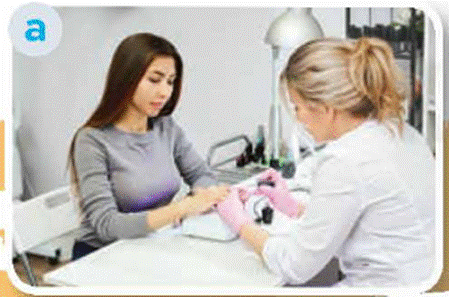


Answer:
1. c - Receptionist
2. a - Manicurist
3. b - Online teacher
2. Read the article and do the tasks that follow.
When you turn 15, you should start thinking seriously about your career. However, making career choices can be challenging, especially in this changing world.
1. Assembly workers and ticket sellers, whose jobs are repetitive, are being replaced by machines. However, technology has also created new jobs, such as software engineers and online teachers. Besides, beauty jobs like nail artists and hairdressers are becoming popular because people want to take better care of themselves.
2. Computer skills have become a must for many jobs. For example, doctors need to keep digital medical records of their patients. People also collaborate with each other so often that teamwork and communication skills are now increasingly important.
3. Many teenagers are willing to take vocational courses instead of going to university. Training can be both face-to-face and online. Opportunities to learn new skills are open to everyone provided that they have inquiring minds. In the future, there may be even more changes in the world of work. It's a good idea for you to work well in teams, keep on learning and have good computer skills. By doing so, you can move confidently on your career path.
a. Which number (1-3) does each sentence (A- C) below fit in? Tick(v) the correct number for each sentence.
| 1 | 2 | 3 |
A. The skills needed for the jobs are changing, too.
|
|
|
|
B. The preferred type of training is also changing. |
|
|
|
C. The kinds of jobs people are doing are changing. |
|
|
|
Answer:
1. C. The kinds of jobs people are doing are changing.
2. A. The skills needed for the jobs are changing, too.
3. B. The preferred type of training is also changing.
b. Which of the following is the best title for the article?
A. The changing world of work
B. How to choose your career path
C. Making good job decisions
Answer:
The best title for the article is:
A. The changing world of work
3. Read the article again and tick (v) T(True) or F (False)
| T | F |
1. Teenagers should consider their career paths as soon as they reach 18 |
|
|
2. A nail artist is an example of a job created by technology. |
|
|
3. In many jobs, people need to be able to use computers well. |
|
|
4. People can get job training in more ways than they could in the past. |
|
|
5. There will be fewer changes in the world of work in the future. |
|
|
Answer:
1. F - Teenagers should consider their career paths as soon as they reach 18 (Explanation: When you turn 15, you should start thinking seriously about your career)
2. F - A nail artist is an example of a job created by technology (Explanation: Besides, beauty jobs like nail artists and hairdressers are becoming popular because people want to take better care of themselves.)
3. T - In many jobs, people need to be able to use computers well.(Explanation: Computer skills have become a must for many jobs)
4. T - People can get job training in more ways than they could in the past (Explanation: Training can be both face-to-face and online)
5. F - There will be fewer changes in the world of work in the future (Explanation: In the future, there may be even more changes in the world of work)
SPEAKING
4. Complete the conversation with the sentences from the box. Then practise it with a partner.
A. You're creative and fashionable. You're good at persuading other people, too. B. What skills do you need for the job? C. What job do you think you'll do in the future? D. Why do you like this job? |
Ben: (1)______
Hoa: I want to be a hairdresser.
Ben: Interesting! (2)_______
Hoa: Well, I'm keen on creating new hairstyles. I can also earn a good living because it's a well-paid job.
Ben: (3)______
Hoa: Though there are many skills, I think hair cutting and colouring are the most important.
Ben: You'll do that job well. (4)_________
Hoa: Thanks. I hope I'll be such a successful hairdresser that I'll have my
own hair salon someday.
Answer:
1. C - What job do you think you'll do in the future?
2. D - Why do you like this job?
3. B - What skills do you need for the job?
4. A - You're creative and fashionable. You're good at persuading other people, too.
5. Work in pairs. Make similar conversations about the job you want to do in the future. Then report your conversation to the class.
You may use the following template for your report:
My partner is... She wants to be a … because ... She'll need to learn many skills, such as... She'll do the job well since… She hopes that one day, she'll ...
Answer:
Ben: What job do you think you'll do in the future?
Anna: I want to be a software engineer.
Ben: Interesting! Why do you like this job?
Anna: Well, I love coding and solving problems. Plus, it's a high-demand field with great earning potential.
Ben: What skills do you need for the job?
Anna: I'll need to learn many skills, such as programming languages, software development, and debugging.
Ben: You'll do that job well. You're detail-oriented and analytical. You're good at finding solutions, too.
Anna: Thanks. I hope I'll be such a successful software engineer that I'll create my own tech startup someday.
Report
My partner is Anna. She wants to be a software engineer because she loves coding and solving problems. She'll need to learn many skills, such as programming languages, software development, and debugging. She'll do the job well since she's detail-oriented, creative, and has strong analytical skills. She hopes that one day, she'll create her own successful tech startup and develop innovative software solutions for everyday problems.
SKILL 2
LISTENING
1. Work in pairs. Which of the reasons below is the most important to you when choosing a job?
1. passion
2. family tradition
3. ability
4. salary
5. opportunity to travel
Answer:
A: Which of the reasons below is the most important to you when choosing a job?
B: For me, passion is the most important reason. I believe that if you love what you do, you'll be more motivated and happier in your career. What about you?
A: I think ability is the most important. If you have the right skills and talents for a job, you're more likely to succeed and enjoy it. Plus, being good at something can also lead to better opportunities and higher salaries.
B: That makes sense. Passion and ability often go hand in hand, don't they?
A: Absolutely. It's great if you can find a job that aligns with both your passions and your abilities.
2. Listen to two people talking about their career paths and tick (✔) T (True) or F (False).
| T | F |
1. Minh's parents were farmers. |
|
|
2. Minh is now working for an agricultural company. |
|
|
3. Ann first learnt cooking from a family member. |
|
|
4. Ann is now a chef in a famous restaurant. |
|
|
Answer:
1. T 2. F 3. T 4. F
3. Listen again. Choose the correct answer A, B, or C.
1. Why did Minh decide to learn agriculture engineering?
A. Because he wanted to help the farmers.
B. Because he could get a well-paid job.
C. Because he had no other choice for university.
2. What does Minh's job involve?
A. Using technology in farming.
B. Solving problems among farmers.
C. Creating new kinds of plants.
3. How did Ann earn her cooking certificate?
A. By taking a short course in cooking.
B. By attending a vocational college.
C. By enrolling in an online course.
4. In the future, Ann wants to________
A. work in a hotel restaurant
B. get another cooking certificate
C. open her own restaurant
Answer:
1. A 2. A 3. B 4. C
WRITING
4. Work in pairs. Ask and answer the following questions.
1. What is your favorite job?
2. What does this job involve?
3. What skills does this job need?
4. What personal qualities do you need to have for this job?
Answer:
A: What is your favorite job?
B: My favorite job is being a software developer.
A: What does this job involve?
B: This job involves designing, coding, testing, and maintaining software applications. It also includes working with teams to develop software solutions that meet clients' needs.
A: What skills does this job need?
B: A software developer needs strong programming skills, problem-solving abilities, and knowledge of various programming languages. It's also important to have good analytical skills and attention to detail.
A: What personal qualities do you need to have for this job?
B: You need to be patient, persistent, and have a passion for technology. Good communication skills are also important because you often work in teams and need to explain complex technical issues to non-technical people. What about you? What's your favorite job?
A: I want to be a graphic designer.
B: What does that job involve?
A: It involves creating visual content for various media, including websites, advertisements, magazines, and social media. It requires understanding clients' needs and using design software to create visually appealing and effective designs.
B: What skills does a graphic designer need?
A: A graphic designer needs strong artistic skills, proficiency in design software like Adobe Photoshop and Illustrator, and a good understanding of color theory, typography, and layout. Creativity and the ability to think outside the box are also crucial.
B: What personal qualities are important for a graphic designer?
A: You need to be creative, detail-oriented, and have good communication skills. It's also important to be able to handle constructive criticism and work well under pressure to meet deadlines.
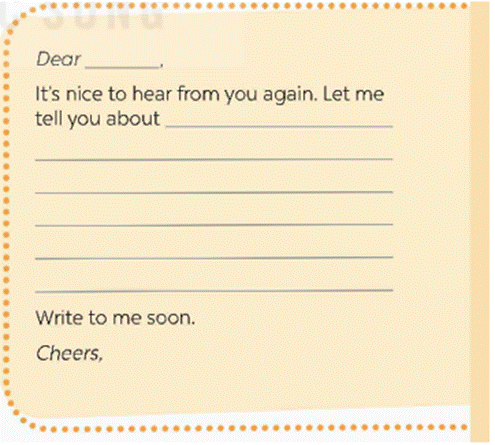
5. Write an email (100 - 120 words) to your friend telling him/her about your future favorite job. You can use the ideas from 4.
Start and end the email as follows:
Answer:
Dear [Friend's Name],
It's nice to hear from you again. Let me tell you about my future favorite job.
I want to be a software developer. This job involves designing, coding, testing, and maintaining software applications. I enjoy problem-solving and working with technology, which makes this career a perfect fit for me. A software developer needs strong programming skills, analytical abilities, and knowledge of various programming languages. Patience, persistence, and good communication skills are also essential because developers often work in teams and need to explain technical issues clearly.
I'm excited about the opportunities this job offers and hope to make a positive impact in the tech industry.
Write to me soon
Cheer,
[Your name]
LOOKING BACK
VOCABULARY
1. Put the words and phrases in the appropriate column.
surgeon repetitive designing teamwork hand-eye coordination | demanding well-paid assembly worker software engineer |
Jobs | Job features | Job skills |
|
|
Answer:
Jobs | Job features | Job skills | |
surgeon assembly worker software engineer | repetitive demanding well-paid | designing hand-eye coordination teamwork | |
2. Complete the text, using words / phrases from the box.
job rewarding | creative sewing | career
|
My mum first learnt (1) ________ skills from my grandmother. She got her (2) _______ as a tailor when she was 16. Now she owns a small tailor shop in the village. She is (3) ______ and hardworking. She has such an excellent sense of style that many ladies love the clothes she makes. Though sometimes she has to work late at night, she finds her job (4)______ because she can satisfy her customers. I think my mum has had a successful (5)_______in tailoring.
Answer:
1. sewing - My mum first learnt sewing skills from my grandmother
2. job - She got her job as a tailor when she was 16. Now she owns a small tailor shop in the village
3. creative - She is creative and hardworking. She has such an excellent sense of style that many ladies love the clothes she makes
4. rewarding - Though sometimes she has to work late at night, she finds her job rewarding because she can satisfy her customers
5. career - I think my mum has had a successful career in tailoring.
GRAMMAR
3. Combine each pair of sentences into one, using the given word in brackets.
1. The salary was low. She accepted the job. (though)
→ She___________________________________________________________
2. My sister is too shy. She can't be an MC. (such)
→ My sister is____________________________________________________
3. Life in the city was too demanding, so he came back to his village. (because)
→ He came______________________________________________________
4. Her backache was too painful. She had to stop working in the factory. (so)
→ Her backache__________________________________________________
5. Clara didn't like academic subjects. Her mum insisted that she go to university. (although)
→ Clara's mum__________________________________________________
Answer:
1. The salary was low. She accepted the job. (though)
→She accepted the job, though the salary was low.
2. My sister is too shy. She can't be an MC. (such)
→ My sister is such a shy person that she can't be an MC.
3. Life in the city was too demanding, so he came back to his village. (because)
→ He came back to his village because life in the city was too demanding.
4. Her backache was too painful. She had to stop working in the factory. (so)
→ Her backache was so painful that she had to stop working in the factory.
5. Clara didn't like academic subjects. Her mum insisted that she go to university. (although)
→ Clara's mum insisted that she go to university, although Clara didn't like academic subjects.
4. Fill in each gap in the text with a conjunction from the box.
although so | because such | since
|
Making career choices is (1) ________ a difficult process that conflicts happen in many families when they discuss their teenager's future career. (2)_______ some parents consider their child's dream job unrealistic, they try to stop him/her from pursuing it. Sometimes, the parents force their child to study for a job which is (3) _______ demanding that he/she feels stressed just (4)______ they overestimate their child's ability. (5)_______ parents want to help their children make good career decisions, they really need to understand their teenaged children's passions and abilities.
Answer:
1. such - Making career choices is such a difficult process that conflicts happen in many families when they discuss their teenager's future career
2. since - Since some parents consider their child's dream job unrealistic, they try to stop him/her from pursuing it
3. so - Sometimes, the parents force their child to study for a job which is so demanding that he/she feels stressed just because they overestimate their child's ability.
4. because - Sometimes, the parents force their child to study for a job which is so demanding that he/she feels stressed just because they overestimate their child's ability
5. Although - Although parents want to help their children make good career decisions, they really need to understand their teenaged children's passions and abilities.
PROJECT
Your future jobs
Work in groups.
1. Choose TWO jobs that members of your group would like to do in the future.
2. Compare the jobs in terms of:
- what they are
- what type(s) of training they require
- what skills and personal qualities you need to do them well
- whether they will be popular in the future
Answer:
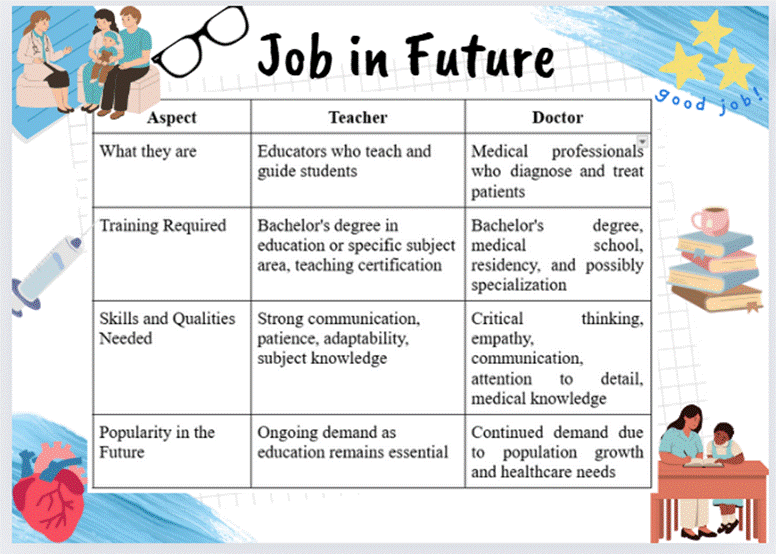
Aspect | Teacher | Doctor |
What they are | Educators who teach and guide students | Medical professionals who diagnose and treat patients |
Training Required | Bachelor's degree in education or specific subject area, teaching certification | Bachelor's degree, medical school, residency, and possibly specialization |
Skills and Qualities Needed | Strong communication, patience, adaptability, subject knowledge | Critical thinking, empathy, communication, attention to detail, medical knowledge |
Popularity in the Future | Ongoing demand as education remains essential | Continued demand due to population growth and healthcare needs |
3. Prepare a poster presentation.
Answer:
4. Present your poster to the class.
Answer:
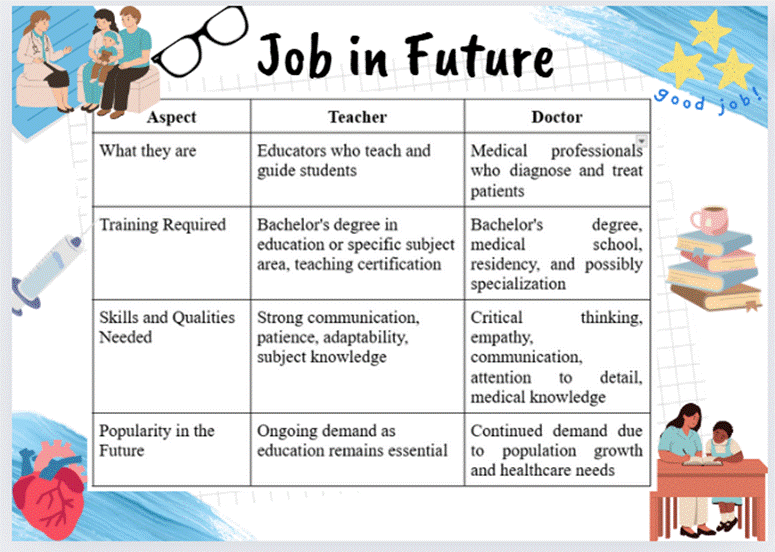
Comparing the professions of Teacher and Doctor reveals fundamental differences in their roles, training, skills, and future prospects. Teachers play a vital role in shaping the future by educating and guiding students. They typically hold bachelor's degrees in education or specific subject areas and often undergo teaching certification. Teachers require strong communication skills, patience, adaptability, and deep subject knowledge to effectively engage with students and facilitate learning. Despite changes in educational approaches and technologies, the demand for teachers remains steady as education continues to be a fundamental aspect of society. On the other hand, doctors are essential medical professionals responsible for diagnosing and treating patients. They undergo extensive training, including a bachelor's degree, medical school, residency, and possibly specialization. Doctors must possess critical thinking skills, empathy, effective communication, attention to detail, and a deep understanding of medical principles. The demand for doctors is expected to persist due to population growth and ongoing healthcare needs. Both teachers and doctors play critical roles in society, contributing to the well-being and advancement of individuals and communities.
Tài liệu cùng môn học
Tài liệu khác
- Trắc nghiệm tiếng anh 2 Family and Friends
- Trắc nghiệm tiếng anh 2 Explore our world
- Trắc nghiệm tiếng anh 3 Family and Friends
- Trắc nghiệm tiếng anh 3 Explore our world
- Trắc nghiệm tiếng anh 4 Family and Friends
- Trắc nghiệm tiếng anh 4 Global Success
- Trắc nghiệm tiếng anh 4 Explore our world
- Trắc nghiệm tiếng anh 5 Family and Friends
- => Xem nhiều môn hơn