Giải Tiếng Anh 9 kết nối: Unit 4 Remembering the past
Hướng dẫn giải Tiếng Anh 9 kết nối tri thức: Giải Unit 4 Remembering the past. Bài được giải chi tiết, rõ ràng, dễ hiểu. Bài giải giúp học sinh nắm vững kiến thức trong sách giáo khoa, rèn kĩ năng giải bài tập và có phương pháp học tập hiệu quả.
Nội dung chi tiết
UNIT 4: Remember the past
GETTING STARTED
At an English lesson
1. Listen and read.
Teacher: Now let's look at what you've done on your projects. Group one first, please.
Mi: OK. This is Angkor Wat in Cambodia. It's a temple complex, the largest religious monument in the world.
Teacher: Fantastic! When did people build it?
Mi: They built it in the 12th century. It's a World Heritage Site. Millions of visitors go there every year.
Teacher: Thank you. I wish I could go there one day too. And now group two, please.
Nam: Our project is about Dinh Bang Communal House in Bac Ninh Province - a national historic site. People were building it for 36 years, and it's about 300 years old!
Teacher: Great! It's quite magnificent! Now group three, please.
Lan: Well, this is Windsor Castle in England. It was built about a thousand years ago. It's been the home for about 40 English kings and queens.
Teacher: Yeah. It's the oldest and largest occupied castle in the world.
Mi Nam: Amazing! So we need to preserve our heritage for future generations.
Teacher: Right. Thanks to preservation efforts, we know a lot about our history and life in the past.
2. Read the conversation again and answer the questions.
1. How old is Angkor Wat?
2. What is Dinh Bang Communal House like?
3. Where is Windsor Castle?
4. What helps us know about our history and life in the past?
Answer:
1. Angkor Wat is about 900 years old.
Explain:
Mi: OK. This is Angkor Wat in Cambodia. It's a temple complex, the largest religious monument in the world.
Teacher: Fantastic! When did people build it?
Mi: They built it in the 12th century. It's a World Heritage Site. Millions of visitors go there every year.
2. Dinh Bang Communal House is a national historic site. It was built for 36 years, and it's about 300 years old! It's quite magnificent.
Explain
Nam: Our project is about Dinh Bang Communal House in Bac Ninh Province - a national historic site. People were building it for 36 years, and it's about 300 years old!
Teacher: Great! It's quite magnificent! Now group three, please.
3. Windsor Castle is in England.
Explain: Lan: Well, this is Windsor Castle in England.
4. Preservation efforts help us know about our history and life in the past.
Explain: Teacher: Right. Thanks to preservation efforts, we know a lot about our history and life in the past.
3. Complete each sentence with a word or a phrase from the box.
occupied magnificent thanks to heritage well preserved
|
1. The best way to preserve our cultural ______ is to share it with others.
2. Vietnamese people take great pride in their culture which has been ______ for thousands of years.
3. The foreign tourists gave a ______ performance of the Vietnamese folk songs and dances
4. ______ your kind contribution, we were able to save the ancient monument.
5. Many beautiful old castles are no longer ______.
Answer:
1. heritage - The best way to preserve our cultural heritage is to share it with others.
2. well preserved - Vietnamese people take great pride in their culture which has been well preserved for thousands of years.
3. magnificent - The foreign tourists gave a magnificent performance of the Vietnamese folk songs and dances.
4. Thanks to - Thanks to your kind contribution, we were able to save the ancient monument.
5. occupied - Many beautiful old castles are no longer occupied.
4. Look at the pictures and complete the sentences.
1. This is a standard serving of _______ with a slice of lemon.
2. The _______ house has a significant meaning in the Bahnar community.
3. In the square, there is a _______ dedicated to the people killed in the war.
4. They have decided to rebuild the _______ which was damaged in the disaster.
5. In Nam Dinh City, there is a complex of three _______ where people worship the Tran Dynasty's Kings and royal family members.
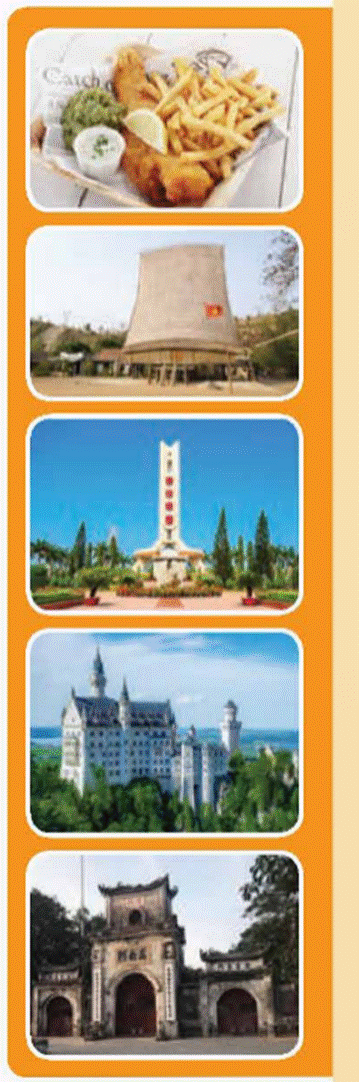
Answer:
1. fish and chips - This is a standard serving of fish and chips with a slice of lemon.
2. communal - The communal house has a significant meaning in the Bahnar community.
3. monument - In the square, there is a monument dedicated to the people killed in the war.
4. castle - They have decided to rebuild the castle which was damaged in the disaster.
5. temple - In Nam Dinh City, there is a complex of three temples where people worship the Tran Dynasty's Kings and royal family members.
5. GAME Remembering past events
Work in two groups. Give short answers to the following questions. The group with more correct answers wins.
1. Who decided to move our capital from Hoa Lu to Dai La (Thang Long) in 1010?
2. When did Columbus discover the Americas?
3. When was the United States founded?
4. When did Nguyen Ai Quoc first go abroad?
5. What happened in world history in 1914?
6. Who was the last king of Viet Nam?
Answer:
1. King Ly Thai To (Ly Cong Uan) decided to move our capital from Hoa Lu to Dai La (Thang Long) in 1010.
2. Columbus discovered the Americas in 1492.
3. The United States was founded on July 4, 1776.
4. Nguyen Ai Quoc, first went abroad in 1911.
5. In 1914, World War I began.
6. The last king of Vietnam was Bao Dai.
A CLOSER LOOK 1
VOCABULARY
1. Complete the following table. There is one example.
Verb | Noun |
protect | Protection |
|
|
|
|
|
|
|
|
|
|
|
|
Answer:
Verb | Noun |
protect | Protection |
| promotion |
| recognition |
| contribution |
| observation |
| preservation |
| occupation |
2. Complete the following sentences, using the correct forms of the words from 1.
1. People in these mountainous areas still ______ their local customs and traditions.
2. The invention of the seat belt made a good ______ to road safety.
3. We believe that ______ of these old structures will benefit the community in many ways.
4. The aim of the culture festival is the ______ of friendship and tourism.
5. In 2006, Duong Lam became the first village that was ______ as a national historic and cultural relic.
Answer:
1. preserve - People in these mountainous areas still preserve their local customs and traditions.
2. contribution - The invention of the seat belt made a good contribution to road safety.
3. preservation- We believe that preservation of these old structures will benefit the community in many ways.
4. promotion - The aim of the culture festival is the promotion of friendship and tourism.
5. recognised - In 2006, Duong Lam became the first village that was recognised as a national historic and cultural relic.
3. Complete the following sentences with the words from the box.
magnificent takeaway heritage generations structures
|
1. Stonehenge, England, one of the oldest stone _______ in the world, is about 5,000 years old.
2. If you are busy, you can get a _______ from one of these restaurants.
3. It's our duty to keep our customs and traditions alive for future _______.
4. Windsor Castle is about a thousand years old but it's absolutely _______.
5. We need a lot of effort to safeguard and preserve our _______.
Answer:
1. structures - Stonehenge, England, one of the oldest stone structures in the world, is about 5,000 years old.
2.takeaway - If you are busy, you can get a takeaway from one of these restaurants.
3. generations - It's our duty to keep our customs and traditions alive for future generations.
4. magnificent - Windsor Castle is about a thousand years old but it's absolutely magnificent.
5. heritage - We need a lot of effort to safeguard and preserve our heritage.
PRONUNCIATION
/m/ and /l/
4. Listen and repeat the words. Pay attention to the sounds /m/ and /l/
/m/ | /l/ |
monument magnificent programme/ custom grandma
| landscape celebrate value /ˈvæl.juː cultural national
|
Answer:
/m/ | /l/ |
monument /ˈmɒn.jə.mənt/
magnificent /mæɡˈnɪf.ɪ.sənt/
programme /ˈprəʊ.ɡræm/
custom /ˈkʌs.təm/
grandma /ˈɡræn.mɑː/
| landscape /ˈlænd.skeɪp/
celebrate /ˈsel.ə.breɪt/
value /ˈvæl.juː/
cultural /ˈkʌl.tʃər.əl/
national /ˈnæʃ.ən.əl/
|
5. Listen and repeat the sentences. Pay attention to the underlined words.
1. The collection includes objects of the Middle Ages.
2. You should be careful when shopping in this mall.
3. This monument is small but magnificent.
4. They maintain these windmills as working museums.
5. David fell off his bike and hurt his ankle.
Answer:
1. The collection includes objects of the Middle Ages.
- collection /kəˈlek.ʃən/
- Middle /ˈmɪd.əl/
2. You should be careful when shopping in this mall.
- careful /ˈkeə.fəl/
- mall /mɔːl/
3. This monument is small but magnificent.
- monument /ˈmɒn.jə.mənt/
- magnificent /mæɡˈnɪf.ɪ.sənt/
4. They maintain these windmills as working museums.
- maintain /meɪnˈteɪn/
- windmills /ˈwɪnd.mɪl/
5. David fell off his bike and hurt his ankle.
- fell /fel/
- ankle /ˈæŋ.kəl/
A CLOSER LOOK 2
GRAMMAR
The past continuous
1. Put the verbs in brackets in the past continuous.
1. My dad first met my mum when he (visit) _______ Hoi An Ancient Town.
2. Tom had a nightmare while he (sleep) _______ in the camp by the old castle.
3. David hurt his foot while he (go) _______ down the steps of the pagoda.
4. My brother was just sitting while I (look) _______ around the weaving workshop.
5. _______ you (watch) _______ TV at 9 p.m. last night? There was a very good programme on Duong Lam Ancient Village preservation.
Answer:
1. was visiting - My dad first met my mum when he was visiting Hoi An Ancient Town.
2. was sleeping - Tom had a nightmare while he was sleeping in the camp by the old castle.
3. was going - David hurt his foot while he was going down the steps of the pagoda.
4. was looking - My brother was just sitting while I was looking around the weaving workshop.
5. Were you watching - Were you watching TV at 9 p.m. last night? There was a very good programme on Duong Lam Ancient Village preservation.
2. Complete the sentences, using the past continuous forms of the given verbs.
live make preserve work build
|
1. People _______ the monument for years because it had great value.
2. When I finished school, my family _______ in the countryside.
3. People _______ the Taj Mahal - a World Heritage Site while Shah Jahan was emperor
4." _______ you still _______ on the coffee farm when the war broke out, Grandpa?"
5. I _______ a presentation when the microphone stopped working.
Answer:
1. were preserving - People were preserving the monument for years because it had great value.
2. was living - When I finished school, my family was living in the countryside.
3. were building - People were building the Taj Mahal - a World Heritage Site while Shah Jahan was emperor.
4. Were….working - "Were you still working on the coffee farm when the war broke out, Grandpa?"
5. was making - I was making a presentation when the microphone stopped working.
3. Put the verbs in brackets in the correct forms.
1. The children wish they (get) _______ more presents every Christmas.
2. I wish I (have) _______ enough money to visit London and Windsor Castle.
3. Do you wish we (have) _______ a swimming pool in our school?
4. We wish we (can spend) _______ our summer holiday on the seaside.
5. I wish I (can go) _______ back to my grandparents' time.
Answer:
1. got - The children wish they got more presents every Christmas.
2. had - I wish I had enough money to visit London and Windsor Castle.
3.had - Do you wish we had a swimming pool in our school?
4.could spend - We wish we could spend our summer holiday on the seaside.
5. could spend - I wish I could go back to my grandparents' time.
4. Read the passage and write down five things that Jenny might wish for. Look at the example.
My sister Jane is very untidy. She and I share the same room, but I have to clean it every day. Whenever she's at home, she lies in bed reading or playing computer games. She often puts her dirty clothes on my bed. I'd like to have my own room, but it's impossible now. I hope she can change her way one day.
Jenny, 14 |
Answer:
1. Jenny wishes she had her own room. - (Jenny ước cô ấy có phòng riêng.)
2. Jenny wishes her sister didn’t put dirty clothes on her bed. - (Jenny ước em gái cô ấy không để quần áo bẩn lên giường.)
3. Jenny wishes her sister Jane would spend less time playing computer games.- (Jenny ước em gái Jane sẽ dành ít thời gian chơi game trên máy tính hơn.)
4. Jenny wishes her sister Jane would change her habits. - (Jenny ước em gái Jane sẽ thay đổi thói quen của mình.)
5. Jenny wishes her sister would clean the room with her. - (Jenny ước em gái cô ấy sẽ dọn phòng cùng cô ấy.
5. Work in pairs. Tell your partner three wishes.
You can refer to the following:
- Your everyday life
- Your study at school
-Your family (family members, relationship, ...)
- Your friends
Example: I wish I had a dishwasher to do the washing-up for me every day.
Answer:
- I wish I could travel to China
- I wish I got a high score in the final exam.
- I wish I could speak English fluently.
- I wish I had more money to by anything what I like
- I wish my family had a big house.
- I wish my younger brother studied harder.
COMMUNICATION
Everyday English
1. Listen and read the conversations. Pay attention to the highlighted parts.
1. Kate: Thank you very much for showing us around Angkor Wat. Guide: You're welcome.
|
2. Alice: Thanks a lot for telling us about life in the countryside. Mi: No problem. |
Answer:
1. Kate: Thank you very much for showing us around Angkor Wat. (Cảm ơn bạn rất nhiều vì đã cho chúng tôi đi tham quan Angkor Wat.) Guide: You're welcome. (Không có gì) |
2. Alice: Thanks a lot for telling us about life in the countryside. (Cảm ơn bạn rất nhiều vì đã kể cho chúng tôi nghe về cuộc sống ở nông thôn) Mi: No problem. (Không vấn đề gì) |
2. Work in pairs. Make similar conversations to express thanks and respond in the following situations.
1. You thank the village head for showing you around the craft workshop.
2. You thank your friend for lending you an interesting book.
Answer:
1.
Person A: Thank you so much for showing me around the craft workshop
Village Head: You're very welcome. I'm glad you enjoyed the tour.
2.
Person A: Hey, thanks a lot for lending me that book, Emma. It was really interesting!
Friend: No problem! I'm glad you liked it.
How our families keep traditions alive
3. Read the passage and complete the table.
Most of Vietnamese families have customs and traditions that they have observed for many generations. Firstly, they worship their ancestors, and they celebrate their death anniversaries every year. That's the way they show their gratitude to their ancestors and teach their young children about traditions. Secondly, they take part in many national and regional festivals, for example the Mid-Autumn Festival and the New Harvest Festival. Thirdly, they celebrate many holidays during the year such as Tet and National Day. In this way, they keep their traditions alive and pass them down to the next generation.
Anniversaries | Festivals | Holidays |
1. _______ anniversaries | 2. _______ Festival 3. _______ Festival | 4.__________ 5.__________ |
Answer:
Anniversaries | Festivals | Holidays |
1. Death anniversaries (Ngày giỗ) | 2. Mid-Autumn Festival ( Trung thu) 3.New Harvest Festival (Lễ Tạ mùa) | 4.Tet 5.National Day (Quốc Khánh) |
4. Work in pairs. Ask and answer about how your family observes customs and traditions.
You can refer to 3 above.
Example:
A: What festival(s) does your family celebrate every year?
B: We celebrate Hung Kings' Temple Festival.
Answer:
Person A: What festival does your family celebrate every year?
Person B: We celebrate the Mid-Autumn Festival every year. How about your family?
Person A: We celebrate Diwali. It's a big event for us with lots of lights, sweets, and fireworks.
Person B: That sounds wonderful! We also enjoy making and sharing mooncakes during the Mid-Autumn Festival. It's a special time for family gatherings.
5. Work in groups. Give a short talk about one of the things in 4 that you and your family do to preserve traditions, for example celebrating family members' birthdays.
You can begin your talk like this:
We celebrate each family member's birthday every year. When someone's birthday is coming, all of us happily prepare for it....
Answer:
We celebrate each family member's birthday every year. When someone's birthday is coming, all of us happily prepare by decorating the house and planning a special meal. My mom bakes a cake, my dad organizes games, and my siblings and I make personalized cards.
On the birthday, we cook the birthday person's favorite meal and gather to sing "Happy Birthday." We each share what we appreciate about the birthday person, creating a heartwarming moment that strengthens our family bond.
This tradition, passed down through generations, makes each member feel special and helps us create lasting memories together.
SKILL 1
READING
1. Work in groups. Discuss the following question.
What do you know about England?
Answer:
England, part of the United Kingdom, is located on the island of Great Britain, bordered by Scotland and Wales. Its capital, London, is a major global financial center. England boasts a rich history, including Roman occupation and the Industrial Revolution. It is a constitutional monarchy with King Charles III. Renowned for its cultural contributions, England has produced literary giants like Shakespeare and bands like The Beatles. Prestigious universities like Oxford and Cambridge highlight its educational excellence. The economy is diverse, with strengths in finance, technology, and manufacturing. Notable landmarks include Big Ben, Buckingham Palace, and Stonehenge.
2. Read the text and write the underlined words in the box.
England's traditions have been around for hundreds, even thousands of years. English cuisine is among the deep-rooted traditions that English people are proud to keep alive.
Typical English cuisine has developed over many centuries, and people say that fish and chips is the most English dish of all. It is believed that fish and chips appeared in England in the 19th century. The earliest fish and chip shop opened in London during the 1860s. Since then people have considered fish and chips to be England's national dish, and it is now a common takeaway in the United Kingdom.
The basic ingredients of the dish are fried fish served with chips. People in different places may add peas, vinegar, lemon, or ketchup. Fish and chips is served hot as the main dish in England. Although there is oil and carbohydrates in fish and chips, it is healthier than other takeaway dishes.
Now there are fish and chip shops in many countries, and it is becoming more and more popular in other countries too. Preserving and promoting fish and chips is the way English people keep themselves associated with the past.
Meaning/Explanation | Word |
1. linked or connected 2. difficult to change or destroy 3. started to be seen 4. necessary and important
|
|
Answer:
Meaning/Explanation | Word |
1. linked or connected (Liên kết hoặc kết nối) | 1. Associated (liên kết)
|
2. difficult to change or destroy (khó thay đổi hay phá hủy)
| 2. deep - rooted (ăn sâu, tận gốc rễ) |
3. started to be seen (bắt đầu được nhìn thấy)
| 3. appeared (xuất hiện) |
4. necessary and important (cần thiết và quan trọng)
| 4. basic (cơ bản) |
3. Read the text again and tick (✔) T (True) or F (False) for each sentence.
| T | F |
1. English people take great pride in their traditions.
|
|
|
2. Fish and chips has been around for hundreds of years.
|
|
|
3. The earliest fish and chip shop opened in London in 1860.
|
|
|
4. Peas, vinegar, lemon, or ketchup are necessary for fish and chips.
|
|
|
5. Fish and chips is not healthy as it has a lot of oil.
|
|
|
6. Fish and chips is sold in many countries now. |
|
|
Answer:
1. T - English people take great pride in their traditions.
Explain : English cuisine is among the deep-rooted traditions that English people are proud to keep alive.
2. T - Fish and chips has been around for hundreds of years.
Explain: It is believed that fish and chips appeared in England in the 19th century.
3. F - The earliest fish and chip shop opened in London in 1860.
Explain: The earliest fish and chip shop opened in London during the 1860s.
4. F - Peas, vinegar, lemon, or ketchup are necessary for fish and chips.
Explain: The basic ingredients of the dish are fried fish served with chips. People in different places may add peas, vinegar, lemon, or ketchup.
5. F - Fish and chips is not healthy as it has a lot of oil.
Explain: Although there is oil and carbohydrates in fish and chips, it is healthier than other takeaway dishes.
6. T - Fish and chips is sold in many countries now.
Explain: Now there are fish and chip shops in many countries, and it is becoming more and more popular in other countries too.
SPEAKING
4. Work in pairs. Match 1-5 in column A with a - e in column B
A | B |
1. name of the dish |
a. glutinous rice, green beans, pork |
2. history | b. at Tet, on the Hung Kings' anniversary |
3. basic ingredients | c. banh chung |
4. on what occasion it's eaten | d. traditional dish
|
5. type of dish | e. originated in 6th Hung King's time |
Answer:
1 – c. name of the dish: banh chung - (tên món ăn: bánh chưng)
2 – e. history: originated in 6th Hung King's time - (lịch sử: bắt nguồn từ thời Hùng Vương thứ 6)
3 – a. basic ingredients: glutinous rice, green beans, pork - (nguyên liệu cơ bản: gạo nếp, đậu xanh, thịt lợn)
4 – b. on what occasion it's eaten: at Tet, on the Hung Kings' anniversary - (ăn vào dịp nào: Tết, giỗ tổ Hùng Vương)
5 – d. type of dish: traditional dish (loại món ăn: món ăn truyền thống)
5. Work in groups. Match the Vietnamese dishes with their names in English.
Choose a typical traditional Vietnamese dish and talk about it.
Your talk should include:
- the name of the dish
- the basic ingredients
- when/ on what occasion it is eaten
- whether you like it or not
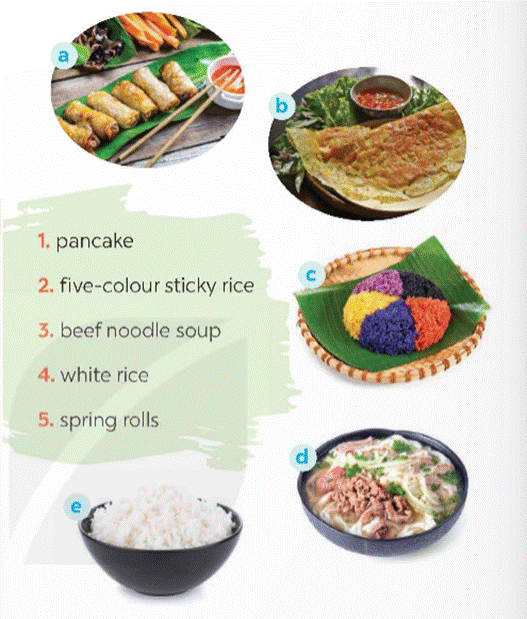
Answer:
1 - b. pancake (bánh xèo)
2 - c. five-colour sticky rice (xôi ngũ sắc)
3 - d. beef noodle soup (phở bò)
4 - e. white rice (cơm trắng)
5 - a. spring rolls (nem cuốn)
- the name of the dish: beef noodle soup
- the basic ingredients: broth, rice noodles, thinly sliced beef, and various herbs and spices
- when/ on what occasion it is eaten: enjoyed as a breakfast dish but can be eaten at any time of the day
- whether you like it or not: I love beef noodle soup
One typical traditional Vietnamese dish is beef noodle soup, known as phở bò. Phở bò is made with a rich broth, rice noodles, thinly sliced beef, and various herbs and spices. The broth is typically simmered for hours with beef bones, star anise, cloves, cinnamon, and ginger to develop its deep, savory flavor. It is garnished with ingredients like bean sprouts, basil, lime wedges, and chili peppers.
Phở bò is often enjoyed as a breakfast dish but can be eaten at any time of the day. It is especially popular during colder weather as a comforting, warming meal. Many Vietnamese people also enjoy it during special family gatherings and celebrations.
Personally, I love phở bò. Its complex flavors and the combination of tender beef, fragrant broth, and fresh herbs make it a delightful and satisfying dish. The experience of customizing each bowl with additional herbs, lime juice, and chili to suit one's taste adds to its appeal.
SKILL 2
LISTENING
1. Match each phrase with the right picture.
1. walking barefoot
2. talking face to face
3. traditional game


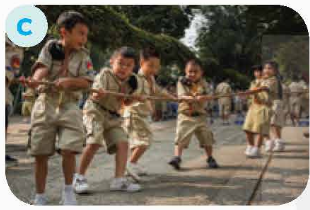
Answer:
1 - b. walking barefoot - (đi chân trần)
2 - a. talking face to face - (nói chuyện trực tiếp)
3 - c. traditional game - (trò chơi truyền thống)
2. Listen to the talk between Thanh and his grandma and tick (✔) the things you hear.
1. Three-month summer holiday
2. Lessons in the morning only
3. A lot of extra lessons
4. Walking barefoot
5. Chatting on mobile phones
Answer:
1. Three-month summer holiday
2. Lessons in the morning only
4. Walking barefoot
3. Listen again and choose the correct answers.
1. The conversation is generally about Thanh's _______.
A. school days
B. grandma's school days
C. grandma's life in the past
2. Thanh's grandma didn't have a lot of _______.
A. homework
B. lessons
C. subjects
3. Thanh's grandma _______ went to school on foot.
A. always
B. sometimes
C. never
4. Students in the past played _______ during break time.
A. computer games
B. games on mobile phones
C. traditional games
Answer:
1 – B ; 2 – A ; 3 – C
WRITING
4. Work in pairs. Ask and answer about school days in the past.
Your talk may include the following:
- school time (When...)
- school subjects (What...)
- leisure time activities (What....).
- summer holiday (How long...)
- means of transport to school (How...)
You can refer to the listening text for your answers.
Answer:
Person A: When did they go to school in the past?
Person B: They only went to school on weekday mornings, and afternoon
Person A: What subjects did they study?
Person B: They studied a variety of subjects including math, science, literature, history, and foreign languages. They also had physical education and art classes. Person A:What did they do during your leisure time?
Person B: During leisure time, they played sports like soccer and basketball, hung out with friends, or played video games. Sometimes, they just relaxed and read books.
Person A: How long were their summer holidays?
Person B: Summer holidays were about two months long, from June to August.
Person A: How did they get to school?
Person B: They used to go to school by foot or by bike.
5. Write a paragraph (100-120 words) about school days in the past.
You can begin your writing with:
Answer:
In the past, students had lessons in the morning only. They had the usual subjects like Math, Literature, English, Ethics, History, and Geography. They often do not take extra classes and have little homework. Therefore, they have a lot of time to have fun as well as help their parents with housework and farm work. During leisure time, they used to read books and engage in traditional games. Summer holidays were a cherished break, extending for about three months, creating a sense of endless freedom. They used to go to school by foot or by bike.
LOOKING BACK
VOCABULARY
1. Choose the correct answer A, B, C, or D.
1. In keeping with _______, we cook five-colour sticky rice on the first day of a lunar month.
A. tradition
B. habit
C. ritual
D. practice
2. Sam is very interested in history, and he remembers a lot of historical _______ and dates.
A. traditions
B. events
C. anniversaries
D. practices
3. The fire of London in 1666 destroyed thousands of old _______ and damaged a large part of London's centre.
A. organisations
B. structures
C. associations
D. connections
4. This practice was more common in _______ times than it is now.
A. beginning
B. antique
C. historic
D. ancient
5. This complex of buildings was _______ by foreign troops during the war.
A. received
B. busy
C. occupied
D. filled
Answer:
1. A - In keeping with tradition, we cook five-colour sticky rice on the first day of a lunar month.
2. B - Sam is very interested in history, and he remembers a lot of historical events and dates.
3. B - The fire of London in 1666 destroyed thousands of old structures and damaged a large part of London's centre.
4. D - This practice was more common in ancient times than it is now.
5. C - This complex of buildings was occupied by foreign troops during the war.
2. Finish the sentence by completing each blank with a word. The first letter of each word is given.
1. The custom of w_____ ancestors is a beautiful and rich tradition in Vietnamese culture.
2. The custom of sending a greeting card has become a d_____ tradition in many western countries.
3. A country's cultural h_____ is a valuable resource.
4. Festivals, which are handed down from one g_____ to the next, are an important way to promote tourism.
5. Besides the key i_____, another secret to achieving the perfect fish and chips is the temperature of the oil.
Answer:
1. worshipping - The custom of worshipping ancestors is a beautiful and rich tradition in Vietnamese culture.
2. deep-rooted - The custom of sending a greeting card has become a deep-rooted tradition in many western countries.
3. heritage - A country's cultural heritage is a valuable resource.
4. generation - Festivals, which are handed down from one generation to the next, are an important way to promote tourism.
5. ingredients - Besides the key ingredients, another secret to achieving the perfect fish and chips is the temperature of the oil.
GRAMMAR
3. Put the verb in brackets in the past continuous to complete each sentence.
1. Luckily, the sun (shine) _______ brightly when we reached the campsite.
2. They (build) _______ Ho Chi Minh Mausoleum from 1973 to 1975
3. When their mum came home, they (not study) _______, they (chat) _______ noisily.
4. _______ they still (wait) when _______ the tour guide arrived?
5. 1 (think) _______ of my grandmother for years after she died.
Answer:
1. was shining - Luckily, the sun was shining brightly when we reached the campsite.
2. were building - They were building Ho Chi Minh Mausoleum from 1973 to 1975.
3. weren’t studying - When their mum came home, they weren’t studying; they were chatting noisily.
4. Were…waiting….. - Were they still waiting when the tour guide arrived?
5. was thinking - I was thinking of my grandmother for years after she died.
4. Rewrite the following sentences, using wish.
1. She doesn't have an iPhone. She'd like to have one.
2. I'm sorry that I don't have a three-month summer holiday as my grandma did.
3. I want my parents to let me make my own decisions, but they don't.
4. Mike wants to play musical instruments, but he can't.
5. My dad is very busy. I want him to have more time with me.
Answer:
1. She wishes she had an iPhone. - (Cô ấy ước mình có một chiếc iPhone.)
Explain: Cấu trúc câu ước với “wish” cho điều ước ngược với hiện tại: S1 + wish + S2 + Ved/V2 (quá khứ đơn)
2. I wish I had a three-month summer holiday like my grandma did. - (Tôi ước mình có một kỳ nghỉ hè kéo dài ba tháng như bà tôi đã từng.)
Explain-Cấu trúc câu ước với “wish” cho điều ước ngược với hiện tại: S1 + wish + S2 + Ved/V2 (quá khứ đơn)
3. I wish my parents would let me make my own decisions.- (Ước gì bố mẹ để tôi tự quyết định.)
Explain: Cấu trúc câu ước với “wish” cho điều ước ngược với hiện tại: S1 + wish + S2 + Ved/V2 (quá khứ đơn)
4. Mike wishes he could play musical instruments. - (Mike ước anh ấy có thể chơi nhạc cụ.)
Explain: Cấu trúc câu ước với “wish” cho điều ước ngược với hiện tại: S1 + wish + S2 + Ved/V2 (quá khứ đơn)
5. I wish my dad had more time with me. - (Tôi ước bố có nhiều thời gian bên tôi hơn.)
Explain: Cấu trúc câu ước với “wish” cho điều ước ngược với hiện tại: S1 + wish + S2 + Ved/V2 (quá khứ đơn)
PROJECT
Life in your neighborhood 40 year ago
Work in groups
1. Collect information and pictures about life in your area about 40 years ago.
You may need to ask your grandparents and/or old people or use the Internet to find information.
You can refer to the following:
- means of transport (on foot, on horseback, by bicycle,...)
- home life (electric devices, cooking,...)
- community services (electricity, running water, library, communal house,…)
Answer:
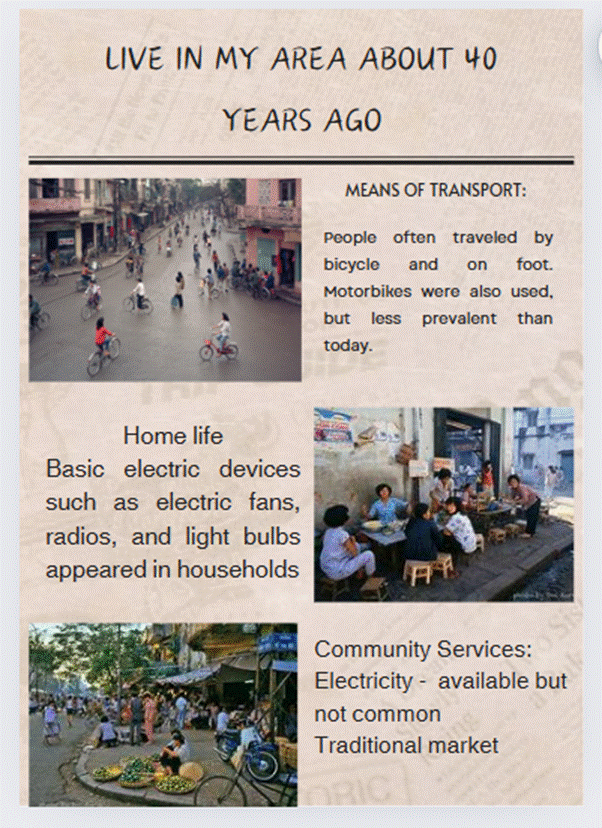
- Means of transport: People often traveled by bicycle and on foot. Motorbikes were also used, but less prevalent than today.
- Home life: Basic electric devices such as electric fans, radios, and light bulbs appeared in households. However, larger appliances like refrigerators and washing machines might have been considered luxury items. Cooking was primarily done using charcoal stoves or gas stoves.
- Community Services: Electricity was available but not common, power outages might have been more frequent. Wells or communal water sources were popular. Traditional markets and communal gathering places played a significant role in community life.
2. Make a poster. Write or print the information and stick the pictures on the poster.
3. Give a presentation to the class.
Answer:
Life in the neighborhood about 40 years ago was characterized by simplicity and close-knit community ties. People relied heavily on bicycles and traveling on foot for everyday transportation, with motorbikes being less prevalent than they are today. Basic electric devices such as electric fans, radios, and light bulbs had made their way into households, but larger appliances like refrigerators and washing machines were still considered luxury items for many. Cooking was primarily done using charcoal stoves or gas stoves, infusing meals with a rustic charm. Community services, though not as advanced as they are now, were vital to everyday life. Electricity was available but not yet common, and power outages were not uncommon. Wells or communal water sources were popular for obtaining water. Traditional markets and communal gathering places played a significant role in community life, serving as hubs of activity where neighbors came together to socialize, trade goods, and share stories. This era reflects a time when simplicity and connection were paramount, shaping the fabric of everyday existence.
Tài liệu cùng môn học
Tài liệu khác
- Trắc nghiệm tiếng anh 2 Family and Friends
- Trắc nghiệm tiếng anh 2 Explore our world
- Trắc nghiệm tiếng anh 3 Family and Friends
- Trắc nghiệm tiếng anh 3 Explore our world
- Trắc nghiệm tiếng anh 4 Family and Friends
- Trắc nghiệm tiếng anh 4 Global Success
- Trắc nghiệm tiếng anh 4 Explore our world
- Trắc nghiệm tiếng anh 5 Family and Friends
- => Xem nhiều môn hơn