Giải tiếng anh 11 Friends Global: Unit 3E Word families
Hướng dẫn giải tiếng anh 11 Friends Global: Giải Unit 3E Word families. Bài được giải chi tiết, rõ ràng, dễ hiểu. Bài giải giúp học sinh nắm vững kiến thức trong sách giáo khoa, rèn kĩ năng giải bài tập và có phương pháp học tập hiệu quả.
Nội dung chi tiết
Word Skills
1. VOCABULARY In pairs, read the adjectives below and talk about situations in which you experience those feelings.
(Theo cặp, đọc các tính từ dưới đây và nói về những tình huống mà bạn trải qua những cảm xúc đó)
Adjectives to describe feelings
afraid anxious ashamed cross disgusted envious proud
I sometimes feel afraid if I see a very large spider.
Answer:
1. That's understandable. I also feel afraid when I'm in a dark and unfamiliar place.
2. As for anxious, I often feel anxious when I have a test or an important interview coming up.
3. I feel ashamed when I make a mistake in public and everyone notices it. It's embarrassing.
4. I can get cross if I'm stuck in traffic or when someone is being rude or unfair to me.
5. I feel disgusted when I see someone littering or when I have to clean something dirty.
6. I sometimes feel envious when someone else has something that I want, like a new car or a better job.
7. Finally, I feel proud when I achieve something that I've been working hard towards, like getting a good grade or completing a difficult task.
2. Read the article and look at the pictures. Match the underline words in the article with pictures 1 - 4.
(Đọc bài viết và nhìn vào hình ảnh. Nối các từ được gạch chân trong bài viết với hình ảnh 1 - 4)
A-gut feeling
Emotions do not just occur in your mind; they also have a physical effect on your body. A group of scientists from Finland decided to find out which emotions affect which parts of the body. They asked 701 volunteers to colour in silhouettes in response to emotional words, stories and videos. The results show that the people generally experience emotions like anger, envy and shame in similar ways.
For example, when you're angry, you probably feel that anger mostly in your chest and head. But if you feel ashamed, you probably notice it in your face and, in particular, your cheeks. Depression makes your whole body feel less active, whereas happiness affects your whole body in a positive way.
‘Hot’ colours like yellow and red show an increase in activity, while blue shows the opposite. Black is neutral.
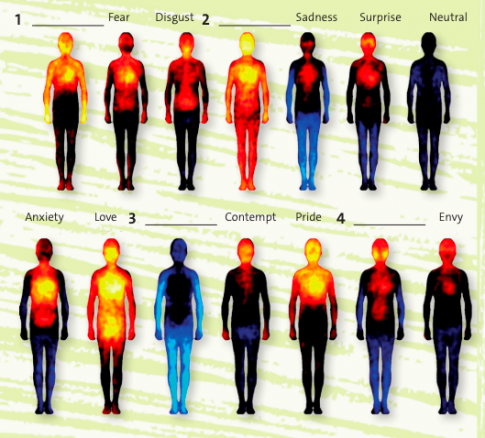
Answer:
1. shame
2. depression
3. happiness
4. anger
3. Complete the tables with words from exercises 1 and 2.
(Hoàn thành các bảng với các từ từ bài tập 1 và 2)
| Noun | Adjective | Noun | Adjective |
| (1) ________________ | angry | (5) ________________ | happy |
| anxiety | (2) ________________ | pride | (6) ________________ |
| (3) ________________ | ashamed | (7) ________________ | sad |
| (4) ________________ | envious | (8) ________________ | surprised |
Answer:
| Noun | Adjective | Noun | Adjective |
|---|---|---|---|
| (1) Pride | proud | (5) Joy | joyful |
| (2) Anxiety | anxious | (6) Calm | calm |
| (3) Shame | ashamed | (7) Grief | grieving |
| (4) Envy | envious | (8) Shock | shocked |
4. Read the Learn this! box. In pairs, write down two more examples for each rule (a—d). Use a dictionary to help you if necessary.
(Đọc Learn this. Theo cặp, viết thêm hai ví dụ cho mỗi quy tắc (a—d). Sử dụng từ điển để giúp bạn nếu cần thiết)
LEARN THIS! Word families
a. Some nouns are formed by adding a suffix like -ness or -ment to an adjective.
sad -sadness content - contentment
b. Common adjective endings are -ed, -ing, -ous, -ful, -less, -y and -al.
surprised / surprising suspicious hopeful / hopeless dirty political
c. Most adverbs are formed by adding -ly to an adjective.
cross - crossly happy — happily
d. We can change the meaning of many adjectives and adverbs by adding a prefix.
Surprisingly - unsurprisingly
Answer:
a. Happy - Happiness
Sweet - Sweetness
b. Bored - Boring
Famous - Famous
Shameful - Shameless
Cloudy - Cloudy
Chemical - Chemical
c. Slow - Slowly
Smooth - Smoothly
d. Legal - Illegal
Polite - Impolite
Patient - Impatient
Correct - Incorrect
5. USE OF ENGLISH Complete the sentence with the adjective or adverb related to the noun in brackets. You may need to add a prefix.
(Hoàn thành câu với tính từ hoặc trạng từ liên quan đến danh từ trong ngoặc. Bạn có thể cần phải thêm một tiền tố)
1. He told me ___________ (anger) not to be late again.
2. Liam is ___________ (hope) that he’ll pass all his exams.
3. I was ___________ (surprise), but I tried no to show it.
4. We waited ___________ (anxiety) for news of his arrival.
5. He looked for his wallet, but ___________ (sadness) he couldn’t find it.
6. That’s a good mark for this exam - don’t be ___________ (shame) of it.
7. He stared ___________ (enny) at his friend’s new bike.
8. Her neighbour is always very bad-tempered, so she found his angry reaction ___________ (surprise).
9. My sister was ___________ (annoy) late.
10. He didn’t try to hide his ___________ (happy) - he just cried.
Answer:
1. He told me angrily not to be late again.
2. Liam is hopeful that he’ll pass all his exams.
3. I was surprised, but I tried not to show it.
4. We waited anxiously for news of his arrival.
5. He looked for his wallet, but sadly he couldn’t find it.
6. That’s a good mark for this exam - don’t be ashamed of it.
7. He stared enviously at his friend’s new bike.
8. Her neighbor is always very bad-tempered, so she found his angry reaction unsurprising.
9. My sister was annoyedly late.
10. He didn’t try to hide his happiness - he just cried.
6. SPEAKING Discuss the questions in pairs.
(Thảo luận các câu hỏi theo cặp)
1. Do you think money can make people happy? Why? Why not?
2. When is pride good? When is it bad?
3. Is fear ever a good emotion? If so, when?
Answer:
1. Do you think money can make people happy? Why? Why not?
Money can provide basic needs and opportunities for experiences that may contribute to happiness, but excessive focus on money and material possessions can lead to neglect of other important aspects of life, such as relationships and personal growth.
2. When is pride good? When is it bad?
Pride is good when it stems from a sense of accomplishment or self-worth, but bad when it turns into arrogance, self-centeredness, or superiority over others, hindering personal growth and relationships.
3. Is fear ever a good emotion? If so, when?
Fear can be a useful emotion when it alerts individuals to potential threats or danger, triggers a fight or flight response, or serves as a motivator to take action or prepare for challenges. However, excessive or irrational fear can lead to anxiety, phobias, or prejudice, limiting individuals' daily functioning or enjoyment.
Tài liệu cùng môn học
Tài liệu khác
- Trắc nghiệm tiếng anh 2 Family and Friends
- Trắc nghiệm tiếng anh 2 Explore our world
- Trắc nghiệm tiếng anh 3 Family and Friends
- Trắc nghiệm tiếng anh 3 Explore our world
- Trắc nghiệm tiếng anh 4 Family and Friends
- Trắc nghiệm tiếng anh 4 Global Success
- Trắc nghiệm tiếng anh 4 Explore our world
- Trắc nghiệm tiếng anh 5 Family and Friends
- => Xem nhiều môn hơn