Giải tiếng anh 11 Friends Global: Unit 7F Graffiti's softer side
Hướng dẫn giải tiếng anh 11 Friends Global: Giải Unit 7F Graffiti's softer side. Bài được giải chi tiết, rõ ràng, dễ hiểu. Bài giải giúp học sinh nắm vững kiến thức trong sách giáo khoa, rèn kĩ năng giải bài tập và có phương pháp học tập hiệu quả.
Nội dung chi tiết
Reading
1. SPEAKING Work in pairs. Choose one of the photos and describe it to your partner. Use the words below to help you.
(Làm việc theo cặp. Chọn một trong những bức ảnh và mô tả nó cho đối tác của bạn. Sử dụng các từ dưới đây để giúp bạn)

Nouns
boxer bus cover message parking
meter statue street wool writing
Verbs
wear kneel cover knit
Adjectives
brightly coloured patterned striped
In the first photo there's a bus with a patterned wool cover
Answer:
In the first photo there's a bus with a patterned wool cover. The bus is parked on the street, and there's a parking meter beside it.
The statue is of a boxer, and he's wearing striped shorts and gloves. He's kneeling down as if he's ready to fight. There's a message written on the statue's base, it's 'go see the art'.
2. Read the article and match the photos (A-C) with two of the artists.
(Đọc bài báo và nối các bức ảnh (A-C) với hai trong số các nghệ sĩ)
Jessie Hemmons
Magda Sayeg
Granny Graffiti
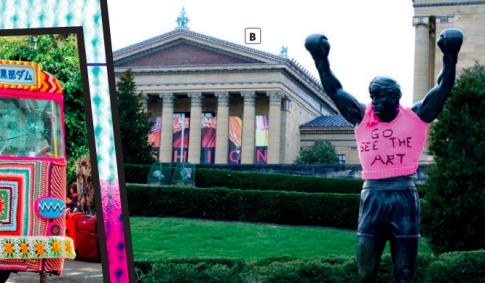
The statue of Rocky outside the Philadelphia Museum of Art is very popular with tourists, who often stop to take their photo in front of it without bothering to visit the museum itself. This irritated the artist Jessie Hemmons, who knitted a bright pink jacket and put it on the statue of the boxer. On the front of the jacket, Jessie knitted the words ‘Go see the art’. Jessie hopes that more people will visit the gallery. This form of street art has become known as ‘yarn bombing’.
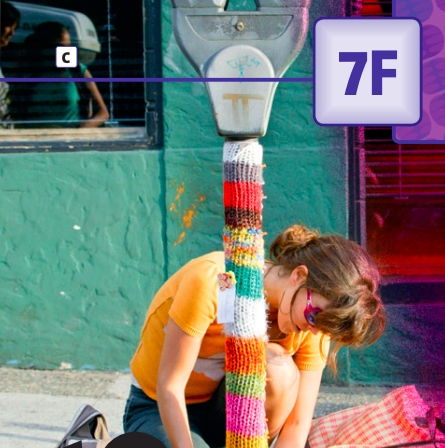
The craze is believed to have started in 2005 by Magda Sayeg in Houston, Texas. One day Magda decided, just for fun, to knit a blue-and-pink cover for her shop's door handle. She loved it, and unexpectedly, so did her customers. Pedestrians stopped outside the shop to photograph it. Motorists slowed down to take a closer look. Their reaction inspired Magda to make covers for other objects in the street, such as a stop sign, a lamp post, a parking meter — and even an entire bus, which took awhole week to complete!
There are now yarn bombing groups in dozens of countries. They photograph and film their works and upload them to the internet.
Jessie believes that most street art is done by men and that yarn bombing is a more feminine activity. But not everyone approves of the new form of street art. Some people argue that covering public objects in wool is vandalism and littering, but the police appear to have a relatively relaxed attitude towards yarn bombers. They might interrupt them if they see them at work in the street, but they do not often view them as criminals.
Whether you see yarn bombing as a bit of fun that brightens up drab cities, or as a form of high culture with a serious message, it is a craze that is likely to continue.
Answer:
Photo A: A bus covered entirely in knitted wool in a blue-and-pink pattern.
Photo B: Jessie Hemmons with the statue of Rocky wearing a pink knitted jacket and the words 'Go see the art'.
Photo C: A stop sign and a parking meter covered in colorful knitted wool.
Artists: Jessie Hemmons and Magda Sayeg.
Reading Strategy
1. Multiple-choice questions are always in the same order as the information in the text.
2. If there is a question testing the main idea of the text, or the writer's overall opinion, it will come last.
3. The correct option will match the meaning of the text but use different words. Make sure the other options are not right or are not mentioned in the text.
4. If you can’t decide between the options, an intelligent guess is better than no answer.
3. Read the Reading Strategy. Is there a question about the main idea or the writer's overall opinion in the questions in exercise 4?
(Đọc Chiến lược đọc. Có câu hỏi nào về ý chính hoặc ý kiến chung của người viết trong các câu hỏi ở bài tập 4 không?)
Answer:
Yes, there is a question about the main idea or the writer's overall opinion in exercise 4. Question 5 asks about the writer's overall opinion of yarn bombing.
4. For questions 1-5, circle the correct answers (a—c).
(Đối với các câu hỏi 1-5, hãy khoanh tròn các câu trả lời đúng (a—c)
1. Jessie Hemmons ‘yarn bombed’ the statue of Rocky because
a. she wants people to take photos of it.
b. she thinks too many tourists come and see it.
c. she wants more people to go and see the paintings in the museum.
2. Why did Magda Sayeg knit a cover for the door handle of her shop?
a. For her own amusement
b. To attract customers
c. Because someone passing the shop suggested it
3. Jessie thinks that yarn bombing is different from other forms of street art because
a. its popularity has spread via the internet.
b. it’s temporary and soon disappears.
c. it’s less masculine.
4. What is the police’s usual attitude to yarn bombing?
a. They make it clear that it is against the law.
b. They think that yarn bombers are strange people.
c. They hardly ever try to arrest yarn bombers.
5. What is the writer's overall opinion of yarn bombing?
a. It is wrong because it’s against the law.
b. The writer doesn’t express a personal view.
c. It deserves to be called ‘art’.
Answer:
1. Jessie Hemmons ‘yarn bombed’ the statue of Rocky because
c. she wants more people to go and see the paintings in the museum.
2. Why did Magda Sayeg knit a cover for the door handle of her shop?
b. To attract customers
3. Jessie thinks that yarn bombing is different from other forms of street art because
c. it’s less masculine.
4. What is the police’s usual attitude to yarn bombing?
c. They hardly ever try to arrest yarn bombers.
5. What is the writer's overall opinion of yarn bombing?
c. It deserves to be called ‘art’.
5. VOCABULARY In paragraphs 1 and 2, underline four things (excluding vehicles) that you might find in the street. How many more items can you add to the list?
(Trong đoạn 1 và 2, hãy gạch chân bốn thứ (không bao gồm xe cộ) mà bạn có thể tìm thấy trên đường phố. Bạn có thể thêm bao nhiêu mục nữa vào danh sách?)
Answer:
Possible answers:
1. Lamp post 2. Stop sign 3. Parking meter 4. Bus (covered in yarn)
Additional items that could be found in the street:
5. Trash cans 6. Benches 7. Fire hydrants 8. Trees
9. Bicycle racks 10. Streetlights 11. Mailboxes 12. Phone booths
13. Public art installations 14. Newspaper stands 15. Manhole covers
16. Sidewalks 17. Potholes 18. Graffiti
6. SPEAKING KEY PHRASES Work in pairs. Discuss the questions. Use the phrases below to help you.
(Làm việc theo cặp. Thảo luận các câu hỏi. Sử dụng các cụm từ dưới đây để giúp bạn)
Arguing your point ,
In my opinion,... As I see it,...
It could be argued that... I agree with you.
I see your point, but... That may be true, but...
1. Do you think that yarn bombing is art, or vandalism and littering? Why?
2. What about other forms of street art, such as graffiti and chalk drawings on the pavement? Are they art or vandalism? Give reasons for your opinion.
Answer:
Partner 1: In my opinion, yarn bombing is a form of art. It is a creative way to add color and interest to public spaces. Plus, the fact that many yarn bombers have messages or meanings behind their work makes it even more thought-provoking.
Partner 2: It could be argued that yarn bombing is a form of vandalism and littering because it involves covering public objects without permission. While the intention might be to add beauty to a space, it could also be seen as an act of defacing public property.
Partner 1: I see your point, but I would argue that yarn bombing is a temporary form of street art. It can easily be removed or taken down without causing any permanent damage.
Partner 2: That may be true, but I still think that permission should be obtained before covering public objects in any way. What about other forms of street art, like graffiti and chalk drawings on the pavement?
Partner 1: As I see it, graffiti and chalk drawings can also be a form of art, especially when done with skill and creativity. However, I do think that they should also be done with permission or in designated areas to avoid damaging private or public property.
Partner 2: I agree with you. Graffiti and chalk drawings can be very impressive, but they can also be a nuisance and cause damage if not done properly. It's important to find a balance between creativity and respect for public property.
Tài liệu cùng môn học
Tài liệu khác
- Trắc nghiệm tiếng anh 2 Family and Friends
- Trắc nghiệm tiếng anh 2 Explore our world
- Trắc nghiệm tiếng anh 3 Family and Friends
- Trắc nghiệm tiếng anh 3 Explore our world
- Trắc nghiệm tiếng anh 4 Family and Friends
- Trắc nghiệm tiếng anh 4 Global Success
- Trắc nghiệm tiếng anh 4 Explore our world
- Trắc nghiệm tiếng anh 5 Family and Friends
- => Xem nhiều môn hơn