Giải tiếng anh 11 Friends Global: Unit 4I Royal Places
Hướng dẫn giải tiếng anh 11 Friends Global: Giải Unit 4I Royal Places. Bài được giải chi tiết, rõ ràng, dễ hiểu. Bài giải giúp học sinh nắm vững kiến thức trong sách giáo khoa, rèn kĩ năng giải bài tập và có phương pháp học tập hiệu quả.
Nội dung chi tiết
Culture
1. SPEAKING Work in pairs. Discuss the questions.
(Làm việc theo cặp. Thảo luận các câu hỏi)
1. Have you ever visited any castles or palaces in Viet Nam? Which are the most famous ones? Why?
2. Do you recognise the palace in the photo? What do you know about it?
Answer:
Person A: Hey, have you ever visited any castles or palaces in Viet Nam?
Person B: Yeah, I have visited a few. The most famous ones are probably the Imperial City in Hue and the Royal Palace in Hanoi. They are both historically significant and have stunning architecture.
Person A: I have heard of those places but I haven't been there yet. What did you like the most about them?
Person B: I loved the peacefulness of the Imperial City in Hue. It was once the home of the Nguyen Dynasty and is now a UNESCO World Heritage Site. The Royal Palace in Hanoi, on the other hand, has a lot of French architectural influence and is a great example of the country's colonial history.
Person A: That sounds fascinating. I would love to visit those places someday. By the way, do you recognize the palace in this photo?
Person B: Let me take a look. Hmm, I'm not sure. It looks a bit familiar, but I can't remember its name.
Person A: It's the Independence Palace in Ho Chi Minh City. It used to be the home of the South Vietnamese government during the Vietnam War.
Person B: Oh, I see. I have heard of it, but I didn't know it was called the Independence Palace. It has a very unique architecture, doesn't it?
Person A: Yes, it does. It's a great example of the 1960s modernist style in architecture.
Hue Citadel
* Located on the northern bank of the Perfume River, the Imperial City of Hue was not only the administrative centre but also the royal residence of the Nguyen Dynasty.
* Its construction began under the reign of Emperor Gia Long in the early 19" century and it was completed during the reign of Minh Mang, involving huge expenditure and the recruitment of tens of thousands of labourers.
* The Citadel comprises three concentric walled areas — the Citadel (Kinh Thanh), the Imperial City (Hoang Thanh) and the Purple Forbidden City (Tu Cam Thanh). The entire square shaped complex with a perimeter of nearly 10 km is enclosed within the outer walls which are 6.6 m high and 21.5 m thick.
* Gates were built into the Crtadel walls — four on the south front side and two on each of the other sides.
* During the Nguyen Dynasty, there used to be more than 100 buildings dedicated to specific functions such as palaces for worshipping deceased royal family members, royal government ministries and residential quarters. The Purple Forbidden City was reserved exclusively for the emperor and his close family.
* The restoration work is currently under way to restore the splendour of this iconic site.
* Hue Citadel was designated a UNESCO World Heritage Site in 1993.
2. Cover the fact file. Discuss and try to guess the answers to the quiz about Hue Citadel.
(Thảo luận và cố gắng đoán câu trả lời cho câu đố về kinh thành Huế)
1. When was Hue Citadel built?
a. 17th-c
b. Early 19th-c
c. Late 18th-c
2. Which emperor started its construction?
a. Minh Mang
b. Gia Long
c. Bao Dai
3. How many workers were involved in the building of Hue Citadel?
a. More than 10,000
b. At least 100,000
c. Just under 1,000
4. The height of the outer walls measures:
a. 10km
b. 6.6m
c. 215m
5. How many gates does Hue Citadel have?
a. 8
b. 6
c. 10
6. What was the function of the Purple Forbidden City?
a. The Emperor lived there
b. The Emperor and his family lived there
c. The Emperor's family worshipped there
Answer:
1. When was Hue Citadel built?
Answer: b. Early 19th-c
2. Which emperor started its construction?
Answer: b. Gia Long
3. How many workers were involved in the building of Hue Citadel?
Answer: a. More than 10,000
4. The height of the outer walls measures:
Answer: b. 6.6m
5. How many gates does Hue Citadel have?
Answer: b. 6
6. What was the function of the Purple Forbidden City?
Answer: b. The Emperor and his family lived there
3. Read the fact file and check your answers to exercise 2. What do you think is the most interesting or surprising fact?
(Đọc tập tin thực tế và kiểm tra câu trả lời của bạn cho bài tập 2. Bạn nghĩ điều gì thú vị hoặc đáng ngạc nhiên nhất?)
Answer:
1. When was Hue Citadel built?
Answer: b. Early 19th-c
2. Which emperor started its construction?
Answer: b. Gia Long
3. How many workers were involved in the building of Hue Citadel?
Answer: a. More than 10,000
4. The height of the outer walls measures:
Answer: b. 6.6m
5. How many gates does Hue Citadel have?
Answer: b. 6
6. What was the function of the Purple Forbidden City?
Answer: b. The Emperor and his family lived there
After reviewing the fact file again, I find the most interesting fact to be that the entire square-shaped complex of Hue Citadel has a perimeter of nearly 10 km and is enclosed within outer walls that are 6.6 m high and 21.5 m thick. It's impressive to imagine the sheer scale of the construction and the amount of effort and resources that went into building such a massive structure.
4. Listen to the radio programme. Complete the information about the Queen’s residences. Use the places below in the first column.
(Nghe chương trình phát thanh. Hoàn thành thông tin về nơi ở của Nữ hoàng. Sử dụng những nơi dưới đây trong cột đầu tiên)
| Belfast, Northern Ireland | Edinburgh, Scotland |
| the Highlands, Scotland | London, England |
| near London, England | Norfolk, England |
| Royal Residence | Location | Private or state-owned? |
| Buckingham Palace | ||
| Windsor Castle | ||
| Sandringham House | ||
| Balmoral Castle | ||
| Holyrood Palace | ||
| Hillsborough Castle |
Answer:
HS tự thực hiện.
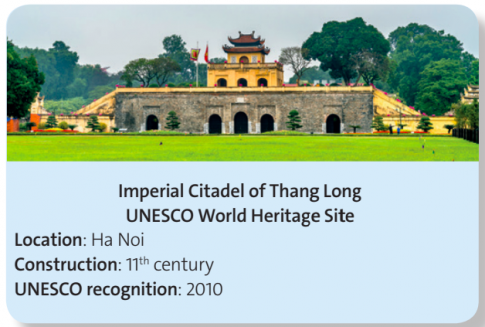
5. INTERNET RESEARCH Work in groups. Find out about Imperial Citadel of Thang Long, Ha Noi. Present the fact file to the class.
(Làm việc nhóm. Tìm hiểu về Hoàng Thành Thăng Long, Hà Nội. Trình bày hồ sơ thực tế trước lớp)
Answer:
The Imperial Citadel of Thang Long is a cultural complex located in the heart of Hanoi, Vietnam.
It was built in the 11th century during the Ly Dynasty and served as the political and cultural center of Vietnam for almost 13 centuries.
The citadel was the seat of the royal court and the emperor's residence until 1802, when the capital was moved to Hue by the Nguyen Dynasty.
The site covers an area of 18 hectares and consists of three main sections: the Forbidden City, the Imperial Enclosure, and the Ancient Houses Area.
The Forbidden City was the residence of the king and his family, as well as the center of the court, and is surrounded by walls and a moat. It includes several buildings, such as the Palace of Supreme Harmony, the Hall of Middle Harmony, and the Palace of Celestial Purity.
The Imperial Enclosure is the area where the state affairs were conducted, and it includes various structures, such as the Doan Mon Gate, the Kinh Thien Palace, and the Hau Lau Palace.
The Ancient Houses Area is where the commoners and servants lived, and it consists of several restored traditional houses that showcase the architecture and daily life of the past.
The site was declared a UNESCO World Heritage Site in 2010 for its cultural and historical significance.
The citadel underwent several periods of renovation and restoration throughout its history, with the most recent one being carried out in the early 21st century.
Today, the Imperial Citadel of Thang Long is a popular tourist destination, and it also serves as a cultural and educational center for the local community.
Tài liệu cùng môn học
Tài liệu khác
- Trắc nghiệm tiếng anh 2 Family and Friends
- Trắc nghiệm tiếng anh 2 Explore our world
- Trắc nghiệm tiếng anh 3 Family and Friends
- Trắc nghiệm tiếng anh 3 Explore our world
- Trắc nghiệm tiếng anh 4 Family and Friends
- Trắc nghiệm tiếng anh 4 Global Success
- Trắc nghiệm tiếng anh 4 Explore our world
- Trắc nghiệm tiếng anh 5 Family and Friends
- => Xem nhiều môn hơn