Giải tiếng anh 11 Friends Global: Unit 2A Love it or hate it
Hướng dẫn giải tiếng anh 11 Friends Global: Giải Unit 2A Love it or hate it. Bài được giải chi tiết, rõ ràng, dễ hiểu. Bài giải giúp học sinh nắm vững kiến thức trong sách giáo khoa, rèn kĩ năng giải bài tập và có phương pháp học tập hiệu quả.
Nội dung chi tiết
Vocabulary
1. SPEAKING Work in pairs. Ask about your partner's hobbies. Find two things that he or she a) usually does at the weekend and b) occasionally does at the weekend.
(Làm việc theo cặp. Hỏi về sở thích của đối tác của bạn. Tìm hai việc mà người đó a) thường làm vào cuối tuần và b) thỉnh thoảng làm vào cuối tuần)
Answer:
Person A: Hi, what do you like to do in your free time? Do you have any hobbies?
Person B: Yeah, I love to read and play guitar. What about you?
Person A: I like playing video games and going hiking. So, what do you usually do at the weekends?
Person B: Well, I usually spend my Saturdays practicing guitar and reading some books. On Sundays, I usually hang out with friends and sometimes we go to the movies or grab a bite to eat.
Person A: That sounds cool. Do you ever do anything different or out of the ordinary?
Person B: Yeah, occasionally I like to go to music festivals or concerts. I also love going on road trips with my family and friends. What about you?
Person A: Sometimes I like to try new restaurants or cafes in the city that I haven't been to before. And occasionally, I like to go to art exhibitions or museums to explore new things.
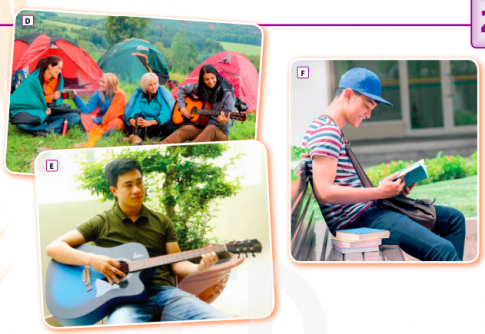
2. VOCABULARY Check the meaning of the activities and sports below. How many can you find in photos A-F?
(Kiểm tra ý nghĩa của các hoạt động và thể thao dưới đây. Có bao nhiêu bạn có thể tìm thấy trong ảnh A-F?)

Activities and sports
bake cakes collect figures, cards, stamps, etc. draw hang out with friends
make clothes read books read magazines text your friends
use social media video blog watch videos online
do, play or go
ballet ballroom dancing basketball boardgames bowling
camping cards chess cycling drama gymnastics ice hockey
martial arts a musical instrument photography rollerblading running
shopping skateboarding weights
Answer:
A. hang out with friends play bowling
B. play chess play boardgames
C. do photography
D. hang out with friends go camping
E. play a musical instrument
F. read books read magazines
3. Read the Learn this! box. Which verbs do we use with the blue activities and sports in exercise 2: do, play or go
(Đọc Tìm hiểu điều này! hộp. Những động từ nào chúng ta sử dụng với các hoạt động và thể thao màu xanh trong bài tập 2: làm, chơi hoặc đi)
LEARN THIS! do, play and go
a. We normally use do with individual sports and activities not ending in -ing.
b. We normally use play with team sports, ball sports, games and musical instruments.
c. We normally use go with sports and activities ending in -ing.
Answer:
Do: cycling, gymnastics, martial arts, photography, rollerblading, running, weights.
Play: ballet, ballroom dancing, basketball, board games, bowling, cards, chess, ice hockey.
Go: camping, drama.
4. Put the activities and sports in exercise 2 into groups A-G. You can put some of them into more than one group. How many more activities can you add?
(Sắp xếp các hoạt động và môn thể thao trong bài tập 2 thành các nhóm A-G. Bạn có thể đặt một số trong số chúng vào nhiều nhóm. Bạn có thể thêm bao nhiêu hoạt động nữa?)
A. Games
B. Music
C. Computer-based activities
D. Home-based activities
E. Outdoor leisure activities
F. Activities and sports you usually do on your own
G. Sports you do with another person or in a team
Answer:
A. Games: boardgames; chess
B. Music: a musical instrument; singing
C. Computer-based activities: use social media; video blog; watch videos online
D. Home-based activities: bake cakes; collect figures, cards, stamps, etc.; draw; make clothes; read books; read magazines; text your friends
E. Outdoor leisure activities: camping; cycling; gymnastics; ice hockey; rollerblading; running; skateboarding
F. Activities and sports you usually do on your own: baking cakes; collecting figures, cards, stamps, etc.; drawing; make clothes; reading books; reading magazines; text your friends; use social media; video blog; watch videos online; ballet; cycling; gymnastics; ice hockey; martial arts; photography; rollerblading; running; skateboarding; weights
G. Sports you do with another person or in a team: ballroom dancing; basketball; bowling; cards; chess; drama
5. SPEAKING Which of the activities and sports in exercise 2?
(Những hoạt động và môn thể thao nào trong bài tập 2)
a. have you tried and enjoyed?
b. have you tried but didn’t enjoy?
c. would you like to try? Why?
d. would you prefer not to try? Why?
Answer:
A: Hi there, have you tried any of the activities and sports listed in Exercise 2?
B: Yes, I've tried baking cakes, drawing, hanging out with friends, reading books, and watching videos online.
A: That's great! Which ones did you enjoy the most?
B: I really enjoy baking cakes and drawing. It's a great way to express myself creatively.
A: How about the other activities? Did you enjoy them?
B: Well, I'm not really into collecting figures, cards, stamps, etc. It's just not my thing.
A: Fair enough. Is there any activity on the list that you would like to try in the future?
B: Yes, I'd love to try making clothes someday. It seems like a challenging and rewarding activity.
A: That's cool! Is there any activity on the list that you would prefer not to try?
B: I'm not really into video blogging or using social media too much. I value my privacy and prefer to communicate with my friends in person or via text.
6. Listen to five people talking about why they hate certain things. What sports or activities do they talk about?
(Hãy nghe năm người nói về lý do tại sao họ ghét một số thứ. Họ nói về những môn thể thao hoặc hoạt động nào?)
Answer:
HS tự thực hiện.
RECYCLE! Present simple and adverbs of frequency
We use the present simple for habits and routines.
Adverbs of frequency (always, usually, often, sometimes, hardly ever, never) come before the main verb but after the verb be.
7. Read the Recycle! box. Then listen again. Complete the sentences with the present simple form of the verbs below and adverbs of frequency.
(Đọc Recycle. Sau đó nghe lại. Hoàn thành các câu với dạng hiện tại đơn của các động từ dưới đây và trạng từ chỉ tần suất)
be buy go play use
a. Speaker 1 _______________ camping with his parents.
b. Speaker 2 thinks that horror films _______________ unrealistic and unconvincing.
c. Speaker 3 _______________ social media.
d. Speaker 4 _______________ things online.
e. Speaker 5 _______________ the guitar at school.
Answer:
HS tự thực hiện.
8. SPEAKING Work in pairs. Do you agree with the opinions of the speakers in exercise 7? Why? / Why not?
(Làm việc theo cặp. Bạn có đồng ý với ý kiến của người nói trong bài tập 7 không? Tại sao? / Tại sao không?)
I disagree with Speaker 1. I think camping is great because sleeping in a tent is fun.
Answer:
HS tự thực hiện.
Tài liệu cùng môn học
Tài liệu khác
- Trắc nghiệm tiếng anh 2 Family and Friends
- Trắc nghiệm tiếng anh 2 Explore our world
- Trắc nghiệm tiếng anh 3 Family and Friends
- Trắc nghiệm tiếng anh 3 Explore our world
- Trắc nghiệm tiếng anh 4 Family and Friends
- Trắc nghiệm tiếng anh 4 Global Success
- Trắc nghiệm tiếng anh 4 Explore our world
- Trắc nghiệm tiếng anh 5 Family and Friends
- => Xem nhiều môn hơn