Giải tiếng anh 11 Friends Global: Unit 8A Talking about cities
Hướng dẫn giải tiếng anh 11 Friends Global: Giải Unit 8A Talking about cities. Bài được giải chi tiết, rõ ràng, dễ hiểu. Bài giải giúp học sinh nắm vững kiến thức trong sách giáo khoa, rèn kĩ năng giải bài tập và có phương pháp học tập hiệu quả.
Nội dung chi tiết
Vocabulary
1. SPEAKING Do you love living in a city? What do you think are the benefits of living in a big city?
(Bạn có thích sống trong một thành phố? Bạn nghĩ những lợi ích của việc sống trong một thành phố lớn là gì?)
Answer:
There are several benefits of living in a big city, including:
Opportunities: Big cities often offer more opportunities in terms of jobs, education, and cultural experiences. There are usually more options for employment and educational institutions, as well as more cultural and entertainment venues.
Diversity: Big cities are typically home to a diverse range of people from different backgrounds, cultures, and beliefs. This can lead to a greater understanding and appreciation of different perspectives and ways of life.
Convenience: Big cities often have better infrastructure and transportation systems, making it easier to get around and access essential services. There are usually more options for shopping, dining, and entertainment, as well as better healthcare facilities.
Networking: In a big city, there are more opportunities to network and connect with people in your field or industry. This can lead to more job opportunities, collaborations, and professional growth.
Innovation: Big cities are often centers of innovation and creativity, with a thriving startup scene and a culture of entrepreneurship. This can lead to exciting new developments in technology, art, and other fields.
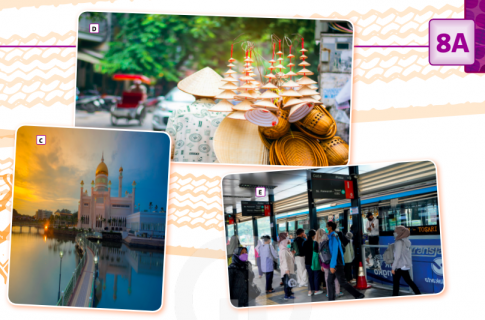
2. Work in pairs. Match the photos A-E with the cities and the countries. What do the countries have in common?
(Làm việc theo cặp. Nối các bức ảnh A-E với các thành phố và quốc gia. Các quốc gia có điểm gì chung?)
Cities
Bangkok HaNoi Jakarta Manila Bandar Seri Begawan
Countries
Brunei Indonesia Thailand the Philippines Viet Nam
Photo D - Ha Noi- Viet Nam
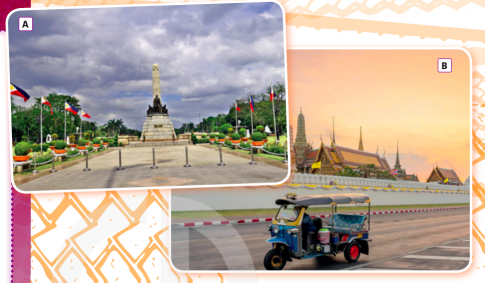
Answer:
Photo A - Manila - The Philippines
Photo B - Bangkok - Thailand
Photo C - Bandar Seri Begawan - Brunei
Photo D - Ha Noi - Viet Nam
Photo E - Jakarta - Indonesia
3. Work in pairs. Check the meaning of the following words. Identify the words that are in the wrong groups.
(Làm việc theo cặp. Kiểm tra nghĩa của các từ sau. Xác định các từ nằm trong các nhóm sai)
People
commuter immigrant resident street vendor temple visitor
Places
antennatower boulevard bus stop car park city hall lake
monument mosque pagoda park skyscraper stadium theatre
Means of transport
hustle pedicab taxi tram tube tuk-tuk
City problems
air pollution fountain noise pollution
overpopulation traffic jams
Answer:
People: temple
Places: antennatower
Means of transport: hustle
City problems: fountain
4. Which words in exercise 3 can you use to describe the photos A—E?
(Bạn có thể dùng những từ nào trong bài tập 3 để mô tả các bức ảnh A—E?)
Answer:
Photo A - Manila - The Philippines:
People: commuter, resident, street vendor, visitor
Places: boulevard, car park, skyscraper
Means of transport: pedicab, taxi, tuk-tuk
City problems: air pollution, overpopulation, traffic jams
Photo B - Bangkok - Thailand:
People: commuter, immigrant, resident, street vendor, visitor
Places: boulevard, car park, monument, park, skyscraper, stadium
Means of transport: pedicab, taxi, tuk-tuk
City problems: air pollution, noise pollution, traffic jams
Photo C - Bandar Seri Begawan - Brunei:
People: commuter, resident, visitor
Places: mosque, park, skyscraper
Means of transport: pedicab, taxi
City problems: none visible in the photo
Photo D - Ha Noi - Viet Nam:
People: commuter, resident, street vendor, visitor
Places: lake, monument, pagoda, skyscraper, temple
Means of transport: pedicab, taxi, tram
City problems: air pollution, traffic jams
Photo E - Jakarta - Indonesia:
People: commuter, immigrant, resident, street vendor, visitor
Places: car park, skyscraper
Means of transport: pedicab, taxi, tuk-tuk, tube
City problems: air pollution, noise pollution, traffic jams
5. Complete the following sentences using the vocabulary in exercise 3. Check your answers with your partner's.
(Hoàn thành các câu sau sử dụng từ vựng trong bài tập 3. Kiểm tra câu trả lời của bạn với đối tác của bạn)
1. Kuala Lumpur Tower is the world’s 7th tallest tower with an _____________ at the top.
2. The first two lines for _____________ were built in Ha Noi in 1901, Line 1 leading to Bach Mai and Line 2 to Giay Village.
3. Many tourists love to visit an Islamic _____________ to see the difference between it and a pagoda.
4. In front of the city hall is a garden with a _____________ in the middle.
5. Baiyoke Tower II is an 88-storey _____________ in Bangkok.
6. Most city dwellers want to escape the _____________ and bustle of the city for the weekend.
7. The tube is overcrowded with _____________ who travel a long way to work every day.
8. Thong Nhat, a multi-purpose _____________ located in District 10 in Ho Chi Minh City, has a capacity of 15,000.
Answer:
1. Kuala Lumpur Tower is the world’s 7th tallest tower with an antennatower at the top.
2. The first two lines for tram were built in Ha Noi in 1901, Line 1 leading to Bach Mai and Line 2 to Giay Village.
3. Many tourists love to visit an Islamic mosque to see the difference between it and a pagoda.
4. In front of the city hall is a garden with a fountain in the middle.
5. Baiyoke Tower II is an 88-storey skyscraper in Bangkok.
6. Most city dwellers want to escape the hustle and bustle of the city for the weekend.
7. The tube is overcrowded with commuters who travel a long way to work every day.
8. Thong Nhat, a multi-purpose stadium located in District 10 in Ho Chi Minh City, has a capacity of 15,000.
RECYCLE! The passive
1. We form the passive with the verb be and the past participle of the verb.
This cruise ship was built ten years ago by Hyundai.
2. We use a passive infinitive after certain verbs. We use a passive base form (infinitive without to) after modal verbs.
The passengers needed to be rescued by the emergency services.
All passports must be shown at the departure gate.
3. When we want to say who or what performed the action in a passive sentence, we use by.
6. Read the Recycle! box. Complete the questions using the passive and the verb in the brackets.
(Đọc Recycle. Hoàn thành các câu hỏi sử dụng bị động và động từ trong ngoặc)
1. Where ___________ Wat Arun ___________? (locate)
2. Why ___________ Wat Arun ___________ the ‘Temple of Dawn’? (call)
3. What ___________ in bread to make difference to banh mi? (can / fill)
4. Why ___________ vegetables ___________ to banh mi? (add)
5. When ___________ the buses ___________ with passengers? (pack)
6. Which opportunities ___________ to the man’s family? (can / offer)
Answer:
1. Where was Wat Arun located?
2. Why is Wat Arun called the 'Temple of Dawn'?
3. What can be filled in bread to make a difference to banh mi?
4. Why are vegetables added to banh mi?
5. When were the buses packed with passengers?
6. Which opportunities can be offered to the man's family?
7. Listen to three speakers and answer the questions in exercise 6.
(Nghe ba diễn giả và trả lời các câu hỏi trong bài tập 6)
Answer:
HS tự thực hiện.
8. SPEAKING Which city in exercise 2 have you been to? Which city do you like to visit most? Why?
(Bạn đã đến thành phố nào trong bài tập 2? Thành phố nào bạn thích đến thăm nhất? Tại sao?)
Answer:
A: Hi there! Have you been to any of the cities in exercise 2?
B: Yes, I've been to Bangkok a couple of times. It's a fantastic city with so much to see and do.
A: Oh, that's interesting! What do you like most about Bangkok?
B: There are so many things I like about Bangkok, from the delicious food to the stunning temples and palaces. I also love the bustling street markets, where you can find all kinds of souvenirs and local products.
A: That sounds amazing! I've never been to Bangkok, but I would love to visit someday. What other cities on the list would you recommend?
B: Well, I haven't been to all of them, but I've heard good things about Manila and Jakarta as well. Both cities are known for their vibrant culture and friendly people.
A: Hmm, I think I would like to visit Ha Noi. I've always been interested in Vietnamese culture, and I've heard that Ha Noi is a beautiful and historic city.
B: Yes, Ha Noi is definitely worth a visit. It has a unique blend of French and Asian influences, and the food is amazing.
A: That's great to hear! I'll have to add Ha Noi to my travel list. Thanks for the recommendation!
B: No problem! Let me know if you need any tips or suggestions for your trip.
Tài liệu cùng môn học
Tài liệu khác
- Trắc nghiệm tiếng anh 2 Family and Friends
- Trắc nghiệm tiếng anh 2 Explore our world
- Trắc nghiệm tiếng anh 3 Family and Friends
- Trắc nghiệm tiếng anh 3 Explore our world
- Trắc nghiệm tiếng anh 4 Family and Friends
- Trắc nghiệm tiếng anh 4 Global Success
- Trắc nghiệm tiếng anh 4 Explore our world
- Trắc nghiệm tiếng anh 5 Family and Friends
- => Xem nhiều môn hơn